"Forest Time" Questions Modern Society: Beyond Braudel's Structures of Historical Time
Updated by Nobuyuki Yamamoto on December 2, 2025, 7:56 PM JST
Nobuyuki YAMAMOTO
Forestry and Forest Products Research Institute, National Forestry Research and Development Institute
Director of Forestry Management and Policy Research Area, Forestry and Forest Products Research Institute, National Institute of Forestry Research and Development / Specializes in forest policy and forestry economics. His recent research focuses on modernization and forests and forestry. His publications include "Forests and Time: A Social History of Forests", "Long-Term Sustainability of Local Forest Management: Future Perspectives from 100 Years in Europe and Japan", and "Theory of Forest Management Systems". His research on the modernization process of forest management systems won the Prize for Academic Achievement from the Forestry Economics Society of Japan, and "The Origins of the Forest Planning System in Japan" won the Paper Award from the Forestry Society of Japan.
The three-tiered structure of history proposed by Fernand Braudel, the French historian and leading figure of the Annales School, in his monumental work The Mediterranean is well known. Braudel introduced a three-tiered temporal structure—geographical time, social time, and individual time—revolutionizing historiography.The striking nature of Braudel's innovation led historiography, spearheaded by the Annales School for some time thereafter, to emphasize geographical time and social time, relatively downplaying event history, which represents individual time. Later, amid a movement to restore the importance of political history, the significance of individual time was revisited. Yet, Braudel's appeal in the age of environmental studies has not faded.
The lowest first layer is "geographical time," like the history of the mountain ranges surrounding the Mediterranean, the story's starting point. Braudel describes this time as "a history that flows slowly, changes slowly, often repeats itself, and is constantly cyclical."The second layer above is "social time." It can also be read as "history with a slow rhythm" or "the history of human groups." And the third layer, closest to the surface, is "individual time." This refers to the "history of events"—such as political history and war history—which dominated mainstream historiography during Braudel's youth.
The significance of Braudel's work lies in his discovery of "geographical time" and "social time"—medium-to-long-term historical fluctuations—beneath the short-term, fluctuating "history of events" that had been the central concern of historiography prior to him, particularly the political history that had dominated the field. This discovery drew the attention not only of historians but also of scholars across many other disciplines within the humanities and social sciences.Social time subsequently gave rise to the Annales School, while the concept of "longue durée," which developed from "geographical time," connects to the environmental history of recent years.

From the perspective of life course analysis—a focus of my edited volume Forests and Time: A Social History of Regions Surrounding Forests—reconsidering Braudel's three-tiered historical structure involves refocusing attention on the individual time relegated to the background in Braudel's argument, then attempting to redefine its relationship with the remaining two tiers.The history of human communities within regional societies, constrained by geographical time; the history of forests, growing slowly; and, in comparison, the far too brief history of each individual. Yet, it is precisely the interaction with the two-layer history, originating from the fleeting, momentary history of the individual, that forms the very foundation of the relationship between people and forests.
Another novelty lies in presenting a four-layered historical structure, adding the history of forests—symbolized by tree growth—to Braudel's three-layer framework.There is no doubt that Braudel's perspective, which explicitly distinguished "geographical time" and "social time," led to the current rise of environmental history. However, the time of the environment surrounding us encompasses everything from the extremely slow pace of geological time to the somewhat faster time of forests, which is the subject of this book. By attempting to distinguish the time of forests from "geographical time," we wish to focus our attention on what becomes newly visible.
Turning to economics, there is a vast body of research on economic fluctuations. Arranged from short-term to long-term, the most famous cycles are the Kitchin cycle (inventory-investment cycle), the Juglar cycle (corporate capital investment cycle), the Kuznets cycle (building investment cycle), and the Kondratieff cycle (technological innovation cycle).
The American sociologist and economic historian Immanuel Wallerstein developed and expanded upon Braudel's framework, constructing a grand theory of world systems. He particularly linked the long Kondratiev waves to changes in the world system.Economic fluctuations are familiar to us, but they are not the only factors bringing change to society. Social change driven by human life and death, which life course analysis focuses on, also teaches us that there are forms of social change distinct from economic fluctuations. This becomes even more strikingly apparent in this book, which focuses on the relationship between forests and local communities.
There remains much to consider regarding the theme of forests and time. As Miki, one of the authors of this book, astutely pointed out (Miki, Atsuro (2025). "What Have We Failed to Reveal?" Rinken No. 252, Tokyo Forestry Research Association), the primary focus of this book was essentially a "positive" narrative concerning domestic timber resources—a vital asset for Japan's capitalist system.
The "negative" narratives woven by non-male, non-elite, and colonial peoples pushed to the periphery of capitalism with forests are equally an important part of our world—this is beyond dispute.Furthermore, this book may have somewhat overemphasized the long-term, timeless nature of forest time. Coexisting with this are shorter-term dimensions of human-forest relationships: relatively short rotation timber production like fuelwood forests and log production, agricultural forests integrated into daily life, and more recently, forest service industries. It is the very nature of modernization that has forced people into long-term forest uses like timber production for construction that should be questioned.
I wish to continue gathering, however clumsily, the memories of the diverse relationships between forests and people that lie buried and forgotten in various corners of the world. (Nobuyuki Yamamoto, Director, Forest Management and Policy Research Division, Forestry and Forest Products Research Institute, National Forestry and Forest Products Research Institute)
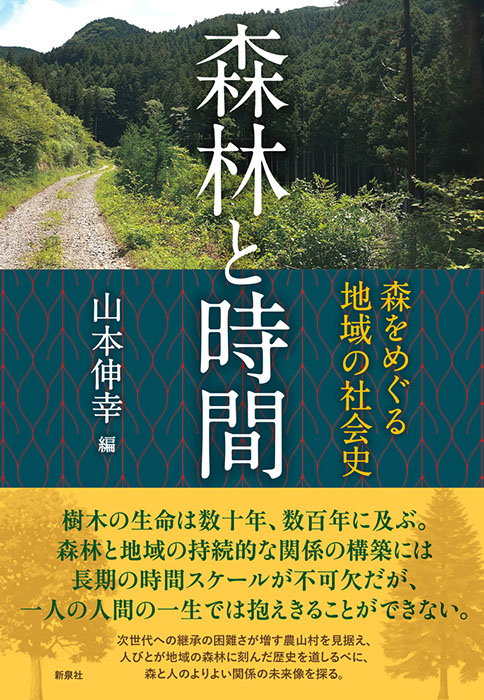
Forests and Time."
Edited by Nobuyuki Yamamoto, published by Shinsensha
The life of a tree can span decades or centuries. A long-term time scale is essential for building a sustainable relationship between forests and local communities, but it is not something that can be carried out in the lifetime of a single person. With an eye on farming and mountain villages, where it is becoming increasingly difficult to pass on the forests to the next generation, we will explore the future of a better relationship between forests and people, using the history that people have carved into the local forests as a guidepost.
<Table of Contents
Introduction: Forest Time and Human Time Nobuyuki Yamamoto
Chapter 1: People Who Encountered Yamazukuri Shimazaki Yoji and the Forest School Atsuro Miki
Chapter 2: Inheritance of Mountain Village Society and Women's Life Course: Women's Progress in 200 Years of a Mountain Village in Tochigi Prefecture Miho Yamamoto
Chapter 3: Life History of a Village and Its Residents Living with Mountains and Rivers Taro Takemoto, Shuhei Sato, Sho Matsumura
Chapter 4: Modernity and Forests in Hamadori, Fukushima Prefecture, Chapter 4: Nobuyuki Yamamoto
Chapter 5: The Interconnection between the Pulp and Paper Industry and Local Sustainability
Chapter 6: The Era of the Akai School: The Origin of Domestic Timber Supply Development in a Local University Yoichiro Okuyama
Chapter 7: Party and Expertise in Forest Management Changes in Forest Policy and Local Practices in Tenryu and Fuji Minami-Foothills Kazuto Shiga
End of Chapter Nobuyuki Yamamoto, Continuing to Re-weave the Relationship between Forests and People