Updated by the Forest Circular Economy Editorial Department on December 22, 2025, 9:34 PM JST
Editorial Board, Forest Circular Economy
Forestcircularity-editor
We aim to realize "Vision 2050: Japan Shines, Forest Circular Economy" promoted by the Platinum Forest Industry Initiative. We will disseminate ideas and initiatives to promote biomass chemistry, realize woody and lumbery communities, and encourage innovation in the forestry industry in order to fully utilize forest resources to decarbonize the economy, strengthen economic security, and create local communities.
Why Isn't Forestry Productivity Increasing? Amid ongoing labor shortages and rising costs, the industry faces the challenge of transforming on-site systems and ensuring its sustainability as a regional industry. The Platinum Forest Industry Initiative, now transitioning from proposals to implementation, held its regular meeting in Tokyo on October 17, focusing on the theme "Improving Raw Material Production Efficiency and Production Management Systems." Yutaka Kuboyama (Forestry and Forest Products Research Institute, National Institute for Forest Science, Tohoku Branch), a leading expert in forestry/wood processing cost evaluation and comparative studies on enhancing the competitiveness of domestic timber, presented findings from Austrian research. He emphasized that Austria's success in dramatically improving upstream material production efficiency and boosting forest owners' motivation stems from "process innovation within the midstream lumber industry."
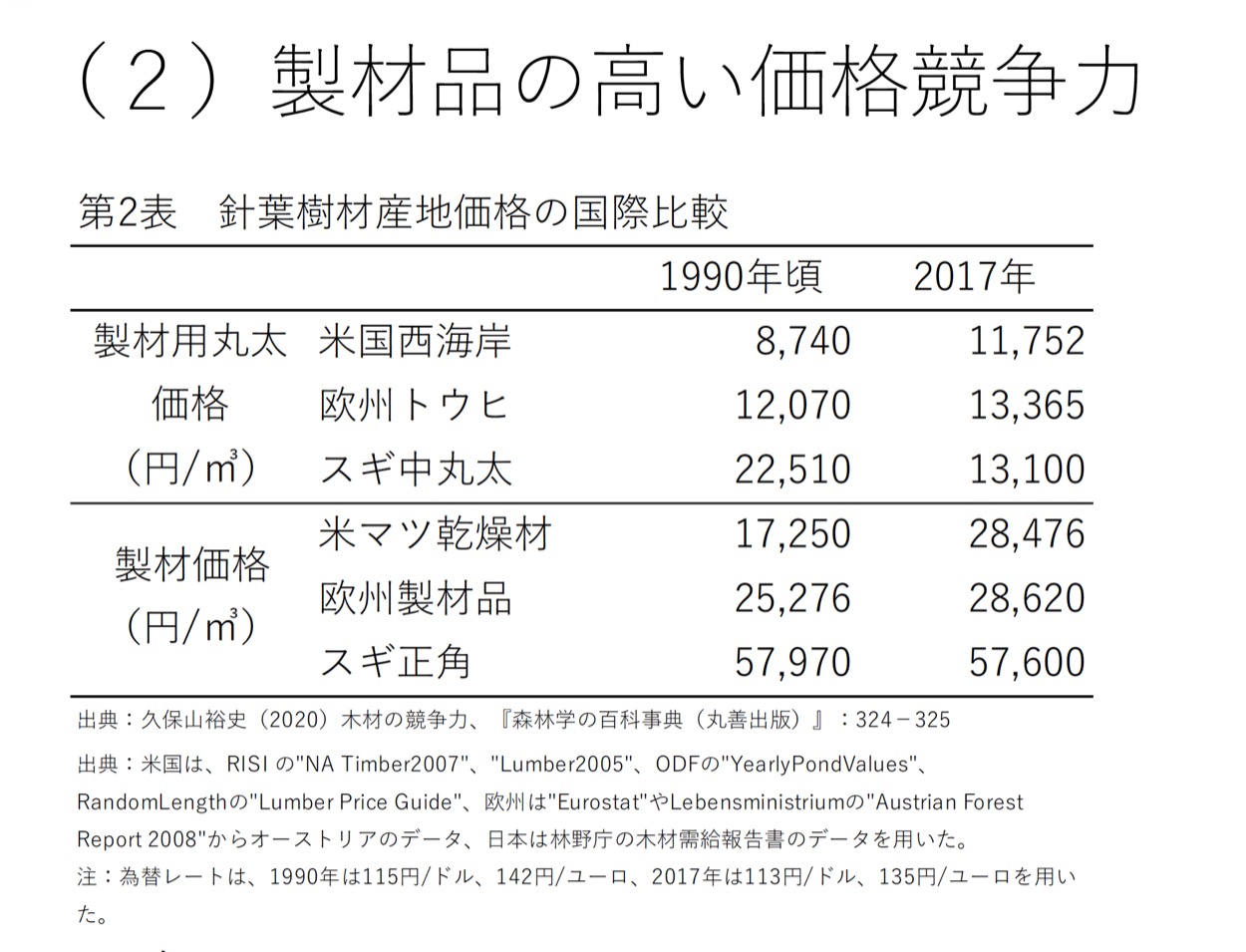
Currently, Japan's lumber industry faces severe challenges. In particular, lumber processing costs have ballooned, with the price ratio of lumber products to logs (lumber price/log price ratio) expanding from around 2.6 in the 1990s to 4.4. This has resulted in persistently low price competitiveness. Although the price of Japanese cedar logs, which were expensive around 1990, had fallen to nearly the same level as European spruce logs by 2017, a significant gap remains in product prices. For example, in 2017, the price of Japanese cedar square timber was ¥57,600 per cubic meter, nearly double the price level of European lumber at ¥28,620 per cubic meter.
The low price competitiveness of these products has led to a decline in domestic demand for raw materials, creating a negative chain reaction that has resulted in falling log prices and a loss of motivation among forest owners to engage in forestry operations.
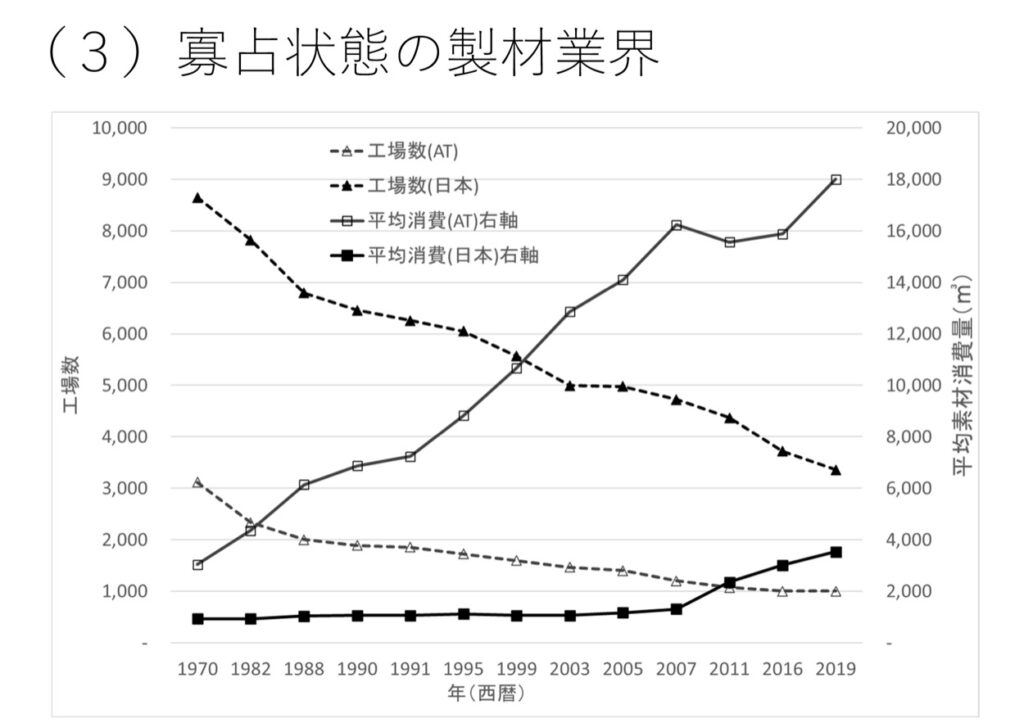
Austria's sawmill industry is highly distinguished within its forestry and wood-based industries, accounting for the majority of raw timber demand. Although over 1,000 sawmills exist, the industry is characterized by extreme concentration. More than 19 large-scale sawmills consume over 300,000 cubic meters of raw timber annually, with the top 40 companies accounting for 90% of sawlog consumption.
Despite a decline in the number of factories, production volume per factory has steadily increased, demonstrating a successful expansion in scale. This fundamental restructuring within the lumber industry has become the driving force behind revitalizing upstream material supply.
Mr. Kuboyama points out that this midstream reform "expanded the demand for logs precisely because the lumber industry achieved process innovation, which in turn improved forestry profits." This innovation was realized through a dual business model consisting of "mass-production factories" and "small-to-medium factories."
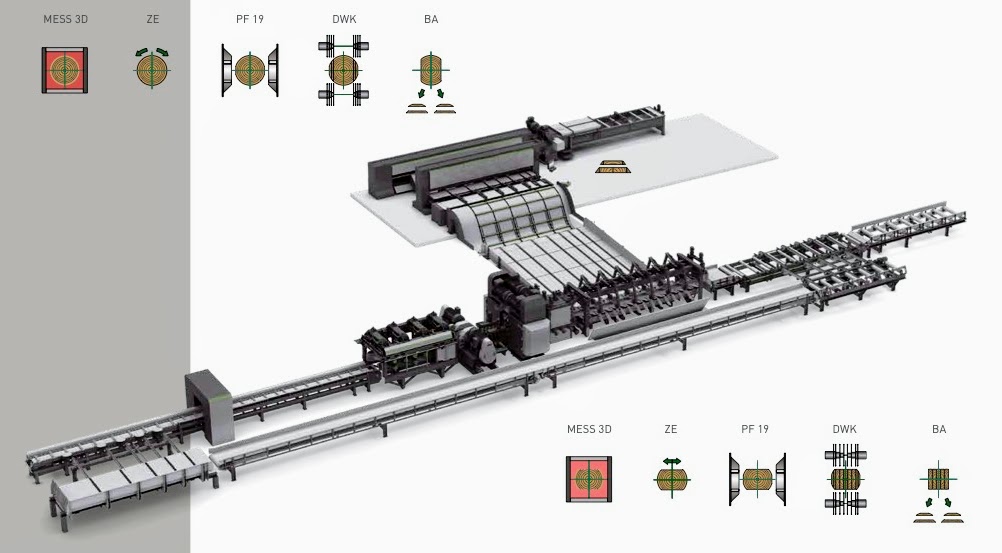
The Austrian mass-production plant primarily focuses on exporting general-purpose products and supplying affiliated engineered wood and CLT factories. In the sawing process, an innovative sawing facility called a profiling line has been introduced. This enables efficient handling of logs of diverse specifications and the production of a wide range of products with high yield rates.
Mass production mills collect logs of a wide range of specifications (diameter 14–50 cm, primarily 4 m in length). These logs are first sorted by quality and size in 1-centimeter increments using a log sorting machine. This sorting gathers logs of the same type, enabling high-speed sawing of products of uniform size.
On the profiling line, logs are roughly cut into square timber using a chipper canters (a sawmill machine with cutting blades). After a scanner determines the optimal wood yield, boards are rapidly cut using circular saws and other equipment. While Austrian sawmills achieve speeds of 120 meters per minute, traditional Japanese sawmills using twin band saws and similar equipment operate at around 30 meters per minute. This overwhelming speed difference is what separates production efficiency.
This high-speed sawmill achieves a thorough increase in throughput while also aiming to improve yield through optimal wood cutting. As a result, it significantly enhances productivity while maintaining a yield equivalent to that in Japan.
Lumber products are exported as general-purpose goods or shipped to affiliated engineered wood, CLT, and three-layer board factories, forming a vertically integrated supply chain. Furthermore, by-products generated during lumbering are fully utilized and sold as paper-making chips, pellets, or thermal and electrical energy, enhancing the overall profitability of the factory.
While mass-production factories establish competitiveness through high-speed production of generic goods, small and medium-sized factories specialize in producing high-value-added lumber products to avoid competing with mass-production factories.
Small and medium-sized mills collect large-diameter or long logs (diameter 40–90 cm, length 4–13 m) that differ from those used by mass-production mills. These logs are processed into high-value-added lumber products such as window frames, raw laminas for construction, and interior paneling.
Even in small and medium-sized factories, thorough inspection and sorting using sorting machines is standard practice. For lumber production, log carriers equipped with chipper canters and band saws are employed. Operators carefully cut each log one by one, following the optimal cutting plan indicated by the computer. While the production system lacks the high-speed lines of mass-production factories, it is based on skilled craftsmanship and technology. This enables the efficient conversion of large-diameter logs into high-value-added lumber while optimizing yield.
Austria's innovation in material production is underpinned by favorable geographical conditions for forestry and abundant resources, but the decisive factor was the sawmill industry's enhancement of price competitiveness—that is, its achievement of process innovation.
The expansion of scale enabled the production of low-cost lumber products, increasing demand for logs and motivating forestry operators to pursue high harvesting rates. In Austria, 89% of annual growth is harvested. This is underpinned by the realization of low-cost harvesting and distribution, which consequently raised standing timber prices.
Mr. Kuboyama emphasizes the importance of innovation in the lumber industry. "Drastic technological innovation is essential to reduce forestry costs in Japan," he states, concluding that "it is precisely the lumber industry's process innovation to expand raw log demand that will drive changes in the material supply system."
The Austrian case suggests that for upstream efficiency and profit improvement, it is essential for the midstream (sawmilling) sector to take the lead in reforming its structure, creating market-competitive products, and building a stable demand base. What Japan should aim for is not merely productivity improvement, but the establishment of an innovative production management system that encompasses the entire supply chain. = To be continued
Yushi Kuboyama's columnthis way (direction close to the speaker or towards the speaker)
■Reference Books
Wood Science Lecture 10: Biomass (Kaiseisha)
Forest Future Conference (Tsukiji Shokan)
Forest Products (Kyoritsu Publishing)