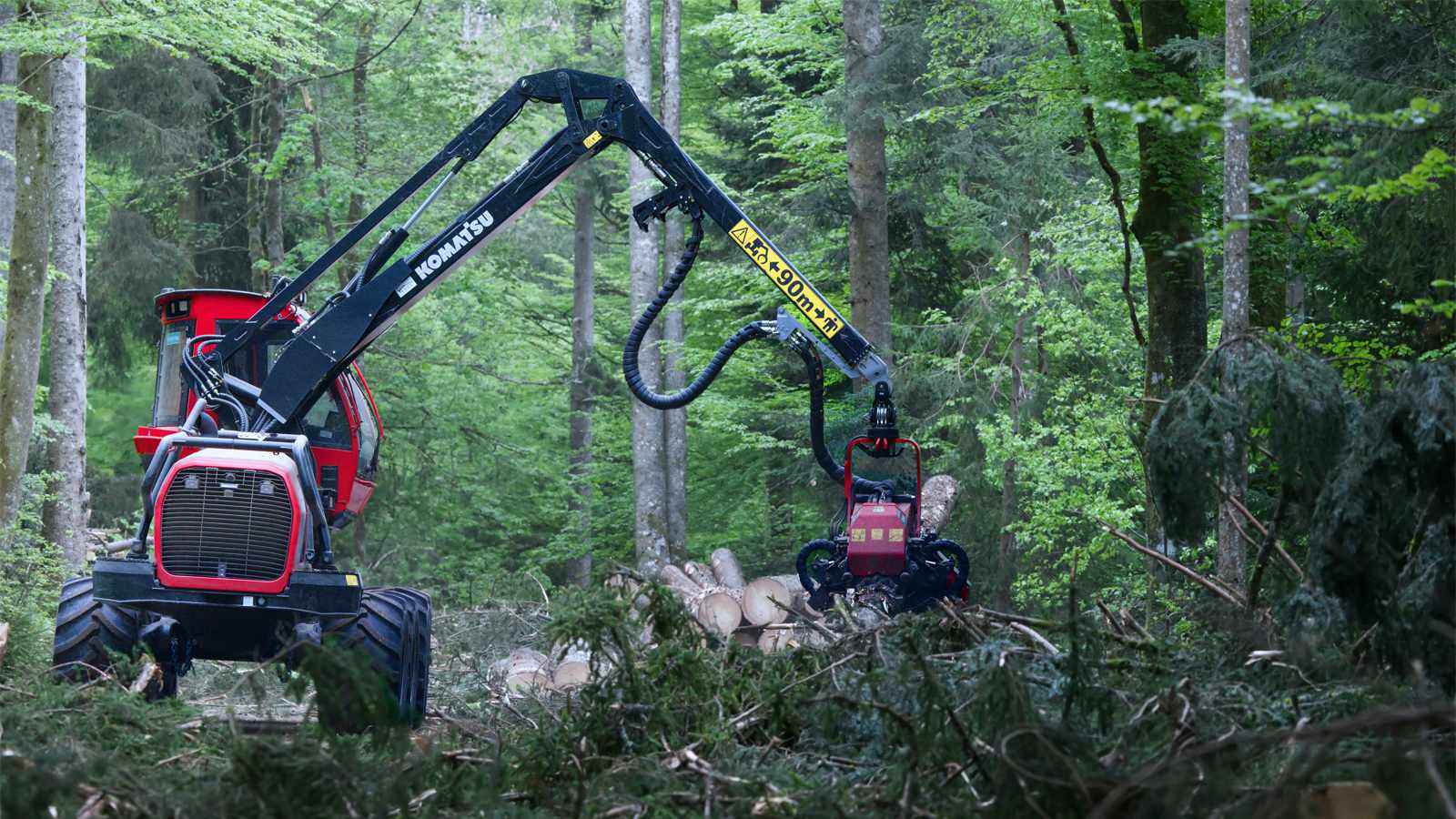
Image by Unsplash
How to increase the utilization rate of high-performance forestry machinery: The key to forest management is securing and maintaining continuity of The key to forestry management is securing and maintaining continuity of forestry land.
Updated by Yasunao Kobayashi on March 18, 2026, 2:44 PM JST
Yasuhisa KOBAYASHI
Alpha Forum, Inc.
President of Alpha Forum, Inc. and Steering Committee Member of the Platinum Forest Industry Initiative. Ltd. in 2001, taking advantage of the company's venture support program. In September 2023, he received the Wood Use System Research Association Award.
Profitable and profitable forestry is one of the requirements for high quality forestry, or platinum forestry. Some groups in Japan are now realizing profitable forestry. In the midst of international competition, the selling price of materials (logs) appears to be stable, but the reason it is not profitable is because the cost is high in relation to the selling price. Let us consider how to escape from the situation where the forestry industry cannot be established without subsidies....
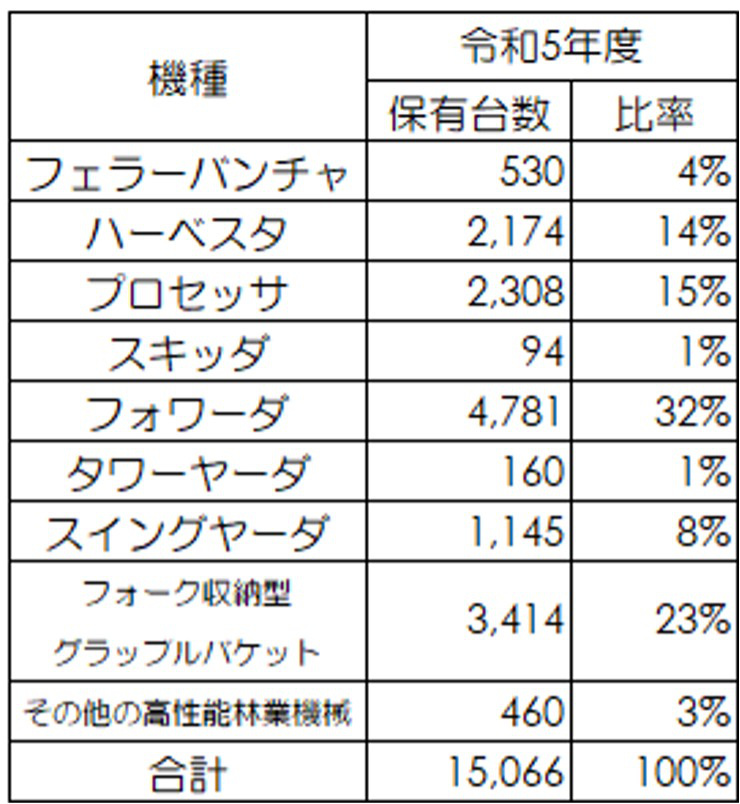
Although chainsaw felling is advantageous in some sites depending on conditions, how many work teams exist in Japan that perform felling - pruning - ball cutting - timber collection - hauling out? Harvesters, processors (combined with chainsaws, etc. for felling), and feller bunchers are responsible for felling - pruning - ball cutting. Work roads are not accessible by ordinary trucks and trailers, so forwarders are responsible for these tasks. According to the Forestry Agency's statistics on high-performance forestry machinery (FY2023), the total number of harvesters, processors, and feller bunchers was 5,012, while the number of forwarders was 4,781. It is safe to assume that there are approximately 5,000 work groups in Japan.
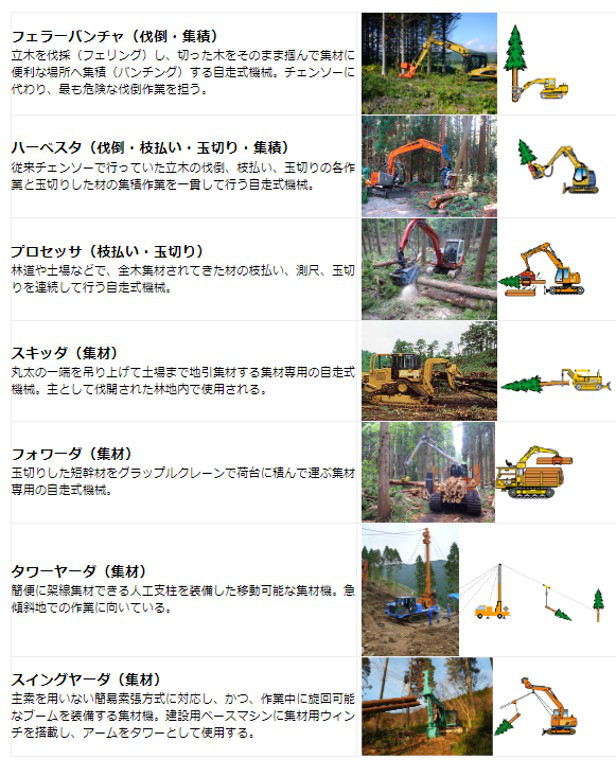
What is the initial investment in high-performance forestry machinery for one work group? Although used machinery is available, a new harvester, forwarder, and grapple set can be expected to cost 100 million yen. Since the price of heavy machinery has been rising over the past few years, the initial investment burden is expected to increase.
The frequency of malfunctioning of forestry machinery increases after 5-6 years of use. Some forestry machinery is used for more than 10 years, but the annual maintenance cost is often several million yen. 100 million yen worth of high-performance forestry machinery is used for 5 years, and the total maintenance cost over 5 years is 10 million yen. Assuming straight-line depreciation, the cost is 22 million yen/year = 1.83 million yen/month.
Annual material production is 21.47 million cubic meters/year (2017, from Forestry Agency statistics), so the average per work team is 4,294 cubic meters/year. So, dividing 22 million yen/year by 4,294 cubic meters/year yields 5,123 yen/cubic meter.
Assuming a work team of three and a labor cost of 6 million yen per person (including social insurance premiums paid by the company), one work team would cost 18 million yen. 18 million yen divided by 4,294 cubic meters per year yields 4,192 yen per cubic meter. Excluding indirect costs, the total cost of machinery and manpower would be 9,315 yen/cubic meter.
Logs for lumber are called "A", logs for plywood are called "B", and biomass lumber is called "C" to "D", and the ratio is 2:3:5. The price varies depending on the species, but A is 13,000 yen per cubic meter, B is 11,000 yen, C (to D) is 7,000 yen, and the weighted average is 9,400 yen per cubic meter. When the cost of diesel fuel to operate high-performance forestry machinery and other administrative costs are added, a deficit is inevitable. The forestry industry cannot do without subsidies.
What is the utilization rate of high-performance forestry equipment in the typical number of work days (business days)? I would like to draw your attention to the utilization rate of forwarders. In my experience, the forwarder is the bottleneck of material production operations. Even if the operating rate of the harvester is increased, the forwarder cannot move the material in time, and in the end, the workload of the forwarder determines the efficiency of felling and hauling out. Why is the utilization rate of the forwarder, which loads the material and moves it back and forth along the work road, less than 50%? The low utilization rate is not a problem of transport speed. Nor is it a problem of the time it takes to load materials. They are not operating in the first place.

There are several possible reasons.
(1) Suspension of work due to inclement weather
Maintenance due to defects, etc.
(iii) Heavy equipment spends a lot of time being moved around (i.e., moving the equipment between working forest areas)
(4) Lack of a place where it can be operated (cannot be operated continuously)
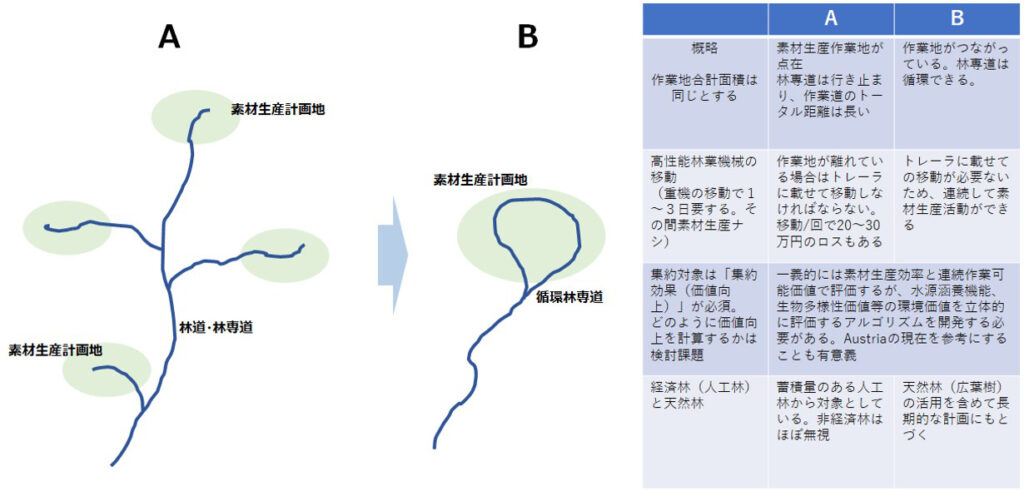
In the primary industry, work stoppages due to bad weather are unavoidable. It is not that the forwarder, which is the rate-limiting factor, requires a particularly long maintenance time. In (3) and (4), the essential issues of our country can be seen. (1) There is no place where continuous operations can be carried out, and they are not continuing. Since small work sites are scattered throughout the country, there is a lot of movement from one work site to the next. If the next work site is connected by a forestry road and the distance is less than about 1 km, then drive on your own. If the distance is more than several kilometers, heavy equipment will be loaded onto trucks or trailers for transport. Just moving high-performance forestry equipment (heavy machinery) is a one- to two-day operation. Maintenance may be performed during this time, which adds several more days to the forestry site transportation. Trucking costs more and takes more time.
For the same area of forest, there would be many A's in the scattered figure. A lot of time is lost in moving between the planned material production area and the next planned area. Consolidation of forests is a measure that the Forestry Agency is actively promoting, and it is highly likely that the time required to move trucks and other equipment loaded with high-performance forestry machinery can be greatly reduced through consolidation. If "circulation" is assumed for dedicated forestry roads as well, multiple trailers can enter the road to transport materials (logs); can we plan a dedicated forestry road that allows trucks and trailers with 10-ton or larger vehicles to pass through without difficulty? The sites for consolidation should be those where reasonable forestry roads can be planned.
Assuming an average annual material production target of 10,000 cubic meters/year (more than double the current target) for forestry work teams using high-performance forestry machinery, 25 ha of planted forest (coniferous forests that have reached the harvesting season) would be required annually. However, in reality, thinning is also necessary, so the forest management plan is based on whether or not a single work group can provide 50 to 100 ha/year of continuous forest land (a few hundred meters of travel on a forestry road can be considered continuous). In order for heavy equipment not to have to move for 5 years, we would like to imagine a contiguous forest of 250-500 ha or more. The target operating rate is to exceed 801 TP3T, which is comparable to the Austrian forestry industry, and the efficiency per unit time is to be increased by 20% ≒ the ratio of main cutting (clear cutting) is to be increased, and 10,000 cubic meters/year of work crews are possible.
If the target area is narrowed down by prioritizing the alignment of forestry roads, natural forests and former firewood and coal forests (broadleaf forests) are likely to be included. Forests with a large area and gentle slopes suitable for forestry are classified as "planted forests. The government will encourage appropriate logging and afforestation, as many planted forests are ready to be used for timber. It does not mean that the current natural forests will soon become economic forests, but the policy is to try to bring in human hands for the next rotation (harvest in 20 to 50 years). Rather than simply "building a road for now" to harvest the current planted forests, the plan is to plan a forest type that will serve as the basis for a forest circulation economy, and hope that the rural areas and communities will move in the direction of gaining vitality toward that type of forest.
The Forestry Agency's policies are substantial, and its website has extensive information. The Ministry of Economy, Trade and Industry, the Ministry of Internal Affairs and Communications, the Ministry of Land, Infrastructure, Transport and Tourism, and the Cabinet Office also all have measures that will encourage the forest circular economy. We would like to realize a model project in which the private sector moves ahead and gains the cooperation of local governments. (Yasunao Kobayashi, President, Alpha Forum, Inc. and Steering Committee Member, Platinum Forest Industry Initiative)
*Reference link
Forestry Agency Sets Goals for Disaster Prevention and Environmental Preservation - Forestry Agency : Jiji.com