People and Society Inheriting Long-Living Forests: Memories of Seven Regions Depicted in "Forests and Time"
Updated by Nobuyuki Yamamoto on October 10, 2025, 9:15 PM JST
Nobuyuki YAMAMOTO
Forestry and Forest Products Research Institute, National Forestry Research and Development Institute
Senior Researcher, Forestry Management and Policy Research Area, Forestry and Forest Products Research Institute, National Forestry Research and Development Institute / Specializes in forest policy and forestry economics. His recent research focuses on modernization and forests and forestry. His publications include "Forests and Time: A Social History of Forests", "Long-Term Sustainability of Local Forest Management: Future Perspectives from 100 Years in Europe and Japan", and "Theory of Forest Management System". His research on the modernization process of forest management systems won the Prize for Academic Achievement from the Forestry Economics Society of Japan, and "The Origins of the Forest Planning System in Japan" won the Paper Award from the Forestry Society of Japan.
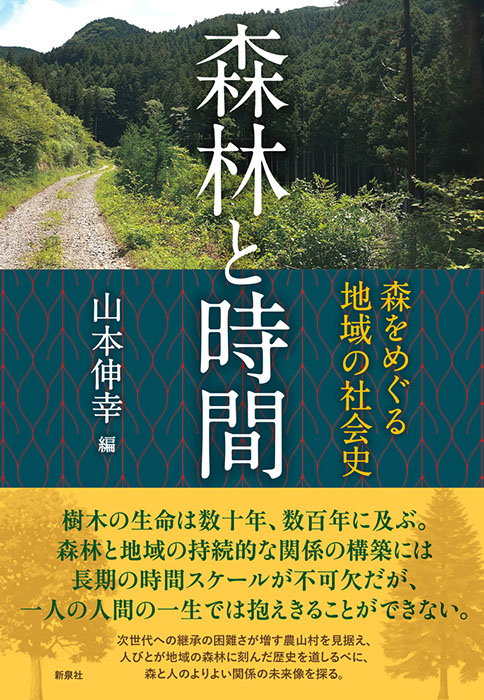
Forest and Time: A Social History of the Forest and the Region.The book was published last summer by Shinsensha with a group of fellow researchers. The obi of the book, with a photo of a road leading to the back of the mountain on the cover, reads as follows
The life of a tree can span decades or centuries. Long time scales are essential for building a sustainable relationship between forests and communities, but they cannot be held in the lifetime of a single person.
With an eye on farming and mountain villages, which are increasingly difficult to pass on to the next generation, we will explore the future of a better relationship between forests and people, using the history that people have carved in local forests as a guidepost.
I had thought that there was some distance between the corporate-led activities that are the main focus of the Platinum Network and the content of this book, which describes various relationships between forests and people in local communities. Therefore, when Mr. Kaoru Sumitomo, editor-in-chief of "Forest Circular Economy" who had read my book, invited me to write something about it because it overlaps with our own concept, I have to admit that I was a bit surprised.
Later, I had the opportunity to speak directly with Sumitomo and Taro Kamagata, advisor to Platinum Initiative Network. And I realized that, indeed, there are some resonant aspects between the two, and that by making our book known to the readers of "Forest Circular Economy," we may be able to create a chemical reaction between the two, which at first glance seemed distant from each other. The part that resonates, that is "time".
Whether it is a company or a local community, people come together to form a group. And the creatures that make up such a cohesive group will all grow old and eventually end their lives. Although it is possible that in the distant future we may be able to create a medicine for longevity, at least at the present time, we are all living only one life, with a limited time span of about 100 years at most.
That is why human groups, such as businesses and communities, change from day to day and will look different tomorrow than they did yesterday. In a few decades, they may be completely different. Forests, which are a bit slower than such human groups, are both a nuisance to businesses and local communities, and at the same time very attractive. I think we share this sentiment.
The chapters of my book are as follows. Seven stories are spun about the social history of forests in different places, times, and people.
preface Forest Time and Human Time Nobuyuki Yamamoto
Chapter 1 People who met in mountain building: Shimazaki Yoji and the Forest School Miki Atsuro
Chapter 2 Inheritance of Mountain Village Society and Women's Life Course: Women's Progress in 200 Years of a Mountain Village in Tochigi Prefecture, Japan Miho Yamamoto
Chapter 3. Life History of a Village and Its Residents Living with Mountains and Rivers Taro Takemoto, Shuhei Sato, Sho Matsumura
Chapter 4. Modernity and Forests in Hamadori, Fukushima Prefecture, Chapter by Nobuyuki Yamamoto
Chapter 5. The Interconnection between the Pulp and Paper Industry and Local Sustainability: The Development of Oji Paper's Forestry Department and the Interconnectedness of Field Work Organizations Masatomo Hayafune
Chapter 6. The Era of the Akai School: The Origin of Domestic Timber Supply Development in a Local University Yoichiro Okuyama
Chapter 7. The Changing Nature of Forest Management and Local Practices at the Southern Foothills of Tenryu and Fuji Kazuto Shiga
last chapter (book, etc.) To Continue to Re-weave the Relationship between Forests and People Nobuyuki Yamamoto
In the future, we hope to publish articles derived from these seven stories, written by each author, in "Forest Circular Economy. The readers may have their own interests, but we would be very happy if you find something of interest in these stories.
Let me conclude this essay with the following sentence, which I wrote in the afterword to the book.
The title, "Forests and Time," expresses the difficulty and sadness of thinking about forests, but also the feeling of being excited by them. We are people who can only live for 100 years at most, and the societies in which we gather and build are subject to change. The relationship between forests, people, and society, which grow together with us over a long period of time, is full of complexity. I hope that this book will help to further deepen our contemplation of forests and time.
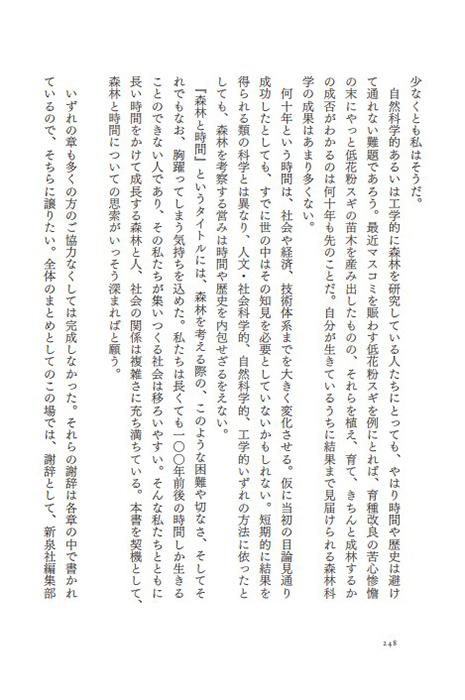
On the Shinsensha website,You can also browse.I would be very happy if you could take a moment to flip through the pages. It would be my greatest pleasure if you could take a few moments to flip through the pages. (Nobuyuki Yamamoto, Director, Forestry Management and Policy Research Area, Forestry and Forest Products Research Institute, National Institute of Forestry Research and Development)