The power of wood shines at the Paris Olympics: Designing a sustainable cycle from forest to city and city to forest
Updated by Nozomu Kanemoto on November 05, 2025, 9:22 PM JST
Nozomi KANEMOTO
Leaf Rain Co.
He joined the Japan Forest Technology Association in 2021 and has been involved in several ODA projects in the forestry sector, calculating GHG emission reductions and managing project operations. 2024 he became independent and is currently working in the forestry sector based in France.
The Paris Olympics held in 2024. The spectacular and creative staging of the opening ceremony and the success of the athletes who competed in close races are probably still fresh in many people's minds. The Paris Olympics were not only an international sports festival, but also attracted attention as the "most sustainable Olympics in history (*1)," with the aim of minimizing environmental impact. One part of this was the architectural approach that placed wood at the center of the building.
In the Village des Athlètes, which was developed as an athletes' village, 100% wood was used for structural materials in buildings less than 28 meters high (*2). (*2) The wood used was sourced from environmentally managed forests, at least 30% of which are in France (*3).
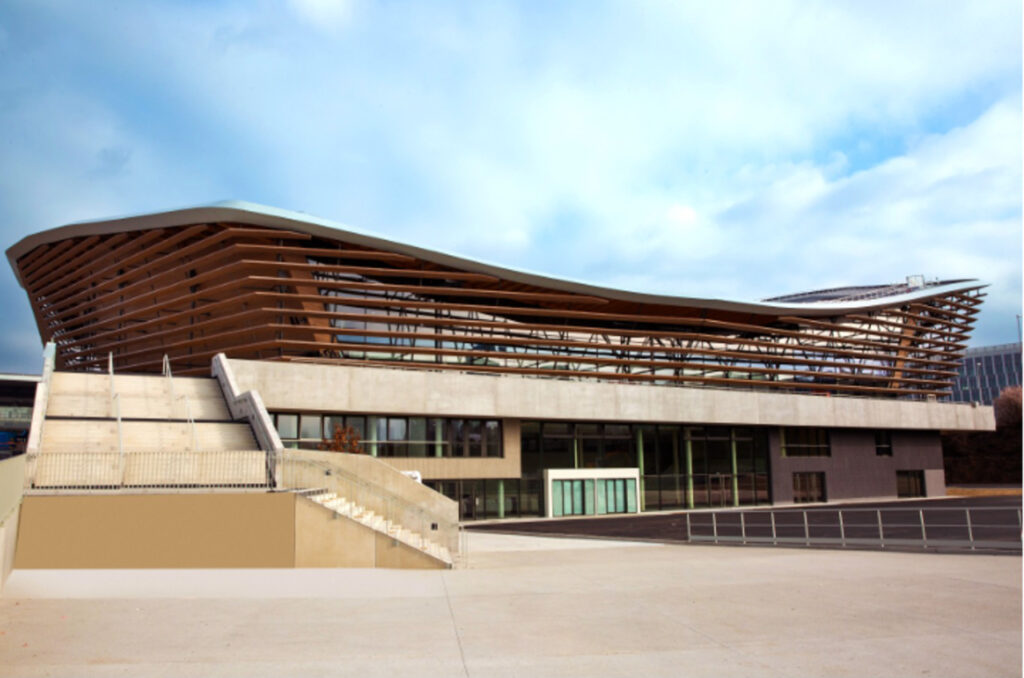
The aquatics center (Centre Aquatique Olympique) also features a spectacular wooden frame with approximately 90 meters of wooden beams. This architecture combines design and functionality, and the building itself serves to anchor carbon (*4).
Wood was also chosen to frame the Grand Palais Ephémère, a temporary facility built on a 10,000 square meter (*5) site, with wooden arches supporting the temporary structures, all of which are made of wood from certified sustainably managed forests (*6). (*6).
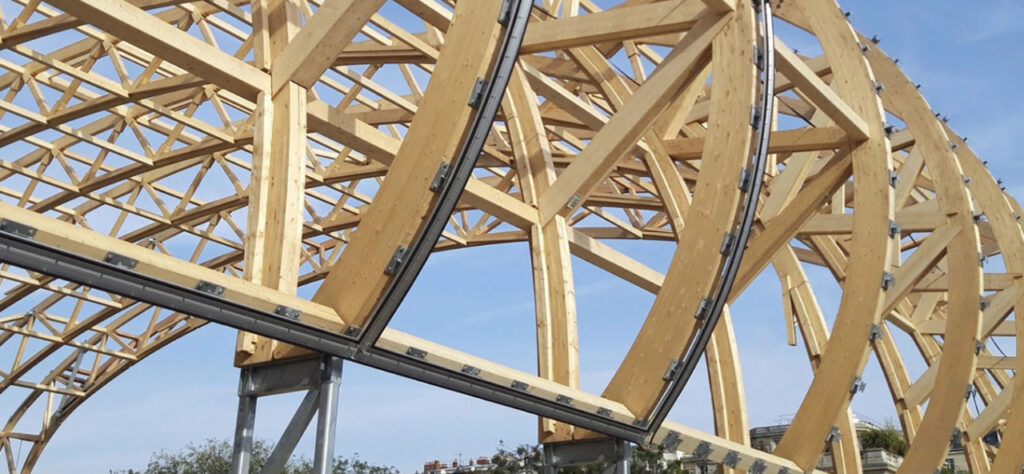
These efforts are a model case of how to balance the reduction of environmental impact and architectural functionality while promoting the revitalization of the forestry industry and the development of local economies through sustainable wood use.
*Reference 1:Internatinal Olympic Committee(Viewed October 31, 2025)
*Refer 2:SOLIDÉO (SOCIÉTÉ DE LIVRAISON DES QUVRAGES OLYMPIQUES) "LE VILLAGE DES ATHLÈTES"P14 (viewed October 31, 2025)
*Reference 3:ICADE(Viewed October 31, 2025)
*Refer to 4:Centre aquatique Olympique(Viewed October 31, 2025)
*Refer 5:les bois lamelles(Viewed October 31, 2025)
*Refer 6:GL events(Viewed October 31, 2025)
In France, forest management has long been institutionalized at the national level: the Edict of Brunoy of 1346 provided for the planned implementation of logging, and the Forest Law of 1827 specified the regeneration and protection of national forests (*7).
Since the establishment of the French National Forest Office (Office national des forêts/ONF) in 1965-1966, biodiversity conservation and recreational use have been emphasized along with efficient management of public forests, and the multifaceted value of forests has been protected as an institution (*8).
Since the 2010s, environmental standards for buildings have also been strengthened, and the RE2020 (Reglementation Environnementale 2020) (*9), which will come into effect in 2022, evaluates the environmental impact of buildings throughout their life cycle and encourages the use of low-carbon materials such as wood. (*10).
Behind these systems lies the philosophy of protecting forests through sustainable forest management. Many of France's public forests are managed under PEFC or FSC(R) certification, and forest resources are maintained over the long term through the cycle of harvesting, utilization, and regeneration (*11).
*Refer 7:Office National des Forêts(Viewed October 31, 2025)
*See 8:Office National des Forêts(Viewed October 31, 2025)
*See 9:MINISTÈRES TRANSITION ÉCOLOGIQUE TRANSPORTS AMÉNAGEMENT DU TERRITOIRE VILLE ET LOGEMENT(Viewed October 31, 2025)
*Refer 10:L'institut technologique FCBA(Viewed October 31, 2025)
*See 11:Office National des Forêts(Viewed October 31, 2025)
Vision proposed by our media "Forest Circular Economy" (article published on May 7, 2025)Is Cutting Down Trees Evil? Let's Rejuvenate Old Forests: A Recycling Society Supported by Japan's Forests (2)".The Paris Olympics and France's efforts have one thing in common: the two-way circulation of resources from forests to cities and from cities to forests. The two sides of the story are the two-way circulation of resources from forests to cities and from cities to forests.
Trees are cut down, used in various ways such as lumber, furniture, and energy, and eventually returned to the forest through reuse and afforestation. Incorporating this cycle into industry, economy, and culture will lay the foundation for a decarbonized society. Sustainable society and forest management are organically linked, creating a domestic cycle of timber, which also contributes to the revitalization of local economies and carbon fixation.
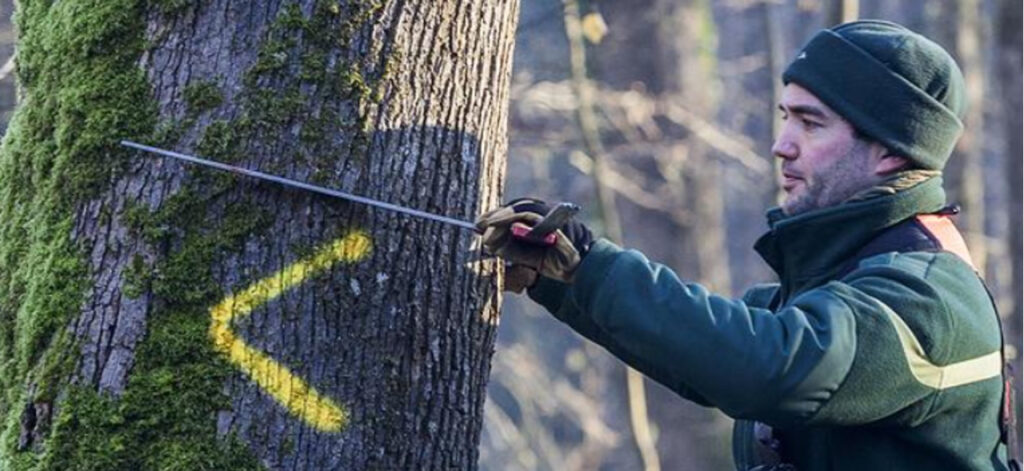
Although Japan is one of the most forested countries in the world, much of its demand for timber is dependent on imports. Despite the availability of domestic resources, the cycle of harvesting, processing, utilization, and regeneration does not function well, and in many cases, forests are left unattended. According to the Forestry Agency, Japan's planted forests have accumulated unused during the growth process, and more than half of the mature forests are more than 50 years old.
What we can learn from the French case is the thorough use of certified timber and the creation of demand for domestic timber through wooden construction and other means. These efforts are a pathway to simultaneously achieve the three goals of recycling forest resources, promoting local industry, and combating climate change.
The key to creating a sustainable society for the next generation will be to establish this two-way relationship between the city and the forest, and the forest and the city. (Nozomu Kanamoto, Forest Consultant, Leaf Rain Co.)