Japan was built on "easy-to-split" cedar
Updated by Kotaro Nagasawa on November 06, 2025, 10:12 PM JST
Kotaro NAGASAWA
(Platinum Initiative Network, Inc.
Born in Tokyo in 1958. Former Senior Managing Executive Officer of Mitsubishi Research Institute. During his tenure, he was mainly engaged in research and studies on infrastructure and social security. During his first few years with the company, he was involved in projects related to flood control, and learned from many experts on river systems at the time to think about the national land on a 100- or 1,000-year scale. Currently, he is an auditor of Jumonji Gakuen Educational Corporation. He is also a part-time lecturer at Tokyo City University. Co-authored "Introduction to Infrastructure" (Nikkei BP, 2017), "New Strategies from the Common Domain" (Diamond, 2021), and "40 Years After the Return" (Heibonsha, 2023). D. (Engineering).
The mainstay of the "circular economy of forests" is, without a doubt, the Japanese cedar. The area of planted forests in Japan is approximately 10 million hectares, with Japanese cedar accounting for 441 TP3T, the largest. Hinoki trees account for 251 TP3T and pines 261 TP3T in total. Hardwoods account for only 3% of the total. In the previous issue of "France, the land of hardwood treesIn the book, there was a description of Japan's increased dependence on softwoods after the Meiji period (1868-1912) because the Japanese cedar, a species native to Japan, was too competent as an industrial timber. I thought, "Wow.
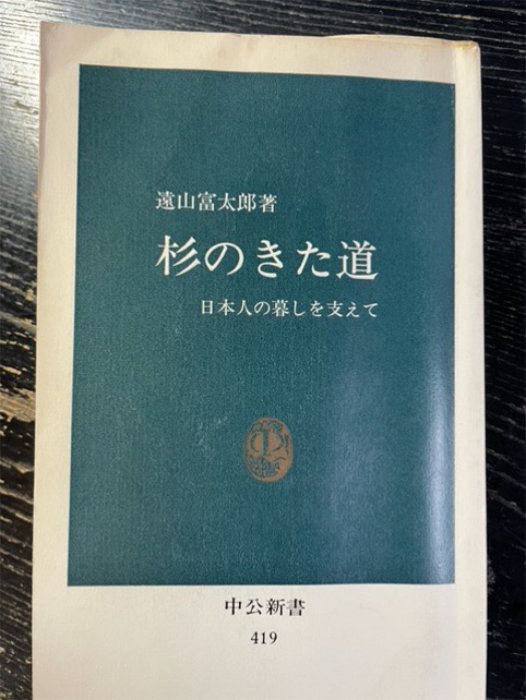
However, I must confess that I myself know almost nothing about cedar. I felt sorry about this and was looking for a good book on cedar when I came across Tomitaro Toyama's "Sugi no kita michi" (The Road Cedar Came) (Chuko Shintosho, 1976). However, I learned a great deal about cedar trees by reading this book. It is a compact new book, but it is full of amazing descriptions. I would like to introduce some of them below.
The book opens with the author's account of seeing an ancient cedar rootstock on display in Uozu City, Toyama Prefecture. It was shocking. In a building about the size of a gymnasium, there was a pool rather than a tank, in which a monstrous cedar rootstock was submerged. According to the story, during the renovation of Uozu Harbor in 1930, many cedar rootstocks were found under the surface of the sea in what was thought to be their habitat, and many of them were over four meters in diameter.
I may be the only one who did not know about it, but if anyone is interested, please search for "Uozu Buried Forest Museum". If you are interested, search for "Uozu Buried Forest Museum" and you will find images of a giant cedar rootstock that would give you a stroke if you saw it up close. There are many giant cedars in the Uozu area, and another giant cedar called "Dorosugi" (cave cedar), which is also a monster, is a tourist attraction.
From this description of the giant cedar, the story jumps to the Toro Ruins. As is well known, the Toro Ruins date back to the late Yayoi period (about 2,000 years ago), when there were 20,000 tsubo of rice paddies, with sheet piles driven into the path between rice fields. They are thin sheets of cedar, about 2 cm thick. The number of sheets is probably several tens of thousands.
There is a warehouse on stilts at the Toro Site. The wall material is cedar planks about 1 cm thick, and thinner planks have also been excavated. If iron tools were already in use, how could people at that time mass-produce such thin sheets?
There are log cabins in Eurasia. In modern terms, they are log cabins. The construction technique used here, in which timbers are stacked in a well-shaped structure, was introduced to Japan from the continent. It is also known by the Japanese name seiro-gumi (井楼組/井籠組). However, although Japan is said to be a culture of wood, there is no history of log huts. Why is this?
For example, the Shosoin storehouse is made of Japanese cedar, and its structure is a seiro-zukuri. However, the members are not logs, but have a unique chamfered triangular cross section that is unparalleled in the world. Although this is said to have the effect of regulating humidity and improving drainage, the author simply explains that "Japanese cedar was unsuitable for log construction because of its large diameter. Incidentally, log cabins around the world are distributed in areas where small- and medium-sized trees are abundant.
To reinforce his theory, the author analyzes the cross sections of Shosoin wood (members). As a result, it is clear that these are split pieces of large-diameter wood, and he notes that the diameter of the original wood is around 1 meter. Certainly, a log house would not be made from a 1-meter-diameter log.
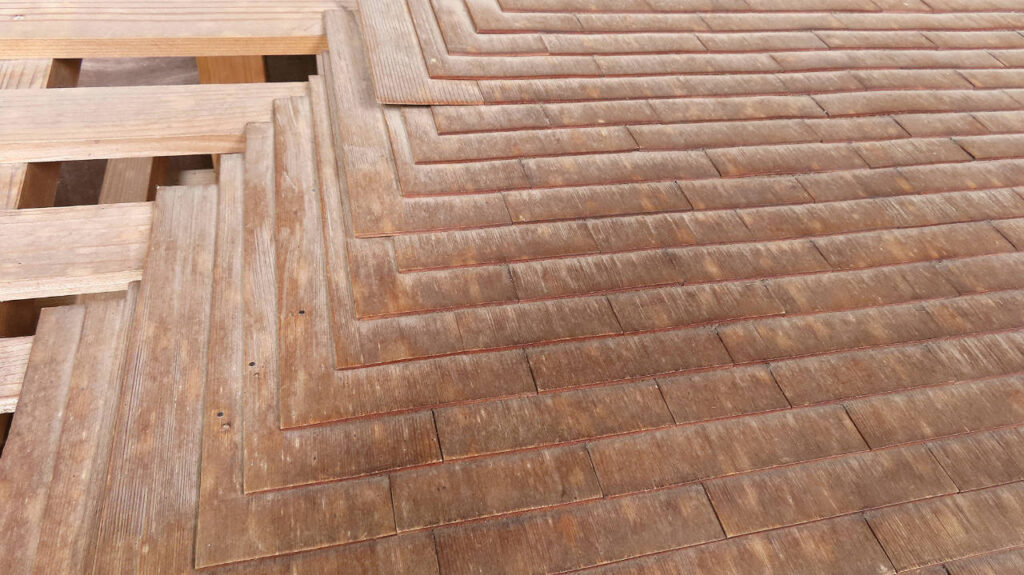
The roofs of Japanese houses used to be thatched with grass or thatch, but around the Nara period (710-794), roof shingles called "kure- shingle thatch" became widespread. The thickness of the shingles at that time was about 1.5 cm. Later, an even thinner roofing shingle called "kokera" was developed. The thickness was less than 1 cm. Kure" turned into an intermediate material that produced "kokera. Kokera became the dominant roofing material during the Edo period. The thickness of Tenryu kokera, which had gained fame, is said to be 1.7 mm. The material used was also sugi (Japanese cedar). The cedar has vertical rings, which form grooves that allow for good drainage.
Around the Kamakura period (1185-1333), wooden tubs made of sugi (Japanese cedar) began to appear, allowing the Japanese to easily store and transport liquids. The use of bamboo for the tag facilitated mass production. Large vats and barrels greatly supported the distribution of liquid products such as soy sauce, miso, sake, and vinegar. Fertilizer vats also became widespread, and "most of the Japanese excrement was collected in cedar vats, stored in large cedar vats, and applied again in cedar vats to farmland throughout Japan. This continued for three hundred years." I barely remember it. The scene must have been visible until the 1950s.
The appearance of a Japanese-style boat is that of a box without a lid. Japanese rivers have swift currents and wide variations in flow, so boats must be flat-bottomed and shallow to be of any use. In ancient times, round wooden boats were the main type of boat, but eventually, relying on the strength and flexibility of thick planks, boats continued to be made simply by joining cedar planks together. Thick planks were easily cut from large-diameter cedar. As mentioned above, soy sauce, miso, sake, and vinegar were packed in cedar barrels and transported on Japanese boats made of cedar.
Compared to the rest of the world, Europe and China, for example, do not have access to large timbers. This forced them to use small and medium-sized timbers for shipbuilding, and the need for structural reinforcement gave rise to modern shipbuilding technology, in which a framework is made of a dragon bone, longitudinals, and ribs, to which planks are affixed. The author wonders if this rational technology was not developed in Japan because Japanese ships could be easily built from large-diameter timber.
Japanese cedar has historically been a large-diameter timber. This is often emphasized by the author. Therefore, how to make "planks" out of it is a technical question, and advances in plank-making technology have supported Japanese people's daily lives.
The author says that the basic technique for producing thin wood is to "split" it (of course, the later processes, such as planing after splitting, become more precise as time goes by). From Yayoi period arrowwood to early modern kokera, wood (mostly sugi) has been "split" and processed in Japan. Fortunately, cedar was a very "easy" species to split. The cedar planks about 1 cm thick used in the stilts at the Toro Site were made by a method called itamegitori, in which the wood is stripped along the annual rings. For the next 2,000 years, Japanese people have continued to split cedar wood to make roofing shingles, barrels, barrels, and boats. =(continued by Kotaro Nagasawa, Director, Platinum Initiative Network)