The "mother of Japanese street trees" - the tulip tree - spread from Shinjuku Gyoen to the rest of Japan
Updated by Kazuo Watanabe on November 14, 2025, 6:48 PM JST
Kazuo WATANABE
As a forest instructor, he spreads knowledge about trees and explains the natural environment, and teaches at NHK Culture Center, Mainichi Culture Center, Yomiuri Culture, NHK Gakuen, and others. He is the author of "Trees in Parks and Shrines," "15 Mysteries to Enjoy Roadside Trees," "Why Do Hydrangeas Collect Aluminum Poison in Their Leaves? Completed the graduate course at Tokyo University of Agriculture and Technology. Doctor of Agriculture.
A spacious park with large trees to admire. Shinjuku Gyoen is one such park where you can enjoy a pleasant stroll. Shinjuku Gyoen is a park located in the center of Tokyo's Shinjuku Ward. The vast park, covering an area of about 60 hectares, has both a Western-style garden and a Japanese garden, and is home to a variety of trees. Large trees such as plane trees, lily trees, and Himalayan cedars can be seen in the park, which is so quiet that it is hard to believe that it is in the center of the city. These large trees were planted as far back as the Meiji period (1868-1912).
The site where Shinjuku Gyoen is located was the Edo residence of the Naito clan, the lord of the Takato domain during the Edo period. Later, in the Meiji era (1868-1912), the site became the so-called "Agricultural Experiment Station" of the government, where research was conducted on the cultivation of vegetables and fruit trees, sericulture, and cattle breeding. Research on trees was also conducted, and various kinds of trees, especially exotic trees such as lily magnolia, platanus, Himalayan cedar, rakusyo, American xeric sagebrush, and Taisanboku, were planted within the experimental station. Later, after the period of the imperial garden, the park was opened as a park in 1949, and those trees have now grown into large trees.
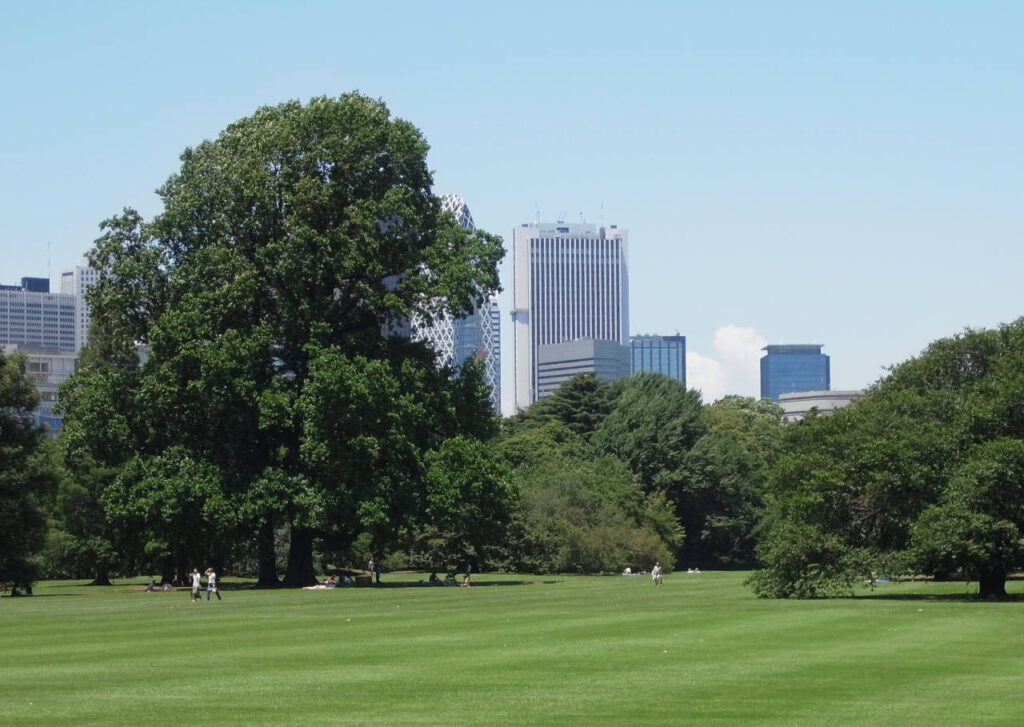
Shinjuku Gyoen is a vast park with an expansive lawn at its center. In this lawn, which is called a "landscape garden," a large lily tree, more than 30 meters high, towers (Photo 1). When viewed up close, the three lily magnolias huddle together as if they were one giant tree. There are about 30 lily trees in Shinjuku Gyoen, but the one in the landscape garden stands out from the rest and is the symbolic tree of Shinjuku Gyoen. The lily tree originates from North America, where it can grow to a height of over 50 meters. The lilies in Shinjuku Gyoen were brought in and planted during the Meiji period (1868-1912).
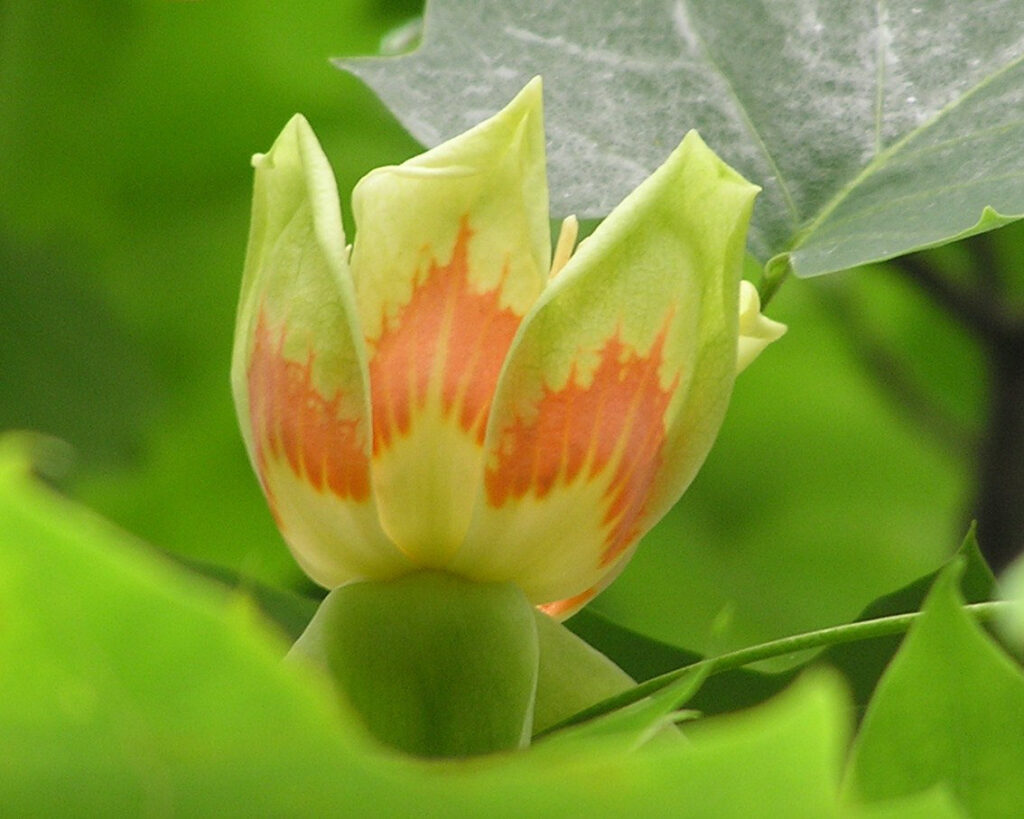
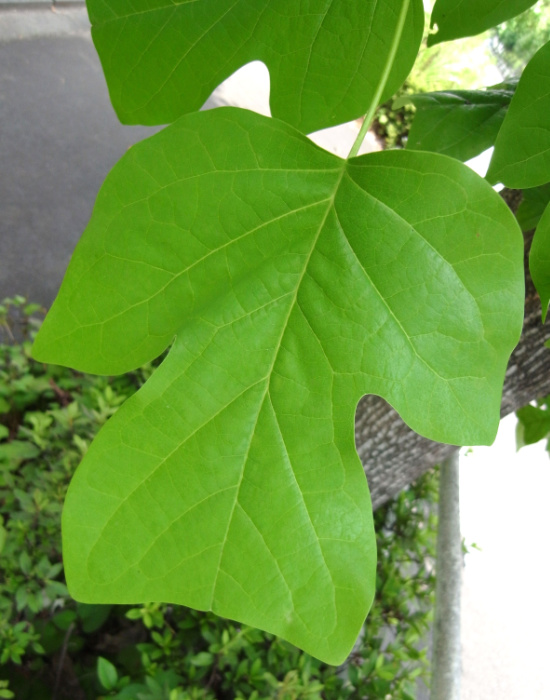
The lily tree is a large flowering tree. The flowers are shaped more like tulips than lilies. The yellow-green petals have a beautiful orange crest (Photo 2). The flower also produces a lot of nectar. In the past, when beekeeping was practiced in Shinjuku, the lily trees in Shinjuku Gyoen were a source of nectar. The tree grows tall and its flowers bloom high up. Therefore, it is rare to see them, but if they are planted as street trees, they can be enjoyed from the windows of buildings or from the tops of pedestrian bridges. The flowering season is early summer. The leaves are also interesting, shaped like a T-shirt. The lily tree is also known as hantenboku, which means "half-clothed tree. The name comes from the shape of its leaves, which resemble a coat (Photo 3).
The lily tree has a beautiful shape and is resistant to cold and pests. For this reason, they are planted along streets and in parks. When the lily tree was brought to Japan in the Meiji period (1868-1912), Fukuba Hayato (1856-1921) was a person who appreciated the tree and popularized it as a roadside tree. Fukuba was a horticultural engineer in the Ministry of the Imperial Household and made great contributions to the improvement of grapes, melons, strawberries, and other varieties. He also made significant contributions to the study of roadside and park trees. He was also the general supervisor of the Shinjuku Imperial Garden.
In order to respond to the demands of the modernization of the city, Fukuha researched what kinds of trees were suitable for street and park trees, and made efforts to promote the use of lily trees, plane trees, Himalayan cedars, and other trees. He also donated large quantities of seeds and cuttings of lilies and plane trees from Shinjuku Gyoen to the City of Tokyo, which provided the impetus for the development of roadside tree seedlings in Tokyo.
It was Yasuhei Nagaoka (1842-1925), a Tokyo city official, who took advantage of this opportunity to popularize street trees in Tokyo. Nagaoka promoted the greening of Tokyo through the construction of parks and the spread of street trees. With a limited budget, he searched for land to grow roadside tree seedlings (nurseries) in Tokyo and personally cultivated tens of thousands of roadside trees with his own saw. He was especially fond of the lily tree, and spread the use of lily trees along the streets.
The lily tree in Shinjuku Gyoen was brought to Japan during the Meiji period (1868-1912). Using this lily tree as the mother tree, its seeds were used to plant lily trees in various places. For example, there is a beautiful row of lily trees in front of the State Guest House in Akasaka. When the Akasaka Detached Palace (former Crown Prince's Palace) was completed at the end of the Meiji era (1868-1912), saplings grown from the seeds of lilies in Shinjuku Gyoen were planted alongside the trees. The second generation of Shinjuku Gyoen lily trees, planted in various locations, have already grown to a large size.
In addition to lily trees, Shinjuku Gyoen has large trees such as platanus and Himalayan cedar. These trees were also collected from abroad and planted during the Meiji period. These trees were studied by landscaping and greening engineers and spread throughout the country as roadside trees and park trees.
The lily magnolia is a tree that grows majestically. It also produces lovely flowers. It also emits a sweet fragrance of honey. People were fascinated by its charm, and it spread from Shinjuku Gyoen to Tokyo and then to the rest of the country. The lilies helped to modernize the city through the development of parks and roadside trees. The mother lily tree of Shinjuku Gyoen continues to watch over its history. (Kazuo Watanabe, forest instructor)
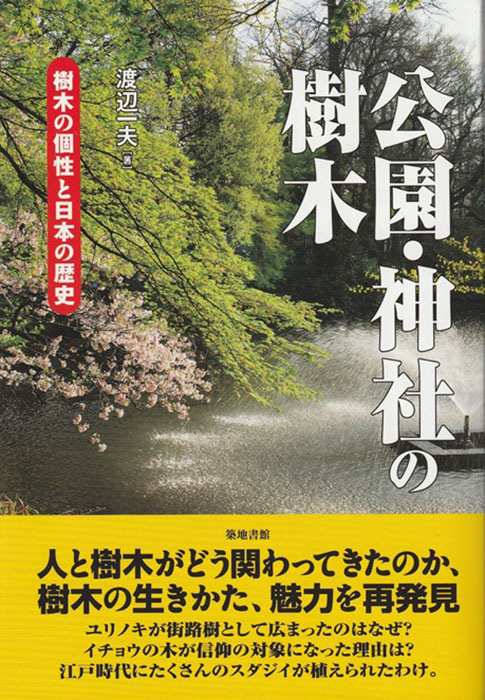
Trees in parks and shrines"
Written by Kazuo Watanabe, published by Tsukiji Shokan
An oasis of greenery loved by people, this book introduces the history and episodes hidden in this oasis of greenery. Through the trees in parks and shrines, this book will rediscover how people have been involved with trees, the way trees live, and their charms.
<Table of Contents
Chapter 1: Sleepless Platanus
Chapter 2: War-Torn Azaleas and Dogwoods
Chapter 3: Enoki, the History of Suigo
Chapter 4: Sudajii fought the Great Fire of Edo
Chapter 5 Camphor Tree from Taiwan
Chapter 6: Why did Eiichi Shibusawa build the park?
Chapter 7: How Ginkgo Came to Be Worshipped
Chapter 8: 5,000 Years of History Hidden in the Cherry Hill