Updated by the Forest Circular Economy Editorial Department on November 20, 2025, 10:08 AM JST
Editorial Board, Forest Circular Economy
Forestcircularity-editor
We aim to realize "Vision 2050: Japan Shines, Forest Circular Economy" promoted by the Platinum Forest Industry Initiative. We will disseminate ideas and initiatives to promote biomass chemistry, realize woody and lumbery communities, and encourage innovation in the forestry industry in order to fully utilize forest resources to decarbonize the economy, strengthen economic security, and create local communities.
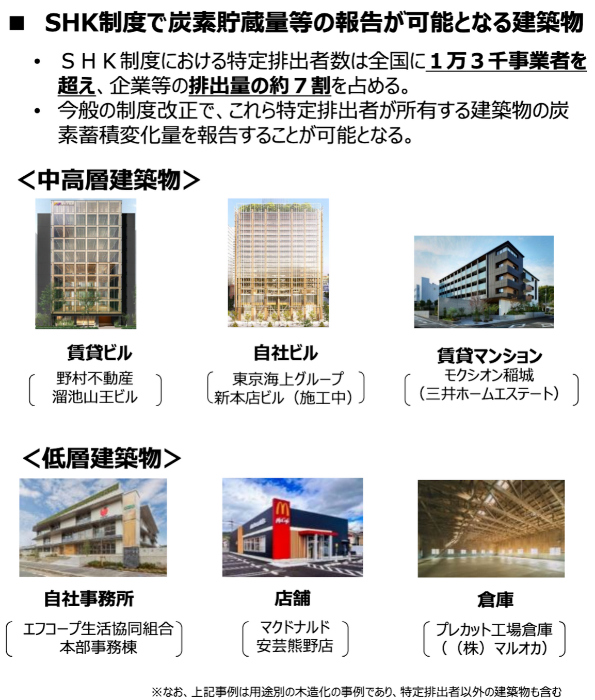
The Forestry Agency is advancing revisions to the SHK system (Greenhouse Gas Emission Calculation, Reporting, and Disclosure System) to reflect the amount of carbon fixed in buildings through wood utilization in greenhouse gas emissions calculations. Scheduled for implementation in April 2026, companies and local governments that construct and own new buildings will be able to report their emissions after deducting the carbon storage achieved through wood utilization.
This marks the first time in Japan that wood utilization has been formally recognized as a “quantifiable emissions reduction” within an official system, representing a significant policy shift.According to the Forestry Agency, calculations show that utilizing 200 cubic meters of cedar lumber can sequester 121 tons of CO2 over the long term, indicating we have reached a stage where the environmental value of wood construction can be explained numerically. This system revision fundamentally changes the premises for corporate sustainability strategies, municipal climate policies, and structural choices in construction. Wood construction is entering a phase where it is treated not merely as a symbol of environmental consideration, but as a practical measure for emissions management.
The impact of the regulatory changes is particularly significant for non-residential buildings. Warehouses, offices, commercial facilities, and rental apartments are often owned by specific emitters. If switching to wood construction can reduce emissions, it directly influences the criteria for selecting construction methods.Examples cited by the Forestry Agency show that wooden warehouses and office buildings can sometimes be constructed at lower cost than reinforced concrete (RC) or steel (S) structures due to lighter foundation work. The rationality of wood construction is increasing from both regulatory and economic perspectives, potentially accelerating structural transformation in the non-residential sector.
Local governments are also beginning to visualize wooden public facilities and carbon storage.Yakushima Town has announced that its new wooden town hall will sequester 222 tons of CO2. It is promoting the use of local timber while also linking this effort to policies as a leading decarbonization region. The SHK system revision provides institutional backing for such municipal initiatives. Carbon sequestration through timber use can now be reflected in regional emissions management, creating a tighter link between forest management, local economic cycles, and policy.
In line with the system reforms, the Forestry Agency has begun accepting applications for the "Forest Nation, Wooden Town Declaration." As of November 18, 207 municipalities, companies, and other entities have made the declaration.Participating organizations will continue to be published on the Forestry Agency's website and will receive information on promoting timber construction and increasing its visibility. The role of these declarations is to spearhead the implementation phase of the policy reforms, and they are beginning to function as a social foundation enabling local governments and companies to advance timber construction collectively.
The impact of regulatory reforms is also significant in corporate management. Under domestic sustainability disclosure standards, emissions disclosure based on the SHK system is expected to be incorporated into securities reports, expanding the potential to report carbon storage from wood utilization as "adjusted emissions."
Japan's planted forests cover approximately 10 million hectares, with half reaching a utilization period of over 50 years. The volume of timber stock increases by 60 million cubic meters annually, making the cycle of "planting, nurturing, and using" essential to maintaining forest health. Establishing urban frameworks that support this cycle holds significant meaning for rebuilding the relationship between forests, local communities, and cities.
Reference Links
Declaration on Creating a "Forest Nation and Wooden Town": Forestry Agency