Image by Unsplash
The key to reducing costs is forestry roads and forest intensification strategies.
Updated by Yasunao Kobayashi on February 26, 2026, 11:14 AM JST
Yasuhisa KOBAYASHI
Alpha Forum, Inc.
President of Alpha Forum, Inc. and Steering Committee Member of the Platinum Forest Industry Initiative. Ltd. in 2001, taking advantage of the company's venture support program. In September 2023, he received the Wood Use System Research Association Award.
*Previous column is here.
Recommendations for High-Quality Forestry] Investment in forestry roads will increase productivity Gravel bedding is 40 cm, twice that of Japan.
I would like to dig a little deeper than in the last issue. Forgive me for being a bit of a geek, but in the Austrian state of Steiermark, we were guided by Conrad to visit a railcar material production site, an overhead line material production site, and a training forest at the Pichl Training Institute. In each case, there were no working roads, and a "forestry-only road" was used for trailers over 10 tons in size to reach the timber production site. The person who gave us the tour commented, "It is important to utilize the overhead line system (tower yarders) and plan for a forestry road in order to reduce material production costs over the medium to long term. The other party commented, "In the medium to long term, the use of overhead line systems (tower yarders) and the planning of dedicated forestry roads are important to reduce material production costs. In other words, it is meaningful to use a forwarder or reduce the travel distance as much as possible.
Caterpillar-type forwarders are common at forestry sites in Japan, mainly for vehicle-based systems, with a work path of less than 500 m and a speed of about 10 km/h or less (actually about 100 m/min in a straight line and 40 m/min in a curve, or about 50 m/min combined). The forwarder transport distance is 500m. If the distance of the forwarder is 500 m, the round trip takes about 20 minutes, 10 minutes for loading the logs, and 10 minutes for unloading, for a total of 40 minutes, or 1.5 round trips per hour. Of course, if the distance is shortened, the number of round trips increases. The average load capacity of a forwarder is 4 to 7 tons per trip, or 5 tons per trip (50% moisture content (wet basis) ≈ 6.6 cubic meters). 6.6 cubic meters✕ 1.5 times/hour✕ 5 hours ≈ 50 cubic meters per day. per year.
However, work is suspended on bad weather days. Also, when forestry work sites change, heavy equipment must be transported on trucks and trailers. There are also days when the machines cannot be moved due to breakdowns or maintenance. The actual number of working days is estimated to be about 150 days/year. This means that one work team would be responsible for 7,500 cubic meters/year.
The volume of a log is calculated by squaring the square of the terminal diameter✕ length. Four meters with a terminal diameter of 50 cm is one cubic meter, and four logs with a terminal diameter of 25 cm is one cubic meter. Assume that the diameter at breast height of the coniferous tree that is being felled is between 30 and 50 cm, and that there is a total of 1 cubic meter from the first ball to the fourth ball. If the harvester can reach the area where the logging is done, it can produce 15 cubic meters (pcs)/h while moving little by little from the forest road to the harvest area, from felling to pruning to cutting branches to cutting logs to sorting and stacking logs. Chainsaw logging can produce 6 cubic meters (pcs)/hour, and the processor can clear the branches and stack the logs on the ground. If the harvester (or processor) and chainsaw felling are used together, the machine has a capacity of about 18 cubic meters (pcs)/hour. If this work is done for 5 hours in effect, it will be 90 cubic meters/day. In effect, 150 days of forestry work would yield 13,500 cubic meters/year/group.
The forwarder, which is the rate-limiting (bottleneck), is balanced if it makes three round trips/hour, including loading and unloading logs. This means that it takes 10 minutes to load logs and 10 minutes to unload them, so three round trips with a travel distance of 0 m. This is not realistic, so the forwarder needs 7 minutes for loading and 10 minutes for unloading (no wood selection). Since this is not realistic, if we can shorten the time to 7 minutes for loading and 7 minutes for unloading (without tree selection), the travel time can be reduced to 6 minutes. Since the actual speed is 50 m/min, a round-trip distance of 300 m and a one-way distance of 100 to 150 m would be reasonable. It is clear that the current working travel distance is too long and that is the rate-limiting factor. If we eliminate the forwarder by clear cutting, we can aim for 10,000 cubic meters/year with one work team (3 people). In Japan, there are several work groups that have achieved even better results in material production than this. In Austria, where the use of forwarders is rare, thinning is in excess of 10,000 cubic meters/year, and clear cutting is in excess of 20,000 cubic meters/year.
The cost of a 4-7 ton forwarder is about 45 million yen/unit, which, if amortized over 5 years, would mean a cost of about 9 million yen/year. The running cost of diesel fuel is about 10 liters/hour, so 5 hours/day for 150 days of operation is 750 hours, or 7,500 liters/year, which is 750,000 yen, assuming an annual salary budget of 6 million yen per person and maintenance costs of 1.5 million yen per year, for a total of 17,250,000 yen. The total cost is considered to be 17,250,000 yen.
The subsidy to establish a road that is equivalent to a forestry road standard and can be used by a 10-ton truck is about 25,000 yen/m. Since this is a basic 50% subsidy, if the operator bears the same amount, it would be 17,250,000 yen/25,000 yen = 690m worth of forestry roads. (Whether a forestry road can be established at 50,000 yen/m requires a detailed study of the conditions of each target site.) Considering a 5-year period, this would amount to 3,450 m, or 6,900 m for 10 years. We would like to add that a circulation forest road should be planned as a probability in the future.
Dedicated forestry roads are not a nice-to-have as they are a requirement to improve material production efficiency. It must be able to plan a reasonable alignment according to the topography, and also be able to efficiently carry out materials from the target forest area. How should we plan? Although it will be difficult to catch up with the efficiency of AUSTRALIA due to differences in various conditions, we would like to consider forest road planning and forest intensification planning in our country in an integrated manner.
The objective is not to consolidate forests, but to dramatically increase the efficiency of material production. The project I am involved in is also utilizing "aerial laser measurement information," and we are now able to get a rough overview of where and how much material is accumulated in each area. This information has enabled us to get a bird's eye view of where and how much material is accumulated in each area. What used to be invisible without the help of local production associations or my own surveying has become dramatically more visible thanks to aerial laser measurement. The figure below summarizes the process of narrowing down the intensification target.
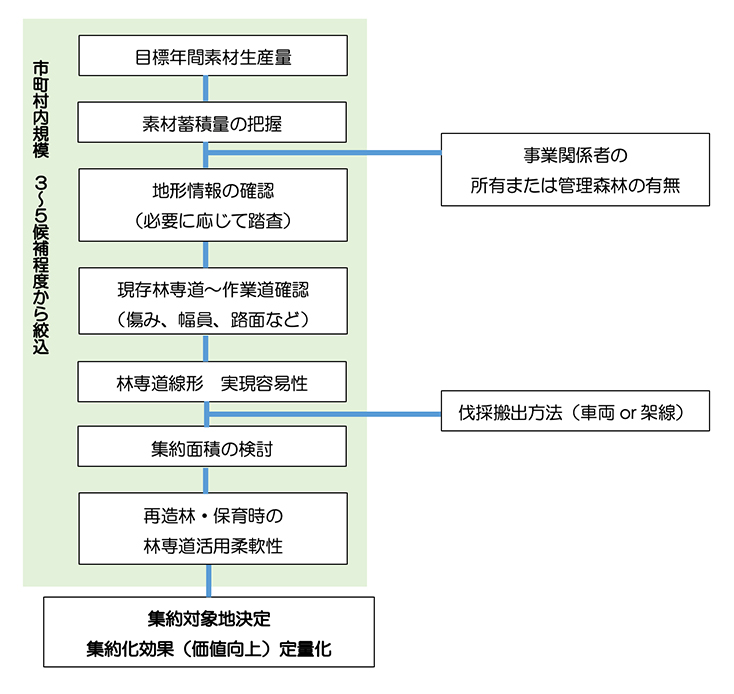
Cost reduction cannot be achieved by simply saying, "It looks easy to consolidate, so let's just do it. First, determine "targets. Forest intensification does not require intensification unless the value of the forest increases, so the study should be taken to the point of quantifying the improvement in economic value.
As mentioned above, where and to what extent can dedicated forestry roads be opened? How much will it cost? We would like to determine the target areas for intensification by considering to what extent it is possible to shorten the distance of working roads, i.e., forwarders.
Cost reduction is one means to a sustainable and profitable forestry industry. The goal is to create continuous employment within the community, to continue to utilize forest resources with economic rationality, and to keep the local economic cycle with less money leaking out of the community.
Forestry feels that the word "intensification" is floating around in the face of inadequate acreage surveys. The land targeted for intensification must be economically compelling. How will the resources produced by forestry be used? How much of it will be produced and at what cost? Can we envision a dedicated forestry road alignment for this purpose? If we cannot sort out the following, we will end up with intensification for now.
We do not want to make a mistake in the order in which we think and express ourselves amidst the three-dimensional intricacies of many rights and laws. We need to develop a habit of backcasting from the objective (a way of thinking in which we clearly set a "future image" or "goal" that we want to achieve, and then work backwards to think about what we need to do now in order to achieve that goal). We also need to be prepared not to solve problems by extending conventional wisdom and business practices.
We should not think that the material production efficiency of AUSTRALIA is impossible because the given conditions are different... but we should be prepared to act with the goal of achieving a higher material production efficiency. (Yasunao Kobayashi, President, Alpha Forum, Inc. and Steering Committee Member, Platinum Forest Industry Initiative)