Reliance on on-site design and construction creates a negative cycle: Industrializing and standardizing the construction process to maximize the benefits of wood
Updated by Sogo Kato on January 15, 2026, 9:04 PM JST
Sougo KATO
Leaf Rain Co.
After working for a financial institution researching companies in the high-tech field, he worked as a supervisor at a landscape construction site before setting up his own business. He is interested in the materials industry, renewable energy, and wood utilization, and in recent years he has been writing about the forestry industry. With his experience of working in the forests in the past, he aims to write articles that explore the connection between the realities of the field and the industrial structure.
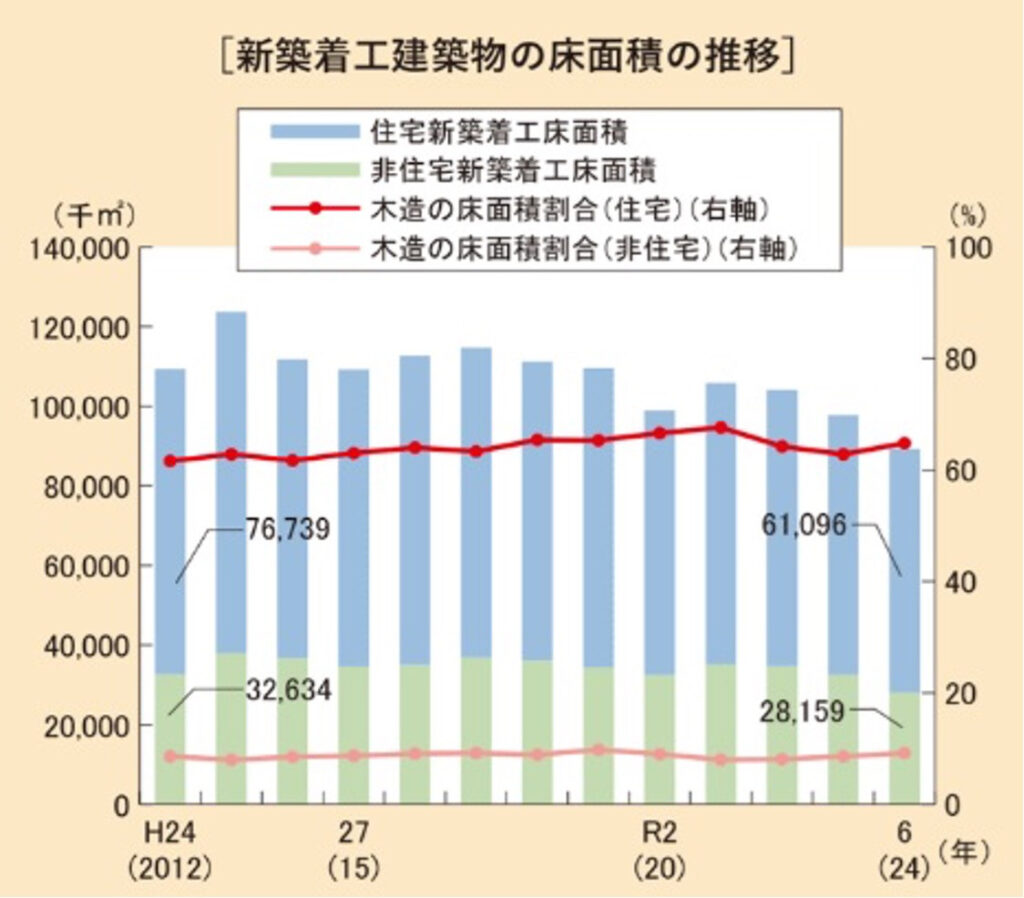
As we saw in the firstWooden construction is a realistic option for the construction industry, which is facing a skills shortage and declining productivity, allowing for industrialization and skill savings. However, wood construction has not necessarily taken root as a "tractable construction method" in the Japanese field. In wood construction, industrialization and standardization of the construction process remains partial, and there is still a dependency on the site, especially in design and construction. As a result, the process tends to be unstable and is often perceived as "difficult construction" by those onsite. These characteristics, combined with institutional requirements for fire resistance and earthquake resistance, make the hurdles even higher in the nonresidential sector. This paper will summarize the frictions that Japanese wood construction faces in the field and clarify the prerequisites for productivity improvement through these frictions.
It is generally pointed out that nonresidential buildings, due to their use and scale, have higher requirements for fire and earthquake resistance than residential buildings, and that the institutional hurdles are higher. However, when looking at the field, there are aspects that cannot be explained by this alone. One of the reasons why wood construction is perceived as unwieldy is that the construction process is labor-intensive.
In Japan, pre-cutting of structural timbers is almost standardized, and posts and beams are factory processed and delivered to the site. In other words, wood is not a material that cannot be industrialized.
On the other hand, there are still few standardized and commercialized components, especially in the interior and exterior design areas that express the "woody architectural character" of the building. For this reason, decorative beams, louvers, wooden panels, and special shaped components are often treated as fabrications that are dimensioned, fabricated, and adjusted onsite. This increases the weight of the woodworking process and can easily become a bottleneck in the overall construction process. In addition, the burden of curing and reworking increases due to interference with other types of construction and vulnerability to stains and scratches. As a result, wood construction faces hurdles in terms of construction as well as institutional aspects.
In wood construction overseas, not only structural materials but also many components including interior and exterior are prefabricated and standardized, and the site is basically designed as an assembly-centered process. In Japan, on the other hand, much of the design and construction work relies on on-site fabrication, and this difference leads to differences in construction time and productivity. The increase in processing and adjustment work, coupled with the shortage of personnel, can easily cause construction schedule delays.
When the construction schedule is tight, the construction types overlap, making it difficult to ensure flow lines and curing. As a result, wood is easily exposed to paint, glue, and mortar stains. Since wood cannot be treated with solvents, strong alkaline detergents, or strong acid detergents, and abrasive repairs can easily damage its appearance, even minor stains require rework or replacement, further stressing the process.
In addition, under tight process conditions, it is not uncommon for phased processes, such as construction, cleaning, and inspection, to be scheduled on the same day. This compression deprives the client of time to check quality and can easily lead to oversights and problems after the handover. The large number of on-site work tends to push back processes and overlap work types, which in turn leads to omission of curing and frequent staining of finished surfaces, which in turn increases the burden of repairs and rework.
The friction organized in this paper stems not from the shortcomings of the wood itself, but from the lack of componentization of the design and construction, and the way in which the process is based on site coordination. Therefore, what is being questioned is not the efforts made on site, but the upstream design of the construction process. The key elements of this design are the standardization of design components and the concept that the construction management side should design and manage the process and quality in advance, rather than leaving it to the contractor, based on the premise that wood is a material that cannot be easily repaired after the fact. Without reducing uncertainties that depend on skills and working conditions and simplifying the construction process as much as possible, the inherent advantages of wood construction, such as skill saving and high productivity, will not be achieved. (Sogo Kato, Forestry Writer, Leaf Rain Co.)