Updated by "Forest Circular Economy" Editorial Board on January 28, 2026, 7:22 PM JST
Editorial Board, Forest Circular Economy
Forestcircularity-editor
We aim to realize "Vision 2050: Japan Shines, Forest Circular Economy" promoted by the Platinum Forest Industry Initiative. We will disseminate ideas and initiatives to promote biomass chemistry, realize woody and lumbery communities, and encourage innovation in the forestry industry in order to fully utilize forest resources to decarbonize the economy, strengthen economic security, and create local communities.
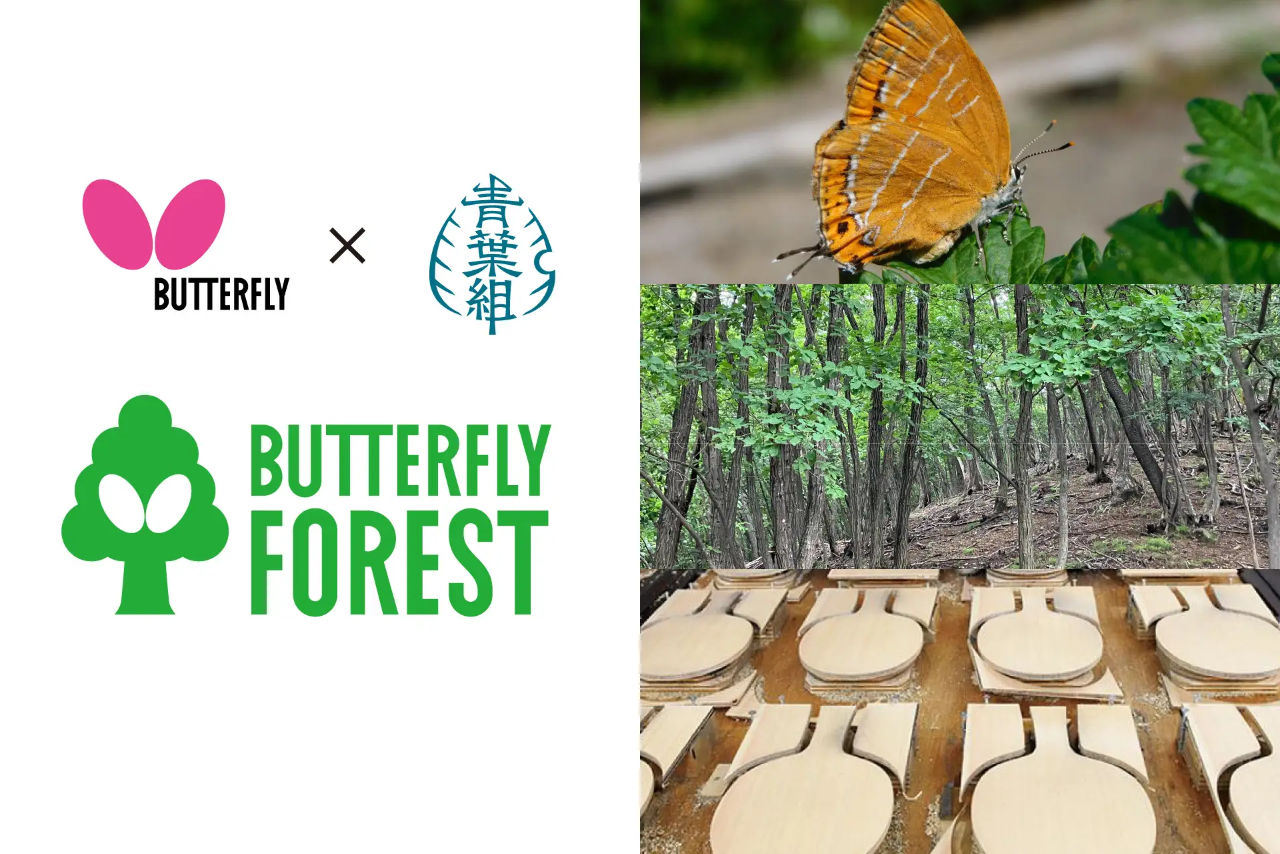
Aoba Gumi, in collaboration with Tamas, the company behind the "Butterfly" brand of table tennis equipment, recently launched the "Butterfly Forest" project in Ashikaga City, Tochigi Prefecture, which incorporates butterfly conservation and habitat restoration into the entire forestry process. The project is the first of its kind in Japan to take concrete measures to "conserve" and "regenerate" butterflies in an integrated manner in commercial forestry, from pre-logging design to afforestation and management.
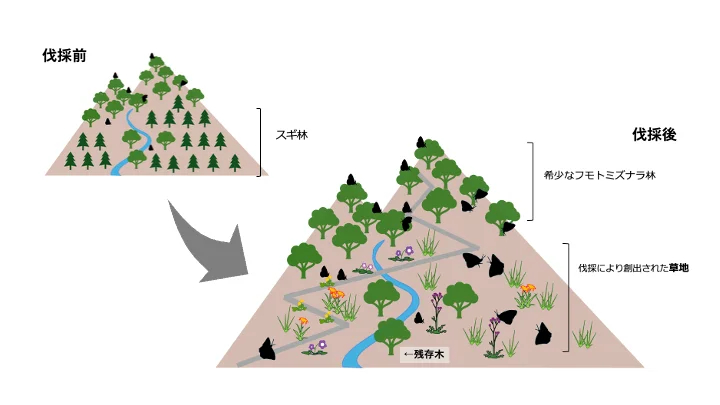
Japan is home to about 240 species of butterflies, about a quarter of which are on the Red List of the Ministry of the Environment. Because they require certain plants during their larval stage and adults are pollinators, they are considered to be a reflection of changes in the ecosystem. Based on these characteristics, a preliminary survey of butterfly habitat and vegetation will be conducted prior to logging, and work paths will be designed so as not to interfere with the butterflies' migration routes. In addition, the existing ecosystem will be maintained by not cutting down all trees, but leaving certain trees, such as Quercus crispula, as "retained trees.
In addition to taking vegetation into consideration during logging operations, after logging, the company intentionally creates grassland areas in addition to planting tree species that serve as food plants for butterfly larvae. This is a system to regenerate a diverse environment in the forest through forestry activities and to create a place where butterflies can continue to grow. This initiative, which not only preserves specific species but also increases their habitat, is an advanced model case in the forestry industry in Japan.
The Japanese cedar and cypress harvested through the project will be used to make table tennis rackets and other materials for research and development. The project aims to accelerate sustainable resource recycling by adding new value to domestic timber through collaboration with sports manufacturers.
Starting with butterflies, the entire forest ecosystem is enriched, and the resources obtained from it are linked to industry. This cycle presents the next generation of forestry, in which the restoration of natural capital is linked to economic activities.
Reference Links
Japan's First* Forestation Project to Protect and Increase Butterflies in All Processes of Forestry -Butterfly, a General Table Tennis Equipment Manufacturer, and Aobagumi Collaborate to Conserve Butterflies - (Aobagumi Co., Ltd.)
Tamas launches ”Creating a Forest with a Butterfly Symbol” in Ashikaga City, Tochigi Prefecture (Tamas Co., Ltd.)