Converting Unused Forest Biomass into Energy: Hita City's Woody Biomass Strategy and Forest Resource Circulation
Updated by Nozomu Kanemoto on February 09, 2026, 9:12 PM JST
Nozomi KANEMOTO
Leaf Rain Co.
He joined the Japan Forest Technology Association in 2021 and has been involved in several ODA projects in the forestry sector, calculating GHG emission reductions and managing project operations. 2024 he became independent and is currently working in the forestry sector based in France.
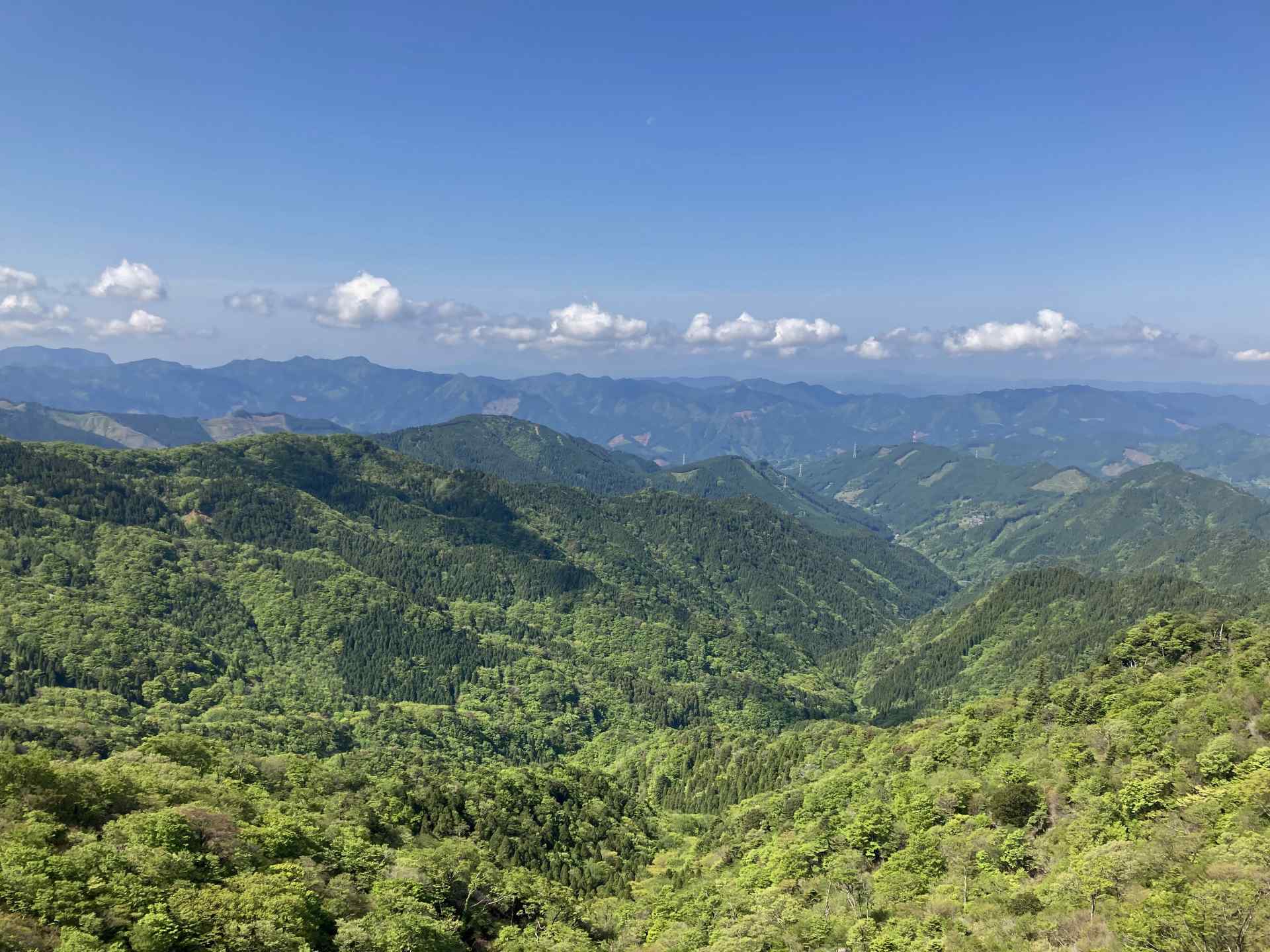
Forests cover approximately two-thirds of Japan's land area. The total forest area is approximately 25.02 million hectares (as of the end of March 2022), of which planted forests account for approximately 10.09 million hectares. The postwar policy of expanding afforestation has led to an increase in planted forests, and Japan is now a country with a large amount of timber resources (*1). On the other hand, in order to maintain planted forests in a healthy state, it is essential to continuously conduct operations such as undercutting and thinning after afforestation. However, the stagnation of timber prices and other factors have made it difficult to adequately carry out such forest maintenance.
At the same time, Japan faces a major challenge in its energy situation. Japan's energy self-sufficiency rate is 12.6% in FY2022 (*2), which is still low among major developed countries. With a structure that is highly dependent on fossil fuels, the import price of fuels has had a significant impact on electricity prices. While there are underutilized wood resources in the forests, the region faces the challenge of unstable energy supply and rising prices. These two issues are the starting point for this paper.
Forest devastation
Artificial forests are forests that have been created on the premise that they will be maintained through systematic operations. Through proper forest maintenance such as undercutting and thinning, forests can fulfill multifaceted functions such as water source recharge, disaster prevention, and biodiversity conservation. If not properly cared for, the health of forests may be compromised.
Declining profitability of the forestry industry
Domestic timber has faced price challenges in the face of competition from imported timber. The slump in lumber prices has made it difficult to fully recover the costs required for forest maintenance and logging, thereby reducing the profitability of forestry operations (*3).
Hollowing out the local economy and human resources
Stagnation of the forestry industry also affects employment opportunities in mountainous areas and the shortage of bearers. Securing human resources for forest maintenance is an important issue for the sustainability of the region (*4).
*Reference 1:Forestry Agency, "FY2024 White Paper on Forests and Forestry.(Viewed: February 3, 2026)
*Refer 2:Ministry of Economy, Trade and Industry, "News Release" (2024)P1 (viewed: February 3, 2026)
*Reference 3:Toshikazu Inakuma (2010), "Issues for Revitalization of the Forestry Industry: Road Network Improvement and Promotion of Thorough Utilization of Trees", Research Office, Committee on Agriculture, Forestry and Fisheries(Viewed: February 3, 2026)
*Refer to 4:Forestry Agency, "Trends in Forestry Labor Force."(Viewed: February 3, 2026)
One of the reasons for the lack of progress in forest development is the low value of the timber generated from forest operations, which makes it difficult to generate profits. One option that is attracting attention as a solution to this problem is "woody biomass," which utilizes wood as an energy resource. Unlike solar and wind power, woody biomass power generation is not easily affected by weather conditions, and is positioned as a renewable energy source that can be operated continuously as long as fuel can be stably secured (*5).
Under the feed-in tariff (FIT) system, woody biomass is classified according to its origin, and higher electricity sales prices are set for power generation that uses unused woody biomass, such as thinned wood and forest residues. Under this system, power generators have an economic incentive to continue procuring unused wood, and the forest industry has new demand for wood and new income opportunities.
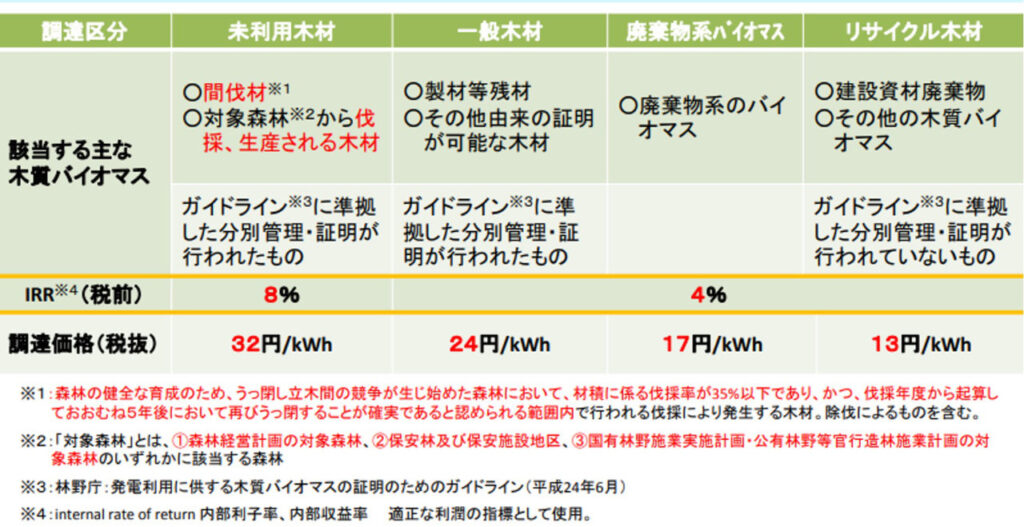
Woody biomass derived from unused wood has the potential not only to contribute to the reduction of greenhouse gas emissions, but also to improve the profitability of the forestry industry and encourage the recycling of forest resources.
*Refer 5:Forest Science, "Can the use of unused wood for power generation be sustainable?" (2018)P14 (viewed: February 3, 2026)
Forestry has long supported local industry in Hita City, Oita Prefecture. In recent years, however, unused timber has remained in the forests, which has become an issue. Against this backdrop, the city has been promoting the use of wood biomass power generation as a solution for unused wood (*6).
This initiative is not a measure that can be completed by the municipality alone, but rather, the private sector is integrally responsible for facility operation, fuel procurement, electricity supply, and even reforestation, thereby realizing effective resource recycling. In the case study commended by the Agency for Natural Resources and Energy, the representative applicant is Morisho Corporation, the joint venture partners are Green Power Generation Oita Corporation, Hita Green Power Corporation, and Japan Forest Corporation, and the cooperating municipality is Hita City.
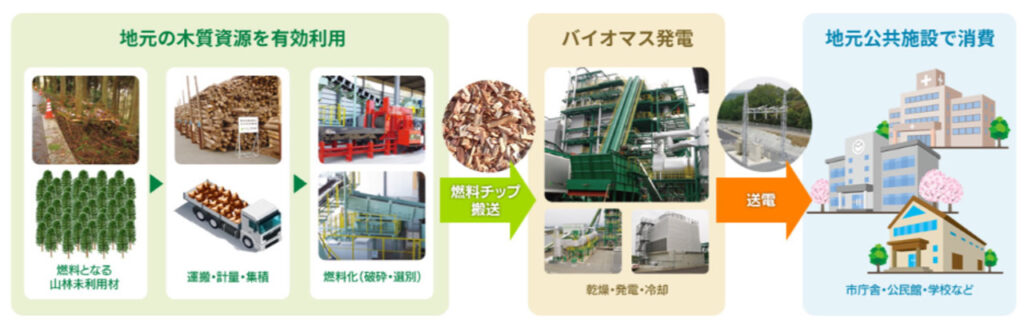
Green Power Generation Oita, which plays a central role in power generation, purchases locally harvested unused timber (unused forest wood chips) at a certain level of price and uses it as fuel to generate power In November 2013, a wood biomass power plant that uses unused timber as fuel began operation. The power generation output is estimated to be 5,700 kW, with an annual output of approximately 45 million kWh, and approximately 70,000 tons of unutilized wood is used as fuel annually (*7).
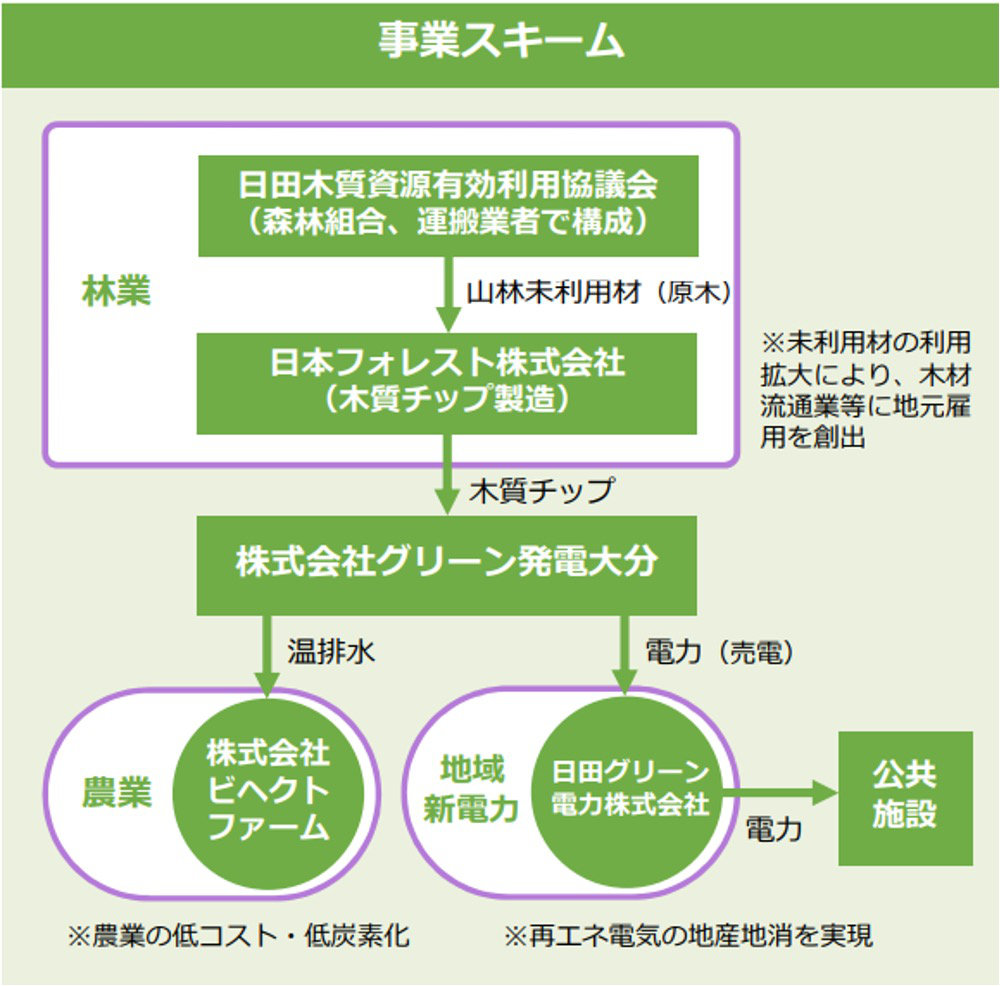
Initially, the electricity generated was supplied outside the region through a feed-in tariff system, but to promote local production for local consumption, a new regional power company, Hita Green Power Co. Since then, electricity has been supplied to 38 public facilities in the city, including city hall and elementary and junior high schools, since September 2017 (*7).
The hot wastewater generated during power generation is supplied to a strawberry farmer growing strawberries in a greenhouse on an adjacent site, and is used to maintain the greenhouse temperature during the winter. The use of hot wastewater has reduced the amount of heavy oil used to about one-third of the conventional level, resulting in a savings of about 2 million yen.
Furthermore, as an effort to secure stable woody resources for the future, the joint venture Japan Forest Co., Ltd. is promoting the introduction of fast-growing trees that will be harvested in 10 to 20 years. Specifically, the company has established a seedling center and is cultivating seedlings of fast-growing trees such as eucalyptus and koyozan, in addition to cedar and cypress, for planting in company-owned forests (*8). In addition, the company has concluded agreements with Oita Prefecture and Hita City and continues to plant trees in Hita City's municipal forests (*9).
*Refer 6:Hita City, Oita Prefecture, "New Vision for the Promotion of Hita's Forests, Forestry, and Lumber Industry".P2 (viewed: February 3, 2026)
*Refer 7:Green Power Generation Oita Corporation, Hita City, Oita Prefecture, Japan "Woody Biomass Power Generation to Revitalize the Community".P2 (viewed: February 3, 2026)
*See 8:Japan Forest Co., Ltd. "Establishment of the Zaitsu Nursery at the Forestry Seed and Seedling Production Center and Afforestation in Company-owned Forests".(Viewed: February 5, 2026)
*See 9:Ministry of Economy, Trade and Industry "Local production for local consumption of electricity by woody biomass power generation using unused timber from mountain forests and greenhouse cultivation using warm water and drainage(Viewed: February 3, 2026)
The Hita City case is an attempt to simultaneously address multiple regional issues by linking the utilization of forest resources and energy supply. By finding value in unused timber, forest maintenance is promoted and employment opportunities are created. Another feature of this initiative is the visualization of the relationship between energy, livelihood, and forests in the community through collaboration with environmental education and agriculture.
This system, designed to meet local resources and demand, can be applied in other regions if the conditions are right. Future development of this system is expected to attract attention as a way to simultaneously promote forest conservation and regional revitalization. (Nozomu Kanamoto, Forestry Consultant, Leaf Rain Co.)