The Ghibli Forest connects the Jomon period to Asia.
Updated by Kotaro Nagasawa on April 03, 2026, 8:03 PM JST
Kotaro NAGASAWA
(Platinum Initiative Network, Inc.
Born in Tokyo in 1958. Former Senior Managing Executive Officer of Mitsubishi Research Institute. During his tenure, he was mainly engaged in research and studies on infrastructure and social security. During his first few years with the company, he was involved in projects related to flood control, and learned from many experts on river systems at the time to think about the national land on a 100- or 1,000-year scale. Currently, he is an auditor of Jumonji Gakuen Educational Corporation. He is also a part-time lecturer at Tokyo City University. Co-authored "Introduction to Infrastructure" (Nikkei BP, 2017), "New Strategies from the Common Domain" (Diamond, 2021), and "40 Years After the Return" (Heibonsha, 2023). D. (Engineering).
*Previous column is here.
The "Civilization of Forests" Theory Proposed during the Period of Rapid Economic Growth: Reading "The Culture of Terrestrial Forests: The Depths of Japanese Culture" edited by Shumpei Ueyama (Part 1)
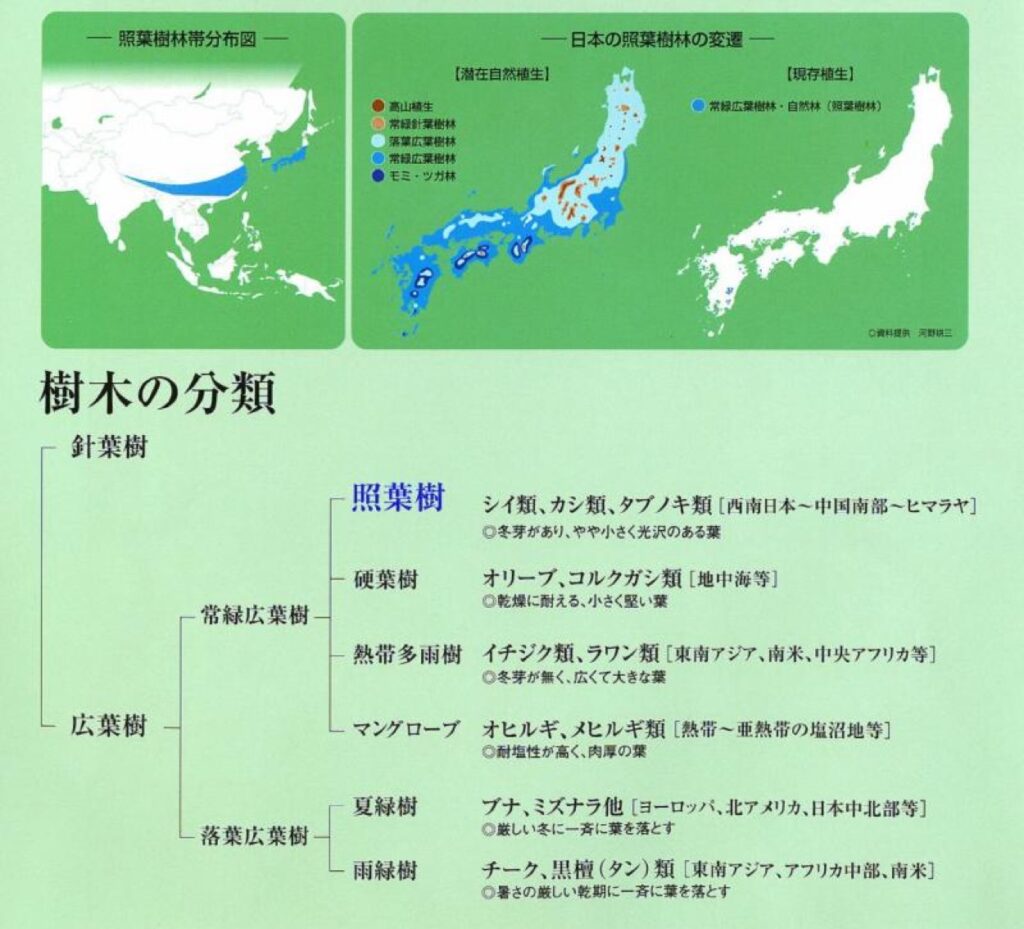
The new book, "Terrestrial Forest Culture," is credited to "Shumpei Ueyama (ed.)," but it was Sasuke Nakao who proposed the theory of terrestrial forest culture. In "Cultivated Plants and the Origins of Agriculture" (Iwanami Shinsho, 1966), Nakao argued that agriculture in the world had four origins, each of which fostered a different culture, and he called one of them, a vast area in East Asia, the shiny-leaved forest zone. Because its contents differed greatly from those of rice culture, Shumpei Ueyama, who is interested in the Jomon period, took notice and organized an interdisciplinary symposium. It is reasonable to understand that this book is the result of that effort.
Sasuke Nakao (1916-1993) was born in Aichi Prefecture and studied at the Faculty of Agriculture, Kyoto University. An inimitable lover of plants since childhood, he joined the 1952 Manaslu expedition led by Nishikiji Imanishi, and after four months of camping, he and Imanishi came across a black forest on a ridge overlooking the Nepalese capital, Kathmandu. It was an evergreen evergreen oak-dominated forest. This landscape and ecosystem is the same as in southern China, southern Korea, and western Japan. It was at this time that Nakao first became aware of the broad structure of East Asia's temperate zone and its evergreen forests. In his book, "The Two Sources of Modern Civilization," Nakao describes the scene at that time in an emotionally charged text. With this hypothesis in mind, Nakao energetically investigated vegetation and human life in Bhutan, Pakistan, Eastern Nepal, and elsewhere.

What, then, is the common culture of this vast shiny-leaved forest zone? Unfortunately, this book does not deal with this point systematically. This may be a limitation of the symposium proceedings. I would like to supplement this article by referring to Takaaki Sasaki's "The Road of the Shoyojyurin Culture. Sasaki is a cultural anthropologist who, together with Ueyama and Nakao, wrote "Sequel to Shoyojyurin Culture.
The elements Sasaki identified as common to areas of the terrestrial forest culture include: slash-and-burn fields, silk, poison oak and lacquerware, fermented soybean food, sake brewing using malted rice, tea, mochi-seeds, similarities in mythology, utagaki, wife-questioning marriage, and August 15th night events.
Baked fields, silk, and poison ivy are easy to understand. Fermented soybean food is natto in Japan. Similar foods are found in Nepal, Bhutan, and China. Mochi varieties are, in rice, glutinous rice. Despite the low productivity of these sticky varieties (e.g., glutinous rice has a lower unit area yield than Uruchi rice), they are widely favored in the shosha forest culture. They share a preference for sticky foods, including natto (fermented soybeans). The August 15th night event is the Japanese moon viewing on the night of the fifteenth day of the month. The Yao and Miao tribes in China's Guangxi Province also have a tradition of offering rice cakes and sweet potatoes to worship the moon on the same day.
This broad common denominator of life is lived in areas that roughly coincide with the expanse of the shrubland forest.
The second half of the book focuses on the Jomon period. Ueyama posits that the shiny-leaved forest culture is the Jomon culture, and that agriculture may have sprouted there. Nakao carefully responded. Based on his hypothesis of the shiny-leaved forest culture and based on his detailed observations of the living conditions of remote villages in various parts of Asia, he tries to reconstruct the Jomon lifestyle in his imagination, mainly in terms of food culture.
According to Nakao, even in the Jomon period, people could not have survived on hunting and fishing alone. They must have used vegetable matter. If there was no agriculture, they would have collected nuts (acorns), berries, and potatoes (root vegetables). Acorns are often found in broadleaf forests and can be preserved well.
In addition, there may be potatoes (root vegetables). The rhizomes of yam, kuzu, higanbana, etc. are crushed and exposed to water to extract the starch. The rhizomes would have been bleached to remove scum and poison, and heated to make the raw starch edible. Earthenware is needed for this process. Some Late Jomon pottery has soot from the fire, which clearly indicates that it was used for boiling.
Agriculture is not something that happens all at once, and a transition state, which we might call "semi-cultivation," is assumed between the use of the wild state and agriculture. If it comes close to humans, its excrement becomes fertilizer, and it actually grows larger by itself. We may consider this situation to have been in place for about 10,000 years during the early to mid Jomon period.
After listening to the above discussion, archaeologist Takashi Okazaki remarked that although it is difficult to find potatoes and bulbs in archaeological site surveys, it may be acceptable to acknowledge the existence of semi-cultivated products in the Jomon period. In response, Nakao argues that the late Jomon period may have progressed to the cultivation of millet, millet, Japanese millet, and okavo. The fact that rice paddy cultivation did not switch all at once during the Yayoi period is known from the fact that chestnuts, acorns, and shii have been found at sites with rice paddies, such as Toro.
The theory of the culture of shiny-leaved forests generated many supporters and also faced much criticism. While some of the hypotheses of the time have been rejected by subsequent research, it is said that the viewpoint that Japanese vegetation and lifestyle culture are not isolated but deeply related to Asia has almost become established. In addition, the recent discovery in Japan of the world's oldest lacquer ware (from the early Jomon period) has led some to reconsider Nakao's hypothesis that the Yangtze River basin is the source of the terrestrial forest culture.
It is impossible to speak comprehensively about the present state of the theory of shiny-leaf forest culture. What I do feel, however, is that Nakao's research approach, which was based on his own detailed observations and attempted to draw a broad picture of the structure that explains the theory, without relying on any authority, is what brought about such a large expansion of the theory.

One prominent advocate is Hayao Miyazaki. The epic film "Princess Mononoke" begins with the story of the Jomon people, who lived in the shiny-leaved forests and were chased away by the Yamato Imperial Court to become the Emishi, who live quietly in the beech forest region of the Tohoku region. Miyazaki himself has often stated that he was greatly influenced by the theory of shiny-leaved forest culture. He has even said that the costumes of the Ezo are modeled after the national costume of Bhutan. This is the culture of the shiny-leaved forest. Miyazaki has also said that he feels the blood of Jomon running through him.
The theory of shiny-leaved forest culture is still an incomplete theory. This book left me with a strong feeling that exploring the history of forests and humans is also a journey to our own roots. (Kotaro Nagasawa, Director, Platinum Network)
*Honorifics omitted in the text.
*Note: This book was published in 1969, and some of the academic terms and findings in the text are expressions based on the state of research at that time.
*References
The Culture of the Terrestrial Forest: The Depths of Japanese Culture, edited by Shunpei Ueyama, Chuko Shinsho.
Saito, Kiyoaki, "'Shizen-gaku' wa nani ga shite no koro ni kansuru ka - on Imanishi Kinji's scholarship", Himalayan Studies Journal, No. 8, 2007
Sasuke Nakao, Gendai Bunmei Futatsu no Genryu: Terrestrial Forest Culture, Hardwood Forest Culture, Asahi Sensho 1978.
Sasaki, Takaaki, The Road of the Evergreen Forest Culture from Bhutan and Yunnan to Japan, NHK Books 1982.