Updated by "Forest Circular Economy" Editorial Board on May 18, 2026, 11:54 AM JST
Editorial Board, Forest Circular Economy
Forestcircularity-editor
We aim to realize "Vision 2050: Japan Shines, Forest Circular Economy" promoted by the Platinum Forest Industry Initiative. We will disseminate ideas and initiatives to promote biomass chemistry, realize woody and lumbery communities, and encourage innovation in the forestry industry in order to fully utilize forest resources to decarbonize the economy, strengthen economic security, and create local communities.
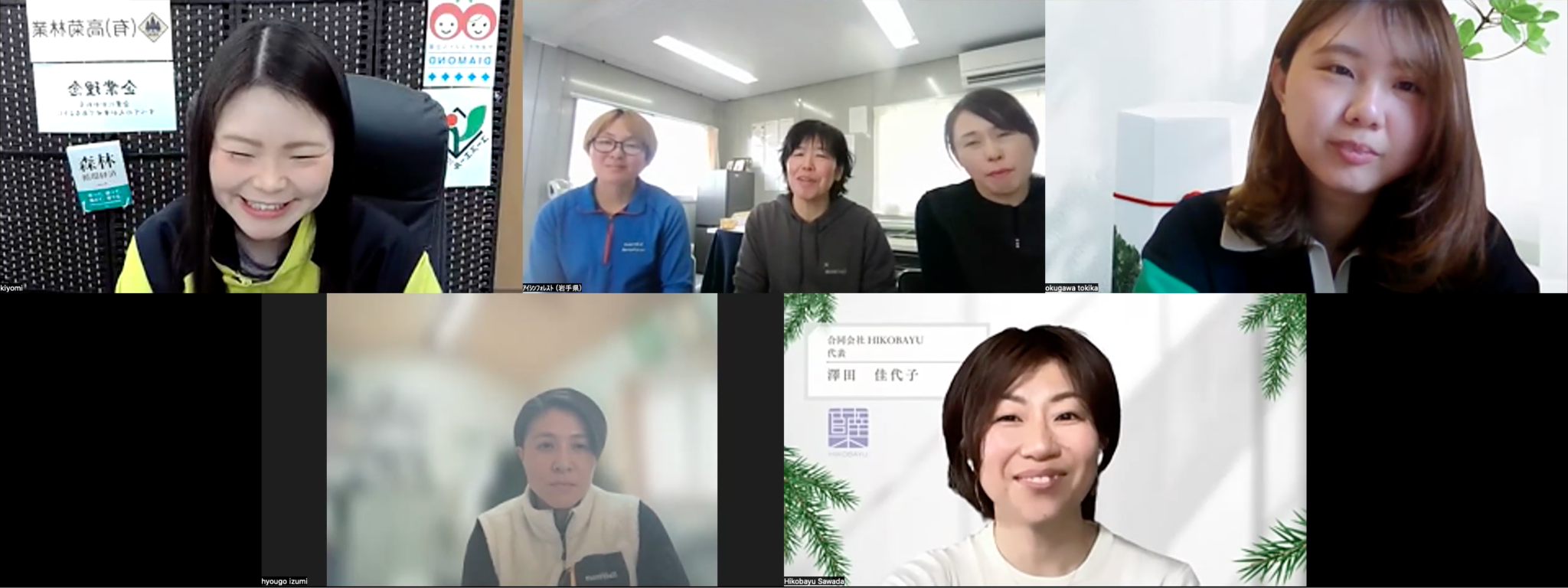
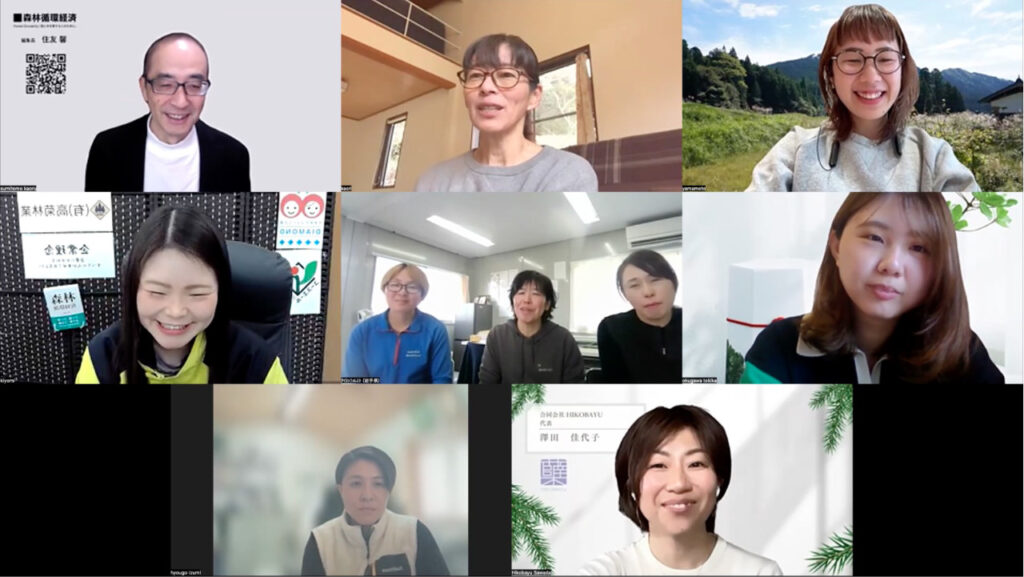
The online event "Forest Circular Economy Talk Live Vol. 2: Women Creating Forest Jobs - Practical Meeting to Link Forests and Communities" was held on February 27, 2012. The event was planned as an opportunity for women who have been creating jobs in the field across Japan to share their past practices and thought processes. Nine women who are involved in forests in a variety of ways, including forestry workers, company managers, café and guesthouse operators, and media producers, gathered at the conference. Their unique backgrounds and real voices from the field drew great empathy and feedback, and demonstrated the diverse ways to engage with forests in the future.
The list of speakers isthis way (direction close to the speaker or towards the speaker)
The entrances of the speakers are truly unique, as they all have their own unique backgrounds that led them to their current jobs.
For some, leisure and immigration were the catalysts. Mr. Sawada, who produces Todomatsu (Abies sachalinensis) essential oil in Niseko Town, Hokkaido, moved to the area because he dreamed of "snowboarding every day," and ended up working in the forest through the Regional Development Cooperation Volunteers. Ms. Kaori, who runs a cafe and guesthouse in Chiba Prefecture, also shared an episode: "I moved here for surfing and happened to find a rough mountain next to my house. As she worked on the mountain by herself, her skills improved, and she even began to do special logging.
On the other hand, there are those who entered the forest out of a strong sense of mission or a turning point in their lives. Mr. Okugawa, a company representative in Wakayama Prefecture, lost a friend in the Kii Peninsula floods when he was in high school, which inspired him to start his own company with the goal of "creating mountains to eliminate landslides. Mr. Hyogo, a representative of a forestry company in Shizuoka Prefecture, said he decided to take over the family business after the death of his brother and his own marriage.
Others jumped in out of everyday intuition. Kiyomi, who is involved in forestry in Yamagata Prefecture, jumped in with no experience because "a truck loaded with trees in her neighborhood led her to visit a forestry company, and the moment she entered the mountains, she thought, 'This is fun! I felt that it was fun! Mr. Chiba, who works for a forestry company in Iwate Prefecture, shared a powerful story of how he entered the industry at the age of 46 after realizing that he, too, was not challenging himself while encouraging his truant children to do so. Mr. Yamamoto, who runs a media business in Okayama Prefecture, recalled how he was inspired by the theme of "lumber distribution" in the laboratory he was assigned to at university.
Instagram of HIKOBAYU run by Mr. Sawada
kaori's Instagram
Okugawa's Instagram
In their own words, they spoke of the joys and attractions that come from working in the field, even in a harsh environment.
Kiyomi told us, "It's fun because the mountains look different every day. Animal tracks, flowers blooming, and so on." These words conveyed the daily joy of facing nature from a prime position in the field. Mr. Takahashi, who also works for a forestry company, expressed his joy in experiencing nature, saying, "When I see a rare flower that blooms only for three days, I think, 'I won! I'm so happy to see my muscles gradually build up, even though the chainsaw was heavy," he said. Chiba also commented, "I like working hard and moving my body. I enjoy being involved in every moment of the work.
Ms. Hyogo also spoke of the overwhelming response she received at the site, saying, "I really feel that I am alive," while working on a steep slope that could be fatal if one step is taken wrongly. Ms. Sawada, a former nurse, expressed the appeal of forests as "the symbiosis of all life, just as it exists." She emphasized the fundamental value of the "scent of the forest," which humans instinctively find pleasant, and which provides healing to city dwellers.
Instagram of Takagiku Forestry, where Kiyomi works
Instagram of Hyogo Oyashin Kaihatsu, run by Mr. Hyogo
Specific innovations were introduced on how each activity is delivered to the local community and the general public.
Mr. Aizawa, who runs a forestry company in Iwate Prefecture, shared the effects of using social networking sites to communicate. He shared an episode in which he started an Instagram account to let the families of his employees know what was going on in the field, but it resulted in a huge response that attracted people from all over Japan, including a woman who joined the company after waiting a year to do so.
Mr. Okugawa is developing a "return seedling" program in which individuals grow seedlings from acorns and return them to the mountains. As he says, "We don't just sell the seedlings and call it a day; we tell them about it for two years, and they become attached to them." The seedlings carefully nurtured by participants are planted by his company at sites where forestry workers are having trouble, such as logging sites where reforestation is difficult due to animal damage, etc. The company arranges for the planting of trees in such sites. The program introduced an initiative to build a system to regenerate forests through hands-on experience.
Ms. Yamamoto also talked about her efforts to involve local residents. kaori has made her backyard maintenance project into an event by "having people play while cutting down trees where they walk and eating pork miso soup together," offering an activity that allows city residents to be unmoved by the activity. Mr. Yamamoto also held a "mountain path picnic" to cut down a bamboo forest to restore a former mountain path, which was well received. In promoting Kagoshima timber, he told us about his efforts to communicate the value of timber by linking it to local culture by setting forth its historical background as "forestry that has continued for 400 years since the Shimazu family's time.
Instagram of Aisin Forest, where Mr. Aizawa, Mr. Chiba, and Mr. Takahashi work
Mr. Yamamoto runs "Just Right Lumber Radio".
What do you do to help women stay in the business longer?" The speakers gave life-size answers to the audience's preliminary question, "What do you do to make women stay longer?
Since differences in physical strength are inevitable, "I tell them what I can't do and ask them to do it for me. I also tell them about my menstrual period and so on." He spoke of the importance of communicating frankly and without overreacting. He also shared his efforts to create a warm environment, for example, by making lunch boxes for employees who live alone and taking care of their health.
He also spoke of his strength in taking even the harshest environment as a positive. He said that in the middle of winter, it gets so cold that the rice in his lunch box freezes, but he laughed it off and said, "If you enjoy it, it's just a story.
More than 100 people watched this event, 80% of whom were women. After the event, we received many sympathetic comments, some of which are listed below.
The fact that the company was able to commercialize the experience of growing saplings from acorns and planting them on a mountain about two years later, and also arrange a place to return the saplings, seemed to me to be a true circular economy.
I thought that his words, "I am happy because the mountains look different every day," captured the essence of the forestry industry. The fact that they are honest about their physical condition on a daily basis is a point that I would like to learn from them, as it is common in any industry.
I enjoyed listening to the different perspectives of each of you on the mountains. I was able to confirm once again that the comfort that people involved in the mountains feel is the same, regardless of where they are located or what they do.
I was very impressed by how they became involved in forestry from various sources such as the sea and leisure activities. Some of them are in the forestry industry themselves, and others are starting their own businesses. They had visions and a spirit of challenge, which gave us an opportunity to look at them in light of our own selves.
The talk live ended on a high note as the women working positively in the field of forests gave hope. It was a time that made us feel that the future of the circular economy of forests will expand powerfully through diverse ways of interacting with forests, not only in timber production, but also in experiences, aromas, and space creation. The editors of "Forest Circular Economy" are planning to hold a sequel to this talk live. Please look forward to the future developments of these practitioners who connect forests and communities.