Image by Unsplash
Updated by "Forest Circular Economy" Editorial Board on April 06, 2026, 8:53 PM JST
Editorial Board, Forest Circular Economy
Forestcircularity-editor
We aim to realize "Vision 2050: Japan Shines, Forest Circular Economy" promoted by the Platinum Forest Industry Initiative. We will disseminate ideas and initiatives to promote biomass chemistry, realize woody and lumbery communities, and encourage innovation in the forestry industry in order to fully utilize forest resources to decarbonize the economy, strengthen economic security, and create local communities.
The destabilization of the Middle East over the Strait of Hormuz has once again highlighted the vulnerability of Japan's energy and economic security due to its dependence on overseas sources of fossil fuels. Amid the urgent need to secure resources and make a drastic structural shift toward decarbonization, a concept to utilize Japan's abundant "forest resources" as raw materials for fuels and chemical products and to build a domestic production base is gaining momentum in earnest.
Platinum Initiative Network (Chairman: Hiroshi Komiyama) released "Promoting a Growth Strategy-oriented Bioeconomy Utilizing Domestic Forest Resources" on April 2. After presenting a vision of a "circular forest economy" that combines decarbonization and economic growth, the report presents a realistic roadmap for how to overcome the challenges of high costs and lack of a market, and how to implement it as a business in society.
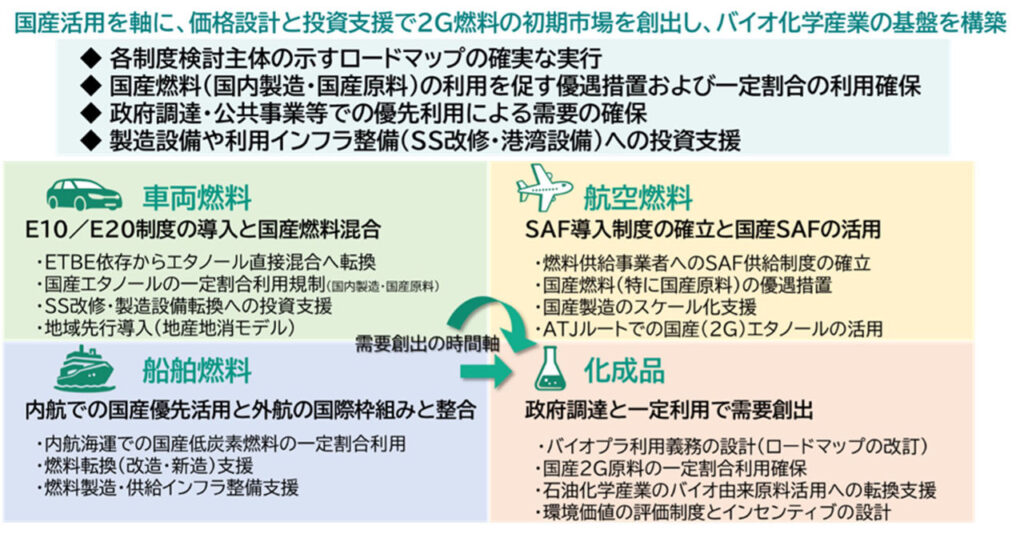
The greatest challenge to the utilization of biomass resources in Japan is the lack of price competitiveness against existing fossil fuels and the associated uncertainty of demand. To break through this barrier, we present a promotion approach consisting of four major frameworks.
The first framework is the creation of a reliable initial market by "regulating" a certain percentage of use, rather than a target of effort left to market forces.
Second, as a starting point for social implementation, the first action is the early introduction of "E10," a 10% bioethanol blended with gasoline, targeting "vehicle fuel" with a relatively simple supply chain. The strategy is to create demand and establish a production base in the fuel field, and then gradually expand the use of bioethanol to chemical products in the future.
Third is "regulatory and support measures" to encourage the use of a certain percentage of domestically produced biofuels and chemical products. In addition to designing incentives for the use of domestically produced products, an environment will be created in which the private sector can step forward with capital investment through support for new investment, such as conversion of production facilities, and deregulation for demonstration purposes.
The fourth is to avoid capital investment from scratch and fully utilize the existing "foundations of the paper and petrochemical industries. The wood collection routes and production facilities already established by paper mills scattered across Japan will be utilized to promote the mass production of domestically produced bioethanol. By structurally transforming paper mills into biorefinery bases and linking them with existing petrochemical complexes, a robust supply chain will be established to support Japanese industry with woody biomass resources.
The proposal presents a phased roadmap delimiting the years 2030, 2040, and 2050.
The "short-term phase" through 2030 will be positioned as a period of mandatory initial market launch through regulations and government support. In vehicle fuels, "E10" will be introduced nationwide after its initial introduction in specific regions, establishing a system for blending 10% domestically produced ethanol. At the same time, in the aviation sector, the mandatory blending of SAF will be started, and in the chemical products sector, the introduction of 2 million tons of bioplastics will be promoted along with a legal framework. During this period, intensive investment by the public and private sectors will be encouraged, including government subsidies for the introduction of equipment for the renovation of gas stations and conversion of existing plants.
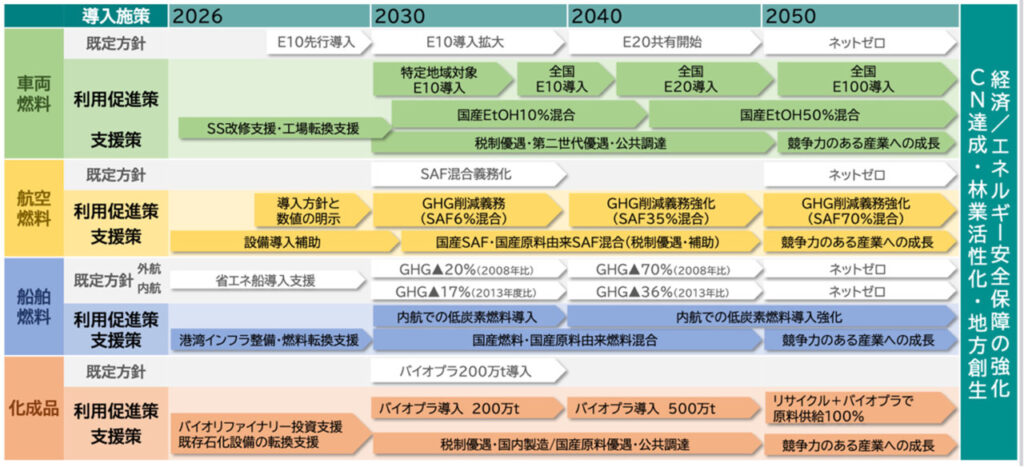
The "mid- to long-term phase" from 2030 to 2040 is a period to push the bio-industry to become a self-sustaining growth industry, leveraging the established infrastructure. The standard for vehicle fuel will be raised to "E20" (20% ethanol blended), and the SAF blending ratio in the aviation sector will be increased to 35%. In the field of chemical products, the introduction of bioplastics will be expanded to 5 million tons in one stroke to ensure economic viability.
Then, in the "final phase" toward 2050, a net-zero society with "zero fossil resource origin" will be achieved in stages through the introduction of "E100" vehicle fuel and 70% SAF blending. This roadmap, which aims to cover 100% of the raw material supply for the chemical industry with only recycled and bio-resources, and to achieve zero fossil resources in the energy sector as well, provides an extremely strong backing for companies to take huge capital investment risks.
Against the backdrop of this demand creation scenario, various industrial sectors are moving toward specific demonstrations and commercialization. As of April 2026, 109 organizations, including 71 corporations, are participating in the Platinum Forest Industry Initiative.
In the paper industry, which plays a central role in the supply chain, Oji Holdings completed construction of a pilot facility at its Yonago Mill in Tottori Prefecture in 2025 with the capacity to produce up to 1,000 kiloliters of wood-based ethanol per year, and is studying the possibility of commercial production of 100,000 kiloliters per year by 2030 Nippon Paper Industries is also considering the production of ethanol from wood in 2030. Nippon Paper Industries also plans to start producing several tens of thousands of kiloliters of bioethanol derived from domestic wood around 2030, and expects to use it as a raw material for SAF and other products. Daiko Paper, a subsidiary of Rengo, is also preparing for commercialization, aiming to produce 20,000 kiloliters of bioethanol per year by 2027 by utilizing unused biomass resources such as construction waste.
Collaborations involving chemical, energy, and trading companies are also gaining momentum. Mitsubishi Gas Chemical Company, in partnership with TRE, has started a verification project to commercialize green methanol production using woody biomass and other resources in Chiba Prefecture. In addition, Marubeni, Mitsubishi Chemical, Chugoku Lumber, Japan Airlines, and Obayashi are jointly studying a project to produce SAF and bionaphtha from forest resources in Japan, with a view to commercialization around 2030.
This forest resource full utilization concept will start with a model that utilizes paper mills on the waterfront in the initial stage, and in the mid- to long-term, will shift to a "regional decentralized model" that integrates large-scale forestry, sawmills, and bio-plants in forested areas throughout Japan.
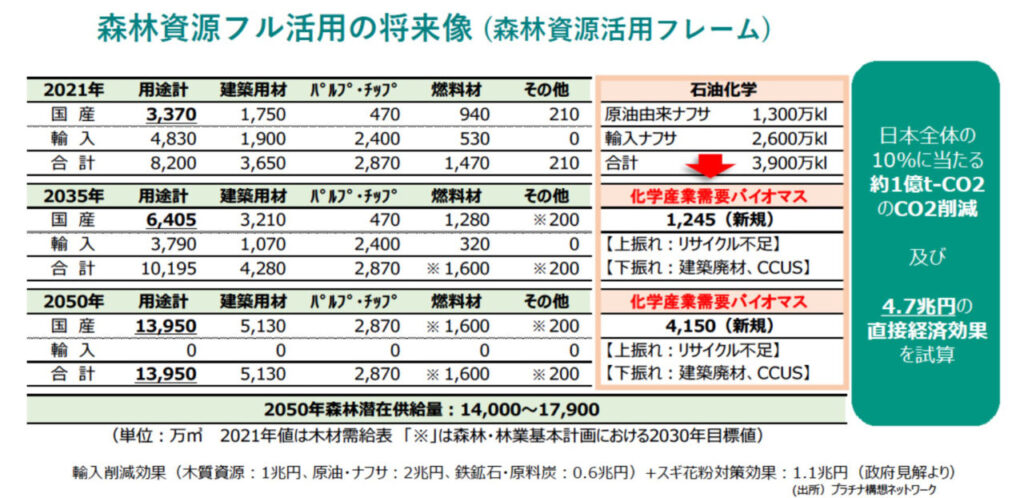
If this vision, which will utilize four times the current forest resources and establish a cycle of logging and reforestation, is realized, it will reduce CO2 emissions by approximately 100 million tons, or about 10% of Japan's total. At the same time, we estimate that direct economic benefits of approximately 4.7 trillion yen will be realized, including the effects of reducing imported resources and preventing pollen allergies.
The steady creation of demand has the power to transform Japan's forestry industry into a profitable industry by encouraging upstream infrastructure investment, such as the consolidation and mechanization of forest land and the development of forest roads.
The utilization of forest resources is a theme that cuts across multiple policy areas: energy security, industrial competitiveness, and regional economies. The current proposal is significant in that it presents the connection as a concrete industrial design.
On the other hand, its realization will entail high hurdles in terms of institutional design, cost burden, and industrial structural transformation. Will the debate on resource independence, which has emerged in the wake of the Middle East risks, move toward industrial redesign starting from forest resources? Or will it face a wall of cost and supply constraints? Policy decisions and corporate investment trends will determine the reality of the situation.
The "Japan Growth Strategy Council," chaired by Prime Minister Takaichi, has taken up "synthetic biology and biotechnology" as one of the 17 growth areas for consideration. It is expected that measures to promote the production and use of domestically produced biofuels and chemical products, which are mentioned in the current proposal, will be included.
*Reference link
Platinum Initiative Network "Promoting a Growth Strategic Bioeconomy Utilizing Domestic Forest Resources: From Dependence on Imported Crude Oil and Naphtha to the Era of Domestic Fuels and Chemicals Pioneered by Forest Resources".
Japan Growth Strategy Headquarters / Japan Growth Strategy Council|Cabinet Secretariat Website