Image by Unsplash
Updated by the Editorial Department of *Forest Circular Economy* on June 15, 2026, at 7:36 PM JST
Editorial Board, Forest Circular Economy
Forestcircularity-editor
We aim to realize "Vision 2050: Japan Shines, Forest Circular Economy" promoted by the Platinum Forest Industry Initiative. We will disseminate ideas and initiatives to promote biomass chemistry, realize woody and lumbery communities, and encourage innovation in the forestry industry in order to fully utilize forest resources to decarbonize the economy, strengthen economic security, and create local communities.
As Japan’s planted forests and satoyama forests enter a period of full-scale utilization and regeneration, the importance of “forest resource circulation”—which places forest resources within a sustainable cycle of “harvesting, using, planting, and nurturing”—is growing. With the latest White Paper on Forests and Forestry also focusing on initiatives to “link timber utilization with reforestation,” new developments are emerging one after another in the private sector as well. From major stationery and office furniture manufacturers participating in regional development initiatives, to support for firewood distribution via outdoor platforms, the establishment of life cycles for locally sourced timber in resort areas, and even fundraising by startups centered on specific tree species, efforts to harmonize the cycles of forests and the economy are gaining momentum.
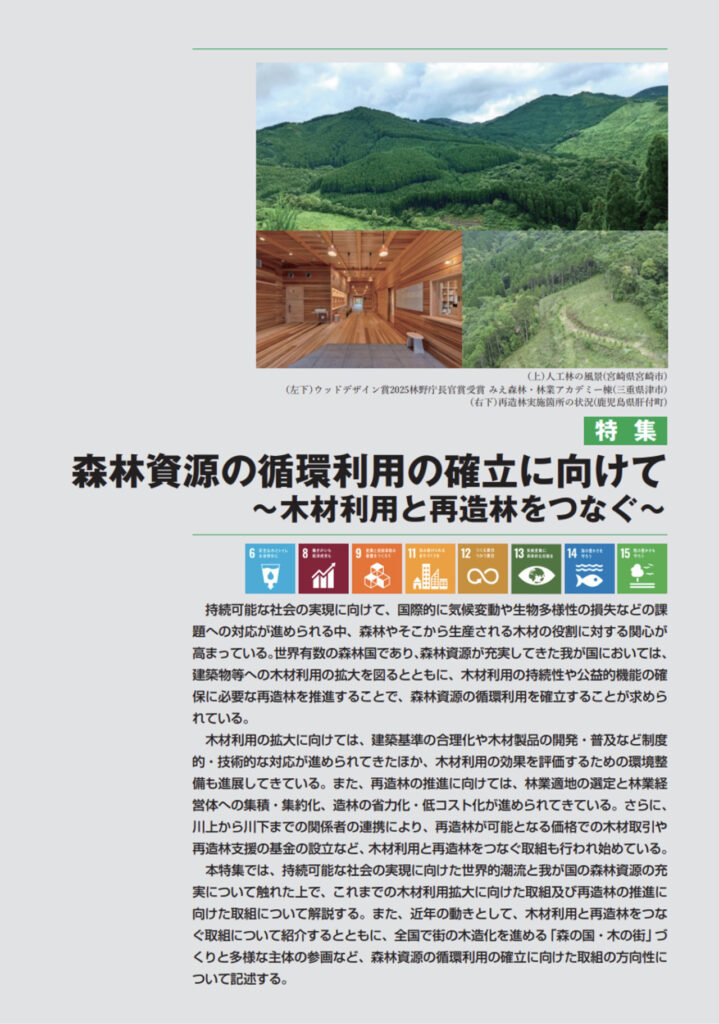
On June 2, the Forestry Agency released the “Reiwa 7 Forestry White Paper,” which summarizes trends in Japan’s forests and forestry sector as well as the progress of related policies. This edition features a special section titled “Toward Establishing a Circular Economy for Forest Resources: Linking Wood Utilization and Reforestation.” In addition to initiatives that link the expansion of timber use with the promotion of reforestation—which is essential for ensuring sustainability—the report introduces efforts such as the “Forest Nation, Wooden Towns” initiative, which promotes the construction of wooden buildings nationwide, and outlines future directions for establishing a circular economy for forest resources. Furthermore, the “Topics” section highlights distinctive developments, such as efforts to foster momentum for timber use through the Osaka-Kansai World Expo and the promotion of “Forestry Industry” (Morigyo) as part of regional revitalization. The White Paper emphasizes the importance of not only increasing timber consumption but also ensuring that this demand is linked to reliable reforestation efforts, thereby creating a circular flow of forest resources through integrated cooperation across the entire supply chain, from upstream to downstream. To address cost issues—a major obstacle to reforestation—efforts are underway to reduce labor and lower costs through “smart forestry,” which utilizes integrated logging and afforestation operations as well as new technologies such as autonomous machinery. Concrete actions are needed to channel the growing momentum for timber utilization—driven by the World Expo and the shift toward wooden construction in urban areas—into a robust economic cycle that supports regional forestry.
*Reference link
Reiwa 7 Forest and Forestry White Paper Released Today | Forestry Agency
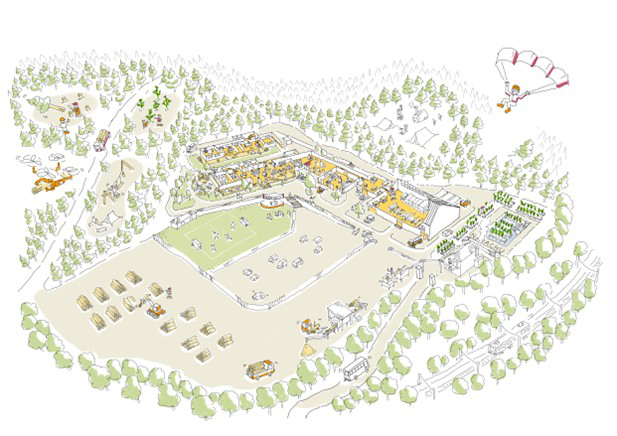
Kokuyo began participating in April in the “Singo-han” (tentative name) project for plywood manufacturing and interior materials processing. This is a core initiative of the “Kiso Forest Grand Cycle Concept,” which aims to effectively utilize local resources and create a sustainable economic cycle through the circular use of forest resources in the Kiso region of Nagano Prefecture. The project is led by Tsumikasa-ne, a consortium established by four companies: Tree to Green, Salt Terminal, Takenaka Corporation, and Tanseisha. Operating out of a facility repurposed from a closed school, the consortium is working to manufacture and process high-value-added plywood using small-diameter timber—a material that has traditionally been difficult to utilize effectively. Kokuyo will leverage its expertise as a manufacturer to expand the potential uses of wood in the architecture, interior design, and furniture sectors and to drive product development. By broadening the applications of locally sourced timber that has not been fully utilized to date and adding new value to forest resources, the initiative is expected to accelerate the resource cycle within the region.
*Reference link
Kokuyo Participates in Core Project of the “Kiso Forest Grand Cycle Initiative” | Kokuyo Co., Ltd.
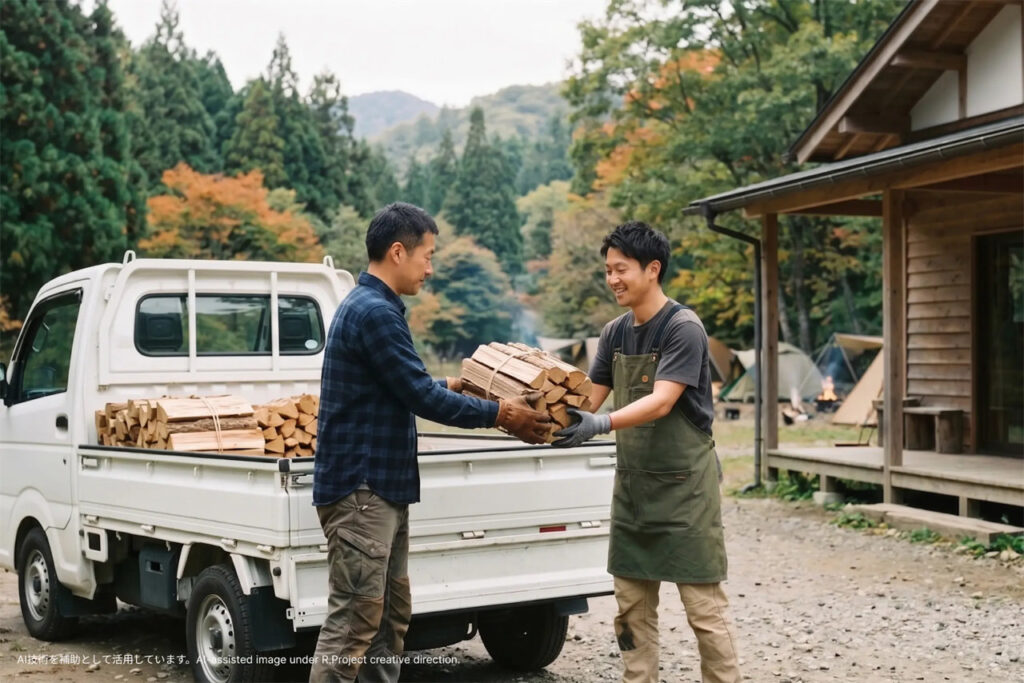
R.project, a company specializing in camping services, launched a firewood supply support initiative in June on “Nappu,” its campground search and reservation website, aimed at resolving fragmentation in the firewood distribution chain. While firewood consumption at campgrounds has increased alongside growing demand for outdoor activities, there has been a challenge in efficiently distributing unused thinned timber from local forests, making it difficult to utilize this material as firewood. By leveraging “Nappu’s” network and reservation data, the initiative directly matches local firewood producers with campgrounds, establishing stable supply routes through logistics optimization based on demand forecasting and the standardization of transactions. It aims to promote the local production and consumption, as well as the circular use, of forest resources through accessible outdoor experiences.
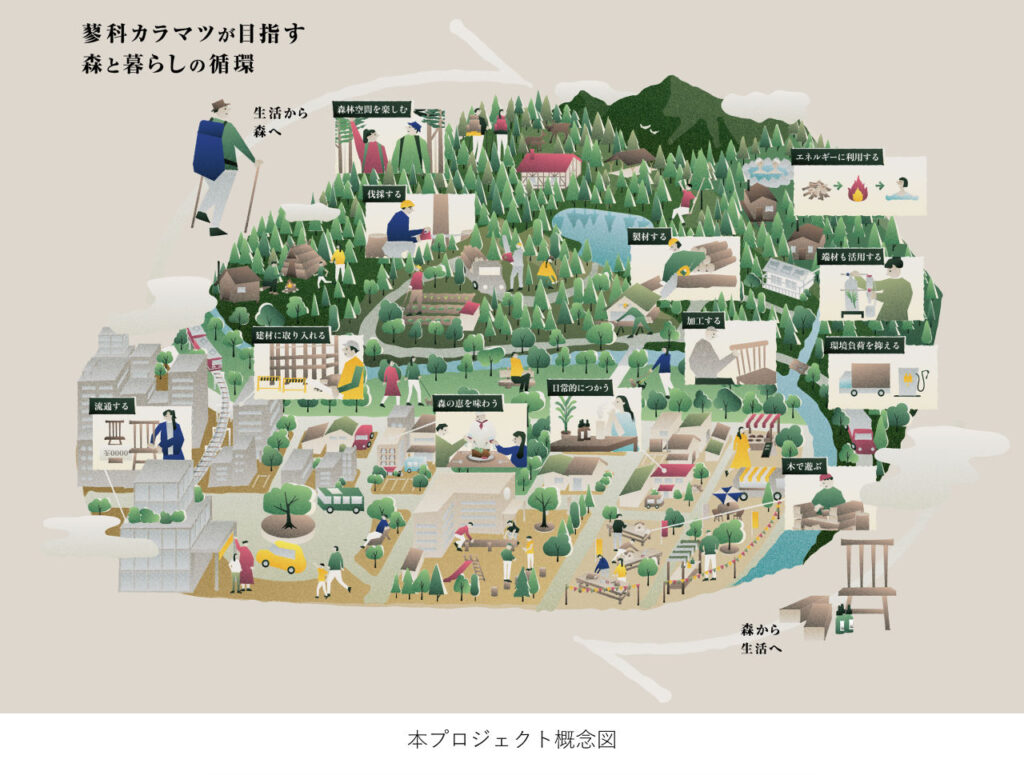
Tokyu Land Corporation has launched the “Tateshina Larch” project—a circular economy initiative—at “Tokyu Resort Town Tateshina” in Chino City, Nagano Prefecture, utilizing larch grown in the forests of Tateshina. This initiative aims to address the challenges posed by forests that were planted during the period of rapid economic growth and have since become overcrowded. It involves making full use of the larch timber harvested during forest management—including as construction materials, furniture, aromatherapy products, and tea—without any waste. Going beyond merely localized timber use, the project aims to support the conservation of the region’s natural environment and enhance the value of locally sourced wood by creating a circular economy for forest resources centered on the resort.
Hibaya 300 has secured a capital investment totaling 60 million yen in a Series A funding round led by KKT. The company focuses on “Aomori Hiba”—a type of cypress known for its rich fragrance—and develops and sells lifestyle brand products that leverage its unique characteristics. The funds raised will be used primarily to strengthen the brand’s foundation and contribute to the local economy. The company plans to advance the development and improvement of wellness products—such as sprays, shampoos, and bath salts—while expanding its sales channels. Furthermore, it intends to accelerate investment in regional revitalization projects, particularly in Owani Town, Aomori Prefecture. At the same time, on the environmental front, the company will move forward with building a “circular supply chain” that makes full use of Aomori Hiba offcuts, sawdust, bark, and other byproducts without waste. By maximizing the cultural and economic value of these unique forest resources and passing on lush forests to future generations, the company aims to establish a “business model in which forests and the economy circulate continuously.”