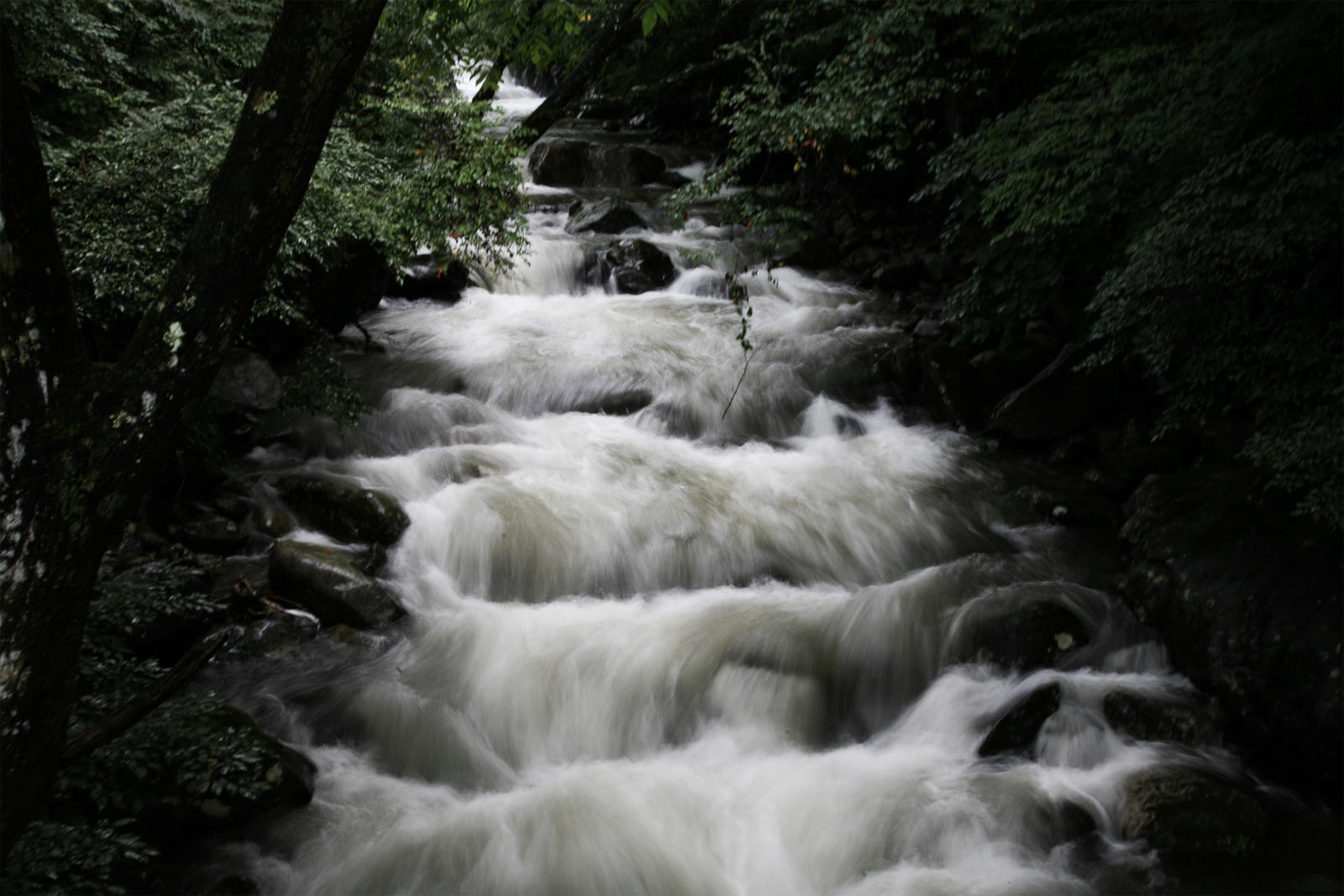
courtesy of takeda@schrodingers.jp / photograph
Updated by "Forest Circular Economy" Editorial Board on June 08, 2026, 6:22 PM JST
Editorial Board, Forest Circular Economy
Forestcircularity-editor
We aim to realize "Vision 2050: Japan Shines, Forest Circular Economy" promoted by the Platinum Forest Industry Initiative. We will disseminate ideas and initiatives to promote biomass chemistry, realize woody and lumbery communities, and encourage innovation in the forestry industry in order to fully utilize forest resources to decarbonize the economy, strengthen economic security, and create local communities.
The movement toward the realization of "nature positivity" (nature revitalization) is developing from multiple angles, transcending the boundaries of the national government, local governments, and private companies. Technology to calculate and visualize the value of natural capital and ecosystems, which had been difficult to quantify in the past, is advancing, and the foundation for conservation and evaluation of forests and other environments is being established. The Forestry Agency has published a simplified evaluation method for quantifying the water resource storage function of forests, and the Ministry of the Environment has expanded the legalized certification of nature-symbiosis sites, and has begun to present a road map for increasing corporate value through nature-positive management. In addition, demonstration of technology for wide-area estimation of ecosystems using satellite data and community-based industry-academia-government initiatives are also underway. Practical efforts to incorporate nature positivity into the common values of the social economy are gaining momentum.
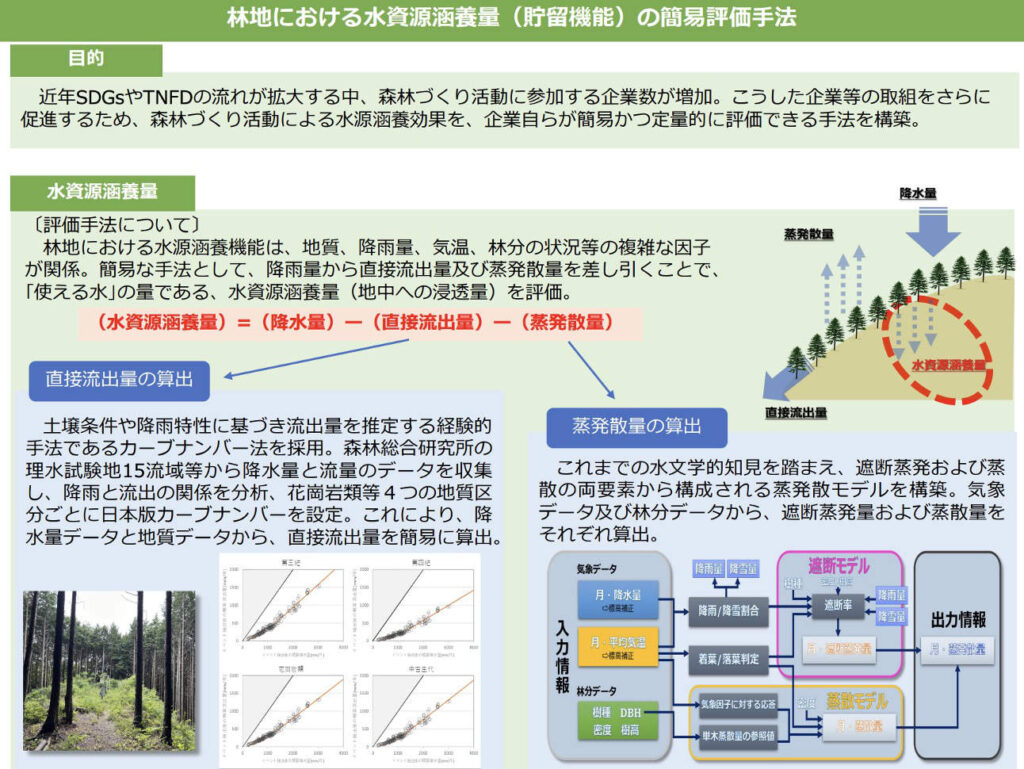
The Forestry Agency has developed and released "The Volume of Water Resource Recharge in Forest Land (VWRR)," a simplified evaluation method for water resource recharge function, one of the multifaceted functions of forests, which can be calculated without specialized knowledge. In the past, quantitative evaluation of the impact of forest conservation and improvement on water resources required a large amount of observation data and complex analysis, and there was a high barrier to calculation at the field level. The newly released method is designed to evaluate the "water resource storage function" of forests of 100 hectares or less, where the trees have grown to the point where their branches and leaves (canopy) are in contact with each other (10-20 years old or more). Using meteorological information and basic forest information such as tree species, stand density, tree height, and breast height diameter, the amount of water resource recharge is calculated by subtracting direct runoff and evapotranspiration from the amount of rainfall. The results can be easily calculated and graphed by simply entering the necessary items into the provided Excel-based calculation tool. The calculated figures are effective for use in corporate TNFD (Task Force on Nature-related Financial Disclosure) and sustainability reports, and can be explained as "Water Positive" if the amount of water resources recharged exceeds the amount of water used by the company. It is also useful for local governments in formulating policies and promoting understanding among local residents. The water source recharge function of forests is the foundation of Nature Positive, and this method can be positioned as the basis for quantitatively demonstrating its value. It is also expected to be used for forestation activities by private companies and policy planning by local governments.

*Reference link
The Volume of Water Resource Recharge (VWRR) in Forest Land| Forestry Agency
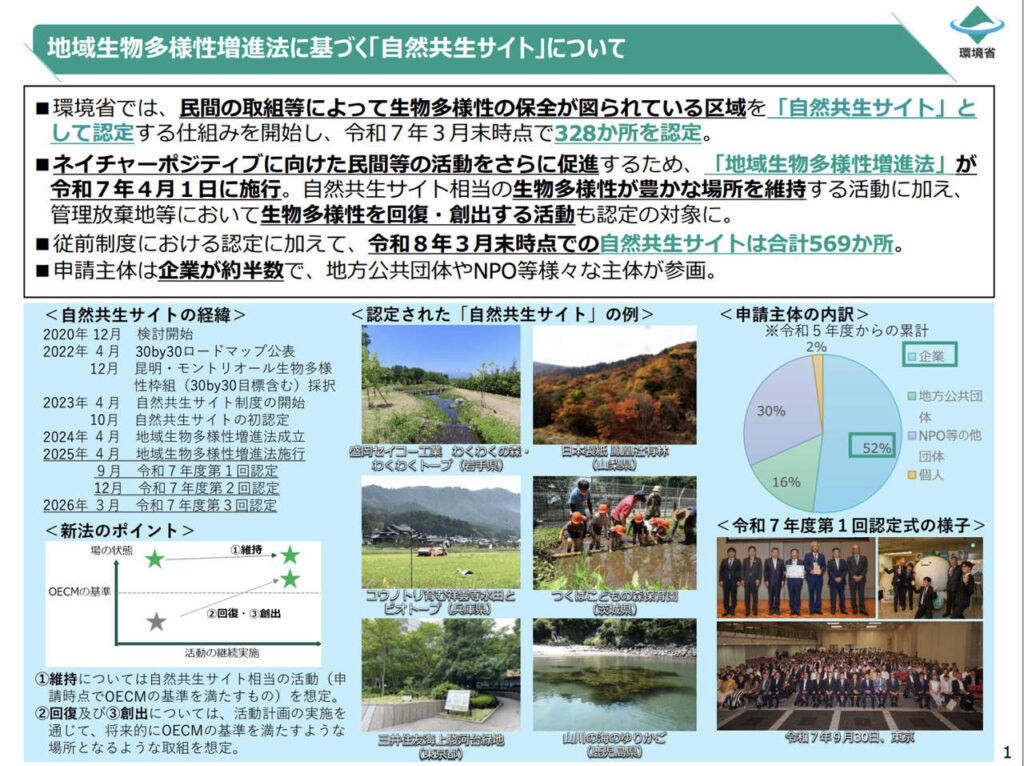
A total of 108 sites were newly certified as "nature-symbiosis sites" under the Regional Biodiversity Promotion Act. This brings the total number of certified sites to 569, achieving the initial target of "more than 500 sites in the near future" that had been set for some time. This is an initiative of the Ministry of the Environment (MOE), which aims to achieve Nature Positive status by publicly designating areas where biodiversity is being preserved through the activities of the private sector and others, such as company-owned forests, green spaces on factory premises, land managed by local governments, and satoyama in the community. Activities are classified into three categories: "maintenance" to maintain rich biodiversity, "restoration" to increase biodiversity on abandoned land, and "creation" to create biodiversity on former development sites. The third round of certification in fiscal 2025 covered a wide range of activities by various entities, including green spaces on corporate premises, company-owned forests, land managed by local governments, and local satoyama (woodlands). The program is positioned as a mechanism to promote biodiversity conservation throughout society, not only through environmental protection activities, but also by reflecting the results in corporate ESG assessments and deepening cooperation with the local economy.

Yamaha Motor Co., Ltd. announced its participation in the "Owase Nature Positive Consortium" launched in Owase City, Mie Prefecture. The consortium, which includes the Japan Nature Conservation Society, Owase City, and private companies, aims to create a sustainable community for the 22nd century by focusing on natural environment improvement such as forestation and seaweed bed restoration, environmental impact reduction, fostering leaders in primary industries, and education. Using the consortium as a foundation for co-creation, the company plans to promote the use of electrically power assisted bicycles and "Mobilit.E.S." for local tourism and education, and to conduct demonstration tests of products and services under development. This is an initiative that is attracting attention as an effort to utilize the company's technological seeds to solve regional issues and to achieve both nature restoration and regional revitalization.

*Reference link
Yamaha Motor Participates in Owase Nature Positive Consortium for Nature Restoration and Community Development | Yamaha Motor Co.
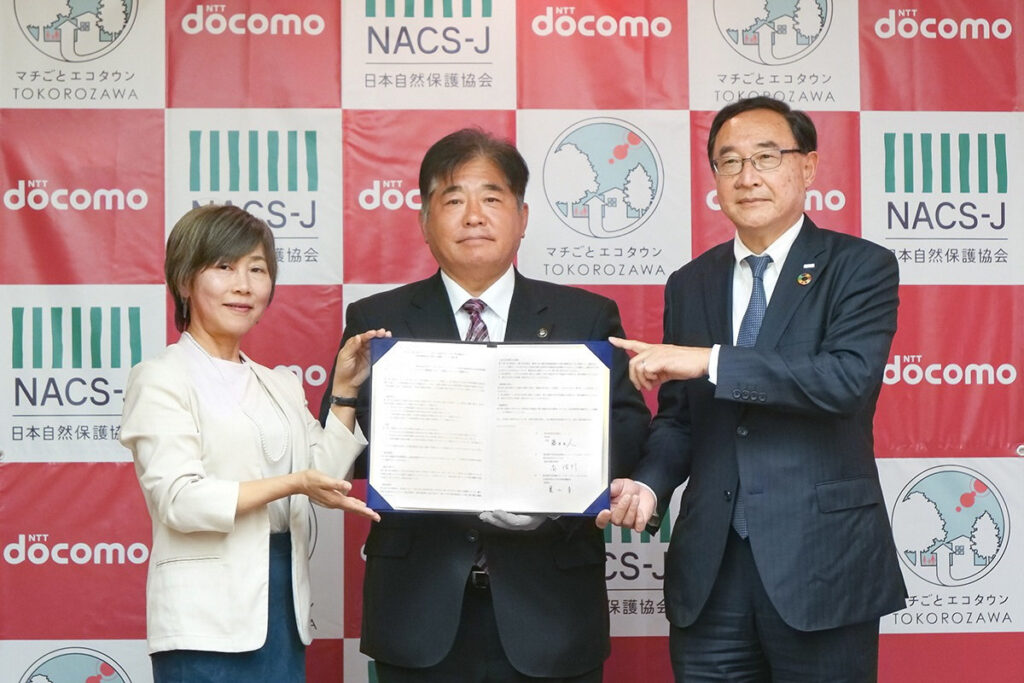
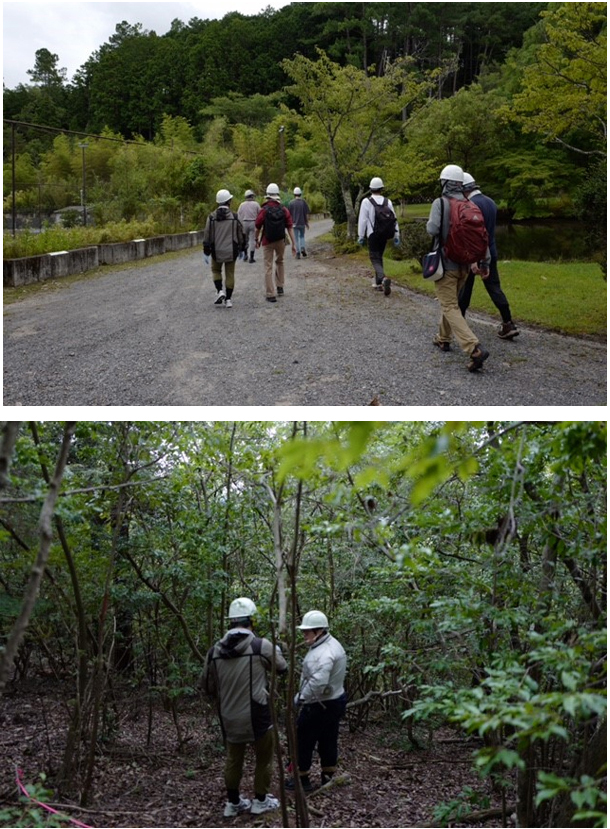
Tokorozawa City, NTT DOCOMO, and the Nature Conservation Society of Japan have started a joint demonstration experiment to estimate local vegetation and habitat conditions using satellite image data and AI. the three parties signed a collaboration agreement to realize nature positivity in Tokorozawa City in 2023, and have been working together to develop and study automatic identification monitoring methods for the dragonfly fauna and The three parties have been working together on the development of a method for automatic identification and monitoring of dragonfly fauna, as well as on satoyama conservation activities. This time, DOCOMO's AI analysis technology and other strengths were further utilized, and a new satellite image-based wide-area estimation technology demonstration was introduced. The aim is to reduce the burden and improve the efficiency of surveys by using ICT technology to supplement conventional on-site inspections of important areas of the ecological network, centering on the "Bodaijuike Satoyama Conservation Area" in the city. The acquired data is expected to be used for registration and monitoring of nature symbiosis sites, planning of new conservation measures, and verification of their effectiveness. The project is expected to be an advanced initiative in which local governments, companies, and public interest foundations will work hand in hand to accelerate the realization of nature positivity using state-of-the-art technology.

*Reference link
Tokorozawa City, DOCOMO, and the Nature Conservation Society of Japan Launch Demonstration of Wide-Area Vegetation and Organism Estimation Technology Using Satellite Image Data - Aiming to further accelerate nature positivity in Tokorozawa City - | NTT DOCOMO, Inc.
Tripartite Collaborative Agreement on Efforts to Conserve and Restore Biodiversity | Tokorozawa City
The Field Science Education and Research Center of Kyoto University and Panasonic Holdings have signed a collaboration agreement to promote "Forest-Satoumi Linkage Studies" and to realize Nature Positive. The goal is to integrate the research findings of Kyoto University's Field Science Research Center with Panasonic HD's corporate activities in the field. Specifically, cutting-edge evaluation methods for biodiversity and ecosystem functions based on environmental DNA and carbon and nitrogen cycles will be applied to the "Forest of Coexistence" in Kusatsu City, Shiga Prefecture, and factory green spaces. The project aims to analyze ecosystem functions and promote sustainable use of natural resources, as well as to build ecosystem networks and develop human resources in the surrounding areas. The project is expected to develop into a model case that combines advanced university research and corporate environmental assets to achieve both social implementation of the results and biodiversity conservation.

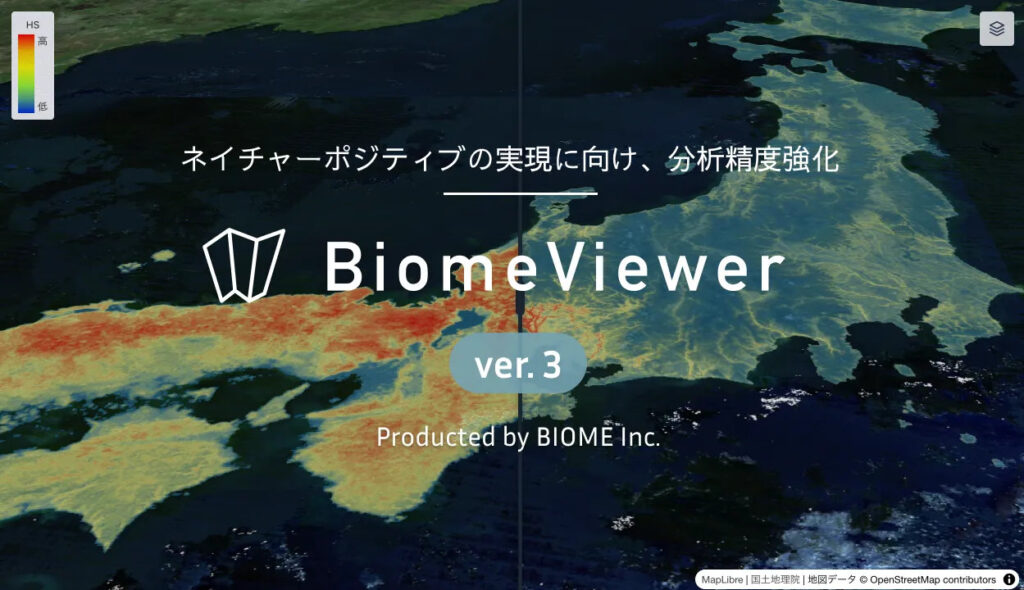
Biome has greatly enhanced the analysis accuracy of BiomeViewer, a visualization and mapping tool for natural capital and biodiversity data provided to companies. It features a high-resolution mesh of approximately 1 km to visualize and evaluate the distribution of natural capital. In this update, the amount of biological data and the number of target species have been expanded by approximately 2.5 times and 1.2 times, respectively, over the previous version by integrating various types of data. In addition, the adoption of "ensemble modeling," which combines up to four different analysis models, and the introduction of the latest satellite data have made it possible to predict biological distributions with higher precision. The new system provides powerful support for visualization of the impact of business activities on ecosystems.

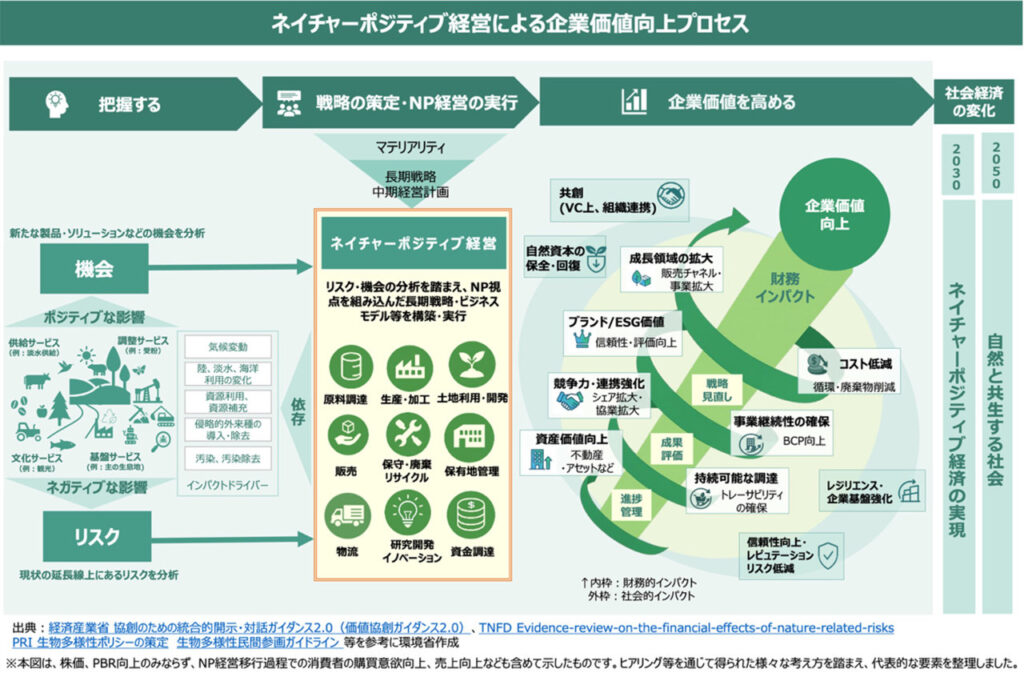
In March, the Ministry of the Environment (MOE) released a "Collection of Corporate Value Enhancement Stories for the Transition to a Nature Positive Economy," a compilation of practical examples of companies promoting nature positive management. This is based on the "Nature Positive Economy Transition Strategy Roadmap (2025-2030)" formulated in July 2025, and introduces specific initiatives of 20 leading companies. The background of the report was the issue of the unclear relationship between nature-positive management and business opportunities and corporate value enhancement. The report introduces the key issues for each company, as well as specific measures such as afforestation activities and land use improvement, and summarizes examples of companies that have transformed their dependence on natural capital into new business opportunities rather than risks. The book will provide practical hints for companies, regardless of size, that are considering nature-positive management to both sustain their business and strengthen their competitiveness.