


Image by Adobe Stock
[The Priest’s View] Why Has the “Space Between” Bears and People Been Lost? — Rethinking Coexistence with Nature Through the Torii Gate
Updated by Kazuhiro Aoki on October 23, 2026, at 8:09 p.m. JST
Kazuhiro AOKI
Representative Director, WSense Corporation / DELTA SENSE Production Committee
Representative Director, WSense Corporation / DELTA SENSE Production Committee Born in Aizuwakamatsu City, Fukushima Prefecture. From a family background of flower arrangement, tea ceremony, and Noh theater, he has been exposed to Japanese culture from an early age. His interest in wood began when he witnessed a shrine carpenter "sharpening a plane" and became aware of the depth of the craft. Currently, based on the knowledge he gained as a Shinto priest, he is promoting initiatives that lead to the public interest. He is a member of the Tokyo Junior Chamber of Commerce, holds a graduate degree and an MBA (Master of Business Administration), and has been a Boy Scout and a soccer player since he was 4 years old.DELTA SENSE Official HP WSense Corporation
Even though the forests are growing, bears are coming into town.
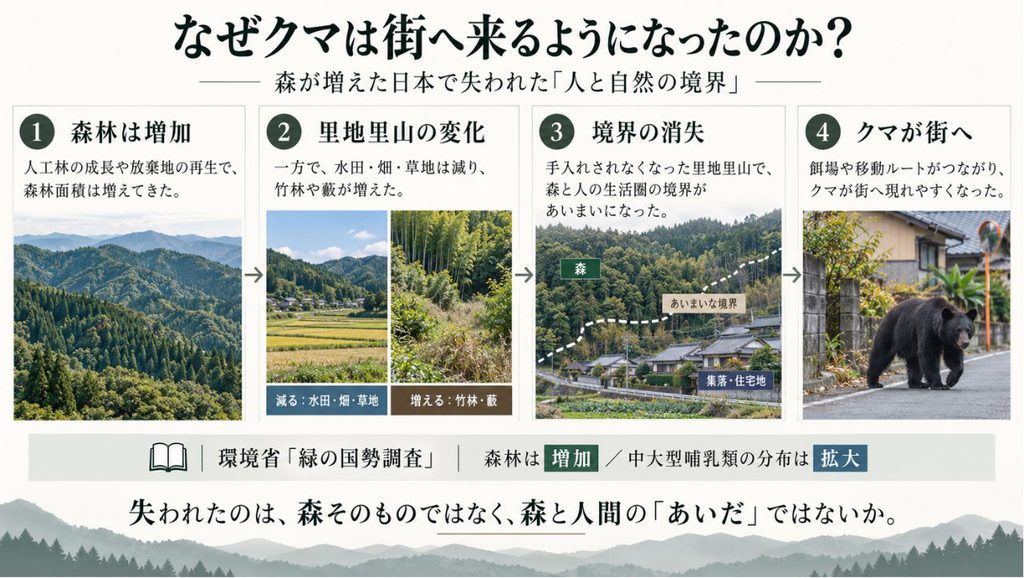
In October 2026, a comprehensive analysis of approximately 50 years’ worth of data from the “Green Census,” released by the Ministry of the Environment, showed that while the area classified as forest under vegetation categories has increased, the area of rural landscapes—such as paddy fields and grasslands—has decreased. Furthermore, the ranges of species such as bears, deer, and wild boars are showing a trend toward expansion.
Of course, this does not mean that changes in the forest alone have caused the increase in bear sightings. The causes are complex and include fluctuations in the availability of nuts and berries as food sources, changes in the bear population, and changes in human lifestyles.
However, this result raises a question.
Perhaps it is not that the forest has been lost, but rather that the “space” between the forest and people has been lost.
In Karuizawa Town, Nagano Prefecture, there is a system in place that involves neither simply removing bears nor leaving them alone.
The town divides the area into human activity zones, buffer zones, and bear habitat zones, and tracks the locations of bears fitted with transmitters. Bears that approach human settlements are driven away using trained “bear dogs.” This measure is designed to avoid needlessly taking animal lives while also ensuring human safety.
The core of this approach lies not in the fact that “there are bears,” but in managing “where bears and people come into contact.”
In Hyogo Prefecture, to manage deer and wild boars, authorities have cleared brush and trees in the areas between villages and the mountains to create clear-sighted buffer zones, which they have combined with protective fencing.
According to the prefecture's report, the number of farmlands where crop damage occurred decreased by about 70 percent in the villages where this comprehensive development project was carried out.
The paradox of “cutting down trees to live in harmony with nature” is interesting.
Leaving a tree standing isn't always conservation, nor is cutting it down always destruction.
What matters is the purpose of the action—what it is intended to protect.
In Slovenia, Europe, the country addresses conflicts with bears and wolves not only through electric fences and livestock guard dogs, but also by combining these measures with waste management, compensation for damages, and necessary population management.
If food is left out even after fences are erected, and farmers are left to bear the burden of the damage alone, this coexistence cannot continue. It is necessary to change not only the behavior of wild animals but also the behavior and burden on the human side.
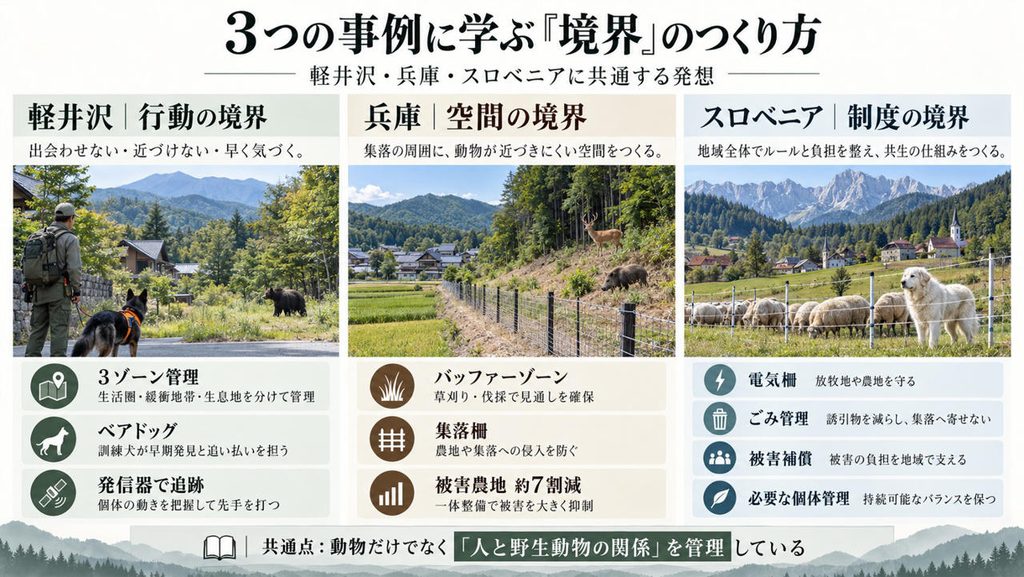
Karuizawa is “Action,” Hyogo is “Space,” and Slovenia is “Institutions.”
What emerges from practices in different regions is a common thread: the focus of management is not merely on animals, but on the relationship between humans and animals itself.
As a Shinto priest, what these three examples brought to mind for me was the torii gate at a Shinto shrine.
A torii marks the boundary between the sacred realm and the everyday world. Yet it is not a wall. People can pass through it; when they do, they bow and adjust their behavior.
Boundaries are not lines drawn to exclude others; they can also serve as markers for changing the way we interact.
I suppose that was true of the satoyama as well.
The activities of cutting grass, tilling fields, and gathering firewood were not merely a matter of resource utilization. They were also part of the daily maintenance required to maintain a proper balance between the forest and daily life.
When that came to an end, it wasn't just the workforce that disappeared.
The agreement regarding who would maintain what and how also began to fade.
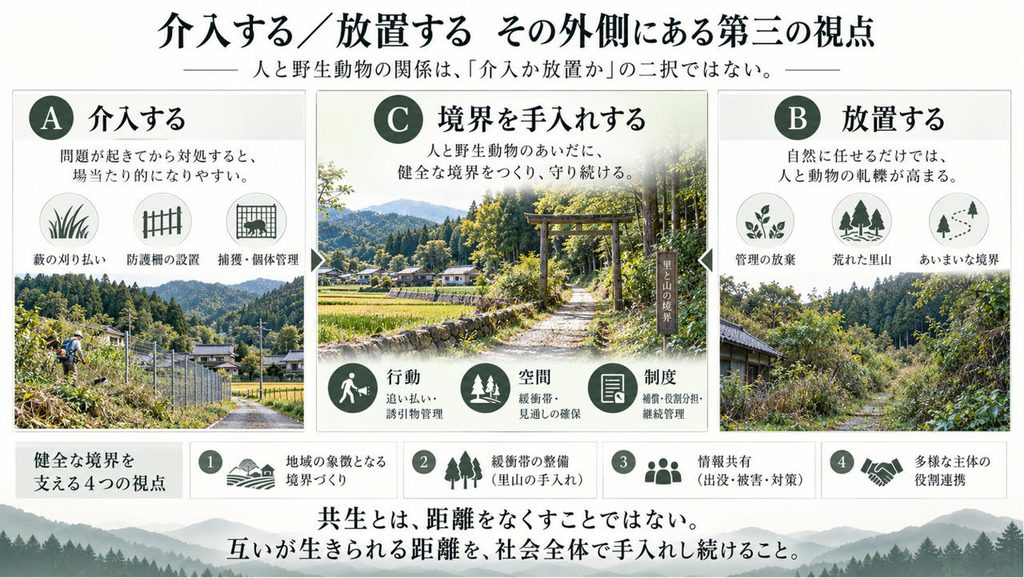
When it comes to wildlife management, the options often boil down to either capturing or protecting the animals. However, these three cases demonstrated that simply choosing one or the other is not enough.
From the trinitarian perspective I am exploring, the third option is not a compromise. It is about changing the very question that is causing the conflict.
It's not a question of "whether to intervene or let things be," but rather,
"Who will maintain the boundaries that allow us both to live, and how?"
When the focus shifts to that question, the discussion of countermeasures expands beyond simply the number of animals captured to include grass cutting, management of bait, information sharing, cost allocation, and the division of roles between the government and residents.
The concept of governance in business administration is also found here.
Companies that utilize forests must not measure their success solely by forest area or the number of trees planted; they must also take into account local management systems and maintenance costs. This is because the value of forests cannot be sustained unless mechanisms are put in place to ensure that these relationships endure.
Coexistence with nature cannot be measured solely by statistics showing an increase in forest cover.
The question is not just about the size of the forest, but also about the relationship between the forest and people.
Coexistence isn’t about eliminating distance. Isn’t it rather about constantly nurturing the distance that allows both parties to live?
Are there any issues in your community or organization where you find yourself faced with the choice of “whether to intervene or let things be”?
If we redesign the relationship that exists “between” the two, what kind of third option might emerge?
(President and CEO, WSense Inc. / DELTA SENSE Production Committee, Kazuhiro Aoki)
