


Forestry Policy and Economic Research That Continued Uninterrupted Through Wartime and Postwar Japan: The Diary Kinzō Shimada Kept Writing from the Night of the Air Raid
Updated by Nobuyuki Yamamoto on August 10, 2026, at 8:25 p.m. JST
Nobuyuki YAMAMOTO
Forestry and Forest Products Research Institute, National Forestry Research and Development Institute
Senior Researcher, Forestry Management and Policy Research Area, Forestry and Forest Products Research Institute, National Forestry Research and Development Institute / Specializes in forest policy and forestry economics. His recent research focuses on modernization and forests and forestry. His publications include "Forests and Time: A Social History of Forests", "Long-Term Sustainability of Local Forest Management: Future Perspectives from 100 Years in Europe and Japan", and "Theory of Forest Management System". His research on the modernization process of forest management systems won the Prize for Academic Achievement from the Forestry Economics Society of Japan, and "The Origins of the Forest Planning System in Japan" won the Paper Award from the Forestry Society of Japan.
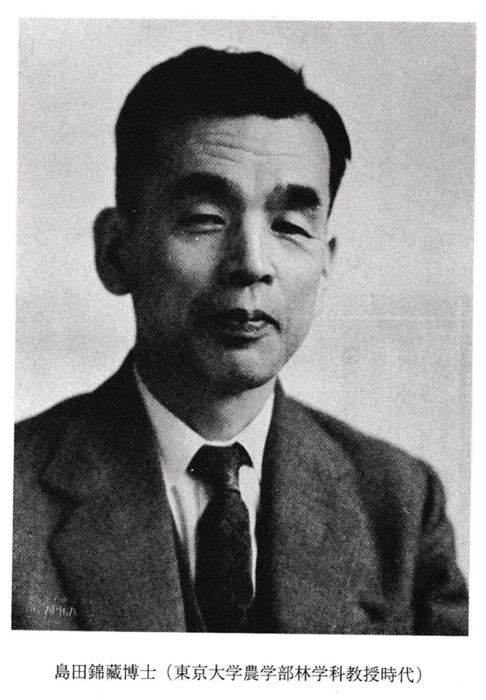
Kinzō Shimada (1903–1992) was one of the leading scholars of forestry policy and forestry economics during the Shōwa period, having served as a professor at the Imperial University of Tokyo and the University of Tokyo, a professor at Tokyo University of Agriculture, and president of the Greater Japan Forestry Association, among other positions. He authored numerous works, including *A Theory of Forest Cooperatives: Based on a Study of the Actual Conditions of Village Communal Lands* (Iwanami Shoten, 1941), published upon his appointment as professor, and *An Outline of Forest Policy* (Chikyu Shuppan, 1948), which went through multiple editions and served as the standard textbook in this field for many years after the war.
Shimada had long made his home near Ikebukuro Station on the Yamanote Line in Tokyo, but it was there that he was caught in the great air raid on Johoku. On that day, April 13, 1945 (Showa 20), Shimada began keeping a diary. The diary continued until December 31, 1989 (Heisei 1), the year the Shōwa era ended and the Heisei era began, and was kept for a remarkable 44 years and 8 months.
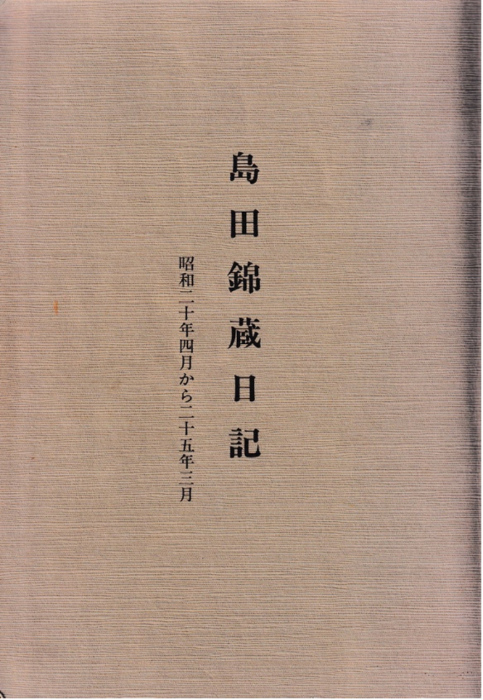
I was told previously by his son that the original diary was lost after his wife, Mieko, passed away. It is deeply regrettable, considering that had they survived, they would have served as invaluable records of postwar forestry policy and the history of the forestry economy. However, before they were disposed of, he cooperated with the publication of “A Prayer for the Fiftieth Year: Toshima Ward Peace Memorial Journal,” organized by Toshima Ward, Tokyo, in 1995 (Heisei 7), and part of the diary was published in print. Furthermore, a slightly expanded version, *Kinzō Shimada’s Diary I: April Shōwa 20 to March Shōwa 25* (hereinafter *The Diary*), which his son edited and proofread, was subsequently published as a privately printed edition.
"Diary" was originally written on the back of student answer sheets made of Senka paper. After the disaster, Shimada evacuated to Shishō Village, Kita-Adachi District, Saitama Prefecture (now Saitama City, Saitama Prefecture), and later in Ikebukuro, Toshima Ward, Tokyo, where he returned. It contains nearly daily entries from April 13, 1945 (Shōwa 20) to March 31, 1950 (Shōwa 25), covering the period of the Allied occupation.
As Shimada himself describes it as a “record of daily life,” many of the entries are simple, and many are little more than notes. Nevertheless, in addition to accounts of the school administration, research, outreach, and government committee work that Shimada energetically carried out despite the postwar chaos and poor transportation conditions, the journal also details his daily life—including his family, local community, and farm work—making it a valuable historical document.
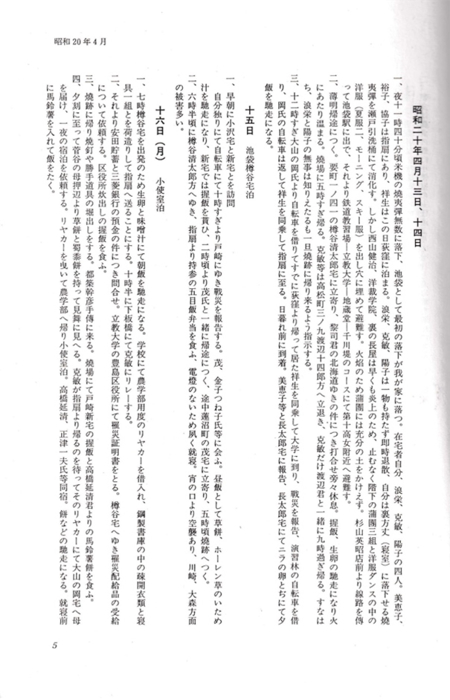
The opening lines of the “Diary” entries for April 13 and 14, 1945 (Shōwa 20), read as follows.
"Around 11:40 p.m., countless incendiary bombs were dropped by U.S. aircraft; the first one to hit Ikebukuro landed on my house."
After describing the safety of her family, the efforts to extinguish the incendiary bomb that had fallen on her home, the spread of the fire in the surrounding area, and the various minor tasks that followed, the entry concludes with: “Mieko and I went to Chotaro’s house to report what had happened, and were treated to a dinner of scrambled eggs with chives there.” As I wrote earlier, Mieko is Shimada’s wife, and Chōtarō is a relative of Shishō.
The *Diary* is like this throughout, matter-of-factly chronicling the daily life of a professor at Tokyo Imperial University toward the end of the war. While handling business trips—such as supervising labor mobilization at a propeller factory in Okazaki, Aichi; instructing at an agricultural school in Takada, Niigata; and conducting surveys for a forestry cooperative in Miyota, Niigata—he also records observations on crop cultivation at his destinations, notes on his reading of specialized texts, and daily menus devised to make the most of scarce food supplies. Eventually, defeat arrives.
"Diary" entries from August 16 and 18, 1945 (Showa 20).
“Arrived at the university at 12:00. The Faculty of Agriculture faculty meeting began at 1:00. Afterward, Nakayama, Yamamoto, and Ogihara and I had tea with the tomatoes I had brought, and we decided to continue the provisional duty roster for the protective night watch as before. I had planned to return home on the 6:25 train, but due to the engineer’s work-to-rule, the 5:20 train didn’t finally depart until 8:00. Perhaps the difficulty in stabilizing the postwar situation lies in this very situation.”
"Anticipating that our university might be requisitioned by the occupying forces, we have decided to transport the charcoal stored on campus to our homes, and today we have taken the first step toward doing so."
Even amid the postwar turmoil, business trips to the provinces continued. In October 1945 (Shōwa 20), he traveled to Akita and Yamagata to survey land reclamation sites, and in December, he visited Shimada, Shizuoka, to survey sawmills. Entry from the “Diary” dated December 22.
"Research on the grading of lumber by species at the mill. First-class and second-class grades do not account for a significant proportion; second-class makes up the largest share, followed by third-class, and there is also a considerable amount of substandard lumber. The issue lies in how to handle the substandard lumber."
According to the entries in his “Diary,” he went on business trips for an average of 93 days a year, despite the poor transportation conditions in the postwar period.
Shimada lived during a period when Japan’s forests, society, and economy underwent major transformations in the wake of Japan’s defeat in the Asia-Pacific War. That war drastically changed our way of life. However, as the *Diary* reveals, there was no clear-cut dividing line between the two eras.
On the day of the great air raid on Johoku, from which he narrowly escaped death, Shimada began keeping a diary, in which he calmly recorded his daily life until the end of the Shōwa era. And even after Shimada’s death, those days have continued uninterrupted to this very day, as we live on.
August—a month of remembrance—has come around again this year. In Japan these days, the news reports on war day after day, while political parties and lawmakers spew hate speech. I shudder at how I’ve gradually grown accustomed to this reality, and I take this as a lesson to be more mindful. What can I do now to ensure peaceful days continue into the “Forest Nation, City of Trees” a hundred years from now? (Nobuyuki Yamamoto, Principal Researcher, Forestry Management and Policy Research Division, Forestry and Forest Products Research Institute, National Research and Development Agency for Forestry and Forest Products)
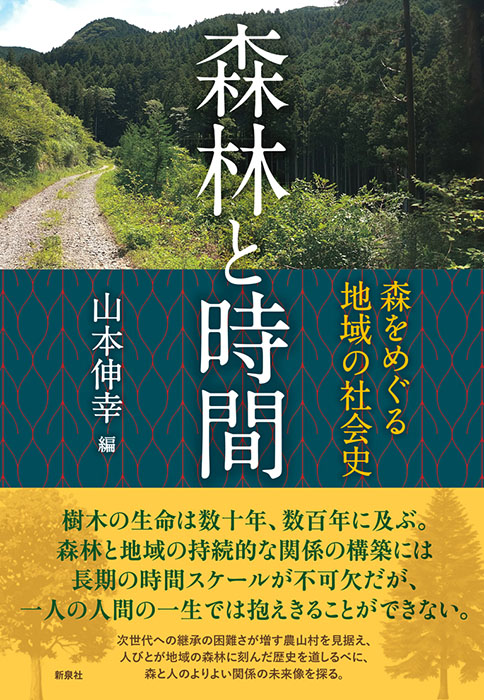
Forests and Time."
Edited by Nobuyuki Yamamoto, published by Shinsensha
The life of a tree can span decades or centuries. A long-term time scale is essential for building a sustainable relationship between forests and local communities, but it is not something that can be carried out in the lifetime of a single person. With an eye on farming and mountain villages, where it is becoming increasingly difficult to pass on the forests to the next generation, we will explore the future of a better relationship between forests and people, using the history that people have carved into the local forests as a guidepost.
<Table of Contents
Introduction: Forest Time and Human Time Nobuyuki Yamamoto
Chapter 1: People Who Encountered Yamazukuri Shimazaki Yoji and the Forest School Atsuro Miki
Chapter 2: Inheritance of Mountain Village Society and Women's Life Course: Women's Progress in 200 Years of a Mountain Village in Tochigi Prefecture Miho Yamamoto
Chapter 3: Life History of a Village and Its Residents Living with Mountains and Rivers Taro Takemoto, Shuhei Sato, Sho Matsumura
Chapter 4: Modernity and Forests in Hamadori, Fukushima Prefecture, Chapter 4: Nobuyuki Yamamoto
Chapter 5: The Interconnection between the Pulp and Paper Industry and Local Sustainability
Chapter 6: The Era of the Akai School: The Origin of Domestic Timber Supply Development in a Local University Yoichiro Okuyama
Chapter 7: Party and Expertise in Forest Management Changes in Forest Policy and Local Practices in Tenryu and Fuji Minami-Foothills Kazuto Shiga
End of Chapter Nobuyuki Yamamoto, Continuing to Re-weave the Relationship between Forests and People
