


Updated by the Editorial Department of *Forest Circular Economy* on September 4, 2026, at 5:50 p.m. JST
Editorial Board, Forest Circular Economy
Forestcircularity-editor
We aim to realize "Vision 2050: Japan Shines, Forest Circular Economy" promoted by the Platinum Forest Industry Initiative. We will disseminate ideas and initiatives to promote biomass chemistry, realize woody and lumbery communities, and encourage innovation in the forestry industry in order to fully utilize forest resources to decarbonize the economy, strengthen economic security, and create local communities.
*Previous article here
How Did the Lumber Mill, Funded by 470 Local Residents, Turn a Profit? The Orochi LVL Mill: 20 Years of Management Reform [Nichinan Town: The Front Lines of Forest Resource Circulation, Part 2]
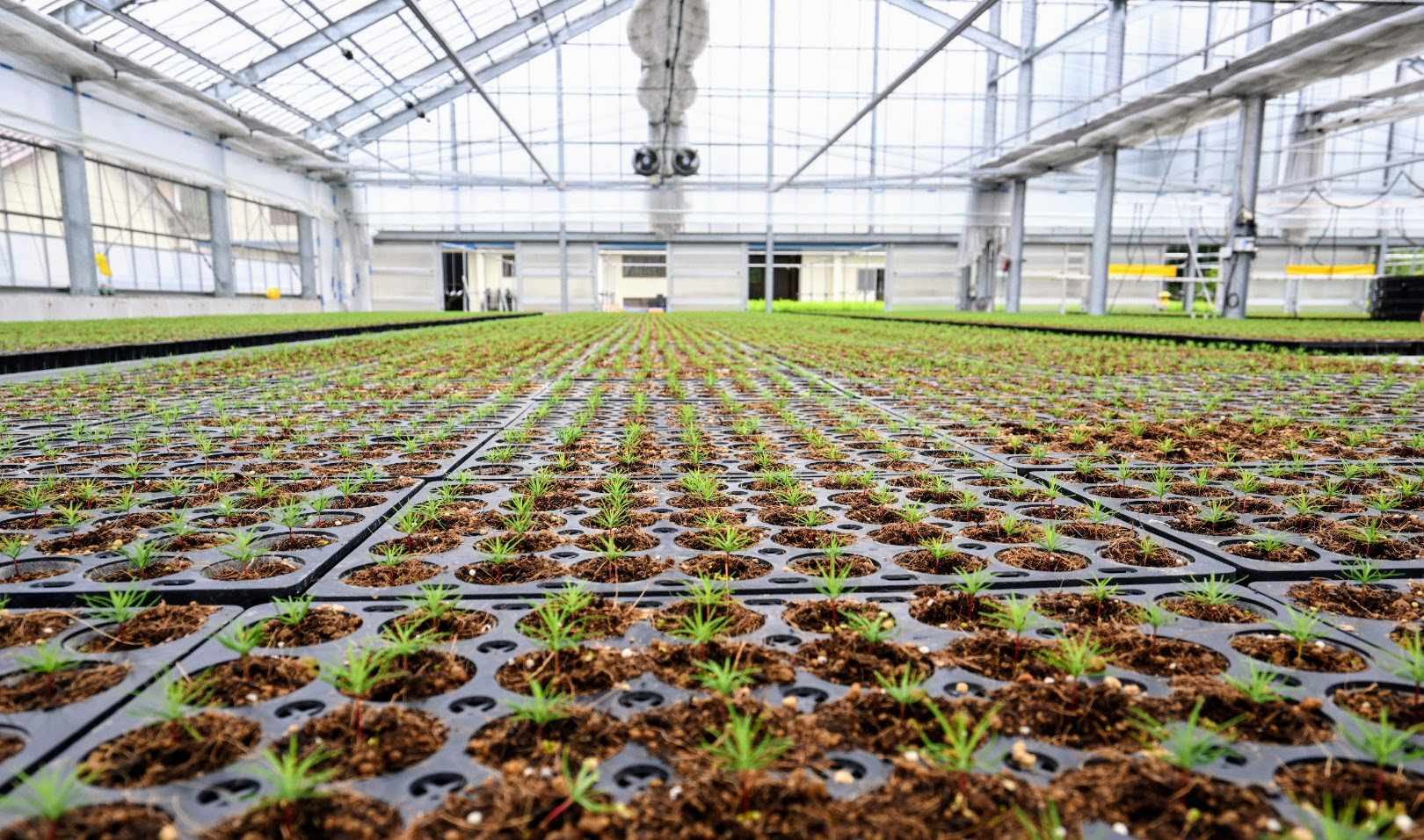
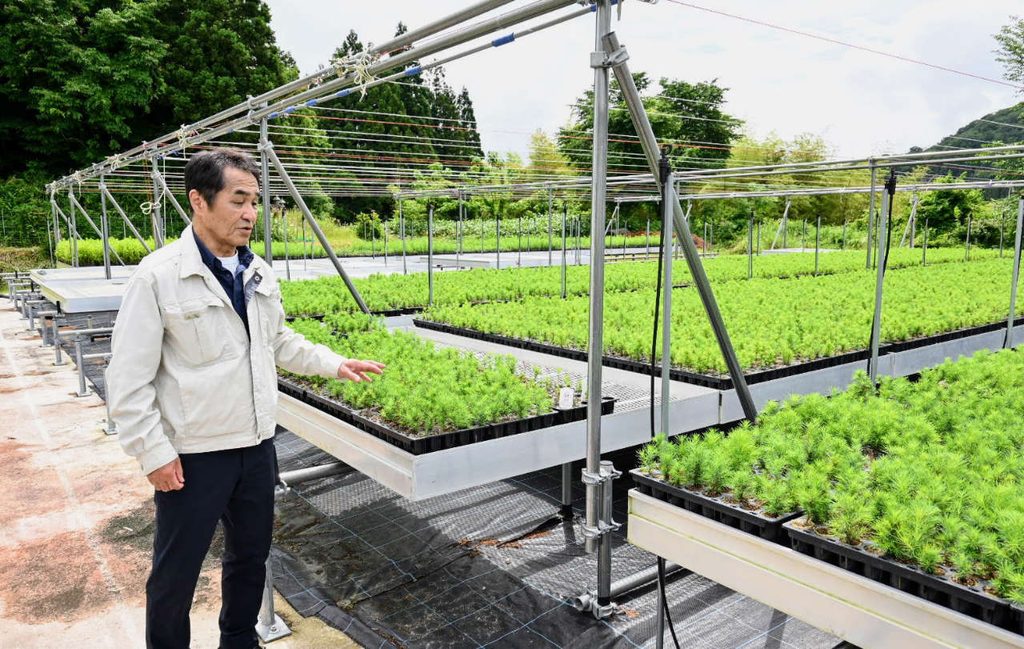
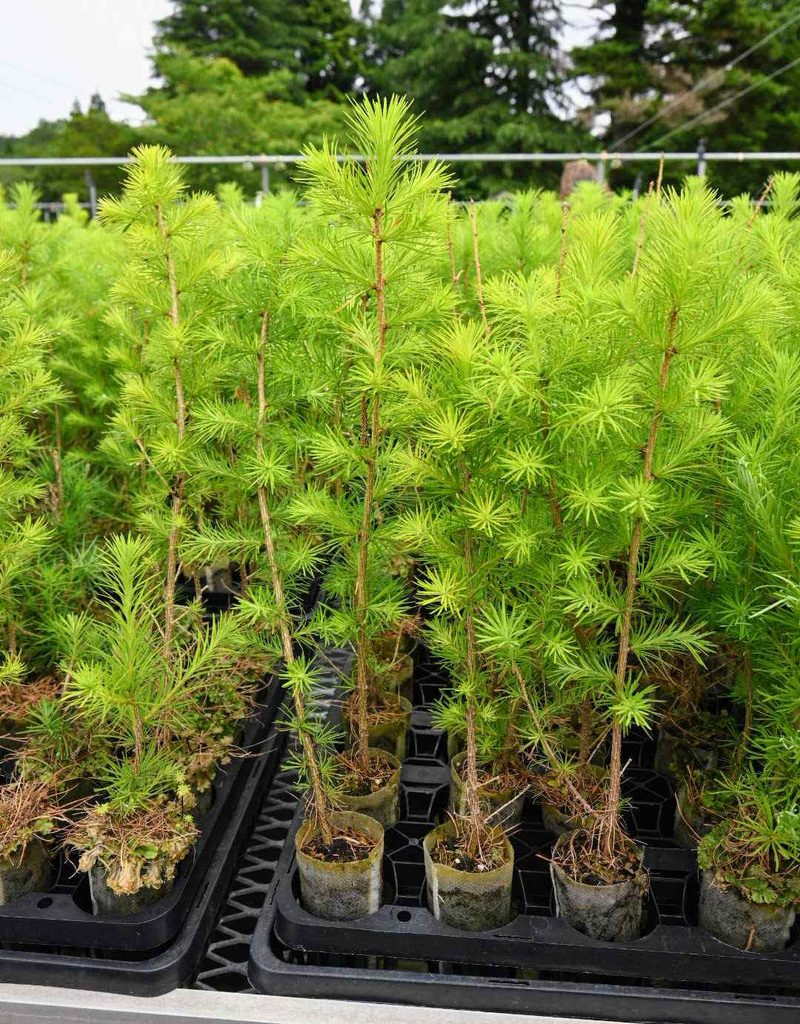
As soon as I stepped into the cultivation building, I saw young larch seedlings neatly arranged on movable cultivation benches—"Moving Benches"—basking in the sunlight streaming in. The “Nichinan Town Tree Nursery Center,” which repurposes facilities such as closed elementary schools, supports reforestation through seedling production and serves as a hub for carrying the forests of Nichinan into the next 50 years. Wood Company Nichinan, which operates this facility—cultivating approximately 200,000 seedlings and shipping about 120,000 to 130,000 per year—why did it shift from being a lumber company to the unfamiliar business of seedling cultivation? This report explores what the company calls its “second founding”—the selection of larch, a species rare in western Japan, and the establishment of a unique “one-year seedling cultivation technique” suited to Nichinan’s climate—as well as the regional economic cycle that returns seedlings to the mountains at virtually no cost to the landowners.
The company was established in 1993 as a semi-public, semi-private lumber mill funded by local forest owners and Nichinan Town, among others. The ownership breakdown is as follows: the Nichinan Town Forestry Cooperative holds 49.9 percent, Nichinan Town holds 21.4 percent, and local forest owners and other stakeholders hold 28.7 percent. By collaborating with an adjacent pre-cut lumber plant and local construction companies, the company has continued to grow, leveraging its integrated system that handles everything from logging to lumber processing. However, structural changes in the timber industry—particularly the rise of industrialized products such as plywood and laminated timber, as well as intensifying competition from imported lumber—dealt a severe blow to regional sawmills. The company was no exception and was forced to suspend its sawmilling operations in 2019.
“Although we had no choice but to end our operations as a sawmill at that time, we continued to grapple with how to fulfill our responsibility to the community,” recalls Koji Akisue, the company’s president.
The turning point came with the national “Model Project for Creating Regions Where Forestry Becomes a Growth Industry,” which Nichinan Town began implementing in fiscal year 2017. In this major project aimed at revitalizing forestry throughout the town, “establishing a system for local self-sufficiency in seedlings for reforestation” was designated as one of the key initiatives. To reward the local forest owners—who were both investors and long-time suppliers of logs—and to ensure the future of Nichinan’s forests, the company decided to shift its business model toward “growing saplings,” aligning its efforts with this model project.
In 2021, the final year of the pilot project, the company registered as a producer under the Forest Seed and Seedling Act, marking the quiet beginning of its “second founding.” The gymnasium of the former Abien Elementary School was transformed into a storage facility for shipping containers and potting soil, while the former kindergarten building was repurposed as an office.
As part of its business model transformation, the company utilized government subsidies and invested approximately 130 million yen in total project costs to build a mass-production greenhouse for container-grown seedlings. However, for a company with a history solely as a lumber mill, seedling cultivation was uncharted territory.
To begin with, why was “larch” (Karamatsu)—a species widely planted in regions such as Hokkaido and Tohoku—chosen as the primary focus for seedling cultivation in Western Japan, where cedar and cypress are the dominant tree species? This decision stemmed from a management strategy unique to Nichinan Town, aimed at enhancing competitiveness as a structural timber and reducing labor requirements in forestry operations.
The primary objective is the wood’s “high strength.” Larch is expected to offer high strength as a structural timber, and it was selected as a species for seedling cultivation in response to requests from local LVL (laminated veneer lumber) mills and other sources for “high-strength domestic wood suitable for structural use.”
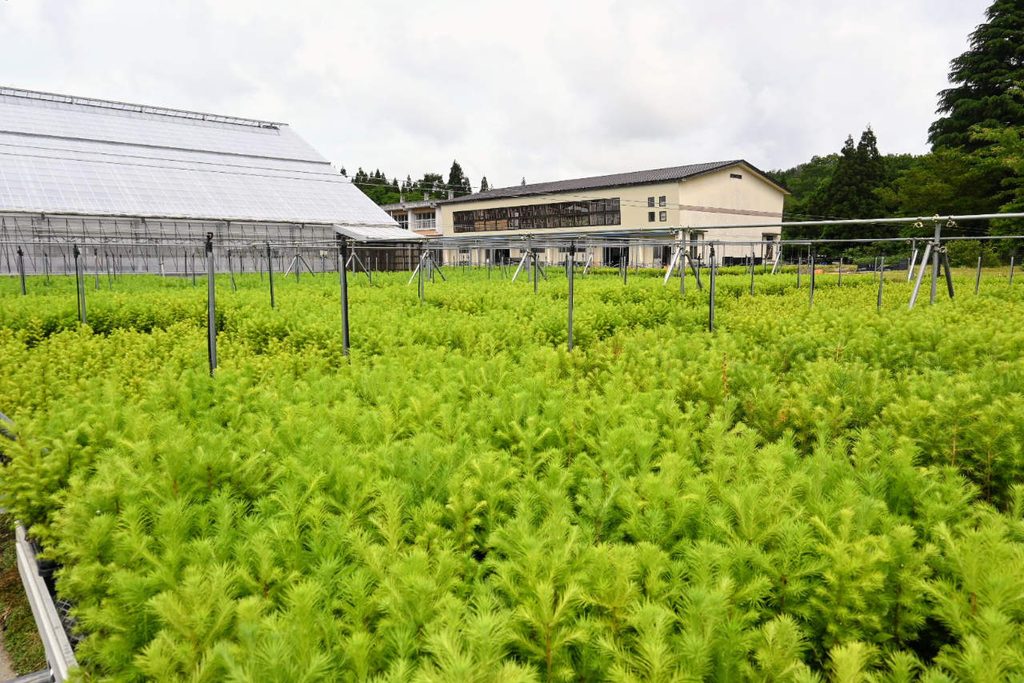
Furthermore, there are significant practical benefits for the demanding forestry work sites. Larch trees grow rapidly in the early stages of planting, and in Nichinan Town, officials expect to be able to reduce the number of underbrush clearings—which have been performed about five times with cedar trees—to about two or three times. For sites struggling with a severe labor shortage, this labor savings will also lead to a reduction in reforestation costs. Furthermore, Nichinan Town anticipates shortening the period from planting to final harvest—which has been about 50 years for Japanese cedar—to about 40 years for larch, and expects economic benefits in the form of a faster return on investment for landowners.
It is extremely rare to find a region in the forested areas of western Japan where an entire town is making a full-scale effort to grow larch seedlings and carry out reforestation. However, after comprehensively assessing market demand, the need to streamline operations in the face of an aging workforce, and the forest’s generational renewal cycle, the company decided to take a calculated risk by betting on larch as a strategic tree species.
In the early stages of the project, we received technical guidance from Sumitomo Forestry, which had a proven track record in container-grown seedling production, and learned from their expertise. However, simply applying manuals and standard specifications that had been successful in other regions did not go smoothly. Nichinan Town experiences extreme temperature fluctuations characteristic of the Chugoku Mountains, and because the well water is extremely cold, it was impossible to ensure stable germination and growth of the larch trees.
From there, on-site staff began conducting observations and engaging in their own trial-and-error process to adapt the crops to the local environment. For example, they accumulated know-how by ordering various types of potting soil and fertilizers to conduct cultivation trials, and by experimenting with different cultivation methods to cope with high summer temperatures.
“It’s not like manufacturing industrial products. The seedlings are constantly growing, and a certain number are bound to wither away. It’s a ‘battle’ to figure out how to provide them with light in the best possible environment and grow sturdy seedlings,” says President Akisue.
Through this hands-on process of trial and error, the company established a technique for growing larch seedlings to a size ready for shipment within one year—a process that previously took several years—tailored to the climatic conditions of Nichinan Town. The company has established a system to consistently produce high-quality seedlings—characterized by high survival rates and sturdiness—that meet Tottori Prefecture’s shipping standards of “a tree height of 30 cm or more and a diameter at breast height of 3.5 mm or more.”
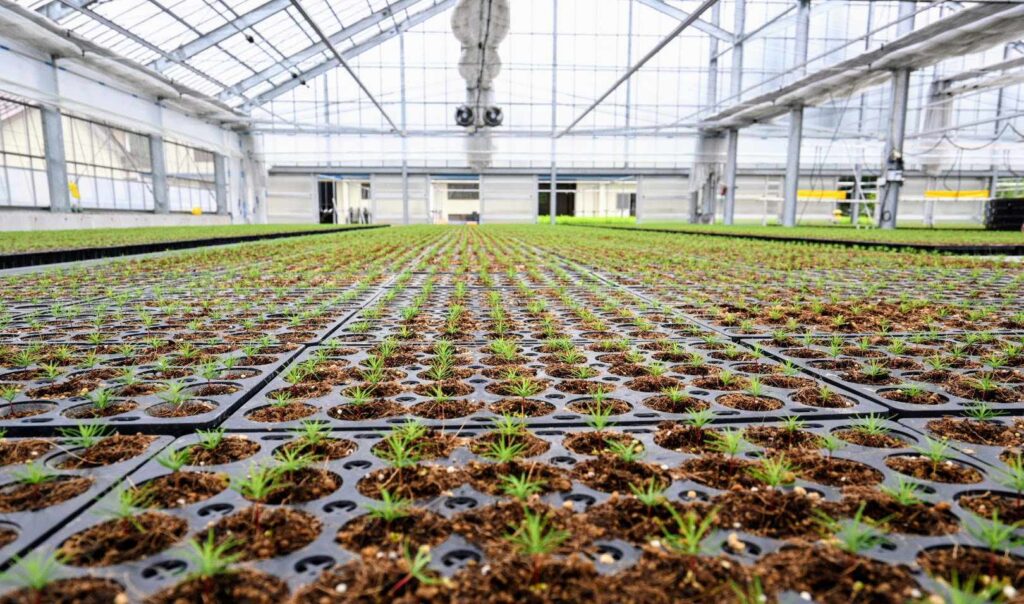
Walking through the seedling center, you’ll see the various pieces of equipment that support the “one-year larch seedling cultivation” process. The seed sorter uses infrared technology to non-destructively measure the lipid content in seeds; by removing seeds with low germination rates in advance, it can roughly double the germination rate. At one point, the germination rate was even improved to nearly 90 percent. Additionally, the center is equipped with a semi-automatic seeder that precisely sows seeds into Excel trays, as well as germination chambers that automatically control temperature and humidity. The moving benches in the cultivation building hold 30 containers per bench—1,200 seedlings, weighing approximately 340 kg. With 10 benches per row, a single worker can slide and manage as many as 12,000 seedlings (total weight approximately 3.4 metric tons), leading to labor savings and improvements in the working environment.
The center is currently working on demonstrating new seedling-rearing technologies in collaboration with external companies. A prime example of this is a joint demonstration aimed at the practical implementation of “Circular Timber Construction®,” a sustainable, circular business model for forest resources promoted by Obayashi Corporation.
In June 2024, a pilot plant for the “hybrid seedling production system” developed by Obayashi Corporation was installed at the center, marking the start of a joint initiative aimed at producing approximately 10,000 larch seedlings annually. Under this system, seedlings are grown in an environmentally controlled facility with artificial lighting during the first two months—a period when they are most susceptible to external environmental factors—and then transferred to open-field cultivation under natural light. Compared to growing seedlings entirely under artificial lighting, this approach reduces costs to about one-sixth and shortens the seedling-rearing period to as little as six months.
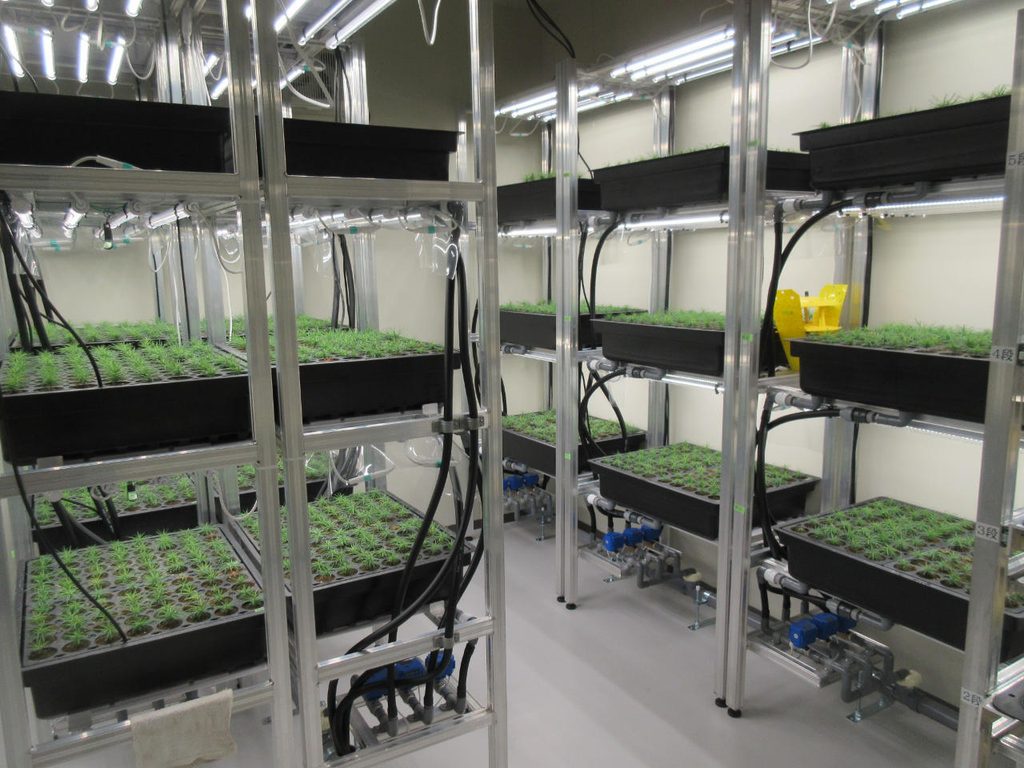
In December of that same year, the first shipment of 290 larch seedlings grown using this system was made. A total of 490 seedlings—including control seedlings grown under natural light only and artificial light only—were planted on approximately 3.2 hectares of clear-cut land within the town, with the cooperation of the Nichinan Town Forestry Association.
Currently, the facility’s total cultivation capacity reaches 180,000 to 200,000 trees per year; however, due to variations in growth timing and shipping schedules, the actual annual shipment volume is approximately 120,000 to 130,000 trees. While the majority of the trees are larch, the company also produces low-pollen cedar. The company takes pride in having achieved “technological self-reliance” through on-site expertise—carefully assessing the specific growing conditions unique to Nichinan Town, such as temperature fluctuations and water temperature, while also learning techniques from external sources.
To begin with, the company’s commitment to “container-grown seedlings”—which are grown in containers with soil still attached, rather than as “bare-root seedlings”—has practical significance in terms of improving productivity per unit area and reducing and leveling out the workload for an aging workforce. Compared to bare-root seedlings, container-grown seedlings can more easily adapt to a wider range of planting conditions. They do not require specialized technical skills for planting, offering the advantage of standardizing work processes and ensuring stable employment for workers.
The total area of privately owned forests in Nichinan Town where clear-cutting operations are managed or overseen by the forestry cooperative amounts to approximately 60 hectares per year. If approximately 2,500 trees are planted per hectare, the town requires about 150,000 seedlings annually. The center’s annual shipment volume of 120,000 to 130,000 seedlings accounts for about 80 percent of that total. This scale of production allows the town to meet the majority of its seedling needs following clear-cutting operations with seedlings produced locally.
Based on the revised unit price of 260 yen, effective in the fall of 2026, annual sales from shipments of 120,000 to 130,000 units would total approximately 31.2 to 33.8 million yen. Subsidies from the national government, the prefecture, and the town were used to fund the construction of the seedling center, which cost approximately 130 million yen.
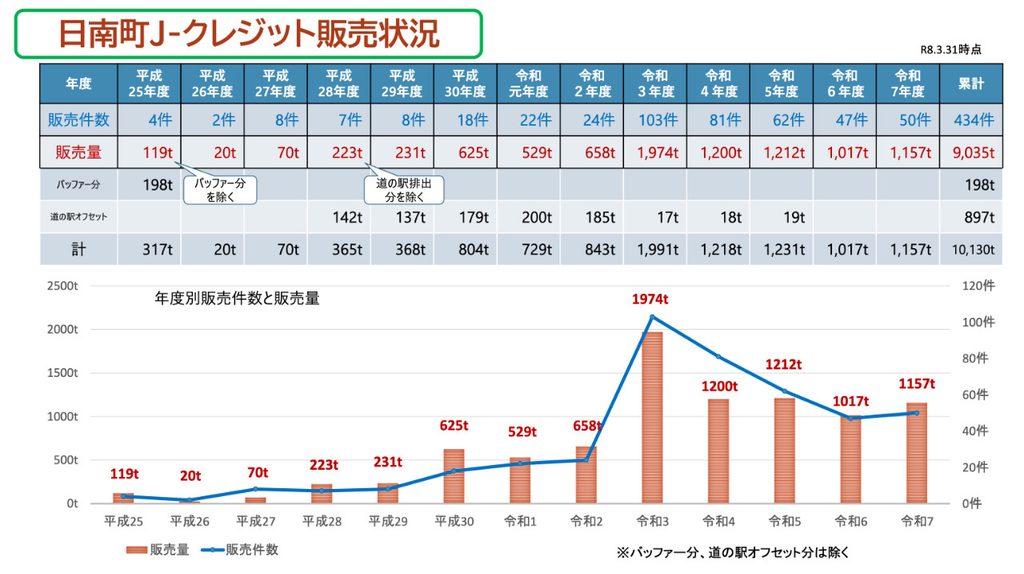
Local forestry revenues—including income from the sale of J-Credits—provide demand-side support for seedling production in this region.
As mentioned in Part 1, the financial backbone supporting Nichinan Town’s unique, multi-layered support package—which effectively reduces the landowner’s out-of-pocket costs to zero—is provided by the national “Forest Environment Grant Tax” (approximately 105 million yen annually) and the “J-Credit sales revenue” (approximately 10 million yen annually), which is generated when local banks (San’in Godo Bank and Tottori Bank), which are sold to private companies. Together, these sources constitute an annual forestry budget of approximately 115 million yen. The town’s relevant department estimates that it needs to allocate approximately 60 million yen annually from the forest management budget to fund support for thinning and reforestation. The town’s own subsidies supporting clear-cutting and reforestation are also implemented within this forest management budget.
Mr. Kimura, chairman of the Nichinan Town Forestry Association, speaks about the significance of this “zero net cost” approach, keeping in mind the nationwide trend of landowners hesitating to invest in reforestation.
"Because the production of saplings and reforestation typically involve high upfront costs, the number of abandoned forests—where trees are cut down but not replanted—is increasing nationwide. That is precisely why we have established a system to support the costs of forest management through government subsidies and funds set aside independently by forest cooperatives, thereby minimizing the financial burden on landowners as much as possible. Creating an environment where forest owners can reforest at effectively no cost is the key to reliably connecting the pieces of the cycle.”
Thanks to these support programs and local forestry funding—including revenue from the sale of J-Credits—the saplings grown by Wood Company Nitchinan are being returned to mountains that have been clear-cut.
Meanwhile, new challenges are emerging for the J-Credit system, which supports reforestation. Currently registered projects are projected to achieve a cumulative net absorption of 29,350 metric tons over eight years. However, if projects are modified in the future as forest management plans are updated, emissions from main harvests are expected to be factored in more heavily, resulting in a decrease in net absorption. For Nichinan Town, where forests in their harvesting phase—ranging from 45 to 65 years old—account for about 60 percent of its planted forests, the challenge lies in securing credits while proceeding with final-cut reforestation.
In addition, the Nichinan Town Forestry Cooperative is working to ensure a stable local supply of larch seeds, which are used to produce seedlings. Over the five-year period from fiscal year 2023 to 2027, the cooperative is planting 1,070 designated larch mother trees and establishing a seed orchard covering approximately 2.5 hectares. The cooperative is moving forward with efforts to establish a system where the region not only grows saplings locally but also takes full responsibility for securing the seeds from which they are grown.
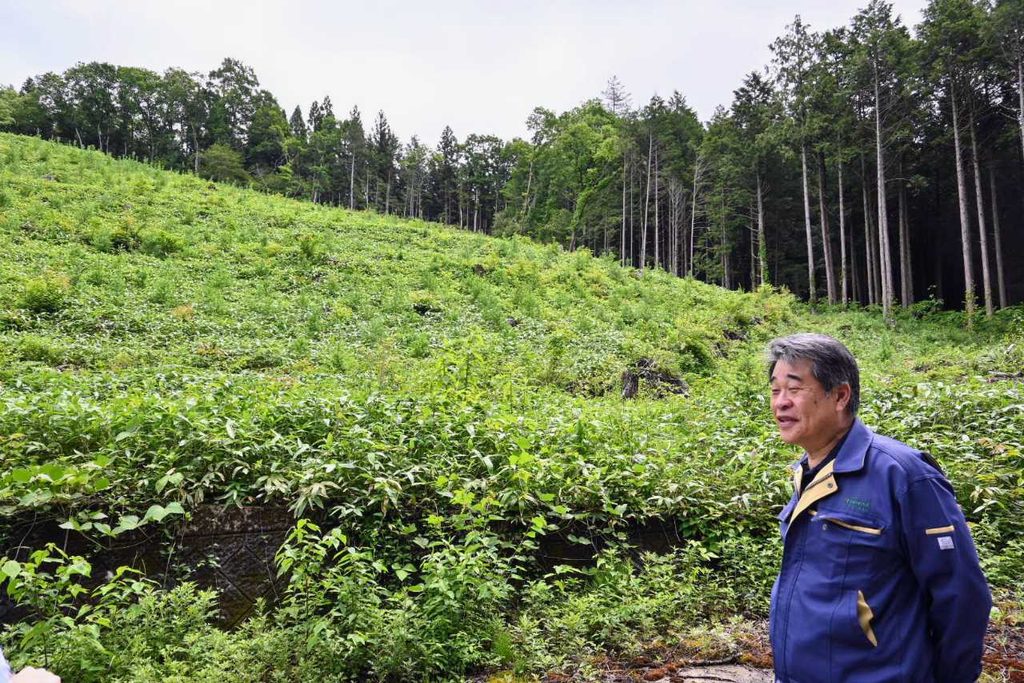
On the mountain following clear-cutting, Mr. Kimura, the union president, gazed out at rows of newly planted saplings. From here, the process of nurturing the next generation of forest begins anew.
The community receives logs, processes them into lumber for use, and replants saplings on the sites where trees were felled. At the site in Nichinan Town, a system has been established in which various businesses each play their part to pass on forest resources to the next generation. Supporting the “planting” phase of this cycle is the seedling production initiative launched as part of Wood Company Nichinan’s “second founding.” “Harvest, use, plant, and nurture.” The forest cycle that Nichinan Town aims to achieve over the next 50 years is beginning anew with each and every seedling planted on the mountains following clear-cutting.
*Reference site
Wood Company Nitchinan
Forestry / Nichinan Town
Obayashi Corporation Begins Production of Larch Seedlings Using a Hybrid Seedling Production System Combining Artificial and Natural Light | Obayashi Corporation
