
Image by Unsplash
GHG Protocol's New Land Sector Standard, Volume 2: Are Forest Carbon Removals a Result of Corporate Activity? Guidance Release and Request for Information Bring the Debate to Its Core
Updated by Takanobu Aikawa on October 8, 2026, at 10:21 p.m. JST
Takanobu AIKAWA
PwC Consulting Godo Kaisha
Senior Manager, PwC Intelligence, PwC Consulting LLC / With a background in forest ecology and policy studies, he has been extensively engaged in research and consulting for the forestry and forestry sectors for the Forestry Agency and local governments. In particular, he contributed to the establishment of human resource development programs and qualification systems in the forestry sector in Japan, based on comparisons with developed countries in Europe and the United States. In the wake of the Great East Japan Earthquake, engaged in surveys and research for the introduction of renewable energy, particularly biomass energy; participated in the formulation of sustainability standards for biomass fuels under the FIT system; since July 2024, in his current position, leads overall sustainability activities with a focus on climate change. He holds a master's degree in forest ecology from the Graduate School of Agriculture, Kyoto University, and a doctorate in forest policy from the Graduate School of Agricultural Science, Hokkaido University.
Column published on June 3, 2026In that article, the author explained the GHG Protocol’s “Land Sector and Removal Standard.” Subsequently, with the publication of guidance on the practical application of that standard at the end of June, it has become clear that the discussion surrounding corporate forest carbon accounting has taken on a more concrete form than the author had anticipated.
The “Standards” repeatedly state that “the forestry sector is excluded,” as I explained in my previous article. However, a reading of the “Guidance” reveals that corporate plantation forestry should be considered within the scope of the standards. Furthermore, even if the land remains forested, cases involving qualitative changes—such as the conversion of natural forests to plantations through logging—are considered land-use changes. This approach goes beyond the LCA calculation methodology used in Japan’s FIT program and other similar initiatives.
In addition, starting at the end of June, a public comment period has begun on the Forestry Sector Standard, with a deadline of February 1, 2027. Until now, it has been common practice to attribute carbon dioxide (CO2) absorption by growing forests to companies’ forest management activities. In contrast, the new forestry sector standards propose a different approach: they strictly distinguish the effects of human activities from natural processes, treating CO2 absorption by forests as a natural process and arguing that such absorption should not be attributed to companies.
This public comment period addresses a core issue in the debate surrounding corporate forest carbon accounting. In the first half of this article, we will explain the section of the Land Sector Guidance pertaining to plantation forestry, and in the second half, we will summarize the key issues in the Forestry Sector Standard, which is currently open for public comment.
As I wrote in my previous article, the Land Sector Standard excludes the forestry sector. The cover states, “This does not apply to forestry.” However, a careful reading of the guidance published subsequently reveals that, at the very least, plantation forestry was already covered as a form of agriculture.
However, the focus here is not on the management of plantations of native tree species—such as Japanese cedar and Japanese cypress—which are common in Japan. Rather, it refers to a form of forestry involving the large-scale cultivation of single tree species—such as eucalyptus and poplar—that have been selected and developed specifically for forestry purposes.
In practice, the products harvested from these plantations are often used as raw materials for paper production; therefore, they are generally referred to as “fiber” rather than “timber” or “wood.” Although the land sector standards did state that fiber was covered, the classification also included items such as cotton. Consequently, it was not possible to infer from this description alone that the forestry sector was also covered.
Furthermore, the guidance adopts calculation methods that have a significant impact on GHG accounting for such plantation forestry.
First, the guidelines stipulate that when natural forests are converted to planted forests over the past 20 years—which constitutes a land-use change—the change in carbon stock must be calculated by dividing the total change by 20 years. In previous LCA calculations, land use change has been limited to cases where forests are cleared and converted to agricultural land. In contrast, the conversion from natural forests to planted forests was not considered a land use change because it represents a shift within the same “forest” category. However, there has been criticism that this calculation method does not serve as a deterrent to the logging of natural forests or the conversion to planted forests, and the latest GHG Protocol is seen as having taken a more proactive stance. Furthermore, the protocol has adopted a strict approach by applying the new rules retroactively to conversions that occurred over the past 20 years.
Furthermore, as explained in the previous article, it is necessary to calculate the “carbon opportunity cost” as an indicator of land carbon leakage. This is an indicator that evaluates the opportunity for carbon sequestration through alternative land uses that is lost when a given piece of land is used for its current purpose. Although this calculation is required only when “high-risk activities” are carried out, the guidance has clarified the specific cases in which the calculation is necessary (Figure 1).
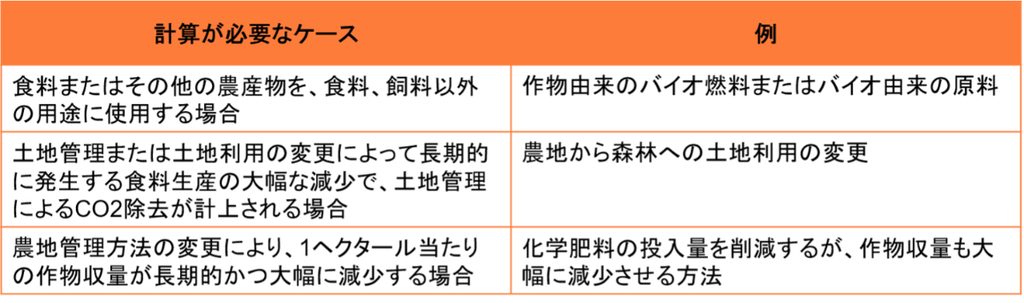
Looking at this, it is clear that the scenarios generally assume an impact on existing food production. On the other hand, while there is no mention of forest bioeconomy activities—such as the shift from existing to new uses of timber, as discussed in my previous article—we will need to continue monitoring this situation closely.
In addition, with regard to forestry, this includes cases where “land use is converted from agricultural land to forest,” but there is a proviso stating, “except where such conversion is carried out to improve the long-term sustainability of food production.” Therefore, while it is considered permissible to convert portions of low-productivity farmland into windbreak or sand-control forests, it remains unclear how new afforestation for carbon sequestration would be assessed.
It is important to note that, concurrent with the publication of the guidance for the land sector, the GHG Protocol launched a Request for Information regarding standards for the forestry sector. As stated in the phrase, “Future versions of this Standard may include forestry,” it appears that the GHG Protocol aims to clarify key issues through these discussions and eventually incorporate the forestry sector into the Land Sector Standard.
Discussions on forest carbon accounting under the GHG Protocol began in December 2024, and a draft was finalized by June 2025. This draft outlined two methods based on different approaches: Managed Land Proxy Plus (MLP+) and Activity-Based Accounting (ABA). In this latest round of information gathering, it appears that the organization is seeking evidence and opinions on these two calculation methods not only from companies but also from environmental organizations and others, in an effort to find a path toward consensus.
“MLP” may be an unfamiliar term, but it is essentially the carbon accounting method currently adopted by most companies and countries. Based on guidelines established by the IPCC (Intergovernmental Panel on Climate Change), this method calculates the annual physical changes in carbon stocks occurring in managed forests owned or controlled by a company, or in production forests attributable to the company’s procurement (Figure 2, left).

The reason the name includes “Plus” is that, in addition to the conventional MLP, it has been proposed to issue a separate report on how interventions such as forest management, conservation, and afforestation have affected outcomes compared to a counterfactual scenario.
On the other hand, ABA is a method for calculating how much corporate logging, forest management, and timber use have actually altered carbon stocks by comparing them to a hypothetical baseline representing the situation “if those activities had not been carried out” (Figure 2, right). In other words, rather than assessing the annual carbon balance of the forest as a whole, it evaluates only the additional impact on atmospheric carbon resulting from specific corporate activities such as logging, afforestation, forest management, and timber use.
If the ABA method is adopted, it will no longer be possible to count the CO2 that trees in a company’s owned forests absorb “naturally,” so to speak, as a result of the company’s business activities. In particular, for overseas afforestation sites, local government regulations may require the designation of large protected areas. Consequently, even if a company owns and manages such areas, there is a risk that the carbon sequestration from protected areas—for which the company cannot demonstrate additionality resulting from specific activities—will not be eligible for crediting.
The difference between the two reflects a fundamental question regarding how to characterize the carbon dynamics of forests managed by companies. Specifically, while the former, MLP+, treats a company’s GHG inventory as a physical carbon balance, the latter, ABA, seeks to characterize it as the difference between the current state and a world without corporate activities.
Of course, this does not impose restrictions on other ecosystem services, such as biodiversity conservation and water resource conservation; however, if a similar approach were applied, it could result in forest owners merely “bearing the costs of ownership.” For this reason, I believe this is a fundamental debate that will significantly influence the future of the forestry sector, particularly the potential for monetizing ecosystem services. While the call for comments will be open globally until February 2027, lively debate is also expected in Japan. (Takanobu Aikawa, Senior Manager, PwC Intelligence, PwC Consulting LLC)
*References
・ Takanobu Aikawa (2026), “Opportunities and Risks for the Forest Circular Economy Posed by the GHG Protocol’s New Land Sector Standard: “Biomass Cannot Be Unconditionally Recognized as Carbon Neutral”」
・ Takanobu Aikawa (2025), “Is Planted Forestry Nature Positive? Interpreting the Interim Report of the Forest Natural Capital Project Released for COP30」
・ GHG Protocol (2026a) “Land Sector and Removals Standard. Version 1.1”
・ GHG Protocol (2026b) “Land Sector and Relocation Guidance. Version 1.0”
・ GHG Protocol (2026c) “Forest Carbon Accounting Request for Information”
・ GHG Protocol (2025a) “FCA Quantification Approach – Activity-Based Accounting (ABA)”
・ GHG Protocol (2025b) “FCA Quantification Approach – Managed Land Proxy Plus (MLP+)”