


Updated by the Editorial Department of *Forest Circular Economy* on September 9, 2026, at 4:26 p.m. JST
Editorial Board, Forest Circular Economy
Forestcircularity-editor
We aim to realize "Vision 2050: Japan Shines, Forest Circular Economy" promoted by the Platinum Forest Industry Initiative. We will disseminate ideas and initiatives to promote biomass chemistry, realize woody and lumbery communities, and encourage innovation in the forestry industry in order to fully utilize forest resources to decarbonize the economy, strengthen economic security, and create local communities.
There is a growing trend to build a circular economy—encompassing processing, commercialization, procurement, financial returns, and forest regeneration—rather than simply “using” or “planting” domestic hardwoods. Until now, due to difficulties in processing and distribution, the majority of domestic hardwoods had been limited to uses such as wood chips and fuel; furthermore, the degradation of neglected satoyama forests and the lack of proper management had been major challenges. In response to this situation, multifaceted approaches are gaining momentum, including the establishment of processing technologies, the restructuring of supply chains, and the restoration of forest ecosystems. From technological development aimed at converting these woods into furniture materials to the establishment of procurement routes that bypass commercial intermediaries, the development of craft products utilizing rare woods, and even tree-planting initiatives for “Nature-Harmonious Site” certification and the restoration of watershed forests—practices that balance economic viability with environmental value are emerging one after another.
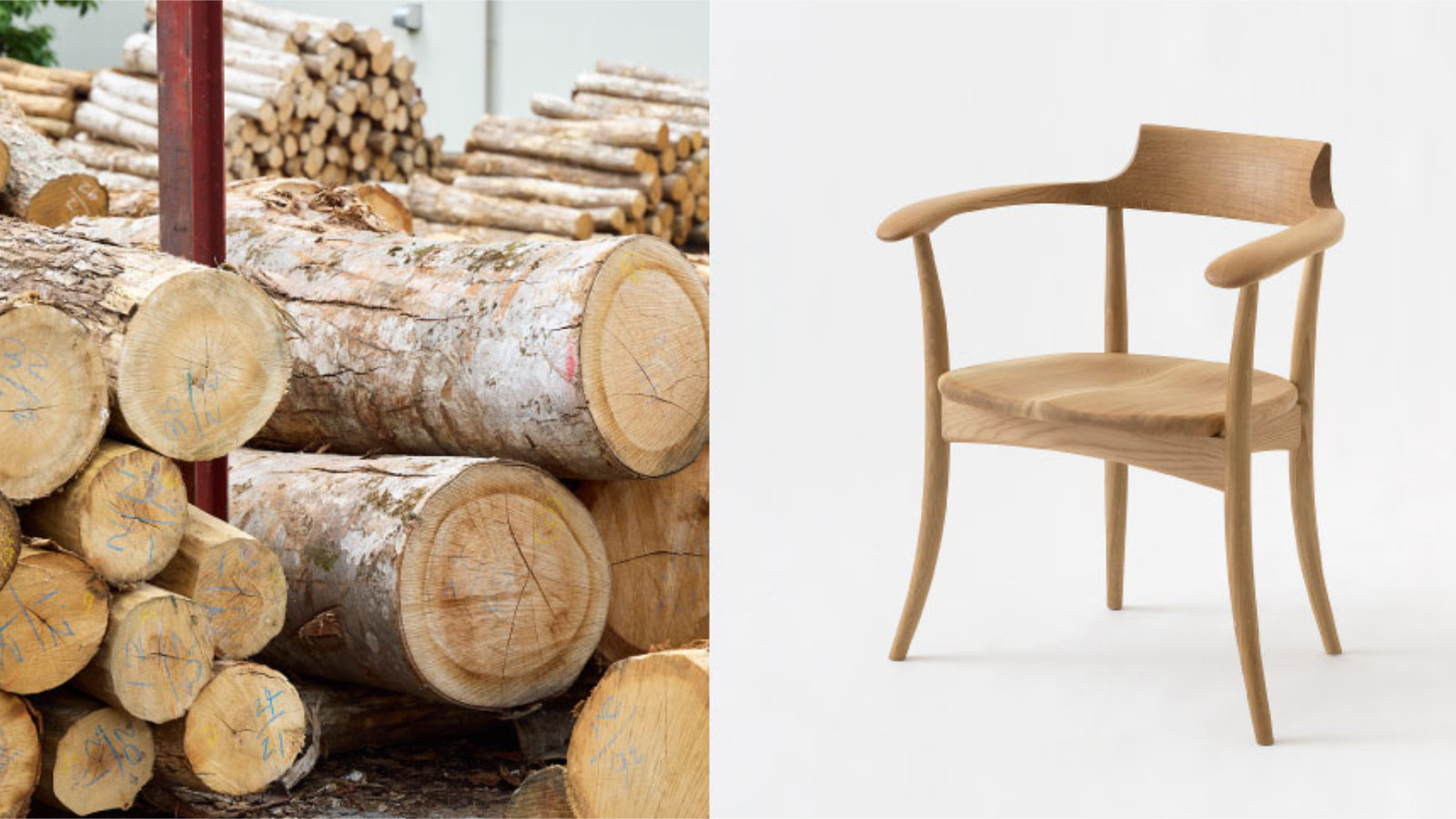
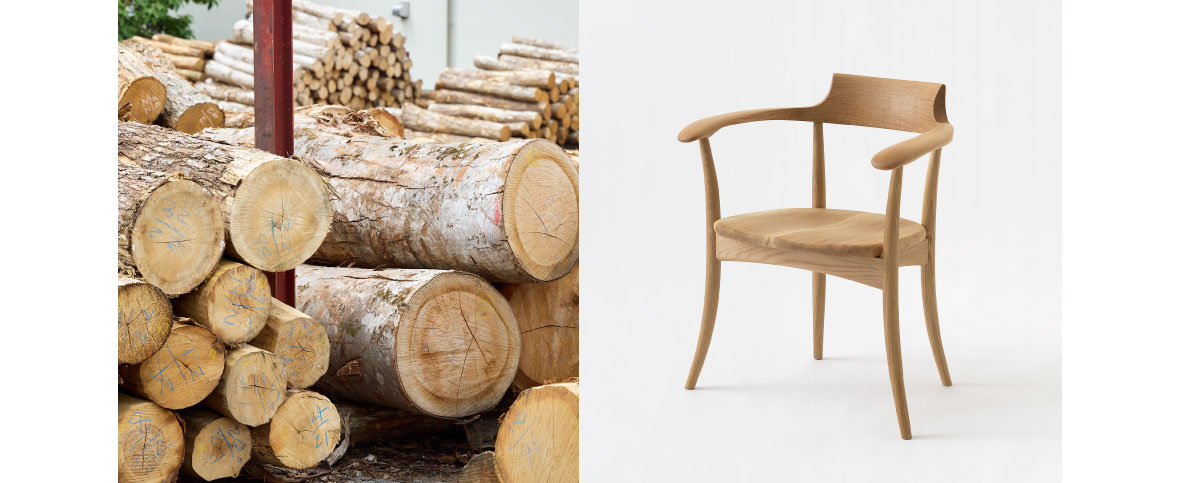
A research project titled “Development of High-Value-Added Utilization Technologies for the Waste-Free Use of Locally Produced Hardwood,” proposed by Hida Sangyo, the Forestry and Forest Products Research Institute, and the Gifu Prefectural Institute of Living Technology, has been selected for the Reiwa 8 “Open Innovation Research and Commercialization Promotion Program” by the Research Support Center for Specific Industrial Technologies in the Biological Sciences. Broadleaf timber harvested from satoyama forests often consists of small-diameter and short-length logs, and because it contains a mix of various tree species in small quantities, it has traditionally been difficult to utilize in conventional furniture manufacturing. Under this project, the team will focus on techniques such as bending small-diameter logs—including Japanese oak, chestnut, beech, and wild cherry. Over the course of four years, the project will develop technologies such as bentwood processing for joined small-diameter lumber and color-adjustment techniques to minimize color variations, as well as three-dimensional machining of “multi-species composite laminated wood” made by layering multiple tree species and new vertical jointing techniques that combine aesthetic appeal with strength. The project will also collaborate on the formulation of log sorting standards. The developed processing and bonding technologies will be applied to the commercialization of Hida Sangyo’s standard chair series. Following the launch of a new series of products in fiscal year 2029—including furniture made from multi-species laminated wood—the company plans to roll out these results nationwide as the “Hida Model.” Japan’s self-sufficiency rate for hardwood stands at only about 10 percent, and its utilization for high-value-added applications such as furniture and interior materials remains at an extremely low level of less than 5 percent. By adding high value to underutilized hardwood—which has primarily been consumed as inexpensive wood chips or fuel—the company aims to establish a system that returns approximately 4.5 billion yen in circulating funds annually to mountain communities, thereby helping to raise its own ratio of domestically sourced wood to 30% by 2030 (compared to 19.9% in 2025).
*Reference link
Joint Research Project Selected for the Open Innovation Research and Commercialization Promotion Program | Hida Sangyo Co., Ltd.
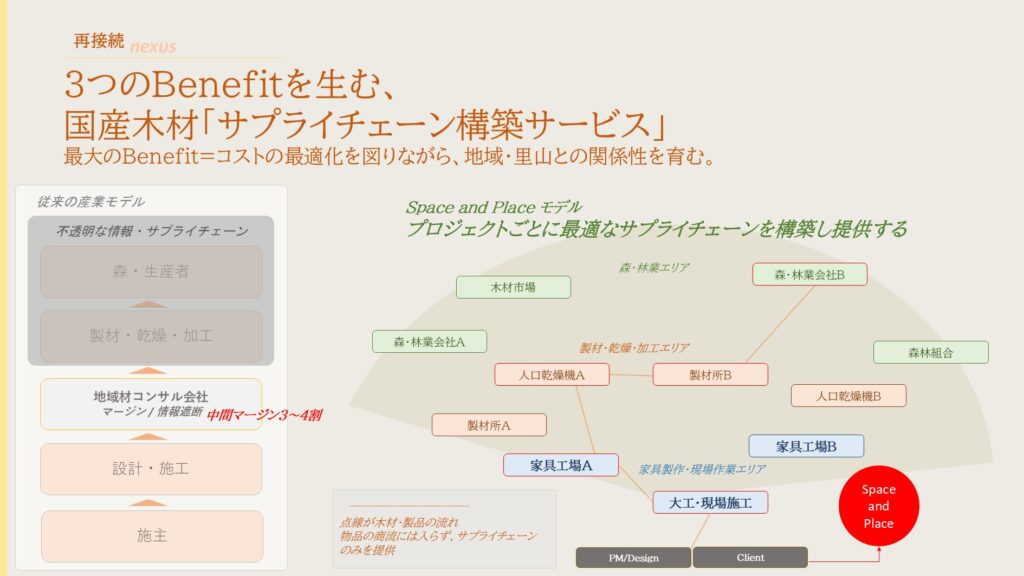
Space & Place has launched a “Supply Chain Development Service” designed to establish procurement channels for domestically sourced timber. A key feature of this service is that the company does not intervene in the physical flow of goods but instead specializes in designing procurement schemes. In addition to coordinating specifications and managing quality control for drying and processing, the company provides ongoing support for document preparation to ensure compliance with the Clean Wood Act (a Japanese law promoting the distribution and use of legally harvested timber) as well as ESG and TNFD standards. “Satoyama broadleaf trees,” such as Konara and Kunugi, which were once used for firewood and charcoal, played a role in fostering rich biodiversity by allowing light to reach the forest floor through regular harvesting. Through corporate timber procurement, the company aims to implement a “regenerative approach” in society—one that revives the circular use of these broadleaf trees and satoyama ecosystems and actively regenerates ecosystems. By overcoming procurement hurdles—such as complex distribution structures and knowledge gaps between upstream and downstream stakeholders—the initiative is expected to accelerate the use of regional timber, including domestically sourced broadleaf trees.
*Reference link
Reconnecting Cities and Forests: Launch of a “Supply Chain Development Service” for Domestically Sourced Lumber | PR TIMES
Shingu Shoko, a comprehensive timber trading company, began accepting orders on September 2 for the “Hokkaido Mizunara Bottle – Kogei,” a premium model of wooden bottles for aging alcoholic beverages made from Hokkaido-grown Mizunara oak. Developed in collaboration with contemporary artist Kei Arabuna, the bottle features a charring process—similar to that used on oak barrels—applied to its interior. This allows the unique flavor and aroma compounds of Mizunara oak to infuse into the poured liquor, enabling further aging at home in about two weeks. The bottle fuses traditional Japanese craftsmanship and materials, including an Ainu pattern officially certified by the Akan Ainu Consultation, a Kutani-ware lid, lacquer finish, and a Takaoka copper hoop. It also incorporates a repairable structure that allows for the replacement of internal components and re-charring, ensuring it can be used for many years to come. Hokkaido-grown Mizunara oak, used in whiskey barrels and other applications, is highly regarded worldwide as a rare broadleaf tree that imparts a distinctive aroma. This project is drawing attention as an initiative to create high added value by leveraging the material’s characteristics in the realm of traditional crafts.

*Reference link
Announcement of the New Release of “Hokkaido Mizunara Bottle -Craft-” | Shingu Shoko Co., Ltd.
“MISHIMA Forest,” a cooperative forest managed jointly by Yusuhara Town in Kochi Prefecture and Dai-Nippon Diamond Consultants, has been certified as a “Nature Coexistence Site” by the Ministry of the Environment. As part of the “Research on the Development of SX Business,” the project has utilized the corporate version of the “Hometown Tax” system to plant broadleaf trees on land where coniferous plantations were previously harvested, thereby promoting the creation of a “satotabi-satoyama” environment. Field surveys confirmed the presence of a diverse range of native flora and fauna, including rare bird species such as the cuckoo and the red-throated loon, and the project’s achievements in biodiversity conservation were highly praised. It is drawing attention as a model case that links the restoration of natural capital with ESG management.
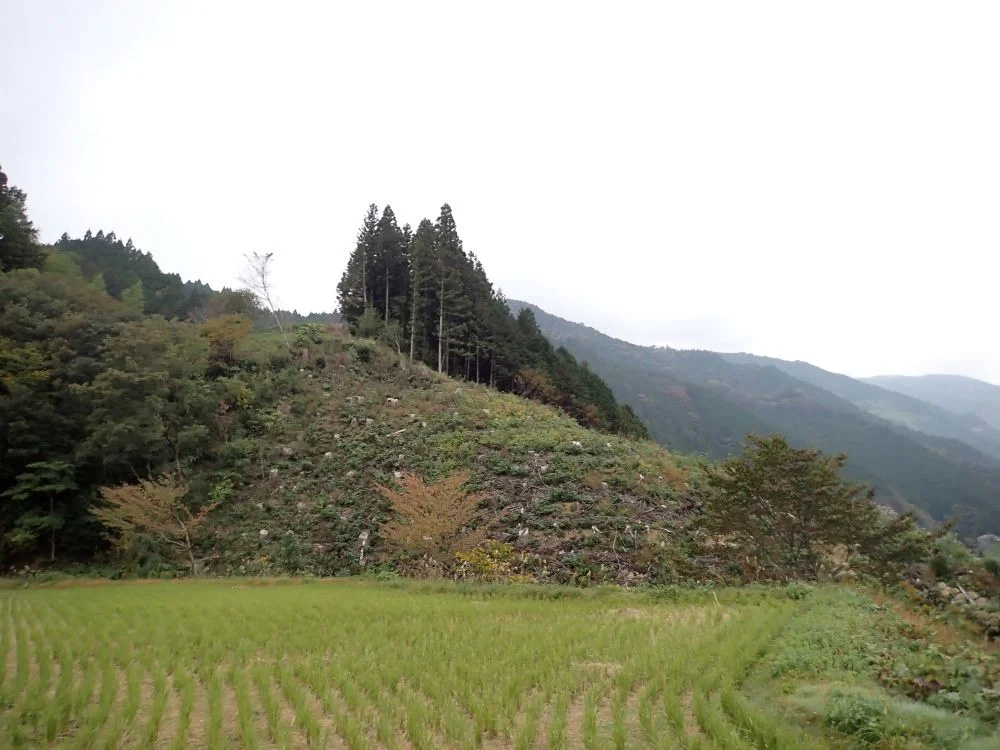
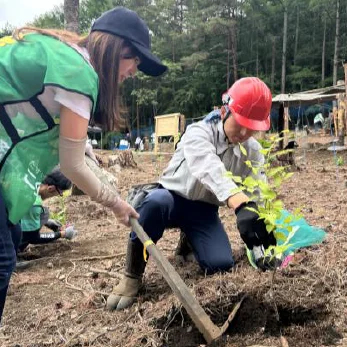
Kokumin Kyosai coop (National Federation of Workers’ Mutual Aid Consumer Cooperatives) held the first tree-planting event for the “Kokumin Kyosai coop Forest” in Ashikawa-cho, Fuefuki City, Yamanashi Prefecture, in May. In collaboration with “Present Tree,” a forest restoration project operated by the certified NPO Environmental Relations Institute, the organization is working to plant a diverse array of native broadleaf trees on a larch logging site in the Ashikawa headwaters—an area where the number of neglected plantations and logging sites has been increasing due to depopulation. Of the 2,000 trees planned, 100 were planted during the first event. We planted native species such as Japanese white oak, beech, magnolia, and wild cherry, which will be nurtured for 10 years. The goal is to cultivate a watershed forest that will endure for the next 100 years. Funding for the initiative comes from cost savings achieved through the cooperative members’ adoption of paperless procedures. The project is being developed as a model for channeling consumers’ environmentally conscious actions back into forest restoration efforts.
*Reference link
On May 28, 2026, we held our first tree-planting event! | Kokumin Kyosai coop
