


Updated by the Editorial Department of *Forest Circular Economy* on September 24, 2026, at 9:31 p.m. JST
Editorial Board, Forest Circular Economy
Forestcircularity-editor
We aim to realize "Vision 2050: Japan Shines, Forest Circular Economy" promoted by the Platinum Forest Industry Initiative. We will disseminate ideas and initiatives to promote biomass chemistry, realize woody and lumbery communities, and encourage innovation in the forestry industry in order to fully utilize forest resources to decarbonize the economy, strengthen economic security, and create local communities.
How can we link the demand for wooden buildings and fuels and chemical products derived from woody biomass to increased profitability in the forestry industry and the circular use of forest resources? At the seminar hosted by the Platinum Vision Network during FORESTRISE 2026 on September 18, experts and practitioners discussed the realization of a “forest circular economy”—which aims to achieve both decarbonization and a reduction in dependence on imported crude oil—from three perspectives: timber-frame cities, biomass chemistry, and forests and forestry. The discussions highlighted the need to design a comprehensive approach that integrates not only demand creation but also stable supply, the consolidation of forest land, and the return of profits to forest owners and forestry operators.
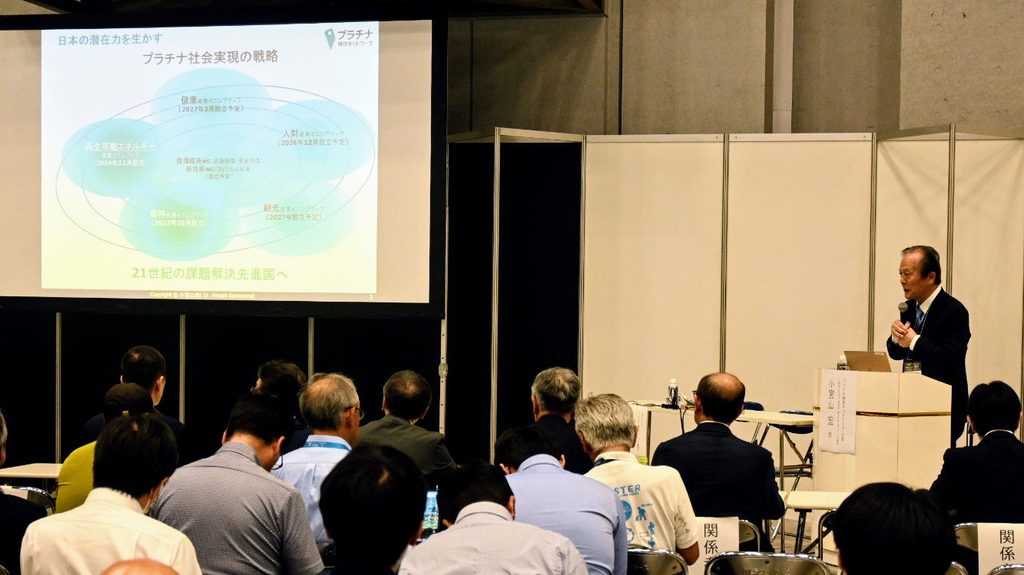
At the start of the seminar, Hiroshi Komiyama (Chairman of the Platinum Vision Network) pointed out that the conventional approach—which sought to improve profitability solely through upstream forestry operations such as logging and reforestation—had structural limitations. Rather than addressing these challenges with piecemeal solutions, he presented a strategy to create new demand—specifically for wood-based cities and biomass chemistry—with an eye toward achieving carbon neutrality by 2050, and to use that demand to drive and revitalize the highly challenging upstream forestry sector. He emphasized the importance of industry, government, academia, financial institutions, and local governments working together to build a sustainable “forest circular economy” aimed at establishing a “self-sufficient nation” that does not rely on imported resources.
As efforts to promote the use of wood in urban construction continue to gain momentum, the Platinum Vision Network has set forth a vision for the future—to promote the use of wood in buildings up to nine stories tall by 2050—with the aim of revitalizing the stagnant forestry industry through massive demand. Furthermore, efforts are underway to implement this vision on a regional scale—extending beyond individual buildings to encompass “entire towns”—such as the development around the new Maglev station in Iida City, Nagano Prefecture.
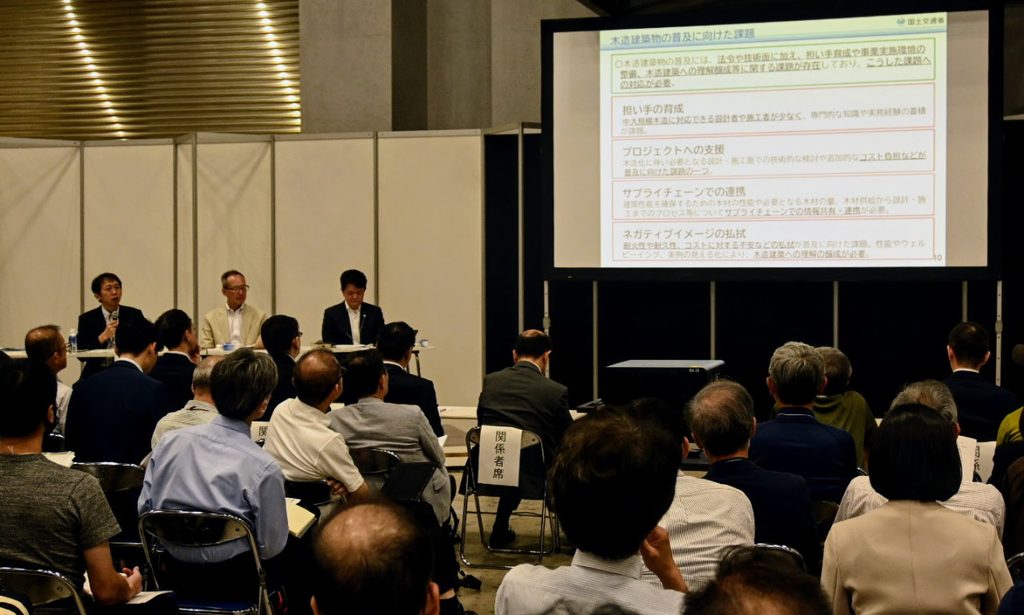
According to data from the Ministry of Land, Infrastructure, Transport and Tourism, while wood-frame construction accounts for about 90 percent of low-rise residential buildings, the proportion is extremely low in mid- to high-rise residential buildings and non-residential structures. To stimulate demand, speakers presented a series of arguments highlighting environmental benefits and well-being. Atsuhito Oshima of the Ministry of Land, Infrastructure, Transport and Tourism explained the CO₂ reduction effects during the material manufacturing and construction phases compared to reinforced concrete (RC) and steel-frame construction, as well as the importance of carbon sequestration assessments. Professor Emeritus Shunji Ikaga of Keio University presented empirical studies demonstrating improvements in children’s physical health following wood-based renovations at schools, as well as enhancements in work efficiency and sleep quality in offices and dormitories. Such quantification (visualization) is considered essential not only for building owners but also for obtaining accurate assessments of asset value and securing long-term financing from investors and financial institutions.
Regarding challenges to widespread adoption, Hiroyuki Adachi (Shelter / Japan Association for Wooden Fire-Resistant Buildings) highlighted the current reality that advancements in fire- and earthquake-resistant technologies have made mid- to high-rise construction possible, as well as the advantage of significantly lower CO₂ emissions during manufacturing and other stages compared to reinforced concrete (RC) construction. He also emphasized the importance of design that takes into account demolition and reuse. Meanwhile, Mr. Oshima emphasized that, in addition to building supply chains that connect upstream and downstream sectors and developing specialized talent, establishing standard models for medium-sized buildings of four to five stories—which are easier to implement even in regional cities—is a key challenge for future adoption.
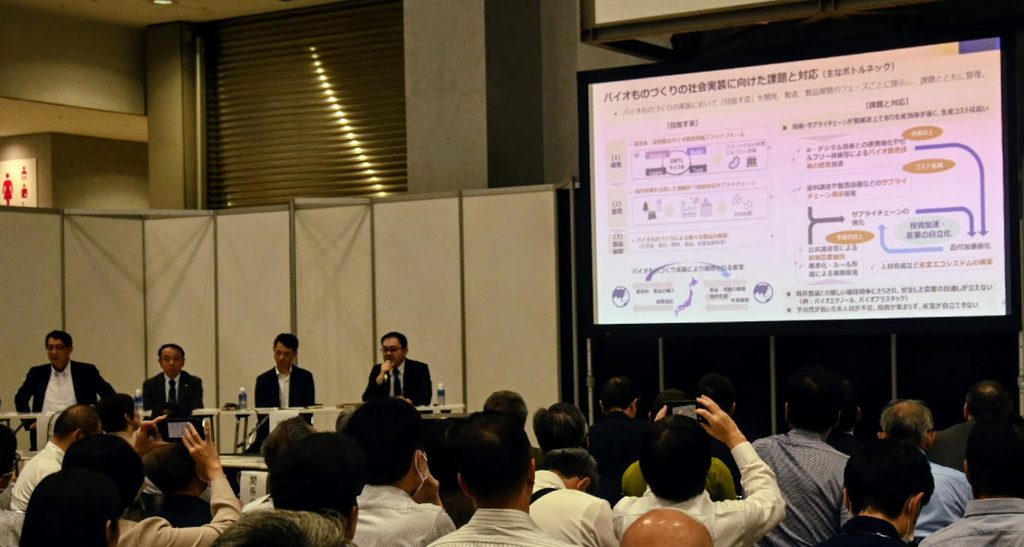
In the chemical and energy sectors, with an eye toward decarbonization, strengthening economic security, and regional revitalization, efforts are underway to produce fuels and chemical products from domestic wood resources in order to reduce dependence on fossil resources such as imported crude oil and naphtha. The goal is to produce fuels and chemical feedstocks—such as ethanol and methanol—as well as materials like modified lignin from wood-based resources, thereby replacing some products derived from fossil resources.
Mr. Makoto Nakayama of the Ministry of Economy, Trade and Industry explained that, through initiatives such as the “Bio-Manufacturing Revolution Promotion Project” and the “Green Innovation (GI) Fund,” technology development and demonstration projects are currently underway in collaboration with private-sector companies, with a view toward industrialization around 2030.
Speakers from private companies presented reports tailored to their respective stages of technological development. Mr. Taketo Okutani of Oji Holdings introduced research and demonstration initiatives aimed at creating biochemicals—such as photoresists for semiconductors and pharmaceutical materials—by leveraging the foundation of the company’s forestry and paper manufacturing businesses, cultivated over many years, as well as the infrastructure of its pulp mills. Additionally, Mr. Shoji Matsukawa of Mitsubishi Gas Chemical explained that a project to build a platform for the production and supply of environmentally sustainable methanol using underutilized forest resources and biogas is currently in the demonstration and commercialization evaluation phase.
Key issues for market development included the price differential compared to existing petroleum products and the “social acceptability” (understanding of environmental value) among the public and consumers. Mr. Nakayama touched on the need to explore ways to generate initial demand through mechanisms such as public procurement, while Mr. Masahiro Naruse of the Forestry Agency explained that establishing a stable supply system for raw materials—including underutilized timber—directly from forest sources is a prerequisite for meeting demand for fuels (such as SAF) and chemical products. Furthermore, the panelists highlighted the importance of promoting understanding through the quantification and visualization of environmental value, as well as the design of an overarching supply chain (a “big design”) that transcends sectors such as forestry, chemicals, and energy.
To meet the demand for lumber, it is necessary to increase supply capacity and productivity at the very source—the forestry sites. Among the challenges facing Japan’s forestry industry are the fragmentation of forest land ownership, unclear property boundaries, and a lack of road networks, such as access roads.
Hiroshi Kuboyama of the Forestry and Forest Products Research Institute presented a structural comparison with Austria, explaining that Austria has a road network density approximately three times that of Japan and logging plot sizes more than four times as large. He further emphasized that a road network capable of accommodating large heavy machinery and trailers has enabled a system of direct delivery from logging yards to mills, and that these cost savings translate into higher stumpage prices for forest owners.
In addition, Professor Satoshi Tachibana of Kyoto University (Chair of the Forestry Policy Council) explained that the new “Basic Plan for Forests and Forestry,” approved by the Cabinet in June, sets forth policies for consolidating operations in areas suitable for forestry and ensuring “reliable reforestation.” In particular, he highlighted the importance of promoting the “perimeter-delimitation method,” which reduces the costs of determining individual property boundaries, as well as zoning that avoids unnecessary logging in areas unsuitable for forestry and instead generates revenue through diversified “forest-based industries” such as J-Credits and forest therapy.
As a concrete proposal for clarifying boundaries and consolidating land, Mr. Takashi Hodo of Yomon proposed a “forest land readjustment project” that applies the methods used in urban “site-reorganization-type land readjustment projects.” By surveying only the perimeter and allocating the interior area on a pro-rata basis, and by utilizing a legal framework that allows the project to proceed with “the consent of two-thirds or more” of the landowners, it is possible to significantly reduce the barrier of obtaining unanimous consent and survey costs. However, Mr. Hodo pointed out the difficulty of recouping development costs in forested areas where land price appreciation is unlikely, and explained that verifying a funding plan—including the allocation of road network subsidies and the disposal of reserved land—remains a challenge for the future.
As an example of high productivity on the job site, Mr. Kimiya Shibata of Shibata Industries reported that the company achieved a high productivity rate of approximately 40 cubic meters per person per day by introducing a European-style CTL system (harvester and forwarder). He noted that the company has established a vertically integrated model that encompasses not only raw material production but also sawmilling, biomass power generation, and construction, and emphasized that diversifying demand within the region—such as through agricultural and livestock facilities—is essential for sustainable business operations.
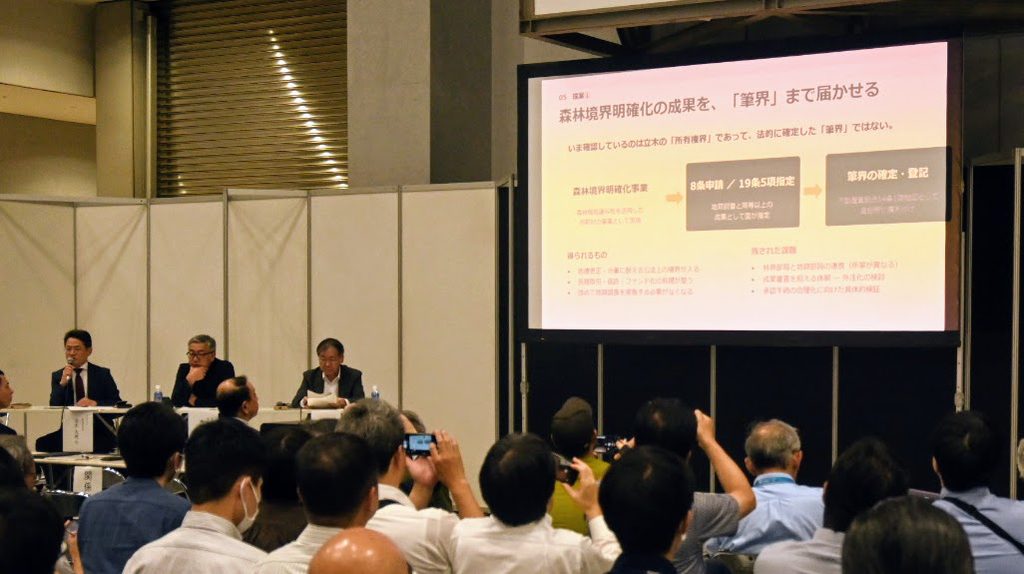
Discussions during the three sessions revealed a structural challenge: even if demand for wood increases, this does not necessarily lead to improved profits for forest owners and forestry operators or to reforestation. Even if demand is generated by wood-frame construction and the biomass chemical industry, costs are incurred at each stage—harvesting, hauling, transportation, and processing—and the price differential compared to products derived from fossil resources acts as a barrier to entry. To return the added value generated on the demand side to the local community, it is essential to design a “cascade utilization” system within the region that combines the long-term use of construction lumber with the utilization of offcuts and low-quality wood for chemical products and fuel, in addition to establishing appropriate pricing and trading mechanisms.
To summarize the discussions from this seminar, the key issues that should be considered moving forward in advancing the implementation of a forest circular economy can be summarized as the following four points.
interpoint (interword separation)"Visualizing Value" and the Recirculation of Added Value: Quantitative assessment of CO₂ emissions, carbon sequestration, and effects on well-being throughout a building’s life cycle, along with mechanisms for generating returns through the creation of high added value.
interpoint (interword separation)Establishing a Stable Supply System and Generating Initial Demand: Low-cost, stable supply through Forest DX and smart forestry, combined with the formation of an initial market driven by public procurement and institutional support.
interpoint (interword separation)Infrastructure Development and Institutional Reform: Funding and legal frameworks to support forest land consolidation (including the legal institutionalization of forest land readjustment projects) and the development of a high-density road network.
interpoint (interword separation)Selection of “Suitable Forestry Sites” and Diversification of the “Forestry Industry”: Promoting consolidation through zoning and diversifying local revenue streams by combining J-Credits with land use and other forestry-related activities.
The development of Japan’s forestry industry hinges on stakeholders from fields such as architecture, chemistry, public administration, finance, and forestry working together to address these issues while fostering an understanding among the public and investors of the value of forest resources.
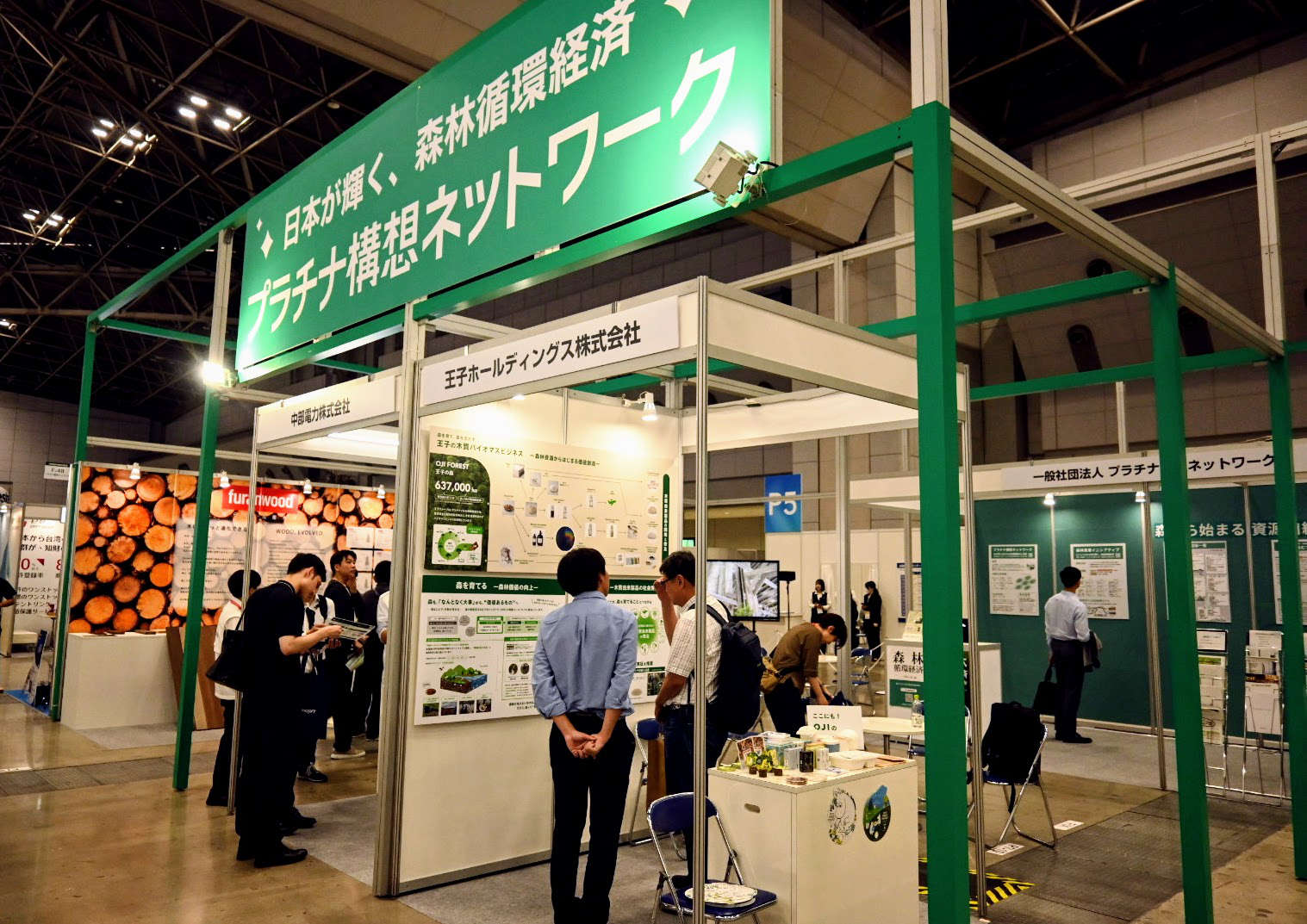
Specific initiatives related to the forest circular economy were also showcased at the FORESTRISE 2026 venue. Five organizations, including member companies and universities, participated in the joint pavilion organized by the Platinum Initiative Network. The exhibition presented a comprehensive overview of forest resource utilization, ranging from upstream initiatives such as forest land consolidation and forest management to downstream value-added activities like the development of new materials and biomass chemistry.
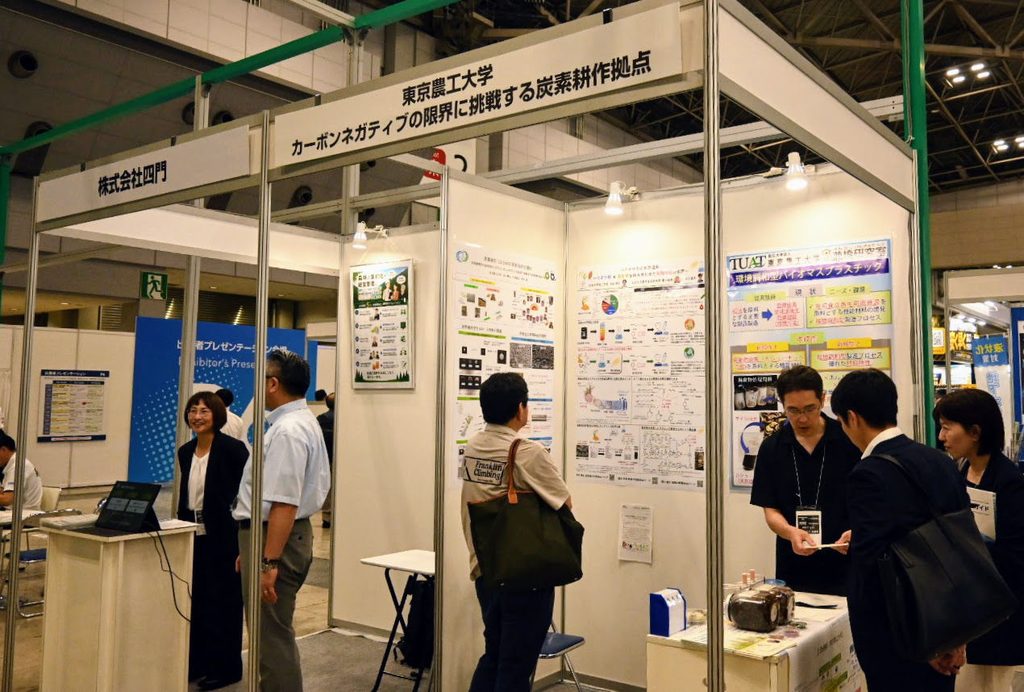
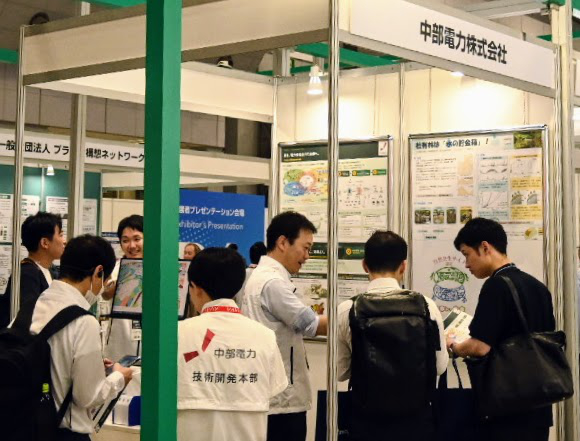
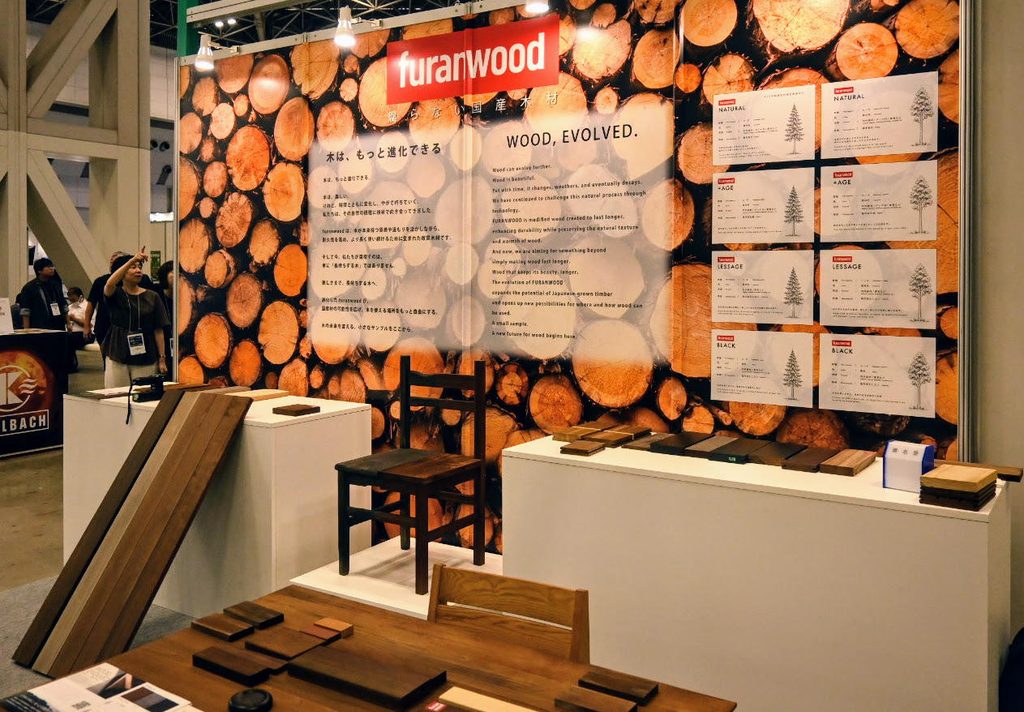
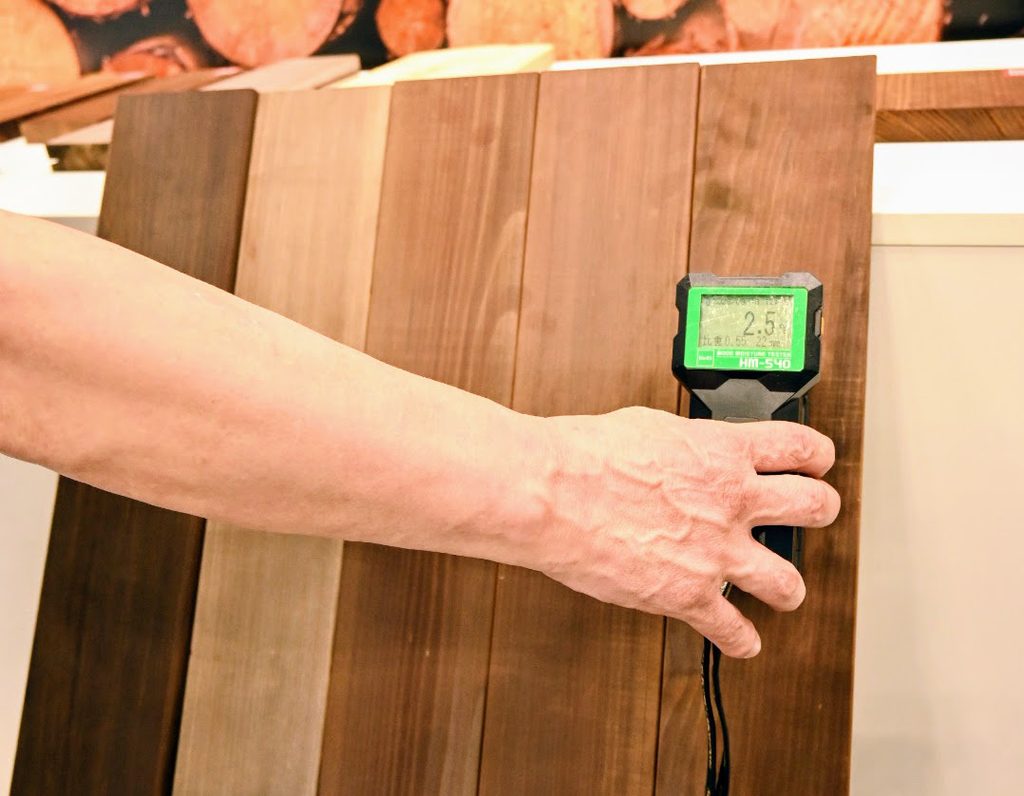

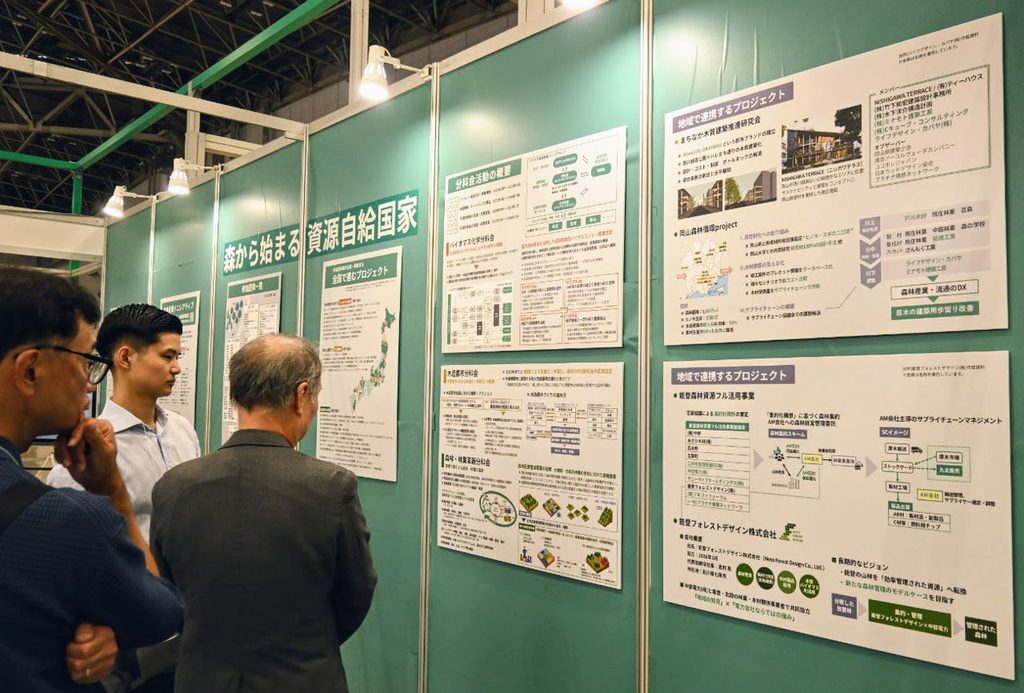
At each booth, in addition to maps introducing the activities of the three subcommittees of the Platinum Forest Industry Initiative and related projects, exhibits included Oji Holdings’ biomass manufacturing, Furuwood’s modified wood technology, Shimon’s support for forest land consolidation, Chubu Electric Power’s community-based forest management, and and material development through “carbon farming” by the Tokyo University of Agriculture and Technology. Special sessions hosted by participating organizations were also held, attracting significant interest from visitors.
*Related Links*
FORESTRISE 2026: The 5th Next-Generation Forestry Industry Exhibition
