


Updated by the Editorial Department of *Forest Circular Economy* on November 17, 2026, at 5:58 p.m. JST
Editorial Board, Forest Circular Economy
Forestcircularity-editor
We aim to realize "Vision 2050: Japan Shines, Forest Circular Economy" promoted by the Platinum Forest Industry Initiative. We will disseminate ideas and initiatives to promote biomass chemistry, realize woody and lumbery communities, and encourage innovation in the forestry industry in order to fully utilize forest resources to decarbonize the economy, strengthen economic security, and create local communities.
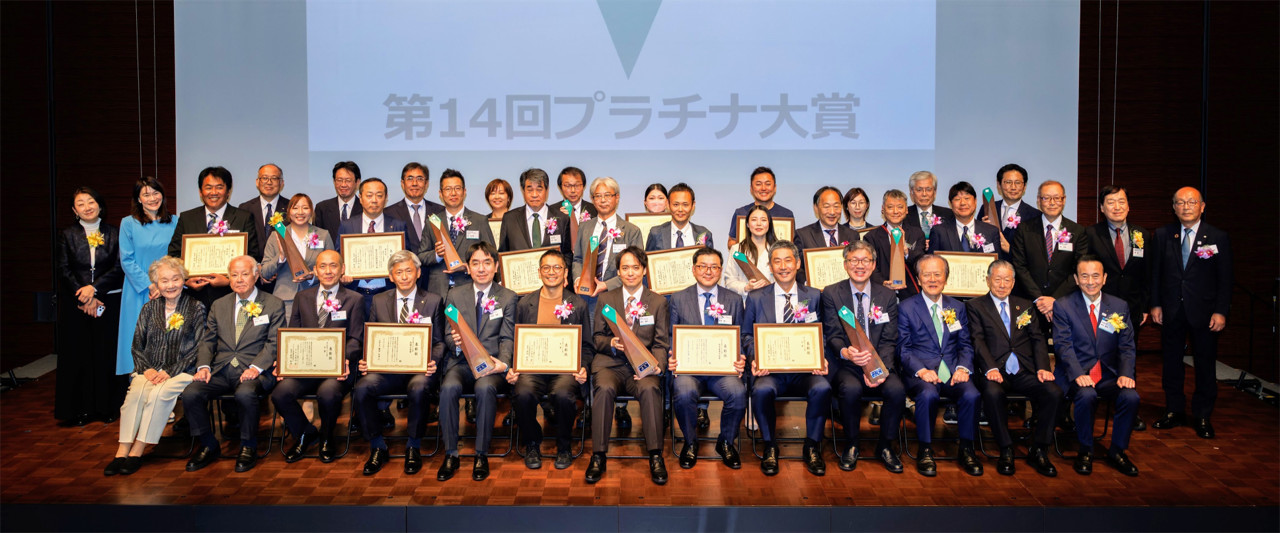
The final judging session for the “14th Platinum Grand Prize,” which recognizes outstanding models for solving regional issues, was held in Tokyo on November 5. Of the 52 entries submitted from across the country, 11 initiatives that passed the initial document screening advanced to the final round. As a result of the judging, three initiatives were selected for the Grand Prize: “Bespla,” which links health promotion with the local economic cycle; “Farmland Connect” in Iwate Prefecture, which uses digital technology to support farmland consolidation; and the “Waita Model,” which returns profits from geothermal power generation to the local community. All three initiatives address regional challenges by leveraging objective data, establishing mechanisms for stakeholder coordination, and fostering self-sustaining financial cycles to generate economic value. The “Forest Circular Economy Award,” an Excellence Award, was awarded to projects such as that of Nichinan Town in Tottori Prefecture, which promotes the integrated use of timber and reforestation.
The Platinum Grand Prize was awarded to Bethpla for its project, “Healthy Longevity and Community Economic Circulation Through ‘Brain-Boosting Apps’ and Health Points.” Based on findings from dementia prevention research, the company developed a smartphone app that encourages social participation through activities such as exercise, dietary management, brain training, and volunteer work. The app awards points based on participation, and the system allows these points to be redeemed at local partner stores or exchanged for local currency.
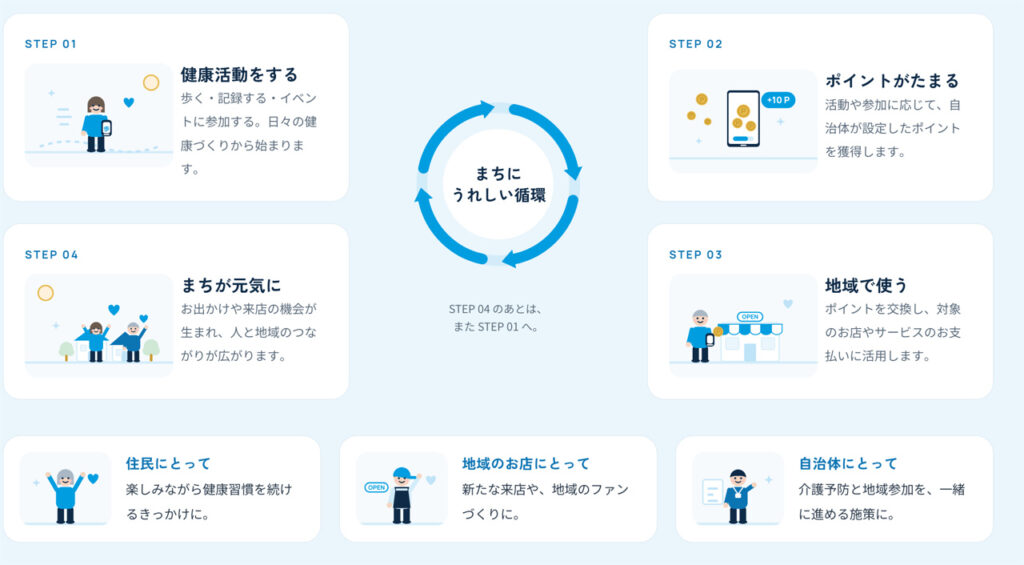
A key feature of this initiative is its attempt to verify the social impact of preventive measures using objective data. According to a report by Bespla, an EBPM (Evidence-Based Policy Making) analysis of national health insurance and long-term care data in Hachioji City, Tokyo, suggested that each app user resulted in an annual reduction in social security costs of 28,819 yen (21,209 yen in medical expenses and 7,610 yen in long-term care expenses).
While the program aims to reduce future financial burdens through health promotion, it is also designed to encourage consumers to shop at local stores by using reward points. Although the actual scale of local spending remains to be verified at this stage, the program’s design—which minimizes initial implementation costs for local governments—has already led to its adoption by more than 25 municipalities nationwide.
The Grand Prize and the Minister of Internal Affairs and Communications Award were awarded to “The Future of Agriculture Pioneered by Farmland Connect,” a project by Iwate Prefecture, Tannbo, and the Bank of Iwate. This initiative addressed a structural challenge: while farmland is increasingly concentrated among active farmers as more farmers leave the industry, the fragmentation and complexity of cultivated land have led to a significant decline in operational efficiency.
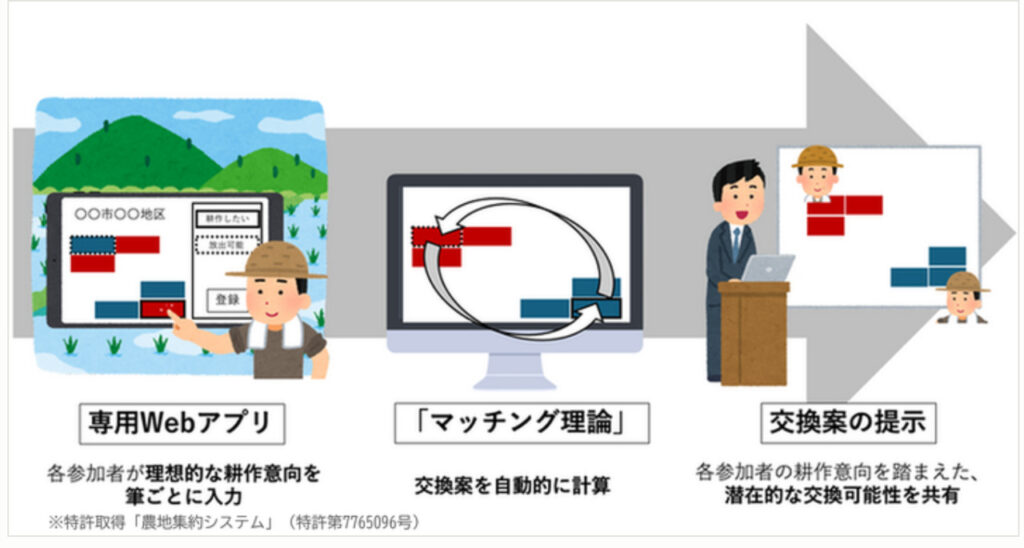
For this project, we developed “Farmland Connect,” a dedicated web application that implements the economic theory of matching. When farmers enter their cultivation preferences for each individual plot via a smartphone or other device, the algorithm automatically calculates and presents the optimal exchange proposal, taking into account the benefits of all parties involved. By using data to visualize land-use coordination—which traditionally tended to rely on individual negotiations among stakeholders—the project facilitated 56 successful matches during pilot tests in Morioka City and other locations, 28 of which resulted in actual farmland exchanges.
The fact that verifying boundaries and coordinating land use rights requires a great deal of effort, and that land use is highly fragmented, presents challenges similar to those faced in the intensification of forest management. An approach that uses mathematical models to support the consensus-building process—which has traditionally relied on ad hoc negotiations—and presents options that are more readily acceptable to stakeholders offers valuable insights for project design in other fields aiming to optimize land use.
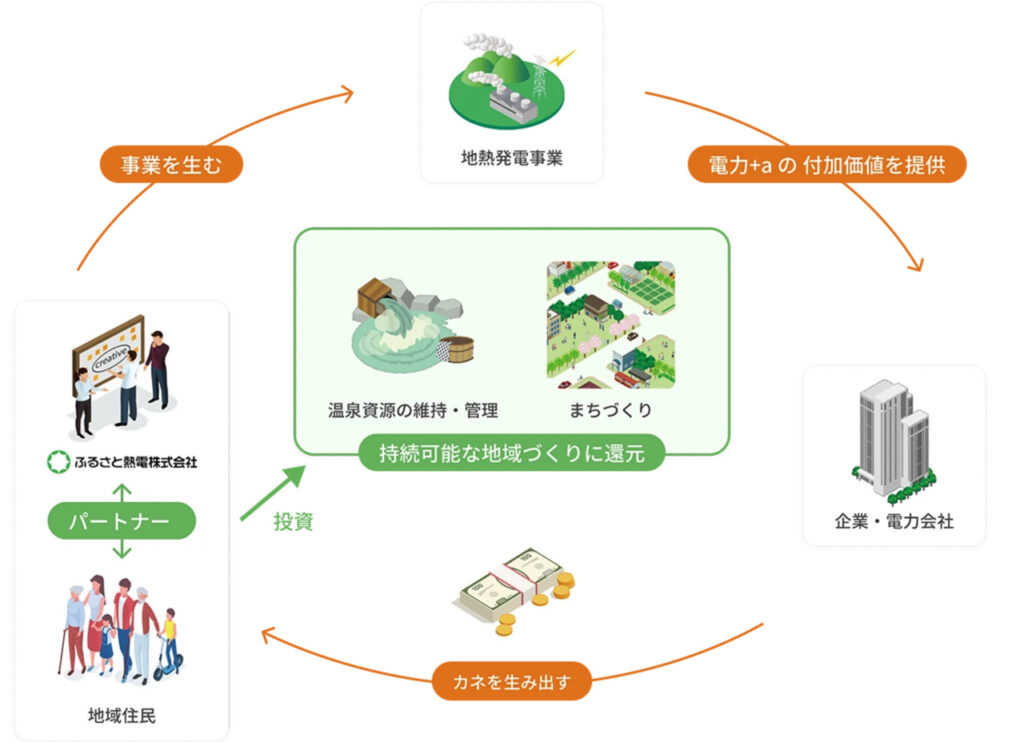
The Grand Prize—the Minister of Economy, Trade and Industry Award—was awarded to the “Waiita Model,” a collaborative effort by NTT, NTT Anode Energy, the Waiita Association, Furusato Thermal Power, the NTT West Kumamoto Branch, and the Regional Revitalization Co-Design Institute. In the Waita district of Oguni Town, Kumamoto Prefecture, this initiative operates a power generation business that harnesses abundant geothermal resources, with the resulting revenue and environmental benefits being utilized through a community-led approach.
Source: Furusato Thermal Power Co., Ltd.
To prevent profits from flowing out of the region due to development driven by outside capital, the Waita Model designates the “Waita Association”—comprising all 30 local households—as the project operator. Working in partnership with “Furusato Thermal Power,” the association builds and operates the power plant, which has a total generating capacity of 6,990 kW. It is estimated that the cumulative economic impact generated in the region over the first 10 years of the project amounted to approximately 5 billion yen. Revenues from the power generation business are reinvested in launching new local initiatives that utilize thermal energy, upgrading infrastructure, and reviving traditional events that had fallen by the wayside, serving as a financial resource for the community’s self-sufficiency.
In conjunction with the transition of Power Plant No. 2—which began commercial operation in March—to the FIP system, the company entered into a virtual PPA with the NTT Group. This arrangement establishes a mechanism whereby NTT Anode Energy will supply the environmental value it procures to NTT West and other entities for approximately 15 years, supporting the decarbonization of regional telecommunications infrastructure and other facilities. By supplying environmental value derived from geothermal energy—a stable power source unaffected by weather—through long-term contracts, the company is transforming local renewable energy into a stable, long-term revenue base. This system, which avoids the haphazard piecemeal sale of local resources and instead enables the region to take the lead while forming equal partnerships with external companies, can be considered a pioneering model for regional businesses that utilize natural resources.
Among the Excellence Awards, the “Forest Circular Economy Award”—recognizing initiatives that pursue sustainability in the forestry and timber industries—was presented to a collaborative project between the Nichinan Town Forestry Cooperative, Nichinan Town in Tottori Prefecture, and Obayashi Corporation. In Nichinan Town, where forests cover approximately 90 percent of the town’s area, the project is promoting the integrated use of timber and reforestation as a single business initiative.
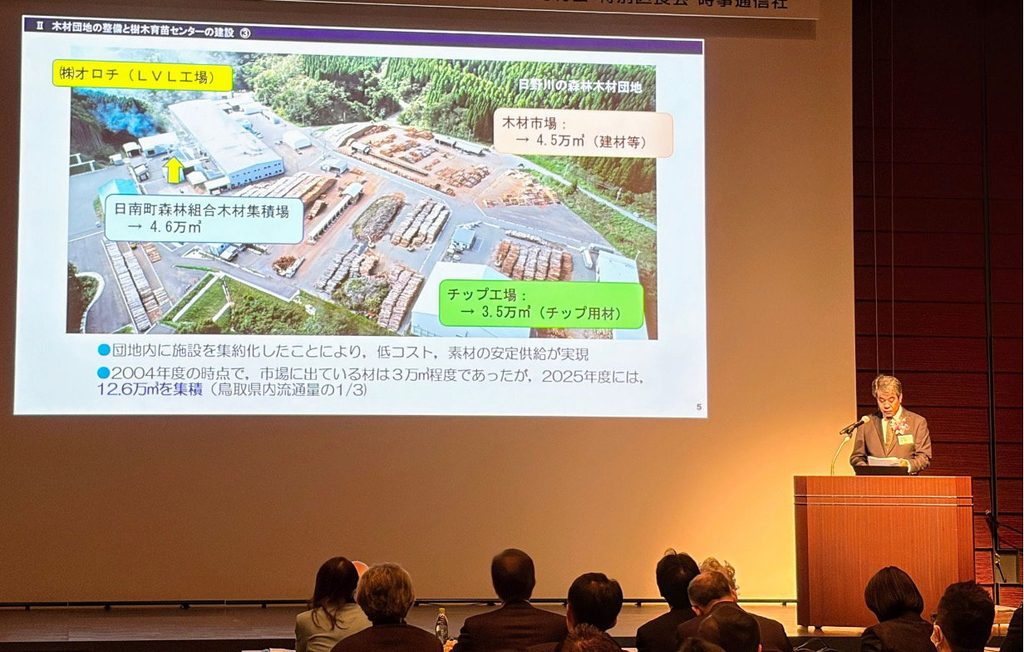
In Nichinan Town, the town has established the “Orochi” LVL (laminated veneer lumber) factory, which processes locally grown cedar and cypress, as well as a timber collection center. By establishing a system to consolidate timber of all grades at the timber complex, the town has achieved a handling volume of over 120,000 cubic meters—equivalent to approximately one-third of Tottori Prefecture’s total annual timber production.
Another major strength is the operation of the “Nichinan Town Tree Nursery Center,” which produces approximately 120,000 container-grown seedlings annually to support reforestation following main harvests. Furthermore, in collaboration with Obayashi Corporation, the company has established a pilot plant for a “hybrid seedling production system” that combines artificial and natural light within the center. By growing seedlings under stable artificial lighting during the first two months after sowing—a period when they are particularly vulnerable to external influences—and then transitioning them to outdoor cultivation under natural light, the company aims to ensure a stable supply of high-quality seedlings while keeping costs down.
Obayashi Corporation’s next-generation training facility, “Port Plus®,” incorporates LVL produced in Nichinan Town, and the company is also working to develop seedling cultivation technology in Nichinan Town. This initiative is drawing attention as a way to link urban construction demand (downstream) with seedling cultivation and reforestation in the mountains (upstream).
In his concluding remarks, Kazuhiko Takeuchi, Chair of the Judging Committee, summarized that the judging criteria went beyond the novelty of the ideas to include verification of effectiveness based on objective data, as well as the reproducibility of the ideas for implementation in other regions and the depth of their social implementation.
Looking back at the three cases selected for the Grand Prize, Bestpla quantifies social impact and links it to government policies; Farmland Connect uses mathematical models to institutionalize the coordination of complex stakeholder interests; and Waita Model builds equal, collaborative relationships with external companies while managing resources under local leadership. Although their approaches differ, they all share the common goal of linking the resolution of regional challenges to the creation of economic value and sustainable business operations. How can we overcome the structural challenges facing local resources and primary industries and make these ventures self-sustaining? The processes demonstrated by the three Grand Prize winners serve as a reliable roadmap for considering the future sustainability of regional economies and the forestry industry.
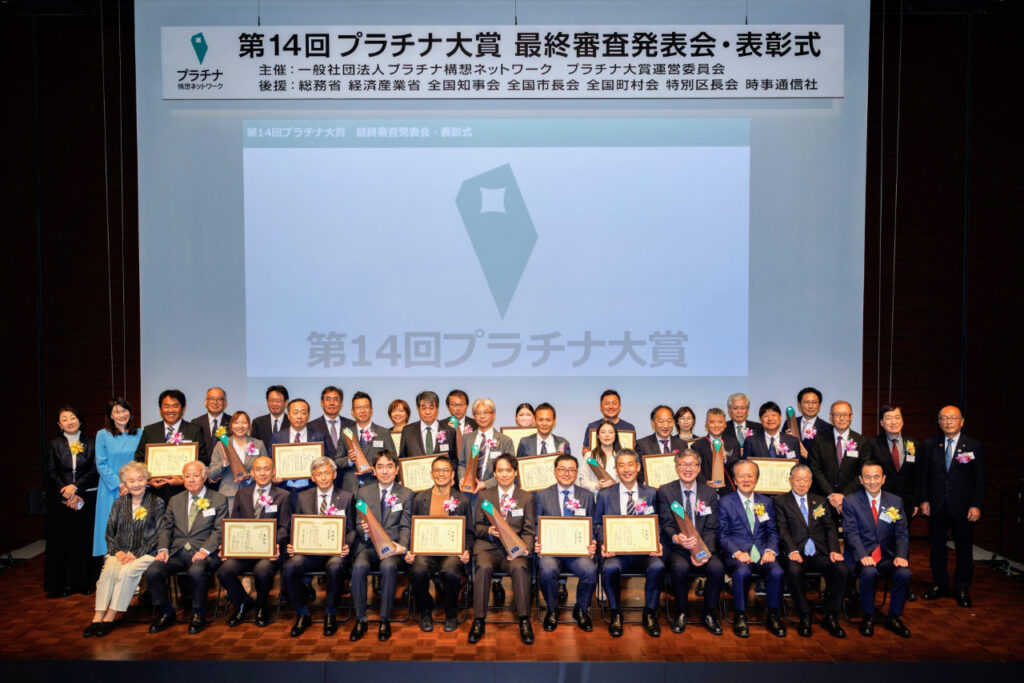
■ Results of the Final Judging for the 14th Platinum Grand Prix
<大賞>
・Platinum Grand Prize
Building Communities for Healthy Longevity and Local Economic Circulation Through Brain-Boosting Apps and Health Points (Bespla Co., Ltd.)
・Grand Prize・Minister of Internal Affairs and Communications Award
Implementation of a Farmland Consolidation Project to Address the Fragmentation of Farmland — The Future of Agriculture Pioneered by Farmland Connect — (Iwate Prefecture, Tannbo General Incorporated Association, Iwate Bank, Ltd.)
・Grand Prize・Minister of Economy, Trade and Industry Award
Realizing a Self-Sustaining Social System Through the Regional Circulation of Renewable Energy Value — The “Waita Model,” Evolving with Progress in the Green Transformation (GX), and the Creation of a Co-creation Platform to Accelerate Regional Revitalization (NTT Corporation, NTT Anode Energy Corporation, Waita-kai LLC, Furusato Thermal Power Corporation, NTT West Corporation Kumamoto Branch, Regional Revitalization Co-Design Institute Co., Ltd.)
<優秀賞>
・Remote Island Mobility Innovation Award
Developing a Decarbonized Remote Island Tourism Model Through Renewable Energy and Electric Mobility (Himejima Ecotourism General Incorporated Association, Himejima Village, Oita Himejima Geopark Promotion Council)
・Regional Bank Award for Innovation
Turning Local Waste into Value: A Regional Bank Takes on the Challenge of Realizing a Local Circular Economy!! (Higo Bank, Ltd.)
・Forest Circular Economy Award
Achieving Green Growth Through the Circular Use of Forest Resources (Nichinan Town Forestry Cooperative, Nichinan Town, Obayashi Corporation)
・Agriculture and Energy Symbiosis Award
Building the Future of Agriculture and Energy Through Solar Sharing (TERRA Co., Ltd., Citizens’ Energy Chiba Co., Ltd., and Sosa Ohisama Hatake Co., Ltd.)
・Cross-Border Mentoring Award
Cross-Mentoring Project for Women’s Career Development Through Collaboration Among Kansai Companies (PERSOL Tempstaff Co., Ltd., Yanmar Holdings Co., Ltd., SCREEN Holdings Co., Ltd., Kanadevia Co., Ltd., TWINKLE STARS Co., Ltd.)
・Agricultural Waste Utilization Award
“Regional Resource-Recycling Decarbonization Energy Project Using the Fully Non-FIT ‘Shin Biomass®’ System” — Creating a New Carbon-Neutral Industry for Regional Revitalization That Achieves Zero Burden on Taxpayers, Zero Waste, and Hormuz-Free Operations — (Biomass Power Technologies Co., Ltd.)
・Entrepreneur Development Award
A New Model for Regional Management Through the Development of Social Entrepreneurs: The “Sunaba” Civic Innovation Hub (Shiojiri City, Shiojiri City Development Corporation)
・Award for Increasing the "Related Population"
"Regional Preservation Rescue (R)"—an initiative that addresses regional challenges from the perspective of creating a "related population" (Aritagawa Town, Shironishi General Incorporated Association)
<特別表彰>
・Platinum Challenging Award
Shizuoka Prefecture Model Program for the Rehabilitation of Children with Hearing Impairments—Toward Independence and Social Participation for Children with Hearing Impairments—(Shizuoka Prefecture)
・Platinum Challenging Award
Creating Time in Clinical Settings and Building a Sustainable Model for Community Healthcare Using “NURVIS,” a Wearable AI Agent for Nurses (peaceful, Inc.)
*Related Links*
"14th Platinum Grand Prize" Final Judging Results Platinum Vision Network, General Incorporated Association
A Town of 3,700 People Receives 120,000 Cubic Meters of Logs Annually: The Timber Complex and Full-Volume Purchase That Transformed the Profitability of Forestry [Nichinan Town: On the Front Lines of Forest Resource Circulation, Part 1]
