Sawako Miura / photograph
Is plantation forestry nature-positive?
Updated by Takanobu Aikawa on December 10, 2025, 11:51 AM JST
Takanobu AIKAWA
PwC Consulting Godo Kaisha
Senior Manager, PwC Intelligence, PwC Consulting LLC / With a background in forest ecology and policy studies, he has been extensively engaged in research and consulting for the forestry and forestry sectors for the Forestry Agency and local governments. In particular, he contributed to the establishment of human resource development programs and qualification systems in the forestry sector in Japan, based on comparisons with developed countries in Europe and the United States. In the wake of the Great East Japan Earthquake, engaged in surveys and research for the introduction of renewable energy, particularly biomass energy; participated in the formulation of sustainability standards for biomass fuels under the FIT system; since July 2024, in his current position, leads overall sustainability activities with a focus on climate change. He holds a master's degree in forest ecology from the Graduate School of Agriculture, Kyoto University, and a doctorate in forest policy from the Graduate School of Agricultural Science, Hokkaido University.
The annual United Nations Framework Convention on Climate Change Conference of the Parties (COP) serves not only as a venue for international negotiations related to the climate change framework convention, but also hosts various side events at pavilions run by governments and organizations, providing a platform for announcing initiatives and reports.
For forestry stakeholders, the interim report released by the International Sustainable Forestry Coalition (ISFC) on its Forest Natural Capital Project was significant. This project aims to demonstrate, within an objective framework, that "forestry activities are beneficial in environmental and social terms" by incorporating forestry activities into natural capital accounting.
In this paper, we will discuss the topic covered in the previous installment.TFFF (Tropical Forest Forever Facility)Following an introduction to the outcomes of COP30, we will examine the significance and implications for Japanese forestry while presenting the ISFC interim report.
The most epoch-making decision on forests at COP30 was the formal launch of the TFFF, as introduced in the previous article. At the leaders' meeting held prior to the COP opening, Brazil and Indonesia—recipients of financial support—joined European nations Norway, Portugal, France, and Germany in pledging funding cooperation, securing the necessary $6.6 billion.Although this falls short of the 125 billion USD target, the Brazilian government appears to view it as a promising start. Japan, while not contributing funds, will continue providing technical and software support, such as forest monitoring, to Brazil and other countries.
On the other hand, a proposal was made to establish a forest loss roadmap as a roadmap to halt deforestation. However, discussions on the simultaneously proposed fossil fuel roadmap became contentious, and ultimately neither roadmap was adopted. At COP, nature-related topics, including forests, have become increasingly prominent, drawing attention to future developments.
While TFFF focused on tropical forests (primary and natural forests) garnered significant attention, plantation forestry has remained in the shadows at COP. In fact, timber is included among commodities posing deforestation risks, and plantation forestry risks being viewed as a source of carbon dioxide (CO₂) emissions. The ISFC was established to address these concerns.The ISFC comprises 18 leading global forestry companies and institutions, including Japanese firms, managing forests totaling 31 million hectares across 39 countries.
Since 2025, the ISFC has been implementing the "Forest Natural Capital Project." To coincide with COP30, it published an interim report and held events at the Forest Pavilion to promote the project. The final report is scheduled for release next year, in time for COP31 in 2026.
The report aims to quantitatively demonstrate the economic value of seven ecosystem services and present the various benefits of plantation forestry (Table). At the interim report stage, the content of the services is described qualitatively.
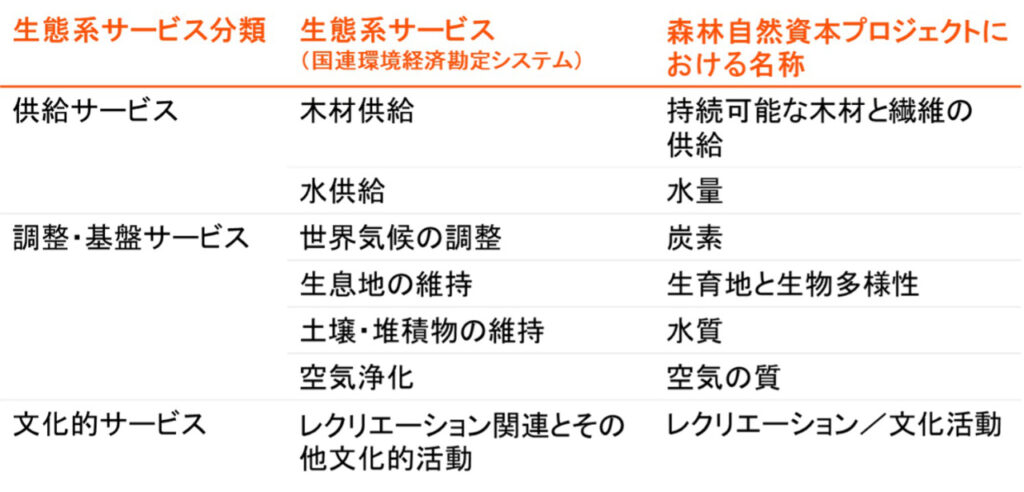
ISFC representatives repeatedly asserted that nature is not free and can be priced. They further argued that pricing can change how land, such as forests, is managed and utilized. Moreover, they aim to promote sustainable forest management and land use by companies through the development of natural capital accounting and its proper integration into such systems.
Another objective is to demonstrate that forestry is "net positive" (where value creation exceeds the burden). ISFC's project is being conducted in collaboration with the Taskforce on Nature-related Financial Disclosures (TNFD). TNFD targets a broad range of companies beyond agriculture and forestry, fundamentally requiring them to assess their dependence on and risks to natural capital and disclose the results.Consequently, information tends to be biased toward "negative" elements, making it difficult to highlight "positive" aspects. Furthermore, concerns were raised that forest certification systems, which certify sustainable forest management and the timber produced from it, also heavily emphasize negative checks and have not yet succeeded in demonstrating the effects and outcomes achieved through sustainable forest management.
Based on this, the ISFC is collaborating with academic projects like TNFD and natural capital accounting to demonstrate that through (cost-intensive) forest management, "forests produce greater value, proving that natural capital is not free."
Such international discussions should be applied specifically to Japan's domestic forestry sector.Japan's Basic Act on Forestry and Forestry Industry states: "Considering that forestry plays an important role in realizing the multifunctional role of forests (Article 3)." While this statement itself may not be incorrect, it ignores the negative environmental aspects of forestry activities. It has failed to move beyond the highly simplified logic that "public benefits are maintained through forestry activities," and has consequently been criticized as a "preconceived harmony theory."
In Japan, since the Kyoto Protocol era, forest sink measures have been implemented on a large scale, and interventions in planted forests—such as thinning—have been considered "climate change countermeasures." However, globally, as already mentioned, the prevailing perception is that "cutting trees worsens climate change," largely due to the reality of deforestation.
In recent years, contributions to biodiversity conservation have been increasingly demanded, and we are hearing the term "nature positive" more often. Here too, some may vaguely assume that forestry is "good for nature."
However, many of Japan's artificial forests were planted with species like cedar, cypress, and larch after natural forests were logged during the post-World War II expansion of afforestation. It is clear that this has had a negative environmental impact, and even considering these negative effects, we must assert that the overall impact is "net positive." Particularly in the global business environment, "disclosure" based on an objective framework is required.
On the other hand, the scale difference compared to large-scale overseas forestry operations like ISFC must be considered. In large-scale industrial plantation areas overseas, establishing protected areas and buffer zones is generally mandated by national laws and regulations, making it easier to claim biodiversity conservation benefits. However, this approach is only feasible precisely because the land is sufficiently vast.In contrast, Japan's plantation forests often surround neglected secondary broadleaf forests, making integrated management difficult to achieve and the effectiveness of such management hard to demonstrate. Therefore, the "land-sharing" approach—where a certain number of broadleaf trees are retained during harvesting, known as "retention forestry," enabling both timber production and conservation on the same land—may prove effective.
Accurately following international discussions and contextualizing Japan's characteristics can help break away from preconceived notions and contribute to asserting that Japan's forest management is "positive." (PwC Consulting LLC, PwC Intelligence, Senior Manager, Takanobu Aikawa)
■References
・Takano Aikawa (2025) "Innovative Nature of TFFF, Brazil's Tropical Forest Conservation Fund at COP30: A Hint for the Future of Community Forest Management in Japan(Forest Circular Economy, October 28, 2025 article)
・ISFC (2025) “Forests and the Future Bioeconomy. Measuring the Contribution of Nature to Global Prosperity”
・"Field Trials and Sustainable Forestry" edited by Yuichi Yamaura and Satoshi Yamanaka (Tsukiji Shokan, 2025)