[Austria Inspection Report] The balance of culture, environment, and structure is the key to "high-quality forestry"
Updated by Yasunari Kobayashi on December 25, 2025, 9:35 AM JST
Yasuhisa KOBAYASHI
Alpha Forum, Inc.
President of Alpha Forum, Inc. and Steering Committee Member of the Platinum Forest Industry Initiative. Ltd. in 2001, taking advantage of the company's venture support program. In September 2023, he received the Wood Use System Research Association Award.
Judging by the number of passport stamps, this was my 25th business trip to Austria. This time, it was a study tour of Austria's forestry sector, organized jointly with the Platinum Concept Network for a group of 16 people, including myself. I believe I have built a broad network in Austria spanning forestry, sawmills, timber construction, and wood biomass-based heat supply projects. I'm particularly interested in district heating projects using wood biomass boilers, and I've even attended foundational training sessions with Austrian wood biomass boiler manufacturers. Everywhere I go, the commitment to technical refinement and development is high, and I'm always amazed by the progress they've made since my last visit. Both the forestry sector and the wood biomass heating industry operate in an enviable environment of mutual competition and mutual improvement.
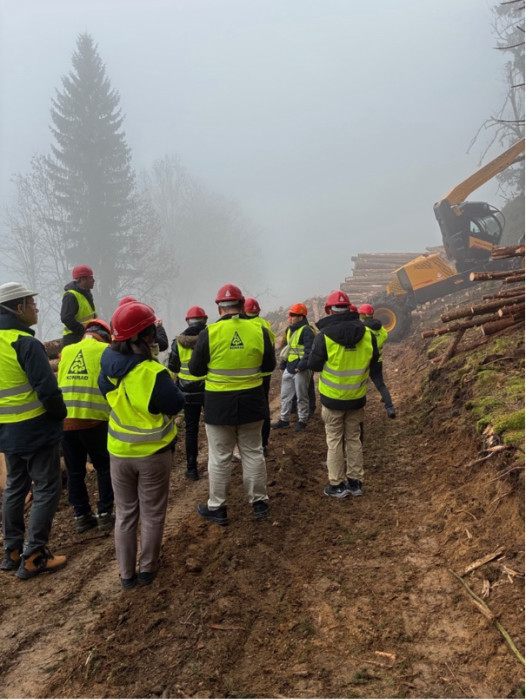
This time, we departed from Haneda on November 30, 2025, and returned on December 7. The itinerary included six nights on-site. Since some members were unfamiliar with forestry or seeing European forestry for the first time, we requested assistance from the Austrian Embassy in Japan. We visited two public institutions: BOKU University (Universität für Bodenkultur Wien) in Vienna and the Pichl Training Center near Graz. There, we received presentations and also conducted field inspections.
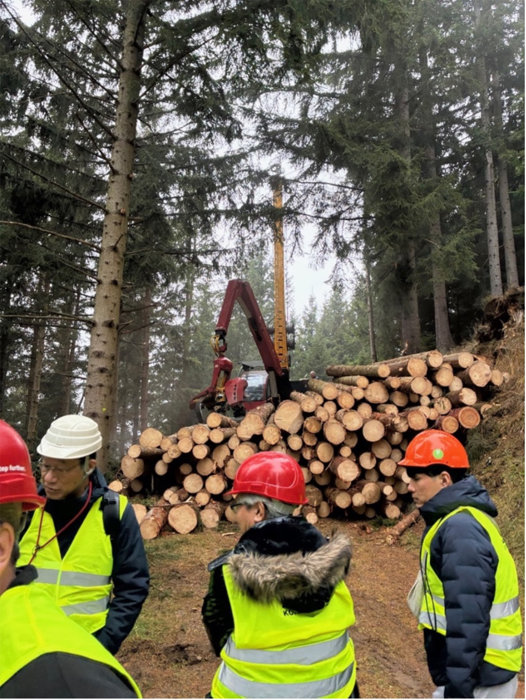
Engaging with forests and utilizing them is fundamentally positioned as a public undertaking. While I don't claim to be an expert on European history, their awareness of the "blessings" derived from their own land, soil, and air (climate) is higher than Japan's. The words from the director of the Pichl Training Institute carried weight: "With global warming, the major challenge is 'What should we plant, grow, and utilize next?' and discussions are progressing..." When it comes to forest resources we pass on to the next generation, there is no room for "just for now."
I define Austria's forestry as "high-quality forestry" and would like to explain it through its three key elements.
One is "Quality of Environment (QOE)". For Austria, a landlocked country, achieving carbon neutrality hinges first and foremost on the thorough conservation, management, and utilization of forests. They systematically harvest approximately 90% of the annual growth in timber each year, and the fact that they share this information through collaboration among foresters is something worth emulating. In fact, senior foresters managing 8,000 to 10,000 hectares are required to complete the necessary credits at BOKU University (literally translated as Soil University). It is therefore no exaggeration to say that BOKU University compiles and analyzes forest information.
Next is "Quality of Culture (QOC)." In modern Japan, where globalization is commonplace, there are concerns that communities within villages and regions have become diluted or lost their vitality. Austria, too, has seen progress in globalization, including its tourism industry, yet its villages and regions appear to be well-maintained. While the presence of churches likely plays a significant role, the robust primary industries of forestry and agriculture are key factors sustaining the vitality of these communities.
Globalization is something to be utilized, and I appreciate the atmosphere that prioritizes and places importance on local communities. Forestry in Austria is positioned as a stable industry, and it seems students can begin learning about forestry as early as middle school. This time, I also had the opportunity to tour the factory of high-performance forestry machinery manufacturer Konrad. It was striking to see several young people under the age of 20 undergoing training at the factory and seamlessly integrating into the workforce. I believe this stems from a culture that emphasizes defining one's field clearly, holding firm convictions, and valuing close-knit communities.
Third is "Quality of (Business) Structure (QOS)". Adding "Business" in parentheses makes it easier to visualize. In forestry, it's not about introducing high-performance forestry machinery just to increase raw material production... Instead, to earn money (to win in competition), how much production per person must be achieved? What types of forest land should be targeted? What functions and performance are required of the tools for that purpose? As we consider these questions, the content we must develop to solve the problems naturally becomes clear. If the machinery is expensive, we must also consider subsidies and investment. I'm not saying Japanese forestry isn't competitive. However, every time I look at European forestry, I find it robust. The specifications and standards for forest roads are meticulously organized, enabling stable profitability. The quality of the structure (Structure) that allows them to continue competing internationally is high.
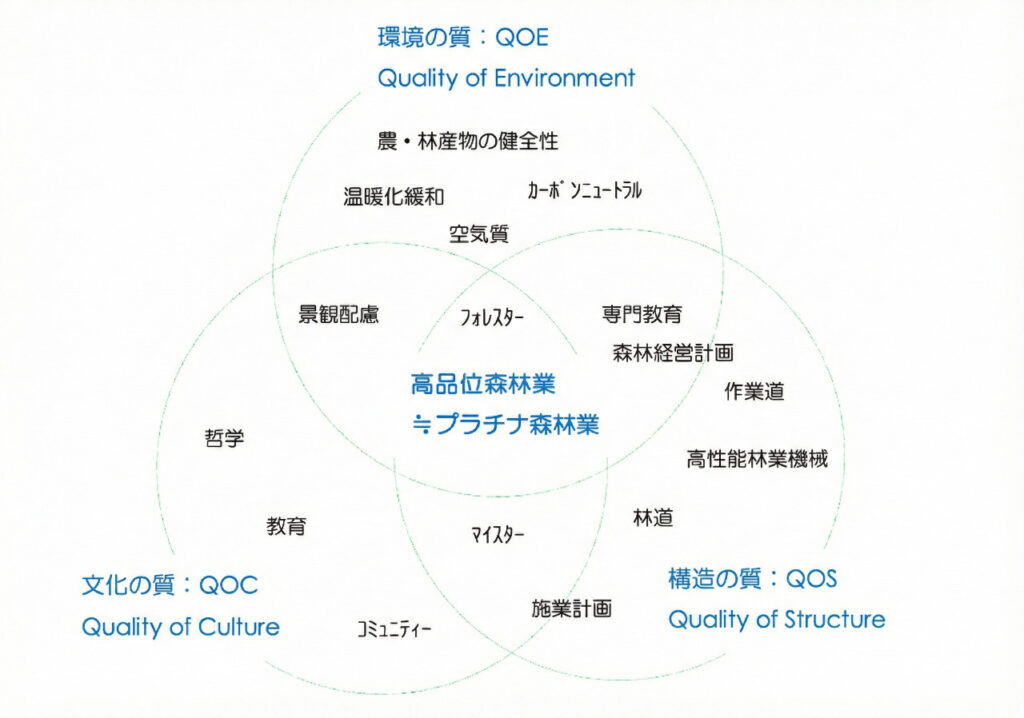
The "high-quality forestry ≈ platinum forestry" exists where all three of these "qualities" are considered and balanced. In future columns, I also plan to add comparisons with Japan's forestry sector. (Yasunobu Kobayashi, President & CEO, Alpha Forum Co., Ltd.; Steering Committee, Platinum Forestry Initiative)