
How to develop "platinum talent" that can adapt to changing times: Turning education into a sustainable industry through "autonomous, decentralized collaboration collaboration" through "autonomous, decentralized"
Updated by Hiroshi Komiyama on January 16, 2026, 9:07 PM JST
Hiroshi KOMIYAMA
(Platinum Initiative Network, Inc.
After serving as Professor at the University of Tokyo, Dean of the Graduate School of Engineering and Dean of the Faculty of Engineering, and President of the University of Tokyo (28th), he was appointed Chairman of the Mitsubishi Research Institute in 2009, and Chairman of the Platinum Initiative Network in 2010 (to be incorporated as a general incorporated association in 2022). Other positions include President of the STS Forum, Chairman of the Association for Super-Education, Chairman of the United Nations University Cooperation Foundation, Chairman of the International Science and Technology Foundation, and Chairman of the Heat Pump and Thermal Storage Center Foundation. He also received the Dubai Knowledge Award (2017), the Order of the Star of Solidarity of Italy (2007.) and "Information and Communication Month" Commendation from the Minister of Internal Affairs and Communications (2014), the Zaikai Award Special Prize (2016), and the Commendation for Merit in Promoting a Maritime Nation (2016), among many other national and international awards.
More than half a century has passed since the cry of "knowledge-intensive education has reached its limits," but a drastic change in the field of education has yet to be realized. However, with the rise of generative AI, education that teaches the "right answer" has completely reached its expiration date. What is required of us now is not simply to destroy the existing education system. What is required of us now is not simply to destroy the existing education system, but to build a "human resource industry" that can be sustained by connecting the excellent examples that are sprouting in various regions and putting them to economic principles. We propose a vision of "autonomous, decentralized, and cooperative" education for the year 2026.
I have a clear definition of "platinum human resources" that I advocate. It is "people who have the courage to change at their own will, take on new challenges, and pursue self-realization.
The pace of change is extremely fast today, and as in the Edo period, "the society that grandparents saw and the society that grandchildren see are not the same. The needs of companies change every few years, so people who wait for instructions or who are fixated only on learning a particular programming language will soon become untenable.
Now that the most powerful "treasure house of knowledge" called AI has appeared, what is required of human beings is the ability to have a unique "will" that AI can never possess, and to continue to update themselves.
The skills required for platinum human capital are the ability to work across multiple domains. Currently, every industry report concludes with the statement, "Human resource development is the key. However, the reality of a society with a declining population is that "100 million people are not enough" if each specialist is trained one by one.
For example, forestry requires a wide range of knowledge, from seedling cultivation to management, AI utilization, and management of several types of heavy machinery. The only solution is not to confine oneself to a specific field, but to have the ability to cross-disciplinary skills, such as "If we have a system in place for forestry, we can transfer that wisdom to the neighboring agriculture industry as well. With human-like negotiation skills and an understanding of the fundamental mechanisms of AI, you can become a platinum human resource who can work in any field.
Platinum human resources must also have the ability to see individual issues from a "meta (bird's eye view)" perspective.
Meta" does not have to be difficult to understand. In short, it is a way of thinking to determine "what is the root cause of the mountain of problems" and "which levers can be pulled to solve the whole problem. This bird's-eye view will enable us to take the shortest route toward the realization of a "platinum society" that functions in concert with resource self-sufficiency, lifelong growth, and resident investment, instead of wasting our time trying to solve problems in our own way.
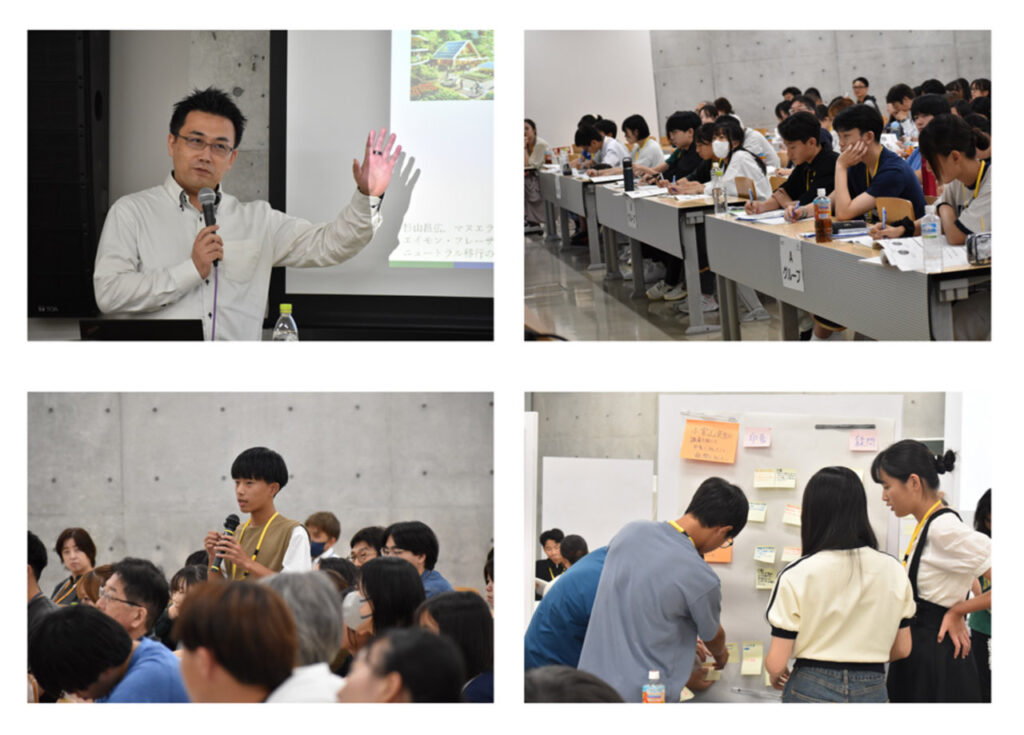
As one who is involved in education, I can assure you that there is in fact no such thing as a "completely new idea" about education. Many of the ideals that are being talked about today have been said for a hundred years.
For example, the "Jiyu Gakuen" founded in 1921 by Motoko and Yoshikazu Hani, whose principles of "unity of life and learning," "self-reliance," and "criticism of standardized and crammed education" are surprisingly in line with those of today's platinum human resources. One of the women who served as my secretary was also a graduate of Jiyu Gakuen, and she was influenced by that education and became wonderfully independent.
The problem is not to come up with new ideas, but how to "implement" the ideals that already exist, in accordance with the current times. That is the single most important point.
It is impossible to remake the centralized educational system that has existed since the Meiji era (1868-1912) all at once under the leadership of the government. This is because it is extremely difficult for those who have received education without creativity to create a system to nurture creative human resources.
That is why it is important to build an "autonomous decentralized cooperative system (IN CONCERT)" that networks "point examples" that educators with a strong will are successfully implementing throughout the country.
At "ISAK" in Karuizawa, Mr. Rin Kobayashi collected donations from many business people to create a place for international learning. At "Kamiyama Marugoto National College of Technology" in Tokushima Prefecture, Shinya Ominami and his team implemented "technology x design x entrepreneurship" against the backdrop of a scholarship fund structure worth approximately 10 billion yen to provide free tuition. At "Kazakoshi Gakuen" established by Shinnosuke Honjo in Karuizawa, a number of immigrants have moved to the area, sympathizing with the integrated education system that mixes elementary, middle, and junior high schools for children. Imitating and linking these successful examples will be a breakthrough in the development of platinum human resources.
In order to develop and sustain excellent education nationwide, it must become an "industry" that turns on economic principles. For example, "Education and Inquiry," Inc. receives sponsorship fees from companies for supporting exploratory learning for high school students. This is because it is established as "research and development (R&D)" for companies that are looking for young people's innovative ideas.
The outcome of human resource development should no longer be measured by the old KPI of "how many students made it to the University of Tokyo" and the like. The "Tanegashima Model" implemented by Professor Yasunori Kikuchi and his colleagues at the University of Tokyo is a symbolic example. Professor Kikuchi spent 300 days on the island in the first year of the program, pursuing a "match between life and learning" by highly integrating local industry, advanced technology, and education, including the use of sugarcane pomace (bagasse), the introduction of local renewable energy, and the implementation of agricultural AI. As a result, Professor Kikuchi told us directly that the number of high school students wishing to return to the island after entering university used to be "0%," but a few years later that number had drastically increased to "44%. This is the true achievement of education, which gave young people the feeling that they can change society by their own will.
An instructive example of how to make education a sustainable industry is the introduction of a "sweepstakes race" (prize business) that takes on specific challenges.
In the Japan Innovation Challenge (mountain distress rescue contest using robots) held in Kamishihoro Town, Hokkaido, specific prizes were set: 5 million yen for finding a mannequin that looked like a person in distress, 3 million yen for delivering a rescue kit, and 20 million yen for rescuing the mannequin and transporting it to a designated location. 20 million yen for rescuing the mannequin and transporting it to a designated location. Finally, last year, a group from the University of Tokyo cleared the most difficult challenge, "Rescue.
Such prize money business is an extremely rational mechanism, as no cost is incurred if the project is not successful, and if successful, the technology can be immediately implemented in society. Creating a stage throughout Japan where people can take on challenges with the enthusiasm of a "competition" that comprehensively demonstrates their intellectual abilities will be the most powerful engine for training platinum human resources.
The Platinum Initiative Network is preparing to launch the Platinum Human Capital Industry Initiative in 2026. It is not realistic to remake the entire public education system at once, both financially and in terms of human resources. Therefore, we propose to use the "Integrated Study (Inquiry) Time" within the existing framework as a breakthrough. We will implement "Lifelong Co-Learning" in society, in which all generations learn together, by utilizing university students and senior citizens as tutors and networking autonomously distributed good practices.
Platinum human resources who "change of their own will and solve problems across multiple domains" will work in concert throughout society, and Japan will be reborn as a world-leading country in problem-solving. (Hiroshi Komiyama, Chairman of Platinum Network and Honorary Editor-in-Chief of "Forest Circular Economy")
Reference Links
Platinum Future Human Resource Development School
Jiyu Gakuen
UWC ISAK JAPAN
Kamiyama Marugoto National College of Technology
Karuizawa Fuetsu Gakuen
Mountain Distress Rescue Robot Contest 2025 Japan Innovation Challenge