Updated by "Forest Circular Economy" Editorial Board on May 12, 2026, 9:38 PM JST
Editorial Board, Forest Circular Economy
Forestcircularity-editor
We aim to realize "Vision 2050: Japan Shines, Forest Circular Economy" promoted by the Platinum Forest Industry Initiative. We will disseminate ideas and initiatives to promote biomass chemistry, realize woody and lumbery communities, and encourage innovation in the forestry industry in order to fully utilize forest resources to decarbonize the economy, strengthen economic security, and create local communities.
The next draft of the Basic Plan for Forestry and Forest Products presented at the Forestry Policy Council meeting in April focuses on the promotion of wood construction in non-residential, medium- and high-rise buildings. Specifically, the plan sets a goal of increasing the amount of domestic timber used for building materials by approximately 30% from the current level to 23 million cubic meters by 2030, with a domestic timber content of 70%. In response to the policy, the private sector is also implementing a number of measures with an eye on the entire life cycle, including the conclusion of an agreement with a view to recycling waste wood, the launch of a plan by a life insurance company to establish 100 wooden sales offices nationwide, the completion of a four-story fire-resistant wooden structure in an urban area that is 57% domestic wood, and the development of domestic wood louvers for a system ceiling.
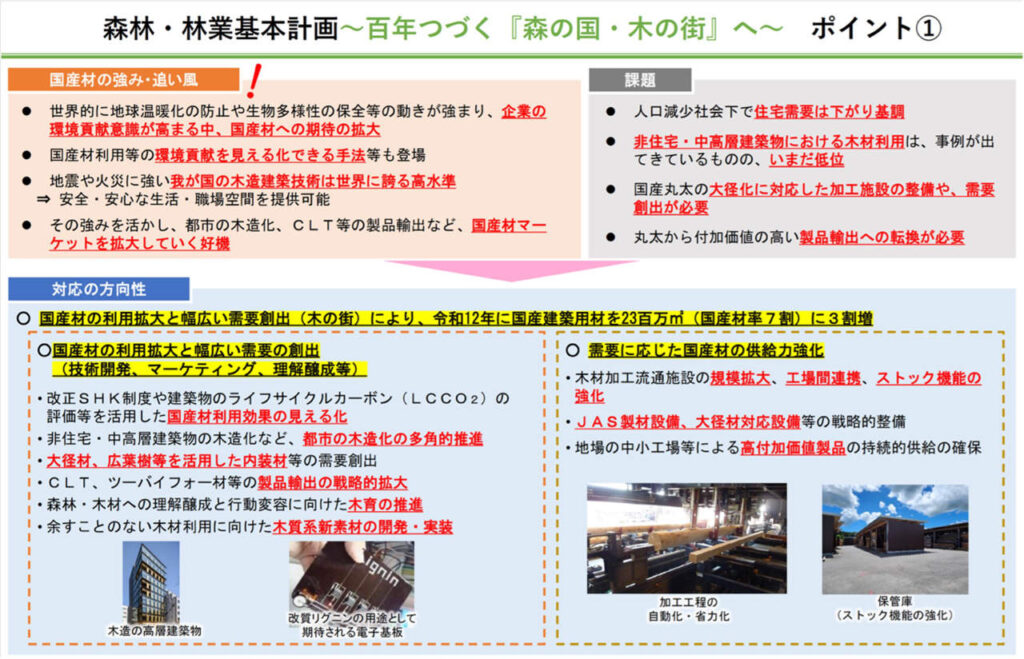
On April 22, the Forestry Agency released a draft of the next "Forest and Forestry Basic Plan" at the Forestry Policy Council meeting. Under the theme of "Toward a 'Land of Forests and City of Trees' that will last for 100 years," the plan presents the current situation and measures in the field of domestic timber construction. The plan reports positive changes, such as the growing environmental awareness of companies, the development of wood use technology for non-residential and medium-to-high-rise buildings, and the first time in half a century that the self-sufficiency rate for building materials has exceeded the majority. The goal is to increase the use of domestic lumber in construction to 23 million cubic meters by 2030, an increase of approximately 30% from the current level. As housing demand is on a downward trend due to the declining population, the project will promote the use of wood and woody materials in the non-residential and mid-to-high-rise sectors in urban areas, where there is significant room for development. In addition, the company intends to create a virtuous circle in the forest industry as a whole by visualizing its environmental contribution through life cycle carbon assessment of buildings, ensuring a stable supply of JAS products with reliable quality and performance, and adding value to interior materials by utilizing large-diameter lumber.
*Reference link
List of Materials Distributed at the Forestry Policy Council Meeting (April 22, 2026) | Forestry Agency
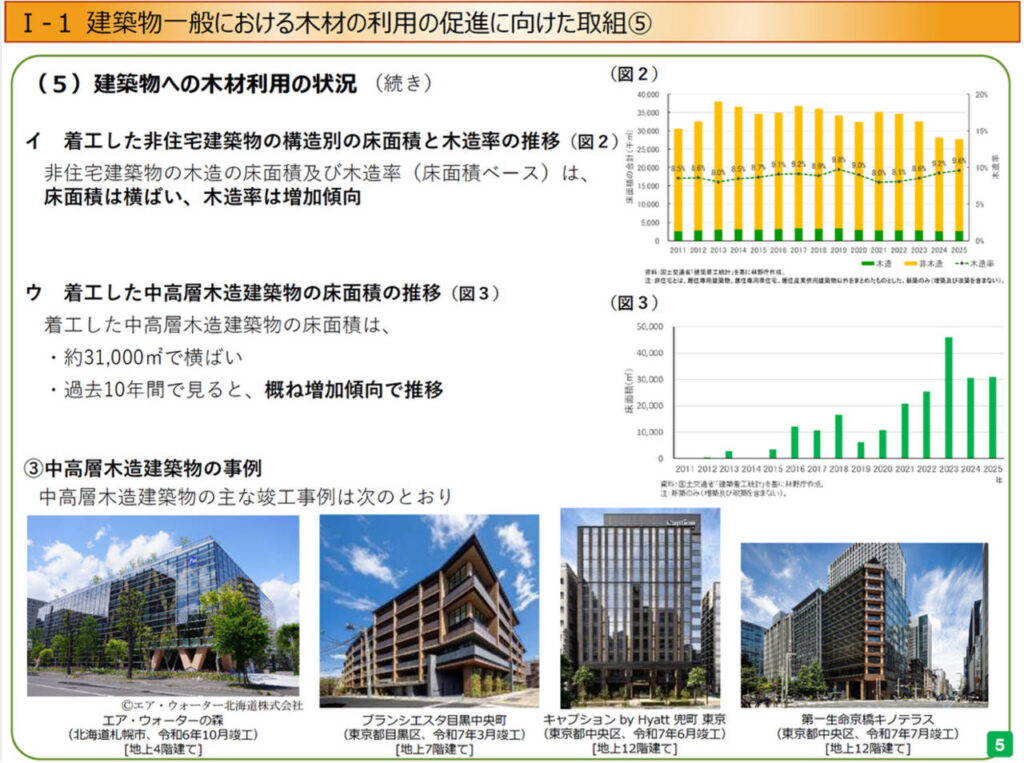
On March 27, 2025, the Ministry of Agriculture, Forestry and Fisheries (MAFF) released a report entitled "Summary of Measures Taken to Promote the Use of Wood in Buildings in Fiscal 2025. The percentage of wood construction starts (based on floor area) for low-rise residential buildings of three stories or less was 83.5%, while the percentage for other buildings as a whole was only 6.6%. Low-rise nonresidential buildings remain low at 16.2%, mid-rise residential buildings at 0.2%, and mid-rise nonresidential buildings at less than 0.1%. While the floor area of mid- and high-rise wood-frame construction remained flat year-on-year, it has generally increased over the past 10 years. As of March 16, the number of "Agreement Programs for the Promotion of Wood Use in Buildings" concluded by local governments and private companies totaled 31 by the national government and 217 by local governments, and the amount of wood used under these agreements in 2025 totaled 132,738 cubic meters. Of the public buildings constructed by the government in FY2024, 51 were converted to wood, achieving a wood conversion rate of 100% based on the results of a joint verification team of the Forestry Agency and the Ministry of Land, Infrastructure, Transport, and Tourism.
*Reference link
Summary of Measures Taken to Promote the Use of Wood in Buildings in FY2025, etc. | Forestry Agency
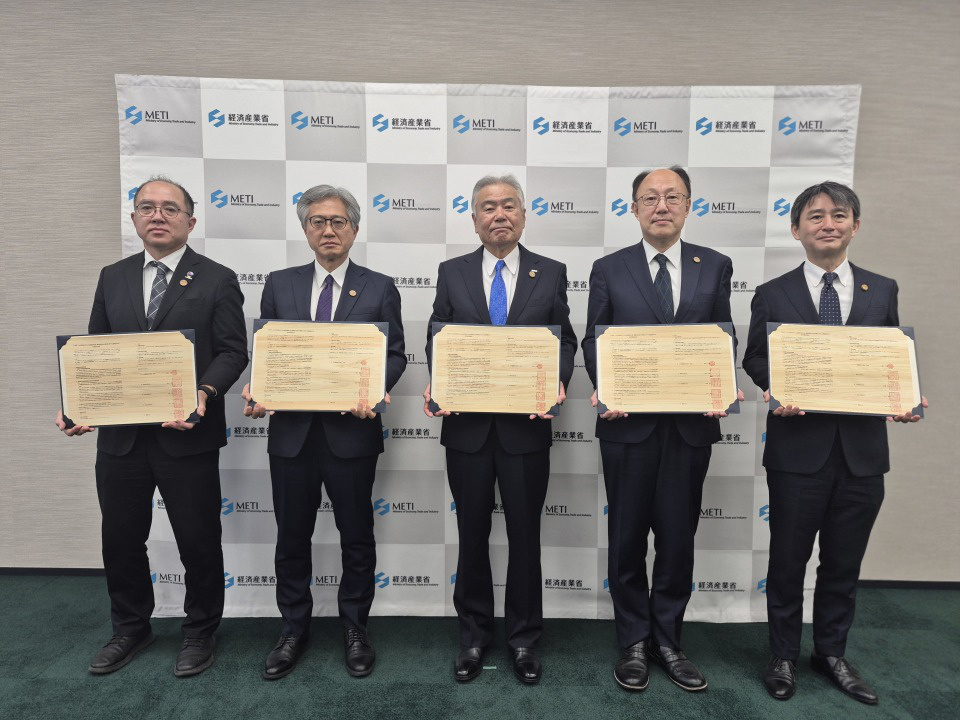
The Ministry of Economy, Trade and Industry (METI), the Ministry of Agriculture, Forestry and Fisheries (MAFF), the Ministry of Land, Infrastructure, Transport and Tourism (MLIT), and the Ministry of the Environment (MOE) signed an "Agreement on Promotion of Wood Use in Construction" with the Japan Fiberboard Industry Association on March 10. The agreement promotes efforts to recycle construction-generated wood, unused wood, waste wood, and damaged wood as raw materials for wood boards. The agreement also includes LCCO2 (Life Cycle CO2) assessments of buildings and the dissemination of environmental benefits related to the SHK system. CO2 emissions from the subject projects will be reduced by 10% from the 2025 level by the end of the agreement period. The joint framework of the four ministries is intended to ensure that the use of wood is not merely a measure to promote agriculture and forestry, but also to enhance industrial competitiveness, to promote the development of housing and building policies, and to protect the environment, The joint framework of the four ministries shows that the use of wood is not just a promotion measure for agriculture and forestry, but is promoted from a multi-polar perspective: strengthening industrial competitiveness, housing and building policies, and environmental conservation.
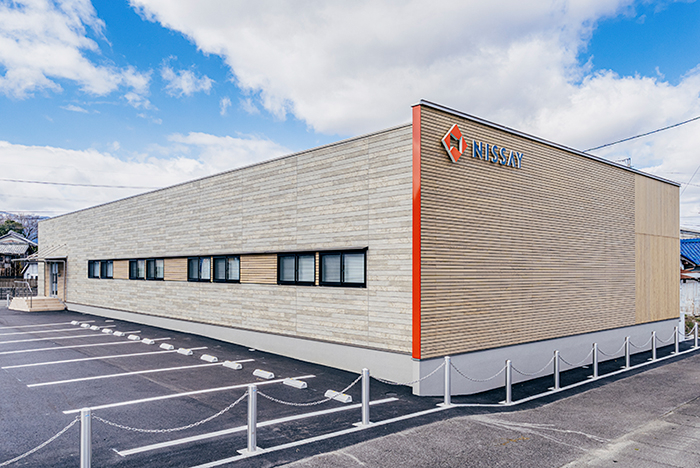
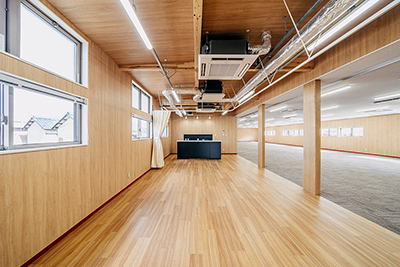
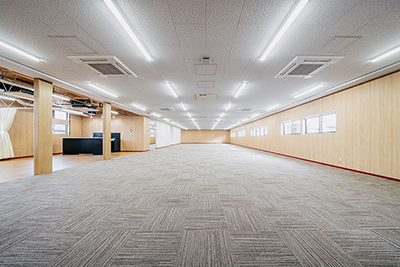
Nippon Life Insurance's Gifu Kaizu Hirata Office, designed and constructed by Sumitomo Forestry, began operations in March. This is the first building in Nippon Life's plan to build 100 wooden sales offices nationwide. Sixty percent of the timber used in the building is domestic timber, and Sumitomo Forestry's proprietary Big Frame construction method (BF construction method) was adopted to create a spacious office area with a long span of approximately 9 meters and few pillars or walls. The warmth of the wood can be felt by using abundant Japanese cedar to expose the exterior members and structural frame. The building's environmental performance is also being visualized, with CO2 (embodied carbon) emissions from materials procurement to construction reduced by 26% compared to steel construction and by 15% compared to RC construction. The use of wood amounted to about 81 cubic meters, which also contributed to carbon fixation of about 68 tons CO2e bio. The project is attracting attention as a model case for next-generation wooden office buildings that combine decarbonization and wellbeing.
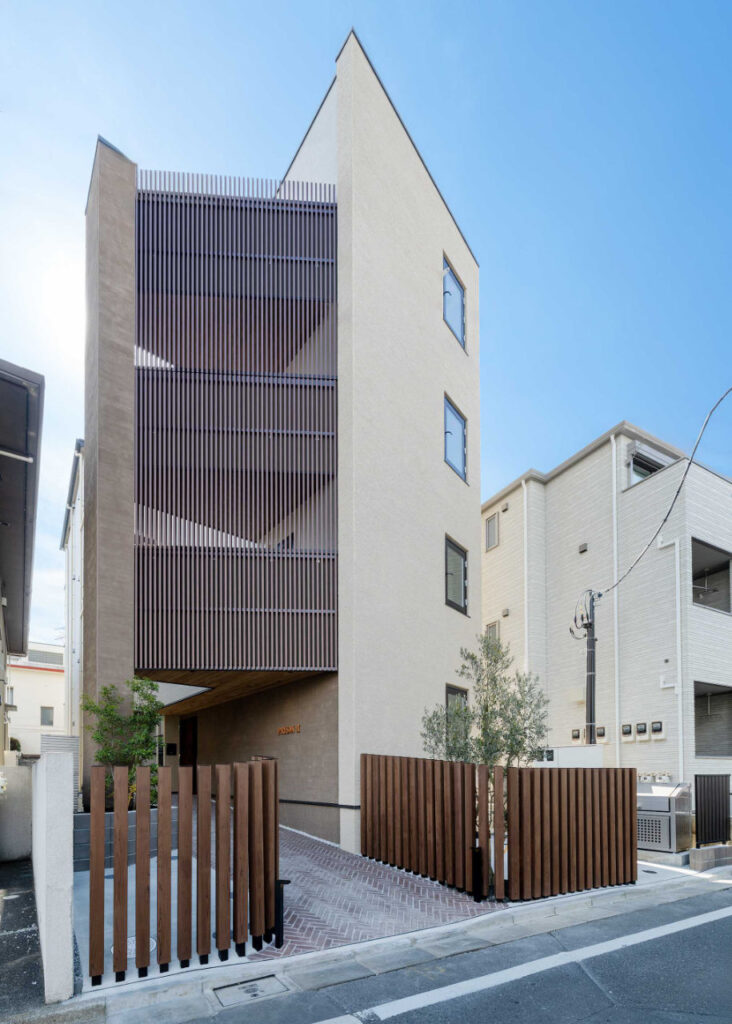
In February, Mitsubishi Jisho Home completed construction of PRISM II, a four-story wooden fireproof building with eight units, in Toshima-ku, Tokyo, as a model for promoting wood construction in urban areas. Taking advantage of the group's collaboration, the company actively used cedar and other materials produced in Kyushu, achieving a domestic wood content of 57% of the 135 cubic meters of lumber used for the structure. This is about three times the national average for the use of domestic timber in 2x4 construction methods. In addition, the lightness inherent in wood construction eliminated the need for piling work, reducing the construction period and cost. Although the panels are assembled by hand on site, it is estimated to reduce labor hours for frame construction by about 30% compared to RC construction, and is expected to help address labor shortages at construction sites. Because of its carbon storage effect, the project has been selected by the Ministry of Land, Infrastructure, Transport and Tourism for the 2024 "Excellent Wooden Building Development Promotion Project," and is attracting attention as a practical model for urban wood construction.
*Reference link
PRISM II, a four-story apartment building designed and built by Mitsubishi Jisho Home Co.
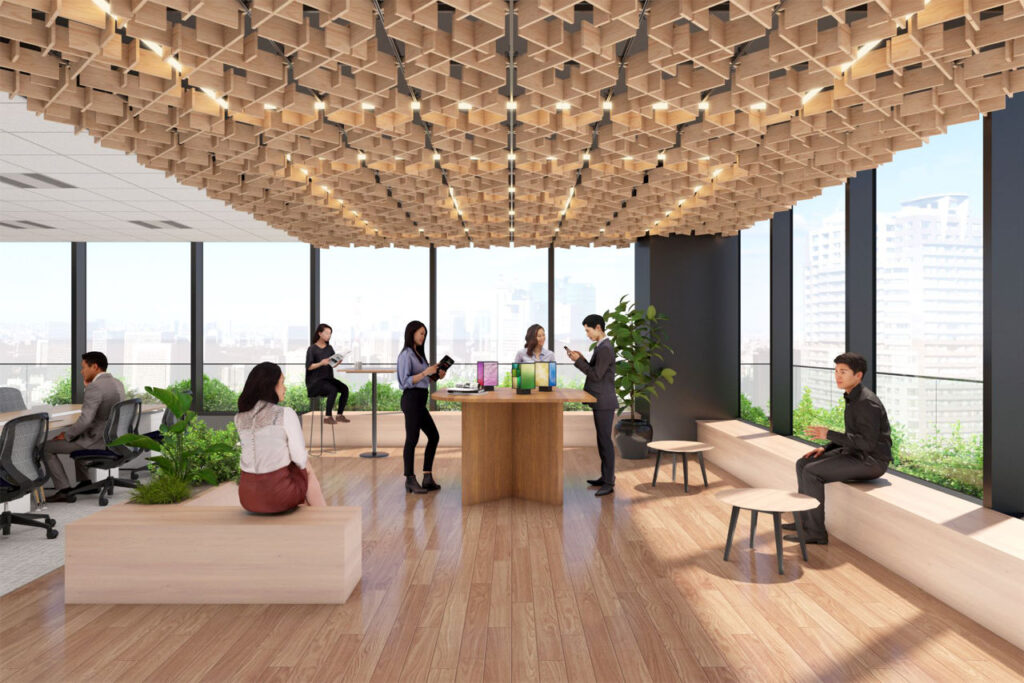
Mitsubishi Jisho Sekkei and Panasonic Electric Works have jointly developed a "domestic wood lattice louver" for system ceilings. Against the backdrop of improved user wellbeing, the louvers can be easily converted to wood in spaces by incorporating them into grid-type system ceilings, which are highly prevalent. No large-scale groundwork is required, and the wood's unique materiality and design can be enhanced while maintaining the workability and renewability of system ceilings. Integration with lighting design also provides an optimal light environment. Even in existing buildings where it is difficult to convert the structure to wood, this solution can promote the use of domestic timber and the conversion to wood through an approach from the facilities and interior design, thereby expanding the scope of timber use.
*Reference link
Joint development with Panasonic Electric Works Co., Ltd. of Japanese wood lattice louvers to enhance the design of system ceilings
The ’Comprehensive Exhibition for Housing, Construction and Real Estate [BREX] 2026" will be held at Tokyo Big Sight for three days from May 13 to 15. 350 companies will exhibit, and more than 100 sessions of specialized seminars are scheduled. Of particular note is the "Non-Housing Wood Construction Fair. In addition to many major general contractors and housebuilders exhibiting, there will also be booths for consultation with professional architects and "Architecture Live '26," a hands-on event where visitors can actually construct and experiment with buildings in the exhibition hall. The latest knowledge and solutions will be gathered, ranging from technical issues surrounding the conversion of non-residential buildings to wood and wood-based construction to the new added value and possibilities that wood offers.
*Reference link
Non-housing Wooden Construction Fair - BREX, the comprehensive exhibition for housing, construction and real estate