Charcoal depicted in a children's magazine from 1943; forest resources that attracted attention as a substitute for oil during wartime.
Updated by Nobuyuki Yamamoto on May 13, 2026, 9:15 PM JST
Nobuyuki YAMAMOTO
Forestry and Forest Products Research Institute, National Forestry Research and Development Institute
Senior Researcher, Forestry Management and Policy Research Area, Forestry and Forest Products Research Institute, National Forestry Research and Development Institute / Specializes in forest policy and forestry economics. His recent research focuses on modernization and forests and forestry. His publications include "Forests and Time: A Social History of Forests", "Long-Term Sustainability of Local Forest Management: Future Perspectives from 100 Years in Europe and Japan", and "Theory of Forest Management System". His research on the modernization process of forest management systems won the Prize for Academic Achievement from the Forestry Economics Society of Japan, and "The Origins of the Forest Planning System in Japan" won the Paper Award from the Forestry Society of Japan.
Rikugien, located near Komagome Station on Tokyo's JR Yamanote Line, is a renowned garden created by Yanagisawa Yoshiyasu. In the Meiji era (1868-1912), the garden became the property of Yataro Iwasaki, founder of Mitsubishi, and was donated to the City of Tokyo, and after the war was designated as a national place of special scenic beauty. The garden continues to delight visitors with its colorful scenery that changes with the seasons, but it is especially famous for its weeping cherry blossoms in spring. Across a narrow street on the south side of Rikugien, next to the main gate, is the three-story office building of FREIBELKAN, which is the subject of this article.
FREIBELKAN was founded in 1907 as SHIROMARUYA. The following year, the company changed its name to the current one, named after the German early childhood educator Friedrich Frebel, the creator of kindergartens. Many people may recognize the company's name from its recent publication of Takashi Yanase's "Anpanman" series, which drew attention as part of NHK's morning drama series.
With its corporate philosophy of "contributing to society by creating rich values that are full of knowledge and sensitivity to support the healthy upbringing of children," FREIBELKAN has pioneered a new era in the industry. Among these, "Observation Picture Book Kinder Book," published in 1927 as Japan's first picture book for nursery school children, was a pioneer in the field of infant magazines and remains a symbol of the company's monthly publication.
The series had been published from Showa to Heisei to 2035, but after the April 1942 issue during the Asia-Pacific War, the magazine was forced to change its name to "Observation Picture Book: Mikuni Nokodomo" and its company name to Nihon Nursery School amid the national movement to eliminate Anglo-American culture and hostile language at the time. The magazine's titles, such as "Manshiu," "Tatakafu kaigun," and "Bokura mo shingun," strongly reflected the wartime atmosphere. The magazine was discontinued after the February 1944 issue, and Nippon Nursery School was also closed. The current "Observation Picture Book: Kinder Book" was newly reprinted by Fureibelkan, which was reconstructed after the war's defeat.
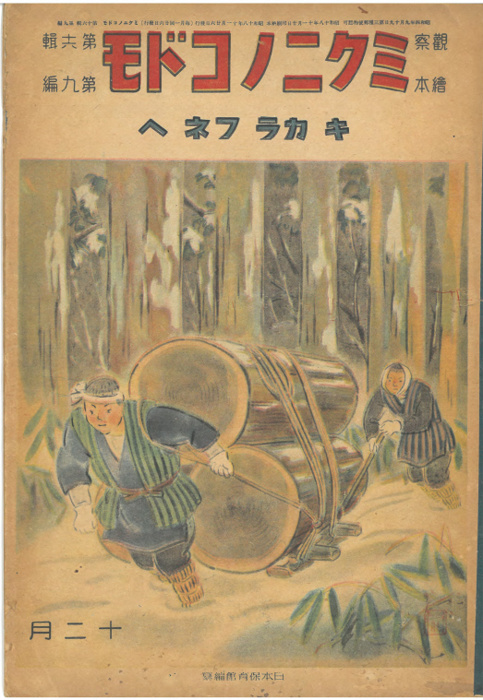
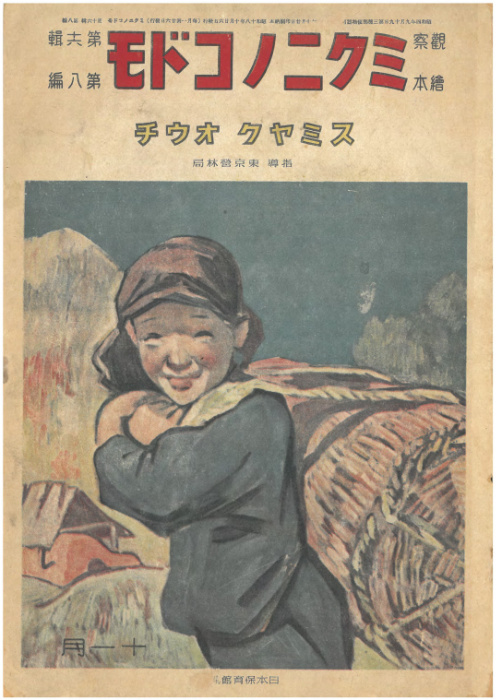
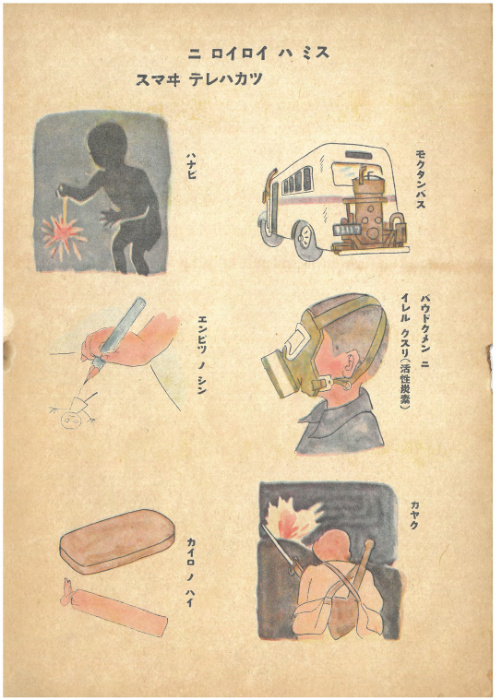
As is well known, the Asia-Pacific War was also a struggle for oil resources. Japan, which lacked oil, scrambled to implement various measures, one of which was to focus on wood resources as an alternative. In addition to the traditional physical use of wood as lumber, the national policy promoted the chemical use of charcoal gas and pine-root oil. With the encouragement of the military, forestry departments were strengthened at universities and national forestry research institutes during this period.
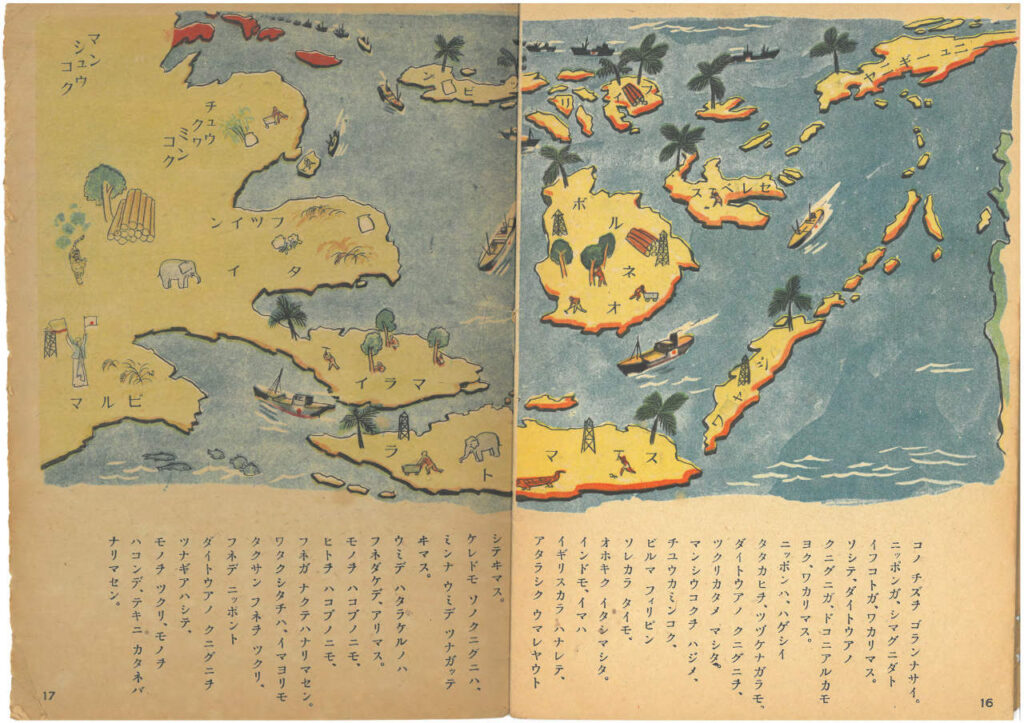
The November and December 1943 issues of "Observation Picture Book: Mikuni no kodomo" were titled "Sumiyaku ouchi" and "Ki kara fune he" (Forestry is the theme of two consecutive issues). In the November issue, Tate Suda, former head of the Tokyo Forestry Bureau and director of the Second Department of Economy, Practice Bureau of the Dasei Tsubasaikai, explains the importance of firewood and charcoal as important wartime commodities in his article titled "One lump of charcoal, one piece of firewood". In the December issue, Saburo Takashima, a former agricultural and forestry engineer and executive director of the Japan Wooden Boat Association, refers to the abundant resources of the occupied territories that expanded as the Greater East Asia Co-prosperity Sphere in his article, "From Wood to Boats. The text of the December issue, which follows Takashima's description, begins as follows.
Oyama no kimo, sensou ni ikkoto ni ikkoto ni narimashita. Two hundred and three hundred and three hundred and four hundred and four hundred and four hundred and four hundred and four hundred and four hundred and four hundred and four hundred and four hundred and four hundred and four hundred and four hundred and four hundred and four hundred and four hundred and four hundred and four hundred and four hundred and four hundred and four hundred and four hundred and four hundred.
In my article, "Forests and Time: A Social History of the Region Concerning Forests," published in 2024 by Shinzensha, titled "Modern Times and Forests in Hama-dori, Fukushima Prefecture: A Chapter", "Observation Picture Book: Mikuni Nokodomo" is mentioned, along with episodes from the Tomioka Forest Office, then known as the "Mecca of charcoal making". In fact, the November issue of "Sumiyaku Ouchi" was produced based on an interview with the wartime Kido Brigade Forestry Office, which was my subject of the issue.
The booklet for parents titled "Visiting the War Charcoal Burners" contains a detailed account of charcoal production at the Kido Forestry Office during the war, indicating that the intention was to educate children through their parents. With war creeping into every corner of daily life, charcoal was one of the important pillars supporting Japan during the war.
The magazine's founding purpose was "a book with unity and communication, drawn with pictures for infants who cannot read freely" ("100 Years of FREIBELKAN," 2008, p. 47), and this issue, which also focuses on charcoal making, depicts charcoal production realistically with beautiful watercolor drawings and text. On the other hand, the text of the November issue, as well as the December issue, is steeped in the post-gun era.
Sensou ni katsutame ni ha taisetsu na mono ga taksusan ni irimasu. There is a smear on the surface.
Eighty-odd years ago, Japan's forests and trees were there solely to serve the nation's war effort.
The world is now in the throes of economic and social turmoil, including the scourge of unreasonable wars and the resulting oil price hikes. The instantaneous transformation of infant magazines from peacetime to wartime is real for those of us living in the present.
Each issue of "Observation Picture Book: Kinder Book" and "Observation Picture Book: Mikuni Nokodomo" is held by the International Library of Children's Literature and other libraries, and can be read on the DVD archive published by the company. (Nobuyuki Yamamoto, Senior Researcher, Forestry Management and Policy Research Area, Forestry and Forest Products Research Institute, National Institute of Forestry Research and Development)
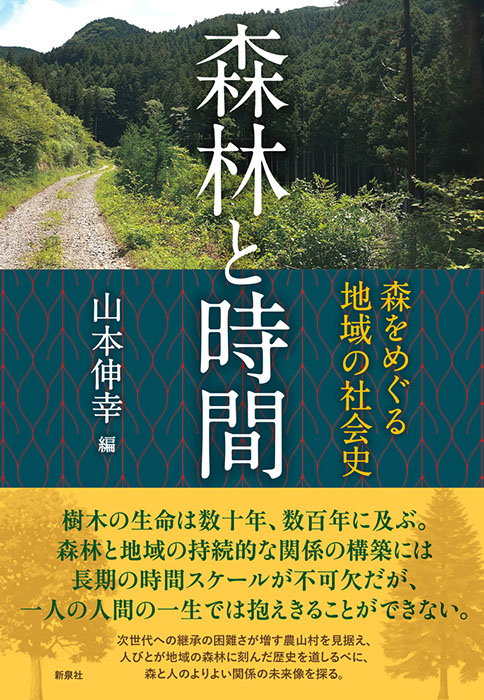
Forests and Time."
Edited by Nobuyuki Yamamoto, published by Shinsensha
The life of a tree can span decades or centuries. A long-term time scale is essential for building a sustainable relationship between forests and local communities, but it is not something that can be carried out in the lifetime of a single person. With an eye on farming and mountain villages, where it is becoming increasingly difficult to pass on the forests to the next generation, we will explore the future of a better relationship between forests and people, using the history that people have carved into the local forests as a guidepost.
<Table of Contents
Introduction: Forest Time and Human Time Nobuyuki Yamamoto
Chapter 1: People Who Encountered Yamazukuri Shimazaki Yoji and the Forest School Atsuro Miki
Chapter 2: Inheritance of Mountain Village Society and Women's Life Course: Women's Progress in 200 Years of a Mountain Village in Tochigi Prefecture Miho Yamamoto
Chapter 3: Life History of a Village and Its Residents Living with Mountains and Rivers Taro Takemoto, Shuhei Sato, Sho Matsumura
Chapter 4: Modernity and Forests in Hamadori, Fukushima Prefecture, Chapter 4: Nobuyuki Yamamoto
Chapter 5: The Interconnection between the Pulp and Paper Industry and Local Sustainability
Chapter 6: The Era of the Akai School: The Origin of Domestic Timber Supply Development in a Local University Yoichiro Okuyama
Chapter 7: Party and Expertise in Forest Management Changes in Forest Policy and Local Practices in Tenryu and Fuji Minami-Foothills Kazuto Shiga
End of Chapter Nobuyuki Yamamoto, Continuing to Re-weave the Relationship between Forests and People