
courtesy of takeda@schrodingers.jp / photograph
Updated by "Forest Circular Economy" Editorial Board on May 19, 2026, 7:28 PM JST
Editorial Board, Forest Circular Economy
Forestcircularity-editor
We aim to realize "Vision 2050: Japan Shines, Forest Circular Economy" promoted by the Platinum Forest Industry Initiative. We will disseminate ideas and initiatives to promote biomass chemistry, realize woody and lumbery communities, and encourage innovation in the forestry industry in order to fully utilize forest resources to decarbonize the economy, strengthen economic security, and create local communities.
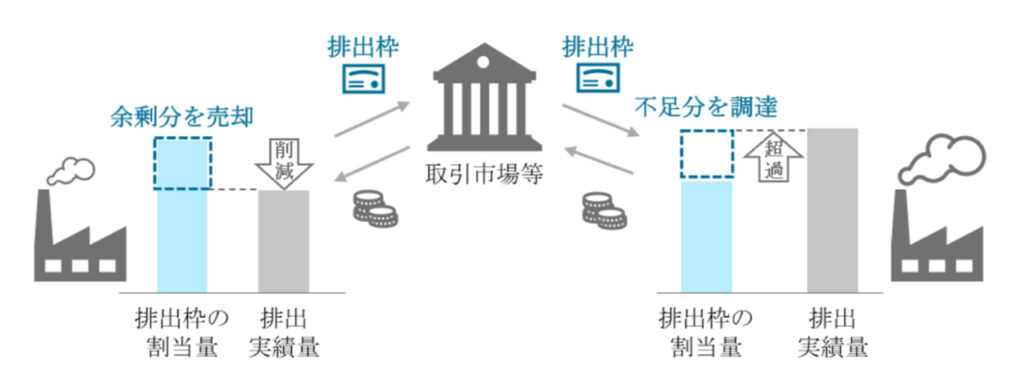
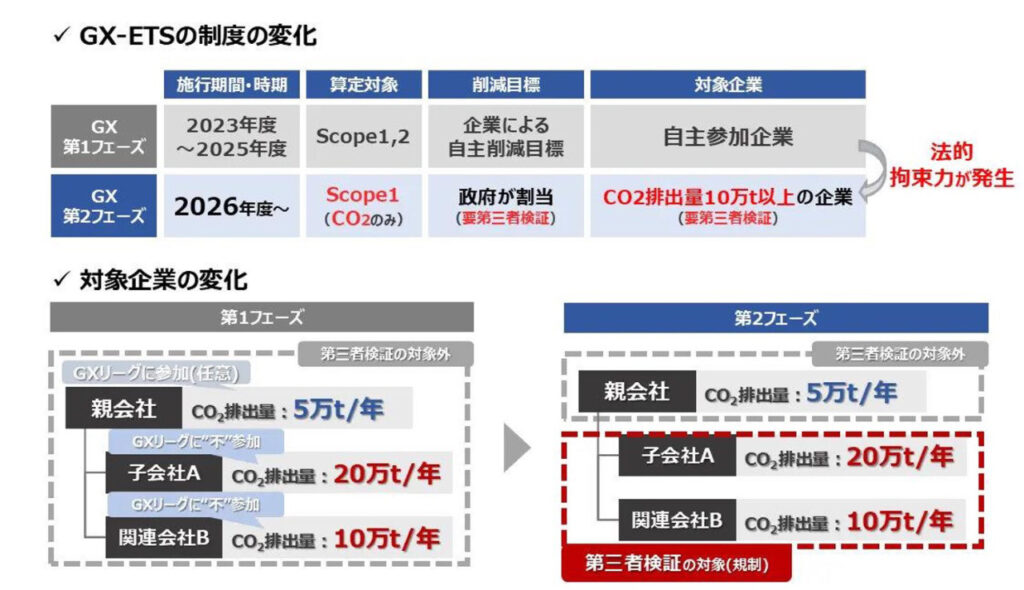
The Emissions Trading Scheme (GX-ETS), which plays a central role in Japan's decarbonization strategy, moved into its second phase in FY2026. The framework has been strengthened to require businesses with direct CO2 emissions of 100,000 tons or more on average in the last three years up to the previous fiscal year to report emission targets and actual emissions for Scope 1 and submit a transition plan, and the transparency and effectiveness of the system is being improved. The GX-ETS is also strengthening its presence as a system that influences the procurement, investment, and supply chain strategies of companies. The GX-ETS is gaining a stronger presence as a system that will have an impact on companies' procurement, investment, and supply chain strategies. The forest industry, in particular, has entered a phase in which business opportunities and institutional compliance are advancing simultaneously, as interest in J-credits and forest credits grows, the value of emission reductions becomes more visible, and the importance of third-party certification increases. As the detailed operation of the system and the formation of market infrastructure progress in parallel, the understanding of the GX-ETS itself is becoming a factor that will determine the competitiveness of companies in the future.
The Ministry of Economy, Trade and Industry (METI) and the GX Promotion Agency have released a series of manuals that provide practical guidelines for companies regarding the second phase of the Emissions Trading Scheme, which will be fully implemented from FY2026. Seven manuals are available, including a setup manual that provides an overview of the procedures, emissions calculation and reporting, transition plan preparation, registration application, and verification operations. In contrast to the first phase, which focused on voluntary participation, the second phase will strengthen the framework for information disclosure and reporting for emitters above a certain size. The target companies are those that directly emit 100,000 tons or more per year on average in the last three years up to the previous year, and are required to submit emission targets and transition plans, as well as emission performance reports by the end of September of the following year. However, for FY2026, the first year of the program, there is a special exception in which notification of emission targets is postponed until the end of September of the following year, 2027. In the future, it will also be mandatory to have third-party verification of calculated targets and actual emissions by a "registered verification organization" registered by the government. As the establishment of a highly transparent calculation and reporting system to ensure the credibility of the system has become an issue, the Ministry of Economy, Trade and Industry (METI) and the GX Promotion Organization (GXP) will support the smooth implementation of the system and the full-scale operation of emissions trading by providing the manuals.
*Reference link
Emissions Trading Scheme Portal Site Various manuals are now available. | GX Promotion Agency
Overview of Emissions Trading Scheme | Ministry of Economy, Trade and Industry
Japan Quality Assurance Organization (JQA) has been registered as a third-party verification organization for the second phase of the GX-ETS, continuing from the first phase. In the second phase, third-party verification is required to ensure the accuracy and transparency of the "emission targets" and "annual emission performance" reported by eligible companies. JQA was the first GHG verification organization in Japan to be accredited (ISO 14065) in 2011, and has over 20 years of experience in third-party verification for the J-credit system and the Ministry of the Environment's SHIFT project. JQA has been engaged in third-party verification for more than 20 years, including for the J-Credit System and the Ministry of the Environment's SHIFT project. JQA intends to ensure the objective reliability of emission data by applying its knowledge based on abundant practical experience to the verification of this program as well.
*Reference link
Registered as a verification organization for the second phase of GX-ETS
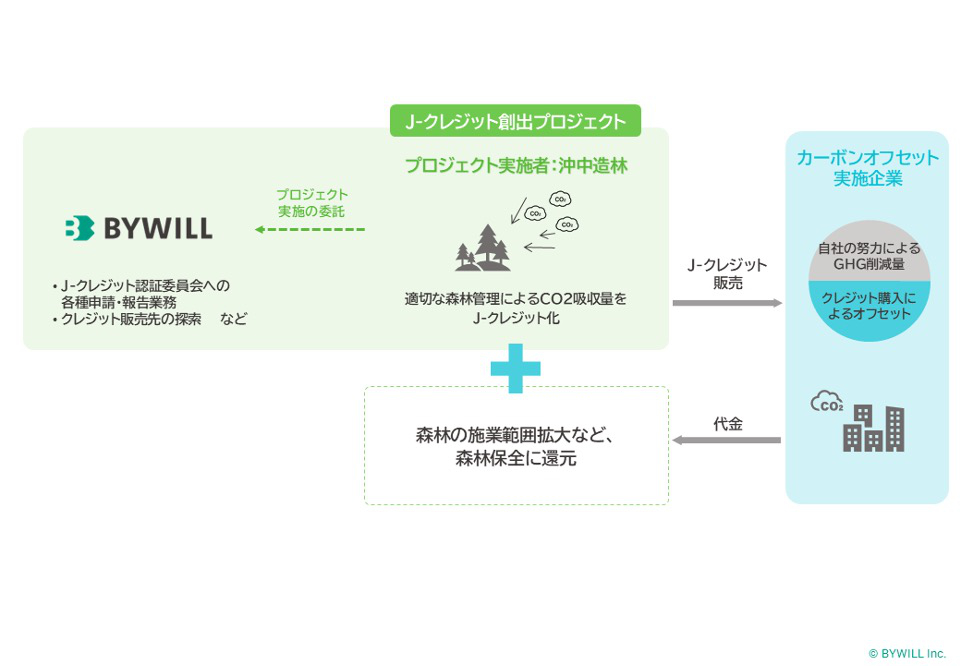
Okinaka Zoshin, a forestry company in Matsusaka City, Mie Prefecture, Sanjusan Bank, and Bi-Will obtained official certification for forest-derived J-credits for 721.76 hectares of forests, mainly in the Haze area of the city. The credit amounted to 4822 t-CO2 as CO2 absorption through appropriate forest management and was visualized as environmental value. Okinaka Zoshin has long supported the local forestry industry by managing and utilizing the "Ise Forest" in Matsusaka City, growing cedar and cypress trees over 100 years old and providing them to residences, shrines, temples, and other structures. J-credits are positioned as eligible carbon credits under the GX-ETS, and are expected to be used strategically as a means to offset the carbon emissions of participating companies that are subject to high reduction targets. J-Credits are positioned as qualified carbon credits under the GX-ETS and are expected to be used strategically as a means of offsetting emissions by participating companies with high reduction targets.
Asuene, a CO2 emissions management cloud service provider, has acquired all shares of exroad, a carbon credit information platform provider, and made it a subsidiary. The complexity of the system and the high level of expertise involved are major barriers to management decision-making. With the acquisition of Asuene as a subsidiary, Asuene has also started considering the merger and business integration of Carbon EX and exroad, two Asuene group companies that operate carbon credit and emissions trading exchanges. This is an ambitious infrastructure development in anticipation of the full-scale operation of the GX-ETS.
*Reference link
Asuene executes 100%M&A of exroad, a carbon credit information platform provider | Asuene Corporation
A seminar to support strategic responses by GX-ETS subject businesses, "GX-ETS System Essentials to Know Now and How to Take a Business Stance," will be held on May 26, 2012. The seminar will be hosted by the New Social Systems Research Institute (SSK). The lecturer will be Katsura Fukuda, Senior Consultant, GX Headquarters, Mitsubishi Research Institute, Inc. In addition to summarizing the key points of the system as it transitions to the second phase, the seminar will cover practical issues such as the impact on renewable energy power generation projects and carbon credits, and future trends in carbon pricing. Specific action guidelines to be adopted by businesses will be discussed from multiple perspectives. The experts' multifaceted analysis will provide an opportunity to deepen understanding of the GX-ETS and accelerate corporate promotion of GX.
■Related Articles
Impact of the GX-ETS ceiling price of 4,300 yen on forest-related J-credits (Part 1) Read about changes in system design and market environment
The Impact of the GX-ETS Maximum Price Limit of 4,300 yen on Forest-based J-Credits (Part 2) Background to Price Setting and the Forest Industry's Imperative to Redesign its Strategies