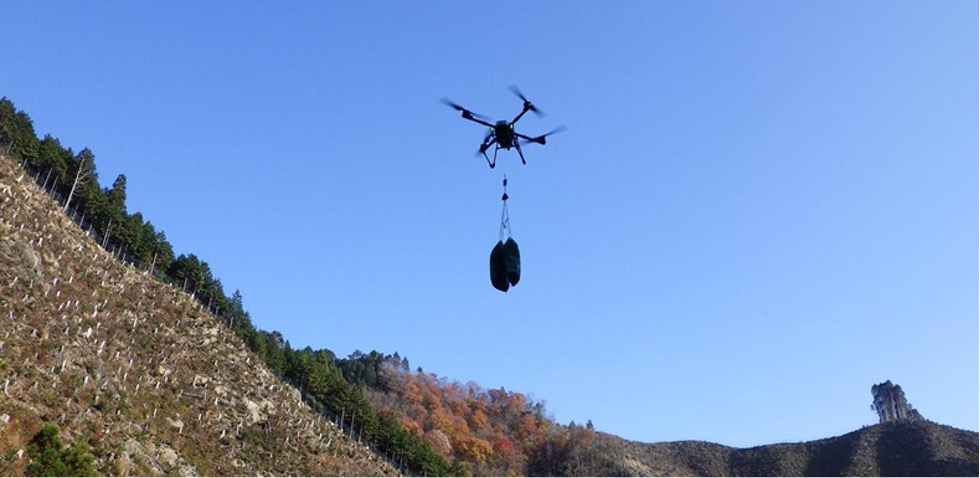
How to compensate for the lack of "Man-Day": The next topic in smart forestry is labor-saving technologies such as seedling transport drones.
Updated by Sogo Kato on May 27, 2026, 11:58 AM JST
Sougo KATO
Amaki Editorial Production
After working for a financial institution researching companies in the high-tech field, he worked as a supervisor at a landscape construction site before setting up his own business. He is interested in the materials industry, renewable energy, and wood utilization, and in recent years he has been writing about the forestry industry. With his experience of working in the forests in the past, he aims to write articles that explore the connection between the realities of the field and the industrial structure.
The focus of forestry DX is beginning to expand from the advancement of forest information to the safety and labor saving of field operations. Smart forestry to date has focused on the use of aerial laser measurement and forest cloud computing to identify forest resources, confirm boundaries, and improve the efficiency of operations planning. In recent years, however, technologies that directly reduce the burden on the field, such as drones for transporting saplings, remotely operated undercutting machines, and automated technologies for collecting overhead timber, have begun to stand out. The question is not only how to visualize the mountain and make more sophisticated operational decisions, but also how to compensate for one man-hour (i.e., one day's worth of labor) in the field. Forestry DX is about to expand from management technology to technology that allows a small number of people to work on a site.
In the early stages of the forestry DX, the emphasis has been on developing information to put forest resources to work. The aim is to increase the availability of the mountain. The amount of resources influences the outlook for the amount of timber output, while boundary and ownership information is related to the consolidation of the operation site. The topography and haul-out distance are prerequisites for road network design and machine layout, and the operation history is a factor in determining the next harvest or reforestation.
Aerial laser measurement, drone aerial photography, forest cloud computing, forest GIS, and operation proposal software have been introduced as technologies to link such information to operation decisions. Visualization of forest information is the foundation for incorporating forest resources into operation plans and facilitating business operations.
The focus has expanded from the maintenance of forest information to labor-saving field operations. In the past, mechanization of logging and removal of trees by harvesters and forwarders has progressed at sites where road networks have been developed. The focus is now shifting to the remaining work of planting trees, clearing underbrush, transporting saplings, and assisting work on steep slopes.
In recent years, technology has begun to enter this area. The backdrop is the diversion of technologies that grew up in construction, agriculture, and logistics. Drones, small traveling machines, remote control, sensors, communications, image recognition, and small motorization have approached a level that can shave the load of a single process unit in forestry. This is why sapling-transporting drones, undercutting machinery, and remotely operated forestry equipment are attracting so much attention.
Importantly, these technologies are beginning to be seen as a cost-effective means of replacing a single manpower job in the field. Forestry DX is beginning to expand from technologies that prepare forest information to technologies that make field work profitable and labor-saving.
DX, which is advancing in many industries, is in the direction of using data to recapture operations that are already in motion and improve the accuracy of management and decision-making. In finance, the focus is on credit and risk management; in retail, inventory and demand forecasting; in construction, process, cost, and safety management; and in manufacturing, operational monitoring and quality control of mechanized processes. The idea is to visualize information generated onsite and improve the efficiency of the entire operation.
Forestry DX also overlaps with this trend in terms of the development of forest information through forest cloud computing and aerial laser measurement. Efforts to improve the accuracy of forest management decisions by using data to understand mountain boundaries, resource levels, and management plans are beginning to make progress in various regions.
However, the challenges of the forestry industry are not limited to information management. It is said that the retention rate of new workers in the forestry industry is less than 50% after 10 years. In addition to the danger and heavy physical workload, there are also concerns about future work styles and income.
So in forestry DX, it is important to have technology that supports not only the sophistication of management but also the field work itself. Sapling-transporting drones, small machines, and remote-control technology are not meant to manage the field from above, but rather as technology to supplement one man-made task, reduce dangerous work and hard labor, and create an environment that allows people to continue working in the field.
In the long run, AI and automation will also advance the sophistication of the forestry industry. However, what is likely to spread on the ground is technology that compensates for a single artificiality in the field.
If labor-saving technologies become easier to use, forestry workers will have more options. For those who want to start their own business, it will be easier for them to take on jobs with a small number of workers, and for existing businesses, it will be easier for them to assemble a site with a limited number of workers. For both employers and workers, technology that compensates for one manpower could be a means of making it easier to continue forestry work.
The more labor-saving technologies that are easy for individuals and small businesses to use, the more attractive it will be to enter the forestry industry. Forestry DX may expand in the direction of how to compensate for a single man-made resource from the field, in parallel with the advancement of management. (Sogo Kato, Forestry Writer, Leaf Rain Co.)