


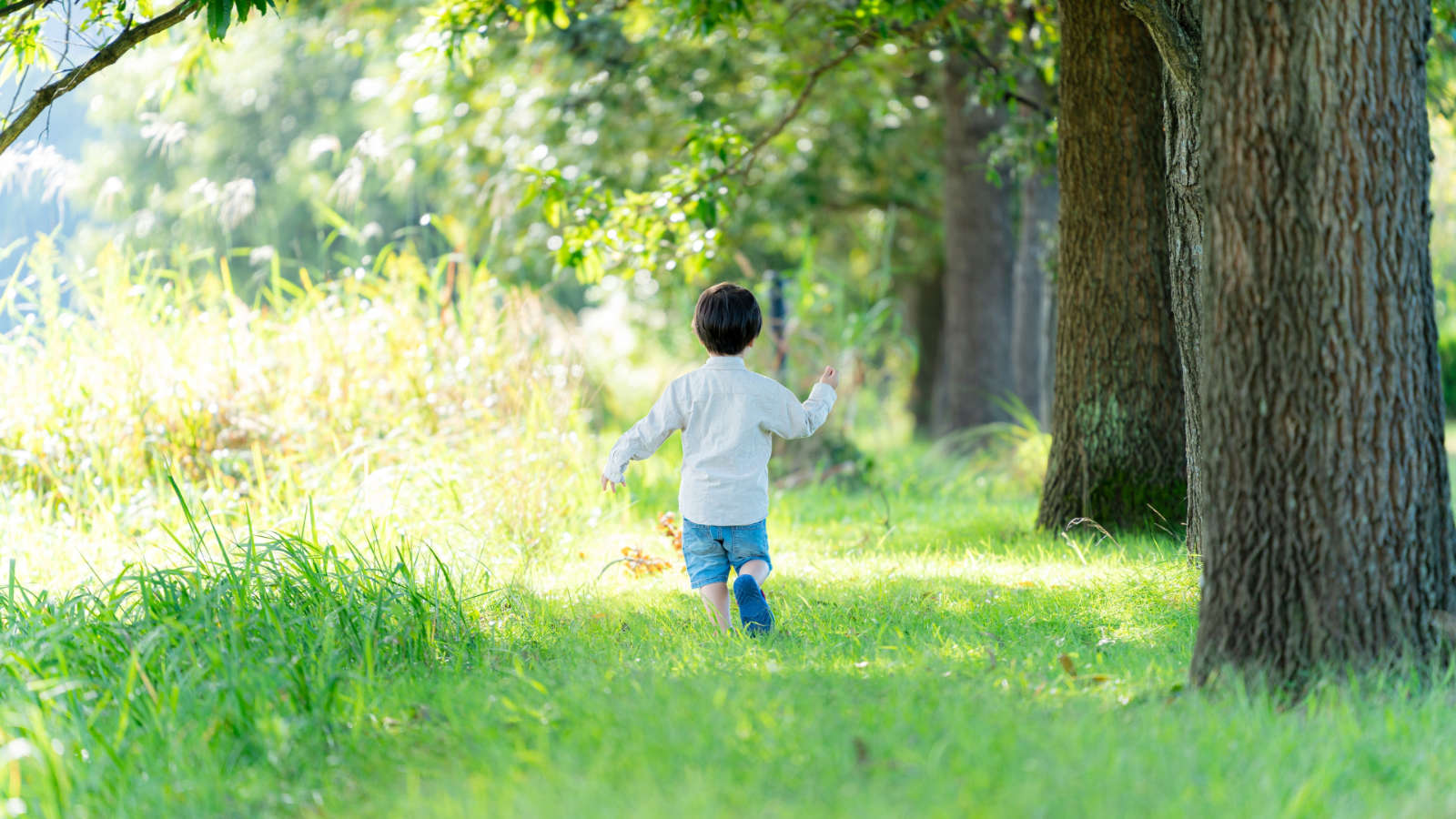
Image by PhotoAC
Practicing "Watchful Childcare" in the Vast Natural Landscape of Chizu, Where Children and Parents Grow Together — The Charm of Forest Kindergarten: Part 1
Updated by Saeko Nishimura on August 14, 2026, at 10:28 a.m. JST
Saeko NISHIMURA
NPO Chizu no Mori Kosodateisha
Born in 1972. Studied forestry as a student, and studied tropical forests (mangroves) in Myanmar as a graduate student. After marrying, she moved to Tottori Prefecture and joined the Tottori Prefectural Government in 2003, retiring in 2012. 2009, she established "Chigashi-cho Morino no Yochien Marutambo" (Forest Playground Marutambo). In 2024, she took over the business and is now enjoying life in Chigashimachi. He is enjoying his life in Chigashira town.
Before I talk about the appeal of forest kindergartens, I’d like to say a few words about the challenges of raising children today—or rather, about the sense of unease I personally feel.
First, due to the declining birthrate—which means some children have no siblings or friends nearby to play with—there has been a dramatic decline in the number of opportunities for children to hang out together or play on their own. Furthermore, in an effort to ensure their safety and peace of mind, adults tend to intervene excessively; in some cases, they may even anticipate every move children might make, leading to a tendency to over-guide them.
I believe the ultimate goal of parenting is for children to become independent and lead happy lives. To that end, I’ve come to feel that the current environment surrounding parenting isn’t necessarily conducive to that. Compared to the children I observed in various Southeast Asian countries during my student days, I don’t really sense that “childlike quality” in Japanese children. They are very well-behaved and good kids, but… I can’t help but feel that this is linked to the difficulties young people face today, such as social withdrawal.
The “Forest Preschool” we started in 2009 amidst the great outdoors of Chizu has practiced “watchful care”—trusting in the children’s abilities and minimizing adult intervention as much as possible while spending every day in the forests of Chizu. In the early days, we ran the program based on our intuition as mothers of young children (not as experts), and I believe that laid the foundation for the “wild” spirit of Chizu Town’s Forest Kindergarten.
As the name suggests, the Forest Preschool doesn’t have a permanent building; instead, the children go to the forest every day. They spend their time in the forest through all four seasons—whether it’s hot or cold, raining or snowing. Naturally, some children who have grown up in comfortable, convenient environments feel a bit lost at first. They might burst into tears just from taking a little tumble, getting their hands dirty, or getting their clothes wet. However, at the Forest Kindergarten, even 3- and 4-year-olds are expected to take care of themselves. No one will come to their rescue if they cry. While older children might offer a helping hand, adults generally won’t rush in to help unless it’s an absolute emergency.
Why is that? No matter how young they are, children are actually quite capable of taking care of themselves. Deep down, they really want to do it. But there are many children who aren’t allowed to (because their parents think they “can’t”). At the Forest Kindergarten, every child—no matter how young—is treated as an individual “person,” and they are encouraged to do as much as possible on their own. Since the older children can handle quite a lot on their own, simply by watching them, the younger children quickly learn to take care of themselves.
This is a bit of a tangent, but this summer, my youngest daughter—a high school sophomore who graduated from Mori Kindergarten and the Nitta Sudbury School—traveled to Hokkaido by herself to attend an open campus event at a university she’s interested in. She did everything on her own—booking the flight, reserving accommodations, and figuring out her transportation. Before she left, she seemed a little nervous since it was her first solo trip, but she’s already 17. This is Japan (where Japanese is spoken). I gave her a little push, telling her, “You’ll be fine!”—and she successfully completed her mission and came back having grown up a bit. To me, this seems “only natural,” but when I asked her about it, she said all the other students attending the open campus were accompanied by their parents. She had actually planned to make friends with other students who were there on their own, but she never got the chance.
Of course, as parents, I can understand the desire to see what kind of school your child wants to attend. However, compared to 30 years ago when we were students, I can’t help but feel that parents today are a bit overprotective—or perhaps overly controlling—and that they don’t really trust their children. It seems a bit off to me to raise children in an overprotective or overbearing way, only to tell them the moment they become adults, “Figure out for yourself what you want to do,” or to complain, “My child can’t do anything on their own.” Unless children repeatedly experience “thinking for themselves” and “making their own decisions” from a young age, isn’t it going to be quite difficult for them to truly do things “on their own”?
Let’s get back to the forest kindergarten. Since we started with this mindset, it was a perfect fit for the forest kindergarten’s “watchful care” approach. Since we were simply “mothers,” we didn’t have any preconceived notions like, “A 3-year-old can do this,” or “A 5-year-old can’t do that.” So, as we practiced “watchful care,” we were moved to see the children rapidly gaining the ability to do all sorts of things—and even when we let them try things we thought, “Surely this is too much for them,” they managed to pull it off.
They even climb steep slopes barefoot. Children who can’t keep up with the more athletically gifted ones think things through, experiment, and find their own routes. Even in a forest where there seems to be nothing, children find interesting things—like rocks, twigs, flowers, and insects—and start playing with them. Even things generally considered “dangerous,” such as fire or sharp objects, can be handled skillfully if they’re allowed to touch them while being taught the key points. In most cases, when adults say, “That’s probably impossible,” they’re actually underestimating the children’s abilities.
When running a forest kindergarten, I often encounter situations where I find myself thinking, “Wouldn’t it be better to let the children handle it themselves rather than have adults intervene?”
One day, while I was out for a walk with four children, we came to a fork in the road: one child wanted to go one way, and the other three wanted to go the other way. What would you do in this situation? At the forest kindergarten, even in situations like this, we leave the decision up to the children (we tell them, “Decide for yourselves,” and wait for them to resolve it on their own). This time, the discussion went nowhere. Neither side would budge. Then, one of the three said, “Actually, maybe I’ll go this way?” and sided with the group that had chosen one path. But immediately afterward, he changed his mind and said, “Actually, I’ll go that way!” and switched back to his original choice.
Before long, they started jokingly doing the “This Way or That Way Dance.” Then the other kids got into it too, shouting, “This way!” and “No, actually, this way!” as they danced. After dancing for a while, perhaps the child who had been insisting on their own way felt that their feelings had been understood. “Okay, let’s go this way (the direction the three of them were pointing) today! But tomorrow, we’re going that way!” they said, voluntarily withdrawing their original suggestion.
It seems to me that we adults don’t have the option of “solving problems by dancing.” At best, maybe rock-paper-scissors? But even here, without adult intervention, the children brilliantly resolve the situation in ways we adults could never imagine—without hurting anyone. At the forest kindergarten, this happens all the time. As a result, we adults are able to trust the children’s abilities more and more, and we’re learning to be patient.
As parents, it’s very important to recognize our children’s abilities. That’s because it makes parenting much easier. If we think of children as “immature beings who can’t do anything,” it puts pressure on us as parents. Thoughts like, “I have to guide them better,” “I have to make sure they can do it well,” and “Shouldn’t I teach them sooner than other kids?” cause the parent’s (physical and psychological) burden to grow steadily.
However, if parents can realize that children “have the ability to learn and grow on their own”—and even that they “can solve problems more brilliantly than adults”—they can trust in that ability and enjoy a “more relaxed” parenting experience. Once parents realize that raising children is easier when done collectively, even those who once thought, “One is enough!” might start thinking, “I’d like one more—no, actually, two more.” I believe that forest kindergartens could also serve as the best “solution to the declining birthrate.” (Saeko Nishimura, Chairperson, NPO Chizu no Mori Kosodachi-sha)
