Updated by the Forest Circular Economy Editorial Department on November 22, 2025, 11:15 PM JST
Editorial Board, Forest Circular Economy
Forestcircularity-editor
We aim to realize "Vision 2050: Japan Shines, Forest Circular Economy" promoted by the Platinum Forest Industry Initiative. We will disseminate ideas and initiatives to promote biomass chemistry, realize woody and lumbery communities, and encourage innovation in the forestry industry in order to fully utilize forest resources to decarbonize the economy, strengthen economic security, and create local communities.
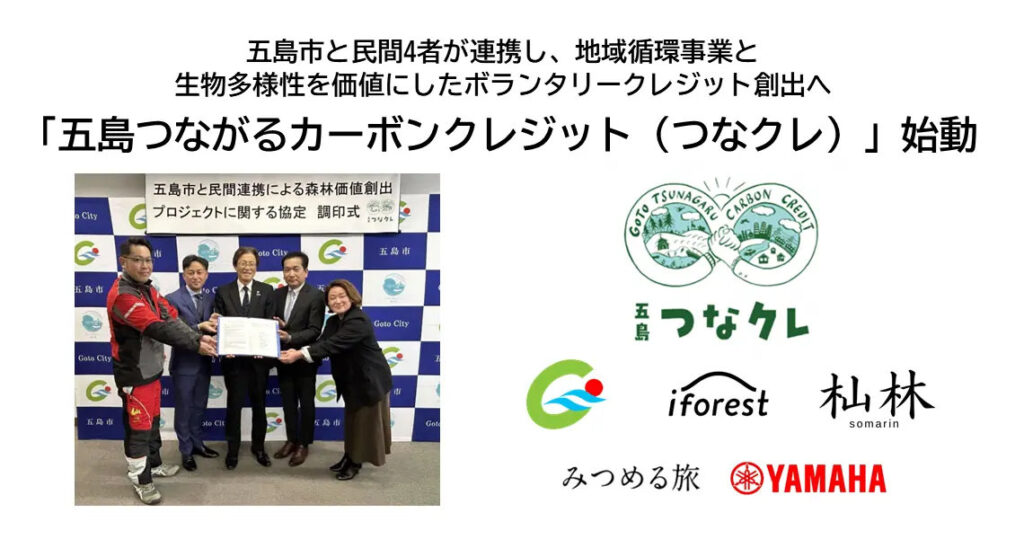
Goto City, Nagasaki Prefecture, has signed an agreement for the joint project "Goto Connect Carbon Credit" (commonly known as Tsunakure), conducted in collaboration with four private entities: iForest, Somabayashi, Yamaha Motor Co., Ltd., and the general incorporated association Mitsumeru Tabi. The project aims to generate absorption and removal-based voluntary carbon credits (JVC) by utilizing unmanaged forests in Goto City and Kuga Island. The revenue generated will be used to implement a regional circular business model, including the development of forestry operators.
This project utilizes an 815-hectare municipal forest on Kuga Island in Goto City, combining precise measurement technology with environmentally conscious forest management practices to quantify CO2 absorption and biodiversity. Specifically, it visualizes the forest's current state through LiDAR measurements using unmanned helicopters provided by Yamaha Motor and biodiversity surveys conducted by iForest.
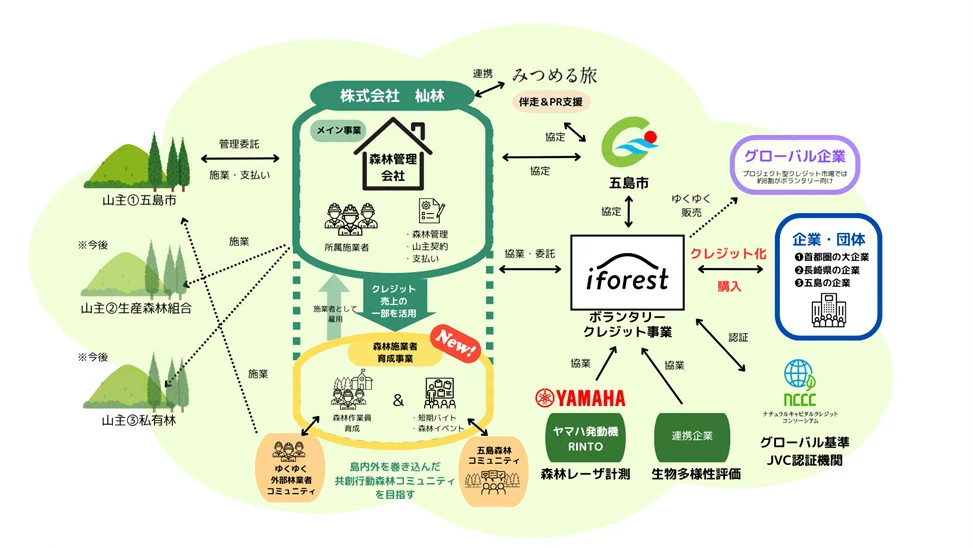
Local company Somorin undertakes phased forest management and human resource development over a 10-year span. It generates revenue by issuing credits based on CO2 absorption created through surveys and forest management, then selling these credits to corporations and other entities. Furthermore, by visualizing the forest management process and disseminating information through PR, CSR activities, and educational training, it also aims to build collaborative relationships with urban companies and related stakeholders.
The credits will be certified by the Natural Capital Credit Consortium (NCCC), a general incorporated association led by the Urban Research Center of Kyushu University. In addition to CO2 absorption, the credits incorporate the measurement and evaluation of biodiversity. These credits, issued under internationally consistent standards, are expected to be the first of their kind in Kyushu.
The core of this initiative extends beyond mere carbon offsetting. It involves reinvesting credit revenues into human resource development and community activities, thereby creating a "forest-related population" engaged with forests across sectors. It aims to solve the regional challenge of forest degradation by riding the wave of decarbonization, while simultaneously pursuing regional revitalization that leverages natural capital.
This regional circular business model, which leverages natural capital to achieve both decarbonization and regional revitalization, has the potential to become a practical model case. As a community-led initiative to regenerate Japan's increasingly degraded forests, its future outcomes are highly anticipated.
Reference Links
Regarding the Conclusion of a Partnership Agreement between Goto City and Four Private Companies (Goto City)