Transforming food waste through cutting-edge technology and business: A circular economy that fully utilizes the luxury of photosynthesis
Updated by Hiroshi Komiyama on March 12, 2026, 8:39 PM JST
Hiroshi KOMIYAMA
(Platinum Initiative Network, Inc.
After serving as Professor at the University of Tokyo, Dean of the Graduate School of Engineering and Dean of the Faculty of Engineering, and President of the University of Tokyo (28th), he was appointed Chairman of the Mitsubishi Research Institute in 2009, and Chairman of the Platinum Initiative Network in 2010 (to be incorporated as a general incorporated association in 2022). Other positions include President of the STS Forum, Chairman of the Association for Super-Education, Chairman of the United Nations University Cooperation Foundation, Chairman of the International Science and Technology Foundation, and Chairman of the Heat Pump and Thermal Storage Center Foundation. He also received the Dubai Knowledge Award (2017), the Order of the Star of Solidarity of Italy (2007.) and "Information and Communication Month" Commendation from the Minister of Internal Affairs and Communications (2014), the Zaikai Award Special Prize (2016), and the Commendation for Merit in Promoting a Maritime Nation (2016), among many other national and international awards.
Continuing from the previous issue, "Japan, the Land of PhotosynthesisFood is an indispensable perspective when discussing "food". If we trace the source of the calories we consume on a daily basis, it all comes down to "photosynthesis" performed by plants. However, "food loss," in which approximately 30% of the food produced in the world is lost, remains a serious issue. In response to this issue, we will present a roadmap for creating new value and realizing a circular economy through the power of cutting-edge technology and business, rather than just a "mottainai" (what a waste) mentality.
Each human being consumes the equivalent of "100W" of energy and generates heat. This is equivalent to a basal metabolism of approximately "2100 kilocalories" per day. And about 20% of the energy consumed by humans, or "20W," is used to power the brain. Just as we need to recharge our batteries to run our smartphones, the energy source that allows us to live, think, and move is all based on solar energy fixed by plants through photosynthesis.
The food we eat, not only rice and wheat, but also pork and chicken, for example, are originally the product of photosynthesis, such as corn, which is used as feed. In fact, most of the corn produced in the world is not eaten directly by humans, but is used as feed and fuel for livestock. The conversion efficiency of energy into meat drops to 20% for chickens, 15% for pigs, and about 10% for cattle. Fish in the sea also end up in photosynthesis by phytoplankton, which grows using nitrogen and other nutrients that come up from the depths. We need to recognize that photosynthesis is the basis of all living things, and that we are eating the "fruits of photosynthesis.
If we calculate the total calorific value of the three major cereals produced in the world today, rice, wheat, and corn, we can theoretically expect to produce enough to feed the world's 8 billion people. Despite this, the current situation is that about 30% of food loss is generated in total.
All food is a resource that provides calories and is never garbage. Food loss is a waste of valuable energy produced through photosynthesis that remains unutilized when it is disposed of without entering the human body. There is nothing more wasteful than this.
As a technological approach to the issue of food loss, we are pleased to introduce the Platinum Catalyst, which was developed by the Catalyst Science Laboratory at Hokkaido University.
Even after harvesting, vegetables and fruits release ethylene gas, a plant hormone, which accelerates their own aging (ripening). In fact, the platinum catalyst was originally created from the unintentional complete oxidation (combustion) of ethylene gas into carbon dioxide and water in the course of research into the production of useful chemicals from ethylene. However, this property became an epoch-making technology capable of completely decomposing ethylene gas even in a low-temperature environment such as inside a refrigerator (e.g., 0°C), and succeeded in inhibiting the ripening process of fruits and vegetables.
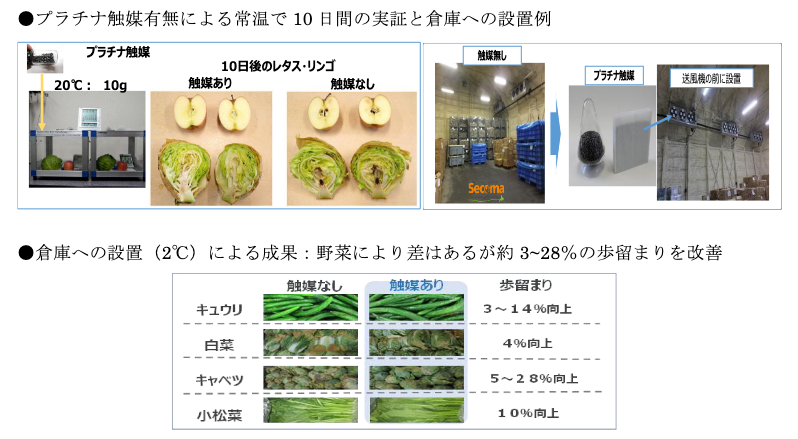
This has greatly contributed to the reduction of food loss in the distribution process. Already installed in Hitachi GLS household refrigerators and in the huge distribution warehouse of the SECOMA Group, a Hokkaido convenience store chain, the system has significantly improved the yield rate of Chinese cabbage and cabbage, generating economic benefits that exceed the cost of installing the catalyst.
On the other hand, there is a movement to change the structure of food loss from a business perspective: the Aomori A-Factory "Cidre" (apple liquor) initiative, in which Yumiko Kamata (representative of ONE-GLOCAL), who was involved in the "Ecute" station interior business at JR East, was involved while at JR East.
Conventionally, produce has been considered "substandard = discarded" if it is slightly damaged. However, by spending time "fermenting" the damaged apples, it is possible to convert them into cider with a higher added value than the original fruit. Furthermore, when the cider is distilled, it becomes apple brandy, which gradually matures to an amber color when laid down for several years or more, and can also be sold at a higher price and without loss. Another example of ONE-GLOCAL's efforts is the extraction and sale of valuable oil containing high cosmetic ingredients from the tea fruits of abandoned tea plantations. (*currently closed).
Rather than making food loss reduction a mere "mottainai" mentality, we must elevate it to a "luxury value creation" that takes time to create more delicious and beautiful products. This is the key to a sustainable business model for the future.
It has been pointed out that the amount of nitrogen produced artificially by humans as chemical fertilizers (aerial nitrogen fixation by the Harbor Method) now exceeds the amount of nitrogen fixed by bacteria in nature, one sign that the earth's ecosystem is approaching the limits of sustainable production. We can no longer afford to discard the "luxury of photosynthesis" that has been produced over time without us eating it.
Preserving freshness through technology and transforming value through business. These two key elements are the key to transforming food loss from a waste product to an asset, and are a solid step toward building a recycling-oriented society by 2050, or the "platinum society" I advocate. (Chairman of Platinum Network and Honorary Editor-in-Chief of "Forest Circular Economy" Hiroshi Komiyama)
*Reference link
Food Loss Reduction Consortium| Hokkaido University Industry-Academia-Regional Collaboration Promotion Organization
One Glocal President Yumiko Kamada...Curiosity Generates Energy: Yomiuri Shimbun