
Image by photoAC
How to design the "entrance" to forest services: A look at Hinohara Village and the interconnectedness of small hubs that attract urban dwellers.
Updated by Sogo Kato on April 28, 2026, 11:07 AM JST
Sougo KATO
Leaf Rain Co.
After working for a financial institution researching companies in the high-tech field, he worked as a supervisor at a landscape construction site before setting up his own business. He is interested in the materials industry, renewable energy, and wood utilization, and in recent years he has been writing about the forestry industry. With his experience of working in the forests in the past, he aims to write articles that explore the connection between the realities of the field and the industrial structure.
In Europe, there has been a growing interest in recent years in the cultural value of forests beyond timber production and the forest services that make use of them. This is due to fluctuating timber prices, climate change risks, and changing values in society. The stability of forest management is becoming more and more difficult to maintain simply by cutting and selling timber, and people are beginning to pay attention to values other than timber.
According to a survey conducted in Europe, the revenue from sources other than timber supply, which includes cultural services, remains less than 20% in both cases, and timber is still the main source of revenue. Cultural use of forests means that forests should not be limited to timber production, but should be viewed as a space for learning, leisure, physical and mental recovery, and food culture. Children's learning spaces, forest walks, and local uses linked to food are examples of such activities. The above trends are also indicated in a commentary article published in February 2026 by the European Commission Directorate-General for the Environment.
The European concept can be helpful in Japan, but it may not be easy to apply it as is. In Europe, there is a certain trend to link forests with health, recreation, and education. This is because spending time in nature has taken root as an extension of leisure time, due in part to differences in the development of parks in mountainous areas with gentle terrain and urban areas, and in the way people spend their weekends.
In Japan, on the other hand, such assumptions are not necessarily strong, and even if the same concept is introduced, the challenge is how to create an entry point and how to spread the concept to the local community. The question for Japan is how to reconfigure the European concept into a form that is easy to access for urban residents and the younger generation with high information sensitivity, and that will spread to the local community while referring to the European concept.
From this perspective, the Forest Service Industry Promotion Project of the Forestry Agency can be positioned as an entry point in Japan. This is an effort to create new jobs and income in mountain villages by utilizing forests not only for lumber production, but also for health, tourism, and education. In the introductory materials, not only the experience program but also the nearby facilities are shown, and the structure is designed to combine multiple locations in the region.
The programs that have actually come to the fore are those with relatively clear objectives, such as corporate training, health management, forest therapy, and experiential education. Such purpose-driven programs may have a certain significance as a gateway to connect forests and urban residents. At the same time, however, it seems that such an entry point with a clear purpose alone is somewhat narrow in terms of expanding contact with forests. It is also necessary to pay attention to how contact points are created where people can enter based on interest or atmosphere, even if they do not have a specific purpose.
The case of Hinohara Village is one of the best examples to consider when considering forest services in Japan. Hinohara Village is a mountain village in Tokyo with 93% of its area covered by forests, a declining population, and an aging population. On the other hand, in recent years, new centers have sprung up, including a forest toy museum, an old private house café, and other food and beverage outlets, as well as saunas and glamping facilities. These facilities are run by people who have moved to the village, people who have served in the Japan Regional Development Cooperation Volunteers, and people from the village, and are linked to local vegetables, timber, crafts, and specialty products.
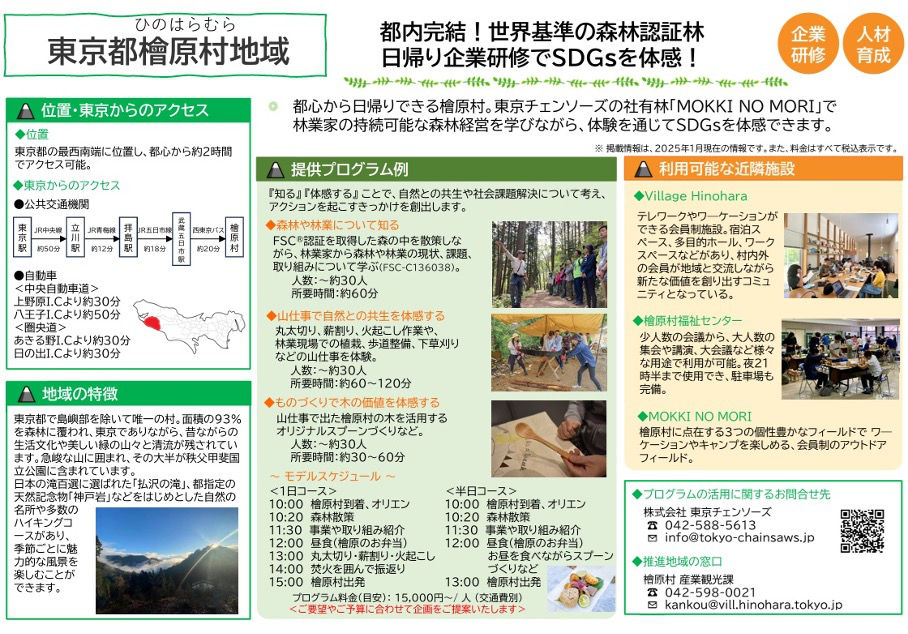
This trend is not only complete on the tourism and food and beverage side. The forestry industry is also expanding its business beyond traditional timber production to include timber utilization and forest services. Tokyo Chainsaws, for example, was established in Hinohara Village in 2006. Initially, the company worked as a subcontractor for the forestry cooperative, thinning trees, but it has since expanded its activities to include logging and removal from the company's own forests, processing and sales, sixth industrialization, and forest services such as forestry experience and corporate training. What is noteworthy about Hinohara Village is that the expansion of tourism and food and beverage facilities and the expansion of work in the forestry industry have been progressing while maintaining contact within the community.
There are three points of reference in the above case study of Hinohara Village. First, the number of bearers and small bases within the region is increasing, rather than being completed by a single company or a single initiative alone. Second, the unique resources of the region, such as timber, landscape, and local products, are connected to the business. Third, mass and trendy elements such as cafes and saunas have become entry points for city dwellers and the younger generation.
What the case of Hinohara Village shows is that even in mountain villages that are not famous tourist destinations, it is possible to establish connections with forests, and that these connections can be linked to the forestry side of the business. More than the scale of the project, the fact that such connections are beginning to emerge concretely within the community is suggestive. (Sogo Kato, Forestry Writer, Leaf Rain Co.)
*Reference site
Introduction of Forest Service Industry Promotion Areas : Forestry Agency
EU forest management still focuses on most profitable services