[The Priest's View] The Economics of "Musuhi" that Connects Divided Forests and Cities
Updated by Kazuhiro Aoki on March 24, 2026, 10:30 AM JST
Kazuhiro AOKI
Representative Director, WSense Corporation / DELTA SENSE Production Committee
Representative Director, WSense Corporation / DELTA SENSE Production Committee Born in Aizuwakamatsu City, Fukushima Prefecture. From a family background of flower arrangement, tea ceremony, and Noh theater, he has been exposed to Japanese culture from an early age. His interest in wood began when he witnessed a shrine carpenter "sharpening a plane" and became aware of the depth of the craft. Currently, based on the knowledge he gained as a Shinto priest, he is promoting initiatives that lead to the public interest. He is a member of the Tokyo Junior Chamber of Commerce, holds a graduate degree and an MBA (Master of Business Administration), and has been a Boy Scout and a soccer player since he was 4 years old.DELTA SENSE Official HP WSense Corporation
*Previous column is here.
The "Teshin" Theory of Restoring Return as a Manner of Forest Circulation
[The point of this article.
Issue: Modern forestry faces a fragmented supply chain (externalization of responsibilities and costs) where cities and forests trade anonymously as "buyers and sellers".
Vision: It is necessary to introduce the Shinto concept of "musuhi" and take an approach of "generating" new value by multiplying different resources, rather than simply exchanging them for equivalent.
Practice: The time has come to redefine forests not only as "timber production factories (natural capital)" but also as "hubs of social capital" where urban businesses and people can interact and co-create, and to launch a true circular economy by building direct relationships.
In previous articles in this series, we have discussed the temporal division of responsibility from the past to the future from the perspective of "Nakaima," and the need to redesign the forest as a "return loop (system)" that returns value and funds to the forest, rather than a straight supply chain (supply chain), using the "Kannagara" perspective. The forest is not a linear supply chain.
However, experts involved in forestry and those fighting on the frontlines must be keenly aware that simply creating a "container" of systems and rules will never start a true cycle. This is because there is a critical lack of relationship between forests (production areas) and cities (consumption areas) today - a "division by anonymity" lies between them.
In the modern market economy, urban businesses and consumers buy timber and J-credits as a "commodity" for money. Mountain businesses "deliver" them. This relationship is an extremely rational "transaction. However, the chain of trade is easily broken when the economy worsens, and is instantly replaced by cheaper alternatives from overseas. As long as forest resources are treated as mere commodities (substitutable commodities), we will be in a price war to reduce marginal costs, and the costs essential for reforestation and long-term forest development will always be externalized (truncated).
How can we transform this fragile and cold chain into a "bond" that is thick, flexible, and unbreakable? What brings us to a clue here is the Shinto "Birth Spirit (Musuhi/Musubi)The concept of "the
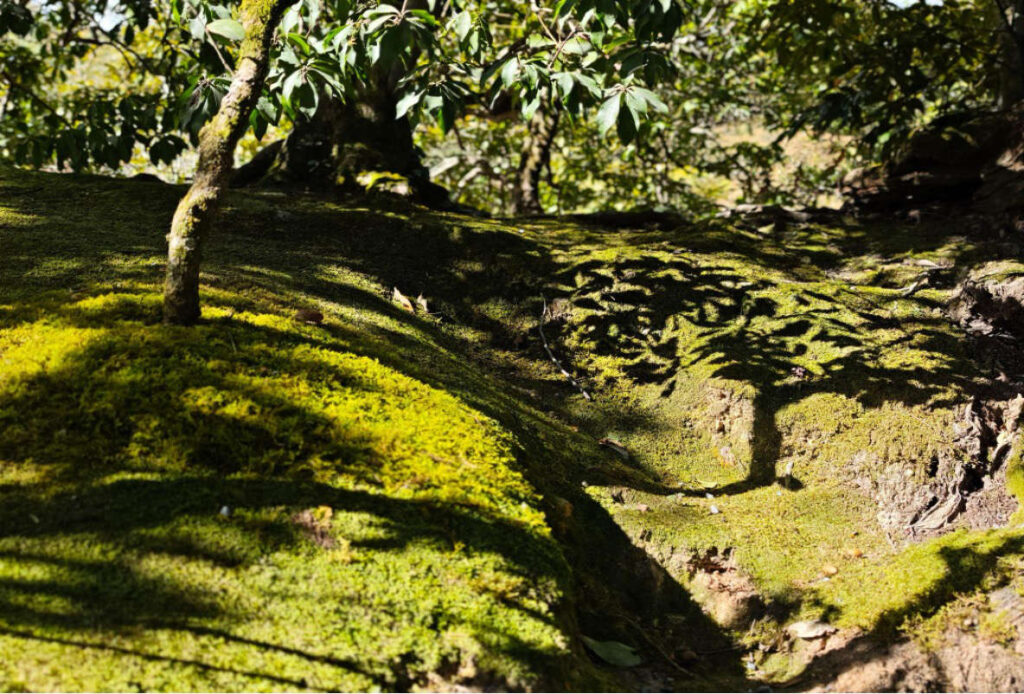
The word "musuhi" may remind many people of a scene in which a broken cord is joined to a string. However, "sansrei" in Shinto does not mean mere physical bonding or equivalent exchange.
Musu" represents a dynamic state in which new life and value arise spontaneously, as moss "grows" or a breath is born. Rei (hi) refers to the invisible, mysterious workings or energies. In other words, sansrei refers to "the dynamism in which two different elements deeply intersect to create an entirely new life or value that has never existed before.
Just as the land of Japan was born from the intermingling of two deities, Izanagi and Izanami, Shinto creation always begins with a "direct relationship with others. Instead of creating something alone, we create something unknown by multiplying. This is the essence of senrei.
What if we translate this into the modern circular economy of forests, especially in the relationship between urban and rural areas? It is a process of "co-creating" a new business, culture, and relationship between cities and forests by combining their resources (funds, technology, human resources, and natural capital), rather than facing each other as "buyers and sellers. Rather than simply providing funds as a form of CSR (Corporate Social Responsibility), the "economics of birth and spirit" is now required to step into CSV (Creation of Shared Value).
How, then, can we create a natal spirit between the fragmented forest and the city? The first step is nothing less than the restoration of "dialogue" and "direct involvement," which have been omitted in the wave of thoroughgoing efficiency.
How important is this "direct involvement"? I myself am involved in the development,DELTA SENSE, the "world's first" card game made of wood, inspired by a celebratory card game.We have also placed this Sanrei philosophy at the core of our management in the development of our business in Japan. This may come as a bit of a surprise to some of you, but we have made a deliberate decision to forgo general retail distribution of this product.
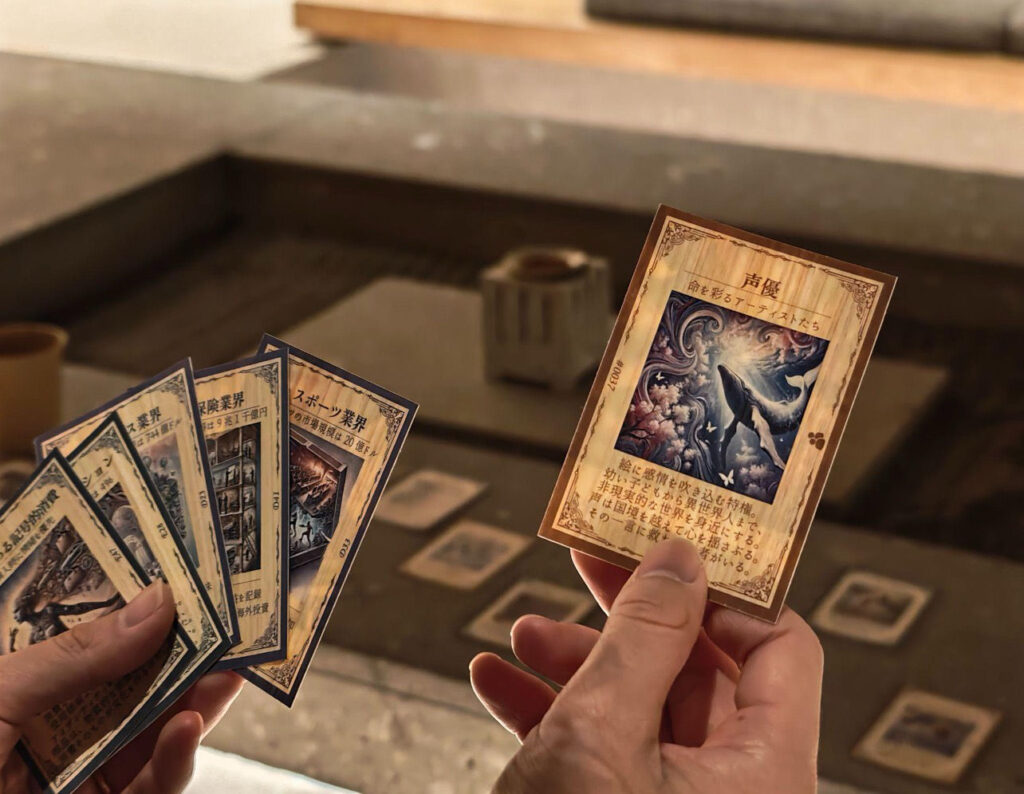
The retail model of mass shelving products to an unspecified number of people and encouraging anonymous consumption can certainly scale in the short term. However, there is no "sosanrei" (generation of new value). This is because products are consumed as mere "objects" and the intentions behind their creation and the background of the forest are discarded. That is why we insist on using our products in "places where direct dialogue can take place," such as hands-on workshops, corporate training, and educational settings. We take the time to give a name to the "value that does not yet have a name" together with the facilitator, drawing out the inner words of the participants themselves. It is precisely in this inefficient process that the "sanspirit" that connects people to people and people to the forest is activated.
The challenges facing the forestry and timber industries in the future are essentially exactly the same. The business model of pouring trees grown in forests into anonymous markets as inexpensive materials is already causing institutional fatigue. Rather than just reporting numbers, such as "how many tons of domestic timber we bought to contribute to the environment," urban companies should actually send their employees into the forests to touch the trees and talk with the local forestry workers. The real issues facing the forests, such as animal damage, lack of forestry staff, and neglected forests, are viewed as the company's "issues," and solutions are worked out together using the company's own resources. This face-to-face relationship, or "rejection of anonymity," is the only way to elevate the transaction to co-creation.
If we take the perspective of a birthing spirit, the definition of the forest as a space can be dramatically expanded. In the future, the value of forests cannot be measured only within the framework of natural capital, such as "how much cubic capacity can be produced (timber production function)" or "how much carbon can be fixed (environmental conservation function). Forests should be redefined as a "crossroads of social capital" where people can meet, interact, and create new value.
For urban businesses, it is an invaluable training and tree-planting "place" that fosters resilience and creativity to survive in an era with no right answer. For rural areas and regions, it will not only compensate for labor shortages, but also provide a strong gateway to attract a sustainable "related population" with new knowledge and passion. And for the forests themselves, they will gain powerful "co-creation partners" who will work with them to care for the future, independent of subsidies and market conditions.
Finally, I will try to connect what has been said in the article about Shinto and the forest circular economy, which has been unraveled from the perspective of a Shinto priest.
First, by drawing attention to the issues with words like "Norito," and by touching the "yorishiro" of trees, we can regain the "ma" (pause) and breathing space that modern people have lost. Next, from the perspective of "Nakaima," we will clarify where the responsibility lies for handing over the hardships of our predecessors in the past to future generations. Then, instead of ending this responsibility with spiritualism, we must follow the principle of "kanagara" and design a "system" that will ensure the return of benefits and value to the forest. Finally, with the power of musubi in the vessel, we will create a face-to-face co-creation relationship between the city and the forest, and pass the blood of perpetual circulation through the forest.
These series of manners are not old-fashioned mentalities. They are a very contemporary and essential social design framework.

To break the chains of dry trade and reconnect the forest and the city in a living relationship again. What should we put on the table for this dialogue? There has never been a time when we need more time than now to touch the trees and listen carefully to each other's innermost feelings. We are advancingDELTA SENSEThe creation of a forum for dialogue through the "Forestry and Forest Productivity Center (FPC)" and collaboration in forests, where experts are working on the front lines, are all solid steps toward creating that "nexus.
Together, let's nurture the Sansho Forest. (Kazuhiro Aoki, President, WSense Corporation / DELTA SENSE Production Committee)