Redesigning agriculture, forestry, and livestock farming with "power generation and physical AI"
Updated by Hiroshi Komiyama on April 08, 2026, 6:13 PM JST
Hiroshi KOMIYAMA
(Platinum Initiative Network, Inc.
After serving as Professor at the University of Tokyo, Dean of the Graduate School of Engineering and Dean of the Faculty of Engineering, and President of the University of Tokyo (28th), he was appointed Chairman of the Mitsubishi Research Institute in 2009, and Chairman of the Platinum Initiative Network in 2010 (to be incorporated as a general incorporated association in 2022). Other positions include President of the STS Forum, Chairman of the Association for Super-Education, Chairman of the United Nations University Cooperation Foundation, Chairman of the International Science and Technology Foundation, and Chairman of the Heat Pump and Thermal Storage Center Foundation. He also received the Dubai Knowledge Award (2017), the Order of the Star of Solidarity of Italy (2007.) and "Information and Communication Month" Commendation from the Minister of Internal Affairs and Communications (2014), the Zaikai Award Special Prize (2016), and the Commendation for Merit in Promoting a Maritime Nation (2016), among many other national and international awards.
The term “advanced issue countries,” which I advocated, is finally being widely used by the public. However, it is not enough to call everything an issue. What I am trying to say is that Japan is one of the countries that is leading the way in addressing some of the most significant challenges that humanity will eventually face, such as demographic changes and global environmental issues. In particular, the growing abandonment of cultivated land and the severe shortage of labor are structural problems that threaten the sustainability of the primary industry. What is important is not to view these issues as mere problems, but to think of them as assets that can be converted into revenue-generating assets. While crop production alone is not feasible, agriculture, forestry, and livestock farming can be redesigned as a "revolving business" by combining revenue generation and labor saving through "physical AI. Rather than individual measures, a structure that simultaneously solves multiple constraints with a single design is required.
The essence of the "supply constraints" facing the Japanese economy is a serious shortage of labor. This is especially true in the agricultural sector, where Japan's farmland has declined from approximately 6.09 million hectares in 1961 to 4.2 million hectares today, and is expected to continue to decline to approximately 3 million hectares by 2040, according to forecasts by the Mitsubishi Research Institute.
Currently, at least 500,000 hectares of agricultural land are left uncultivated. The fact that more than 10% of all agricultural land is not being used is not merely a sign of agricultural stagnation. It can be said that multiple problems are simultaneously manifesting themselves: the exhaustion of the local economy, the stagnation of energy self-sufficiency, and food security. Despite this, the current response is limited to symptomatic treatments such as individual subsidies and partial support for farmers.
I have always said that challenges are meaningful only when they are combined with solutions. What cannot be solved is not a challenge. We need a perspective that reorganizes the structure itself.
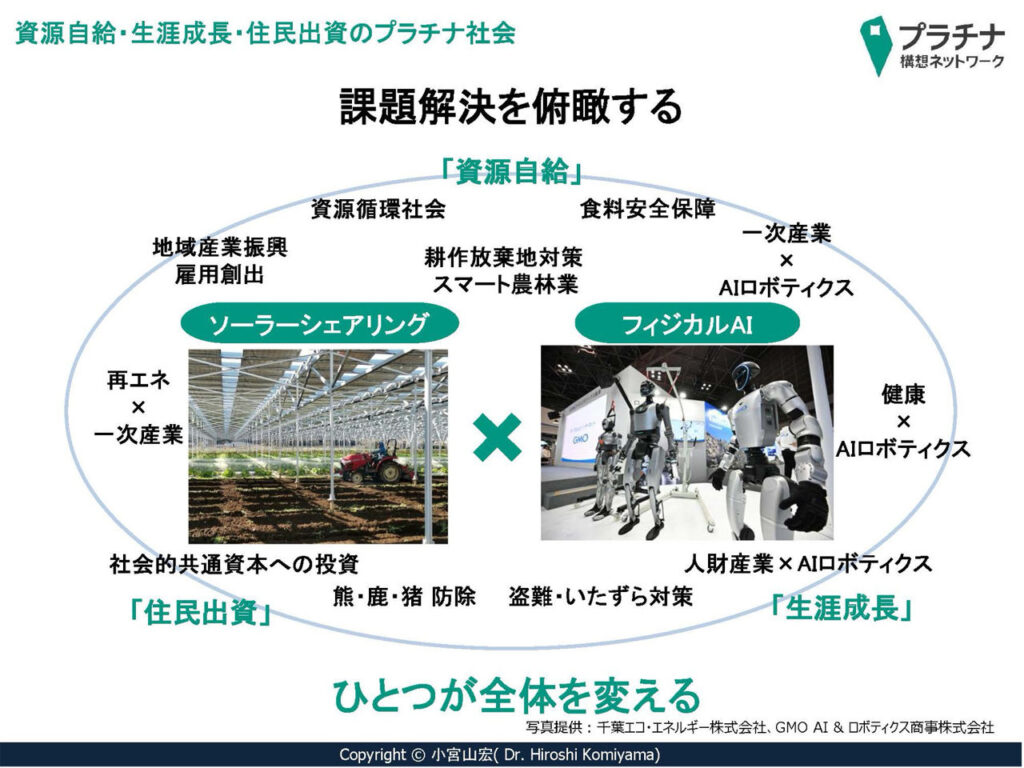
The conditions for revitalizing agriculture, forestry, and livestock production as a business are simple. The first is that it must be profitable. In contrast to the current situation where it is difficult to make a profit just by producing rice and other crops, the premise of management will change by generating income from the sale of electricity through "solar sharing," in which the upper space of farmland is utilized to generate solar power. The previously introduced "Solar Sharing" is a Chiba University ventureThe Case of Chiba Eco-Energy and Tsunagu Farmshows an astonishing eightfold increase in combined income with electricity sales.
Another is that it can be operated by a small number of people. It is impossible to manage a vast area of land by hand as before due to the current shortage of workers. Physical AI is indispensable here. Only when "profits from power generation" and "manpower saving through AI" are combined can agriculture, forestry, and livestock farming become a viable business.
Physical AI is defined as a generic term for technology that enables AI to understand the external world, make decisions, and translate these decisions into real-world actions. We tend to think of bipedal humanoids and drones, but any machine can be a physical AI if it has sensors, moves with AI, and is connected to some structure.
This technology has already begun to be incorporated into social infrastructure practices. For example, Hitachi, Ltd.'s AI solution "HMAX" has installed cameras and sensors on ordinary railcars in daily operation to automatically detect distortions in the tracks and make use of this technology for maintenance. Toyota City is also putting to practical use a technology that uses AI and microwave reflection data beamed from satellites to identify underground water leakage over a wide area.
The same concept can be applied to agriculture, forestry, and livestock production. A simple example is the increasingly serious problem of bears, deer, and other wild animals. As wild animals come down to towns due to depopulation and a decrease in the number of hunters, conventional countermeasures of "just scaring them with sound" will cause them to become accustomed to it. However, a physical AI that learns by itself can take an evolutionary approach, such as "combining sound and light this time" or "learning behavior patterns and changing responses.
These ideas are already beginning to appear in reality.
In the forestry industry, conifer saplings such as cedar and cypress should not be exposed to too much intense light when young, so it makes sense to grow them under solar sharing, which moderately blocks sunlight. In Tokushima Prefecture, for example, the angle of the solar panels is automatically controlled, and demonstrations are underway to combine agriculture and power generation.
In towns such as Atsugishi-cho in Hokkaido, a private company called Machiokoshi-Energy has purchased abandoned farmland and is working to revitalize the land by grazing horses and feeding them weeds. In addition, the company has already developed a system in which solar sharing is constructed on this land and sheep graze under it. Currently, horses and sheep are being bred and raised on the vast pastureland, and this initiative, which will lead to the production of domestically produced Genghis Khan (mutton), is attracting attention as a model for simultaneously generating energy and food (improving self-sufficiency).
Some companies are also focusing on the silkworm, a traditional industry. Morus, an R&D startup, has developed a unique bio-material focusing on the functionality of silkworm-derived ingredients and the mulberry leaves that feed them, and is expanding into overseas markets such as Singapore in areas such as blood sugar control. Mulberry is a plant that is relatively easy to cultivate even on abandoned farmland, and the knowledge gained from the sericulture industry in the past has led to new business opportunities.
Labor shortages, energy self-sufficiency, food security. These are not separate issues, but are occurring simultaneously within a single structure.
The abandoned farmland will have power generation capabilities and will be operated with physical AI. This single design can solve multiple constraints simultaneously. This is not the accumulation of partial optimization. It is the idea that "one can change the whole.
The "structure" of the system and business design itself must be reconfigured for implementation. What I propose here is to reposition "electricity" produced on farmland as a "primary industry" like agriculture, forestry, and livestock products. Currently, energy policy and agricultural policy are under the jurisdiction of different ministries and agencies, but they should be viewed as one and the same, and evolve into a design that can comprehensively support everything from electricity generation to land utilization within the framework of the agriculture, forestry, and livestock sector. (Hiroshi Komiyama, Chairman of Platinum Initiative Network and Honorary Editor-in-Chief of "Forest Circular Economy")
*Reference link
Hitachi's Physical AI|Lumada: Hitachi
Report from the field on "Farming-style solar power generation," which combines agriculture and solar power generation! | Idemitsu's Goal 2050 and Action
Farm-based power generation business Machikoshi Energy Co.
Mors Corporation