
Updated by the Editorial Department of *Forest Circular Economy* on July 15, 2026, at 2:37 p.m. JST
Editorial Board, Forest Circular Economy
Forestcircularity-editor
We aim to realize "Vision 2050: Japan Shines, Forest Circular Economy" promoted by the Platinum Forest Industry Initiative. We will disseminate ideas and initiatives to promote biomass chemistry, realize woody and lumbery communities, and encourage innovation in the forestry industry in order to fully utilize forest resources to decarbonize the economy, strengthen economic security, and create local communities.
In the new Basic Plan for Forests and Forestry, approved by the Cabinet on June 5, the subtitle “Toward a ‘Forest Nation and Wooden Cities’ That Will Last a Hundred Years” was included for the first time. Through an exclusive interview with Satoshi Tachibana (Professor at Kyoto University Graduate School), Chair of the Forest Policy Council who spearheaded the plan’s formulation, we explore this turning point in forest policy, which begins with “wood utilization.” Furthermore, drawing on examples of the well-being and new spatial value provided by forests and wood, we explore how practitioners at the forefront of the forest circular economy currently assess the value of wood and where resources should be invested.
"Forest Circular Economy" Editorial Department (hereinafter referred to as the "Editorial Department"):What is the overall intent behind the newly revised “Basic Plan for Forests and Forestry”?
Mr. Satoshi Tachibana (hereinafter referred to as Tachibana):First, I would like to draw your attention to the fact that this plan is the first to include the subtitle “Toward a ‘Forest Nation and City of Wood’ That Will Last a Hundred Years.” It was added at the suggestion of committee members to appeal more broadly to the general public and to strongly convey the message that “using wood contributes to the sustainability and sustainable management of forests.”
Furthermore, the structure of the preface is also unusual. Traditionally, the preface began with a discussion of the multifaceted functions of forests—that is, “upstream” issues—but this time, we changed the structure to begin with “timber utilization.” This reflects a strong message that creating a society that uses wood contributes to a virtuous cycle for forests, forestry, and the timber industry, and ultimately ensures the sustainability of forests more effectively.
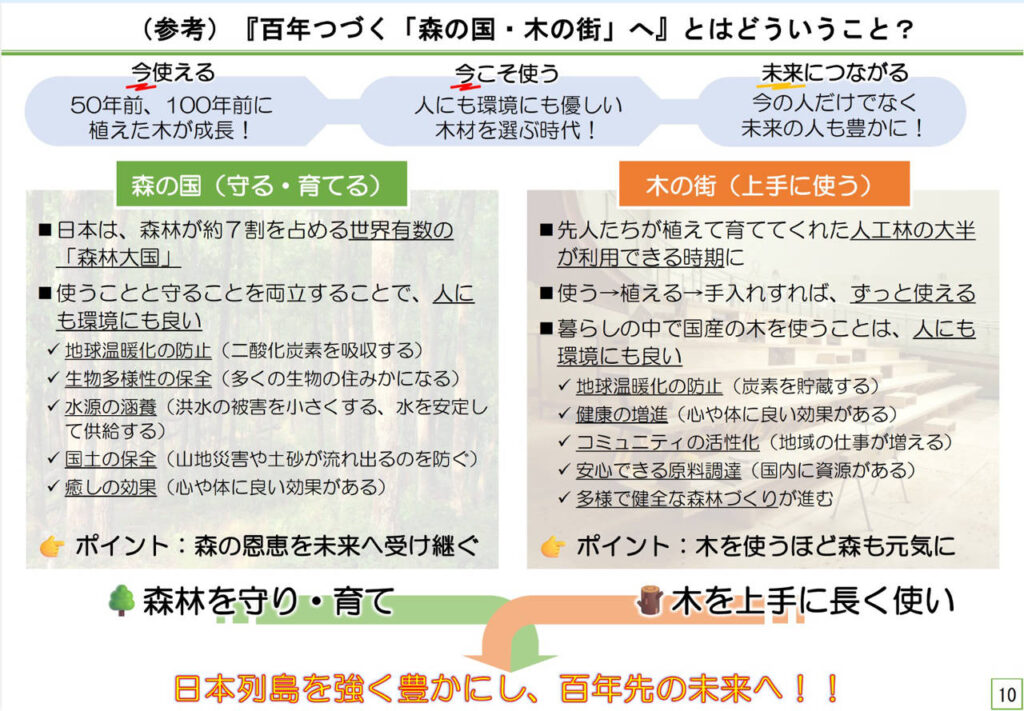
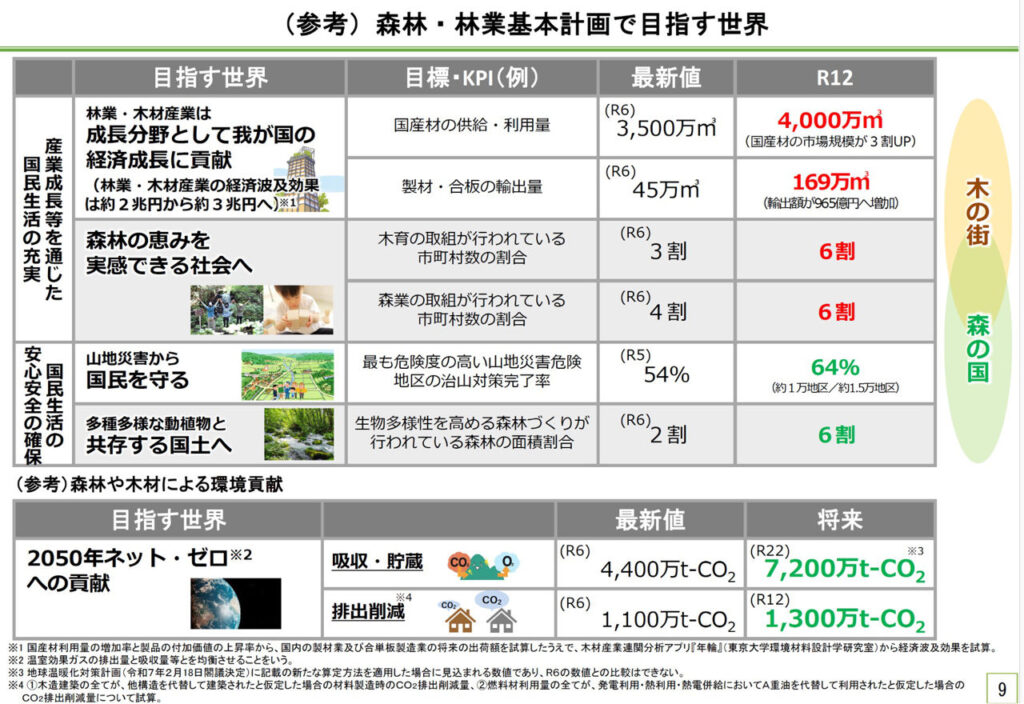
Furthermore, rather than simply drawing up a plan and leaving it at that, we have fully implemented a PDCA cycle utilizing KPIs (Key Performance Indicators). It is a major step forward that we have established a system whereby officials from the Forestry Agency report annually on progress to the Forestry Policy Council, allowing us to review what we have achieved and what we have not.
In addition, the calculation methods for the macroeconomic data underlying the market assumptions have been revised. In calculating the timber self-sufficiency rate, “exports”—which had not been taken into account previously—are now included; under the new calculation method, the rate is expected to rise by approximately 2 percentage points to better reflect actual conditions. Furthermore, regarding the assessment of forest resource volumes, data from the highly accurate “Basic Survey on Forest Ecosystem Diversity” is now used for total standing volume and total growth. As a result, the standing volume per hectare—that is, production volume—will increase, leading to an expected rise in the reforestation rate compared to current levels.
As a result, the standing volume—which was estimated at approximately 5.5 billion cubic meters in 2022 based on the conventional “Forest Register”—has increased significantly to approximately 10 billion cubic meters in 2025 using data from the Basic Survey on Forest Ecosystem Diversity, with annual growth per hectare estimated at 5.1 cubic meters. As a result, the area subject to final harvest (the denominator), which is calculated based on production volume, will decrease, and the reforestation rate will rise to over 50% to better reflect actual conditions.
The purpose of these changes is to more accurately reassess forest resource volumes and actual usage patterns—which had previously been underestimated—and to bring the baseline, which will serve as the foundation for future discussions, closer to reality.
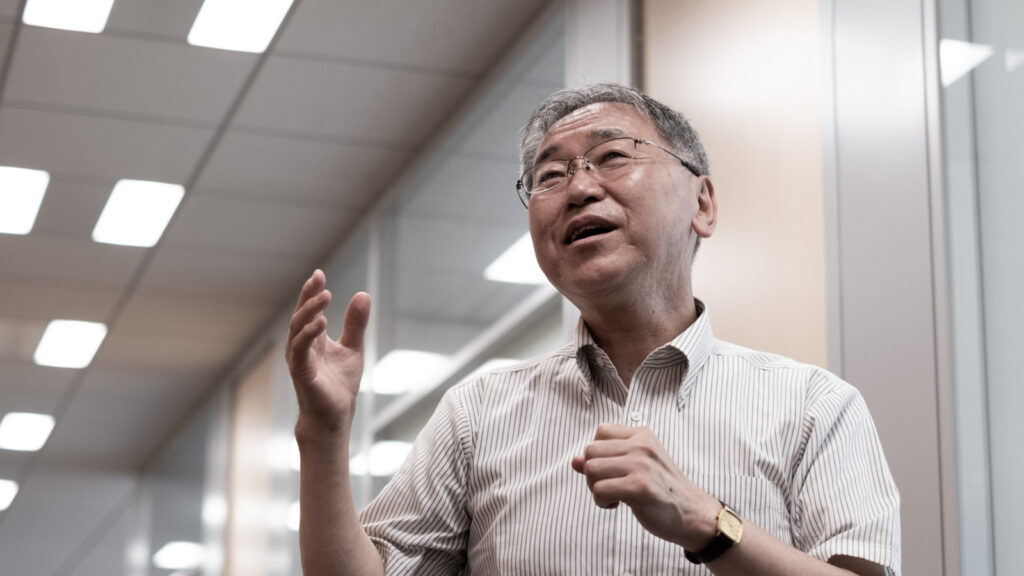
Editorial Department: As we work to build a society that uses more domestically produced timber, how will the market and regulations change?
Tachibana: First and foremost, it is important to increase the supply of “lumber,” which is widely used in construction. Around 1973, 0.6 cubic meters of lumber were used per person in Japan, but that figure has now fallen to 0.2 cubic meters—about one-third of the previous amount. In Germany, a leader in forestry, 70 percent of the logs produced are used for lumber and are also exported. To bring Japan closer to this level, the current plan sets a policy to increase the volume of lumber-grade timber used from 14 million cubic meters (Reiwa 6 actual figure) to 18 million cubic meters (Reiwa 12 target). This continues the direction set in the previous plan to steadily increase the use of lumber-grade timber.
Furthermore, I believe it is necessary to “use wood for the long term.” While there is merit in using wood—a renewable resource—as an alternative to fossil fuels, it is important to practice “cascade utilization”: rather than burning it immediately after harvesting for biomass power generation or similar purposes, we should first make full use of it in buildings and furniture wherever possible; then, transform it into new wood-based materials such as panels to extend its useful life; and only use it as fuel as a last resort. The widespread and long-term use of wood means an increase in the amount of carbon sequestered, which directly contributes to climate change mitigation.
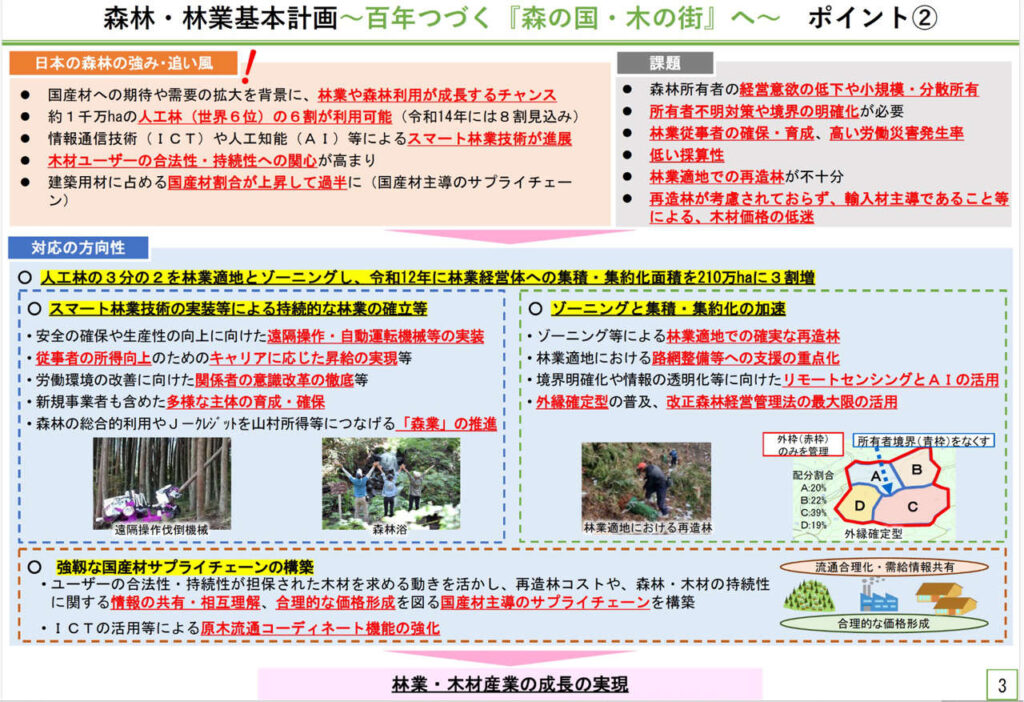
Although not included in the Basic Plan, the development of the used-home market is also a major challenge for the future. Currently, the average lifespan (years until demolition) of homes in Japan is just over 30 years, whereas in the United States it is just under 60 years, and in Europe it ranges from 70 to 80 years. In fact, the short lifespan of Japanese homes has been a stumbling block in the past, leading to the carbon sequestration benefits of the wood used in these buildings not being recognized as “J-Credits.” If a market develops where existing homes are properly appraised and traded, and high-performance wooden homes continue to be used for decades in accordance with people’s lifestyles, the period of carbon sequestration will be extended, yielding significant benefits for society as a whole.
If we use wood for a longer period of time, there will be no need to mass-produce it. How we use wood and how we manage the forests that supply it are important considerations. As part of the first revision in 30 years, we have simplified forest zoning (the division of areas based on function). We have divided forests into two categories—natural forests and planted forests—and our policy is to consolidate the area of planted forests subject to management to 6.3 million hectares, which is approximately 60 percent of the current total. These are planted forests designated as suitable for forestry, where main harvesting and reforestation will be carried out. As for natural forests, we have designated specific areas within them where we aim to maintain and enhance their functions through utilization and other measures. By clearly defining the areas targeted for production and ensuring that the resulting timber is used for extended periods to create a resource cycle, we aim to prevent the degradation and depletion of our forests.
Editorial Department:What is needed to break the current buyer’s market for lumber and build a sustainable supply chain?
Tachibana:We believe that, under current conditions, buyers hold the upper hand, leading to a tendency for timber to be purchased at low prices. If standing timber prices remain depressed, profits will not flow back to forest owners, making it difficult to cover reforestation costs and rendering sustainable forestry unviable. The key to ensuring that users purchase timber at reasonable prices—which include reforestation costs—and do so willingly lies in redefining values such as “well-being” (a state of physical, mental, and social well-being) and “nature-positive” (contributions to the environment, such as biodiversity).
There are numerous specific examples. According to a survey of the “Minato Model” (Minato Ward, Tokyo)—an initiative promoting the use of wood in public buildings—one daycare center reported that after using wood for its interior, the wood’s humidity-regulating properties helped maintain a comfortable indoor climate, leading to feedback that “the children caught colds less often.” In another case, an eyewear store converted its interior to a wooden design and created a space where children could play with wooden building blocks. As a result, its customer base expanded significantly from the traditional older demographic to families with children, which led to increased sales.
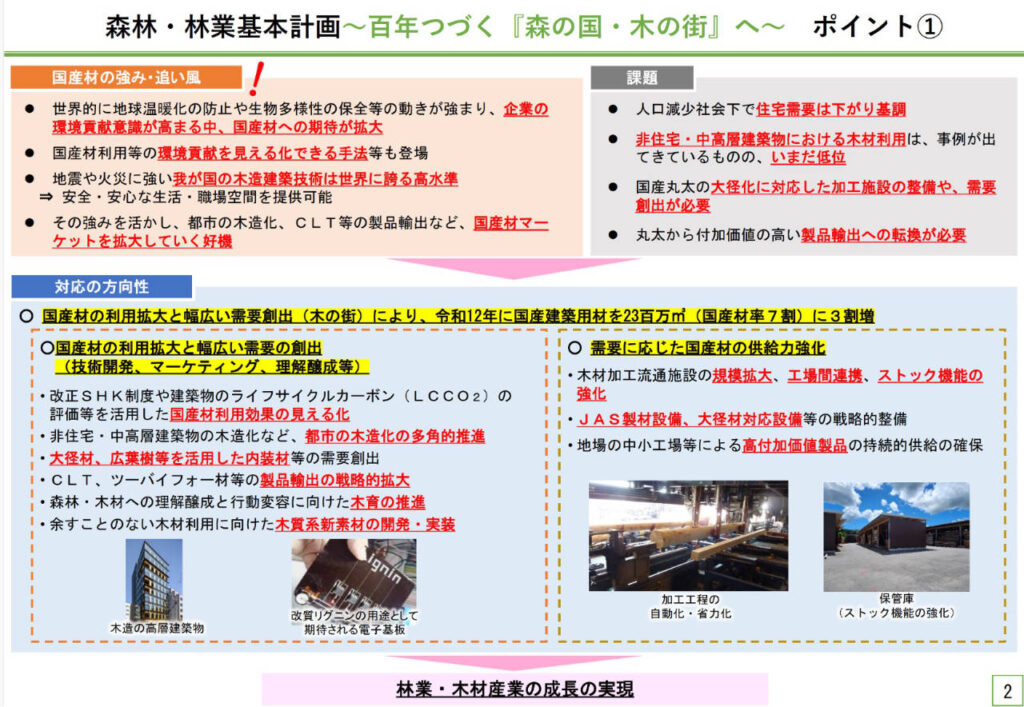
Furthermore, the benefits of wood as a building material are also evident in terms of cost. For example, in cases where convenience store buildings have been converted from light-gauge steel frame construction to wood-frame construction, we’ve heard that because wood is lightweight, foundation construction costs are lower; moreover, due to differences in thermal conductivity, this results in lower utility bills in both summer and winter compared to steel-frame construction.
As such, it is important to clearly highlight the health benefits of wood and the advantages that directly impact end users’ businesses.
Editorial Department:The new Basic Plan introduces the term “forestry business,” which is attracting interest from other industries as well.
Tachibana:"Forest-based industries" is a general term referring to initiatives in which industries other than timber production utilize forest areas to create new value. As a broad concept that rethinks how forest areas are used, it includes the forest service industry and J-Credits, a system for trading carbon dioxide absorption credits. We hope that the development of forest-based industries will lead to increased income in mountain villages.
There is a very interesting real-world example that opens up new possibilities. At one company, the attrition rate for new graduates reached 30 to 40 percent three years after joining; however, after introducing a one-week corporate training program for new hires at a Forest Therapy® center and implementing it on an ongoing basis, the attrition rate reportedly dropped to zero. This was achieved because walking in the forest—a setting different from their usual office environment—strengthened their sense of camaraderie and helped them build relationships that made it easier to seek advice when facing difficulties. I’ve heard that this company continues to conduct similar training programs even several years after employees join. In terms of reducing the enormous costs associated with recruitment and training, the value that utilizing the forest brings to all corporate management is immeasurable.
Editorial Department:What is needed to roll out model forest circular economies nationwide and build regional ecosystems?
Tachibana:First, we must start from the premise that Japan’s forests and forestry sector are not uniform. While some regions focus primarily on the production of general-purpose lumber, others—such as Yoshino and Owase—specialize in the production of high-quality lumber; each region has its own unique approach to forestry and timber utilization.
Therefore, rather than applying a one-size-fits-all national model, what is most important is the initiative of “local communities—including local governments—to think for themselves.” Instead of simply waiting for directives from the national government or following a predetermined plan, we expect prefectures and municipalities to establish their own KPIs and take the lead in building a forest-based circular ecosystem that leverages the unique characteristics of each region. If, 100 years from now, we can realize a future for forests, forestry, the timber industry, and wood utilization that capitalizes on the unique characteristics of each region, we will surely build resilient communities and a resilient nation.
Editorial Department:Finally, please share a message for practitioners working at the forefront of the forest circular economy.
Tachibana:My goal is to “create a society where wood is used in a variety of ways over the long term without causing forest degradation or deforestation.” And I hope that not only Japan but the entire world will move in that direction.
Personally, I don’t believe it’s necessary to treat all existing plantations as production forests; if we manage suitable forested areas with favorable conditions in a sustainable, cyclical manner, I believe we can fully meet timber demand even with half the current area. The ideal society is one that, like those in Europe and the United States, continues to use the timber harvested from these production forests carefully and for long periods—70 or 80 years.
In particular, we ask businesses to shift their approach: rather than treating wood merely as a raw material, we ask that you properly recognize its “multifaceted value”—such as environmental conservation and well-being—and support the industry by purchasing it at fair prices that take the forest’s sustainable cycle into account. It is precisely this shift in how we value timber that will serve as the first step toward building a sustainable supply chain that extends into the future, 100 years from now.

<プロフィール>
Professor at the Graduate School of Agricultural Science, Kyoto University. Born in Iwate Prefecture.
He has held positions including Research Assistant at the University of Tokyo, Senior Researcher at the Forestry and Forest Products Research Institute (FFPRI) and Team Leader at its Hokkaido Branch, and Associate Professor at the University of Tsukuba, before assuming his current position. His areas of expertise are forestry policy and forestry economics. He has served on numerous advisory councils and committees for the Ministry of Agriculture, Forestry and Fisheries, the Forestry Agency, and the Ministry of the Environment.
Solo-authored works include *Introduction to Forest Economics* (Gakubunsha, 2024); edited works include *Sustainable Use of Forest and Timber Resources in East Asia: An Economic Approach* (Agricultural and Forestry Statistics Association, 2018), and *Wood Power Certification Exam 3: 100 Questions on Forests and Forestry* (Kaiseisha, 2014).
The "Forest Products Trade Report" has been serialized in the monthly magazine *Yamurin*, published by the Greater Japan Forestry Association (Public Interest Incorporated Association), since April 2003.
*Reference link
Basic Plan for Forests and Forestry: Forestry Agency
Forestry Policy Council: Forestry Agency