Updated by the Editorial Department of *Forest Circular Economy* on July 14, 2026, at 10:37 a.m. JST
Editorial Board, Forest Circular Economy
Forestcircularity-editor
We aim to realize "Vision 2050: Japan Shines, Forest Circular Economy" promoted by the Platinum Forest Industry Initiative. We will disseminate ideas and initiatives to promote biomass chemistry, realize woody and lumbery communities, and encourage innovation in the forestry industry in order to fully utilize forest resources to decarbonize the economy, strengthen economic security, and create local communities.
Nichinan Town in Tottori Prefecture, with a population of about 3,700, is facing a declining birthrate, an aging population, and depopulation. Its annual timber production, which once stood at about 30,000 cubic meters, has now increased to an annual log handling volume of 120,000 cubic meters. Although this is a town rich in forests with a long history of “tatara” (iron smelting), how was such a significant increase in production made possible? The key to this success lies in a massive “timber industrial park” serving as a hub, strong support from the local government, and a meticulously designed system that transformed the profitability structure of the forestry industry to realize “circular forestry.” The editorial team of *Forest Circular Economy* will be reporting from Nichinan Town in a three-part series.
Located in southwestern Tottori Prefecture, Nichinan Town is a town rich in natural beauty, with forests covering about 90 percent of its total area. However, according to the latest data, its population has declined to about 3,700, and it is also a depopulated area where the proportion of the elderly exceeds 50 percent.
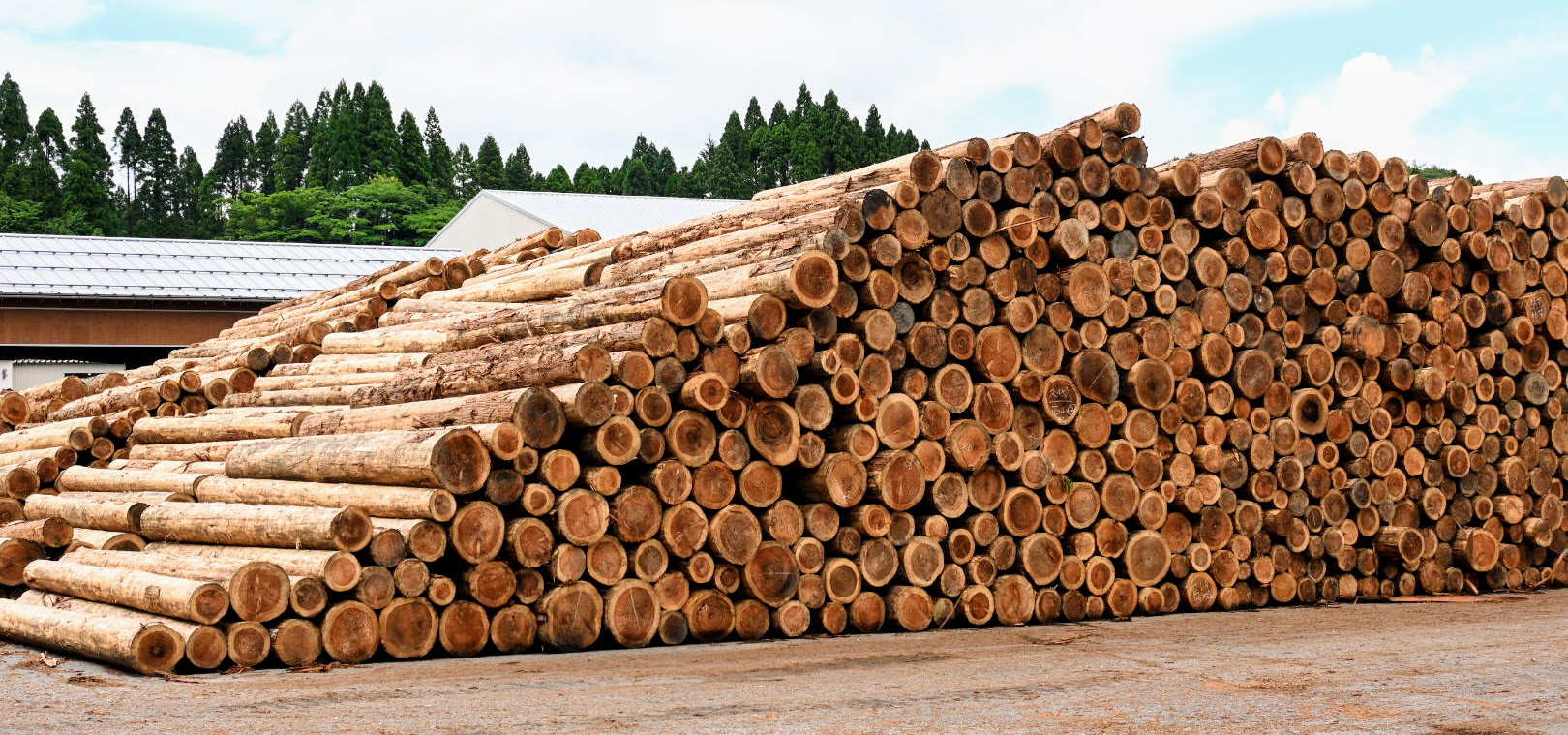
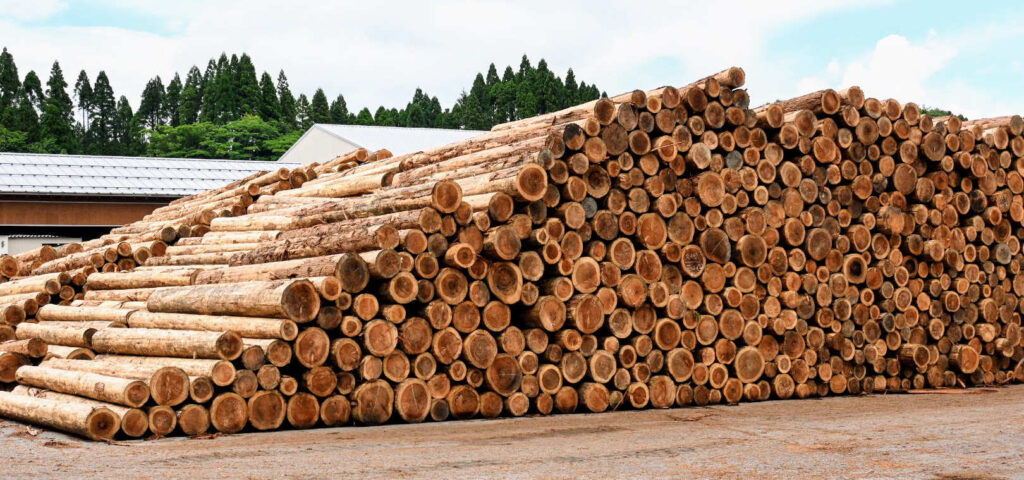
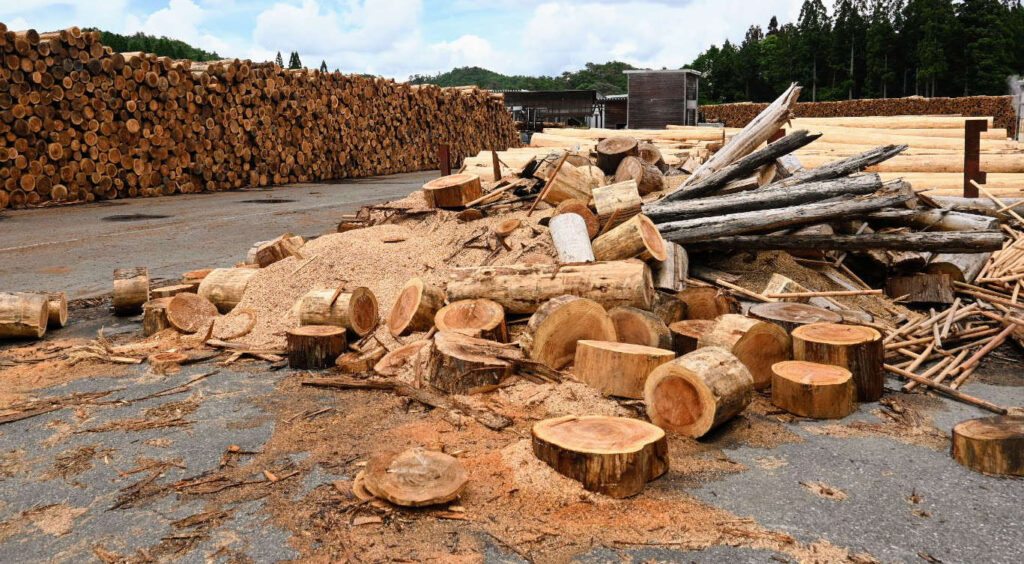
When you step into the “Hino River Forest Lumber Complex,” located near the town center, your image of a quiet town is completely overturned. The grounds are piled high with logs of cedar and cypress, and forklifts and trucks carrying lumber bustle back and forth.
Around 2006, annual timber production in Nichinan Town remained at approximately 30,000 cubic meters. This situation stemmed from serious structural challenges. Although cedar and cypress trees—planted during the postwar expansion of afforestation and now accounting for about 60 percent of the total (8- to 11-year-old trees)—were all reaching maturity at the same time, the forests were becoming increasingly neglected due to a decline in the number of forestry workers and an increase in “absentee landowners”—whose refusal to grant permission for maintenance work hindered intensive forest management. Unless trees are cut down and used, new seedlings cannot be planted; this disrupts the forest’s natural cycle and prevents the generation of economic value.
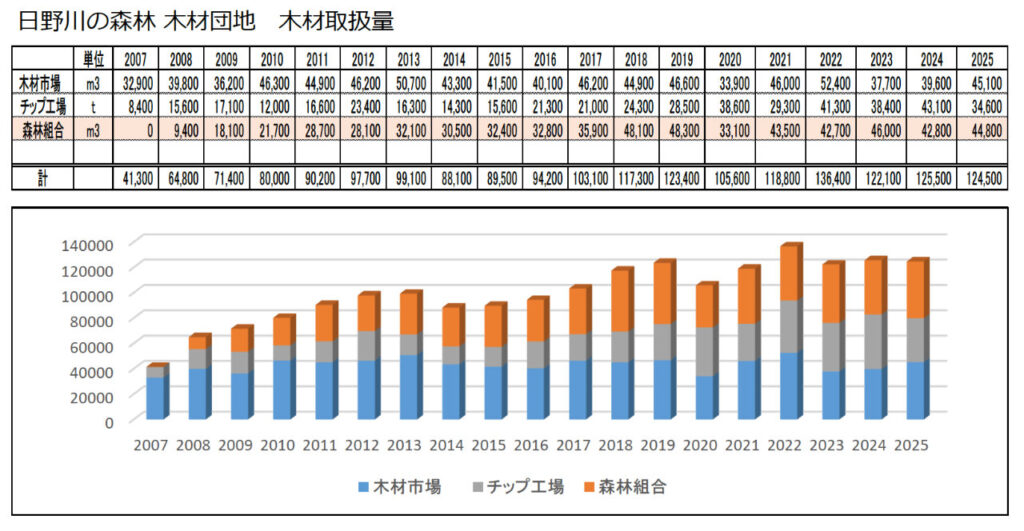
However, Nichinan Town has been vigorously promoting a shift toward “circular forestry,” and its annual log handling volume now exceeds 120,000 cubic meters. This initiative is regarded as a leading example that aligns with the direction of the “100,000 cubic meters per year stockyard concept” advocated by the Platinum Forest Industry Initiative.
The main reason why the timber trade has grown so significantly in Nichinan Town is the existence of the “Hino River Forest and Timber Industrial Park,” which was developed in 2006.
Normally, timber harvested from the mountains is sorted at the logging yard according to its intended use—such as straight lumber for construction (Grade A), lumber for plywood (Grade B), or wood chips and biomass fuel (Grades C and D)—and then transported to their respective markets or factories. However, in Nichinan Town, all of these buyers have been consolidated into a single complex.
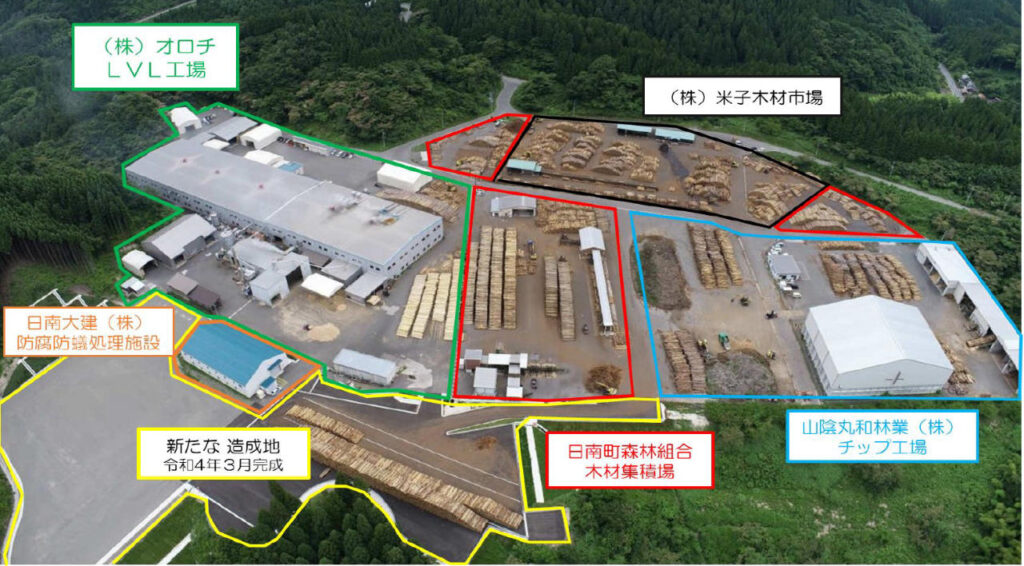
Jin'nan Town Forestry Cooperative Chairman Jitsuji Kimura explains the benefits of this system as follows: “The fact that whether it’s straight lumber or a crooked tree, bringing it here will earn you money is a huge draw.” Furthermore, the complex is located within about a 30-minute truck ride from any forest in the town, giving it the geographical advantage of allowing even maneuverable medium-sized trucks to transport timber efficiently.
With the introduction of a “full-volume pickup” system—which guarantees that all timber hauled out of the mountains will be purchased—the cumbersome process of sorting logs at the mountain landing site, as well as the effort and cost of transporting them to multiple locations, has been eliminated. This significant streamlining of the logistics process has reduced the burden on workers in the field and directly led to an increase in the volume of timber hauled out.
Furthermore, a unique system has been introduced for the timber pricing process. While timber prices tend to fluctuate significantly depending on market conditions, the Nichinan Town Forestry Cooperative has established an “Open Price Agreement” under which the three parties—the mills that purchase the timber, the forestry cooperative, and the timber producers who harvest the wood from the mountains—hold advance discussions to determine purchase prices several months in advance. This is a unique system in which purchase prices for a set period are agreed upon in advance and made public (open) to all parties involved.
Of course, provisions are in place to hedge against the risk of sudden market fluctuations, such as the “Wood Shock.” Even during a fixed-term contract, the rules stipulate that in the event of an emergency, the three parties will promptly hold emergency consultations and flexibly reset the price starting the following month to prevent mutual collapse.
“From the perspective of those supplying the timber, it’s easy to calculate exactly how much they’ll earn for each tree they supply, which gives them peace of mind,” says Kimura, the cooperative’s chairman. “It is precisely because of this system that we can reliably return that amount to the forest owners.” To establish this groundbreaking system, Chairman Kimura—who was still relatively young at the time—and his colleagues reportedly visited timber producers repeatedly to conduct interviews and persuade them. They organized the “Nichinan Town Timber Production Cooperative,” a loose alliance, and laid the groundwork for tripartite negotiations.
With transparency in purchasing and pricing now ensured, forest owners are guaranteed a share of the profits, which has led them to feel confident in their decision to harvest timber from their forests.
The introduction of full-volume purchase agreements and transparent pricing arrangements has made it possible to reliably forecast revenues several months in advance, providing a strong incentive and a sense of security for operators on the ground to take the risk of investing in high-cost, high-performance forestry machinery.
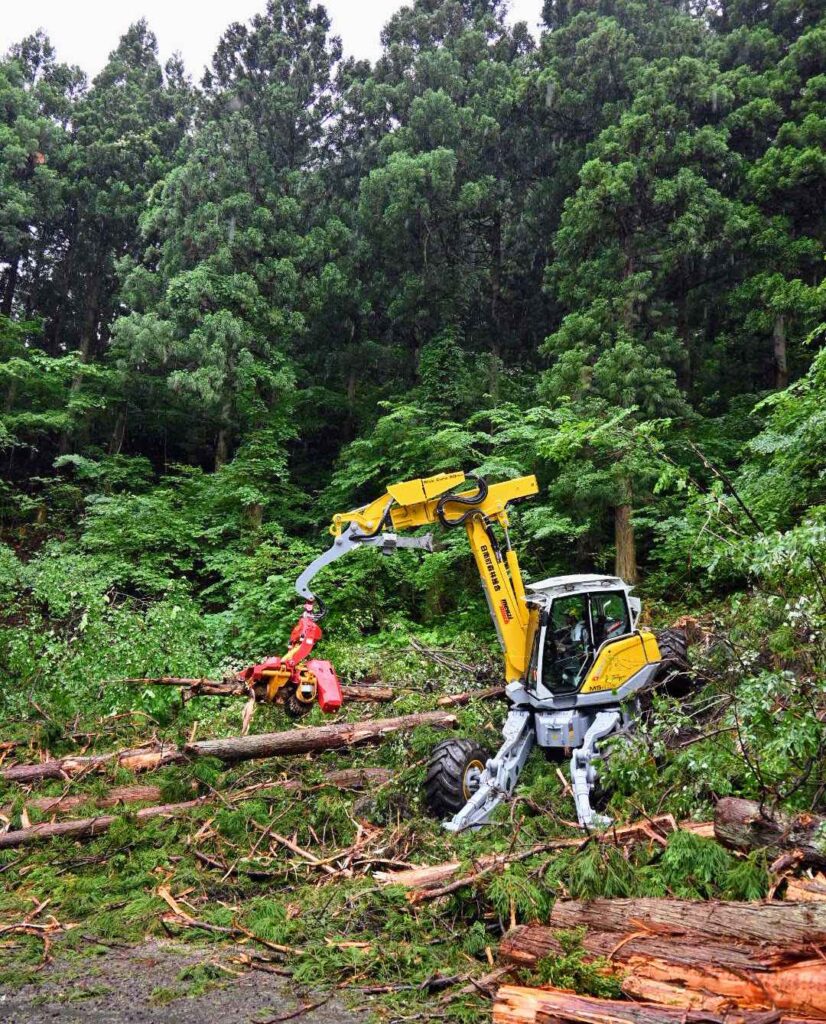
When visiting logging sites in the town, you can see machines like the Swiss-made “Spider”—a four-wheeled, articulated work machine designed for steep slopes—in operation. Moving as if walking on four legs even on steep slopes, this machine—equipped with a harvester attachment—can handle everything from felling to delimbing and log cutting with a single arm. It reduces dangerous manual work involving chainsaws, thereby achieving both the prevention of workplace accidents and improved productivity.
The government is also providing strong support for these on-the-ground challenges. Kohei Takagi, Director of the Agriculture and Forestry Division in Nichinan Town, explains: “The ‘Model Project for Creating Regions Where Forestry Becomes a Growth Industry,’ which we have been working on since 2017, has been a major turning point in recent years. Aiming to rebuild a circular forestry system centered on the cascade utilization of forest resources, we are implementing subsidy programs funded solely by the town.”
According to the town’s explanation, for reforestation following clear-cutting, the town’s own subsidies are added to national and prefectural subsidies, effectively raising the subsidy rate to 100 percent. Furthermore, by extending subsidies to cover pre-planting clearing costs—which are normally ineligible for afforestation subsidies—as well as 10 years’ worth of forest insurance premiums, the town has eliminated out-of-pocket expenses for planting entirely. In addition, the town provides support for the purchase of high-performance forestry machinery, contingent upon expanding the scale of the project.
In addition, the foresters’ association uses its own fund to cover the forest owners’ share of the costs associated with post-planting maintenance—such as underbrush clearing and snow removal—thereby establishing a system in which both the town and the association work together to eliminate the financial burden on forest owners.
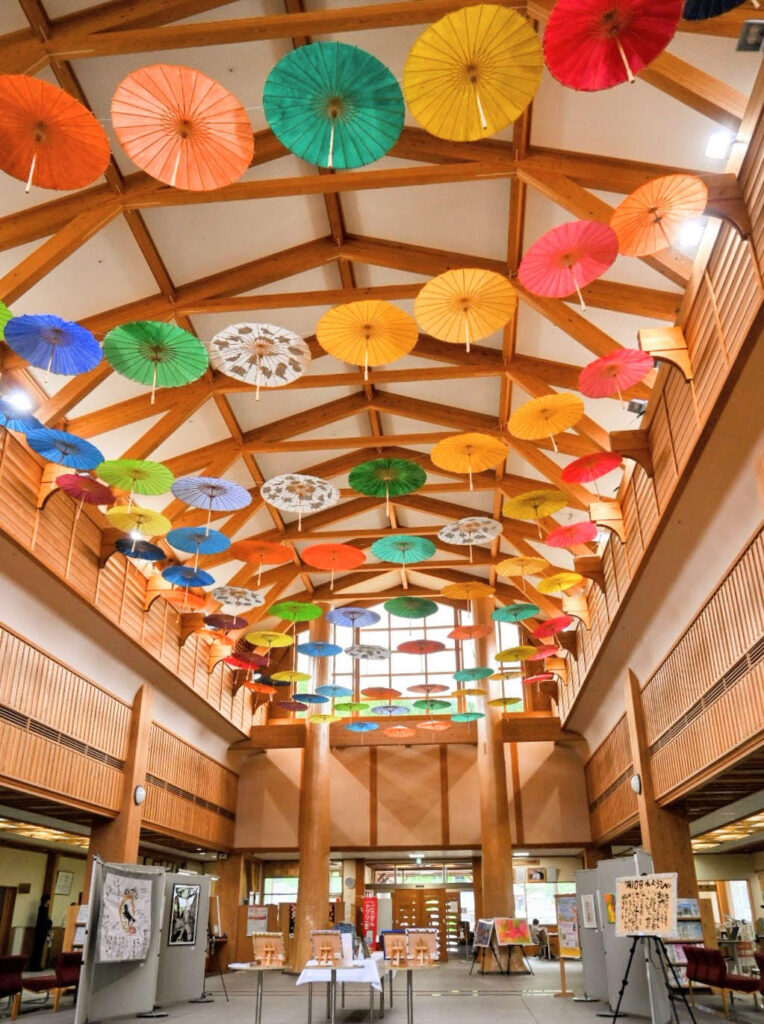
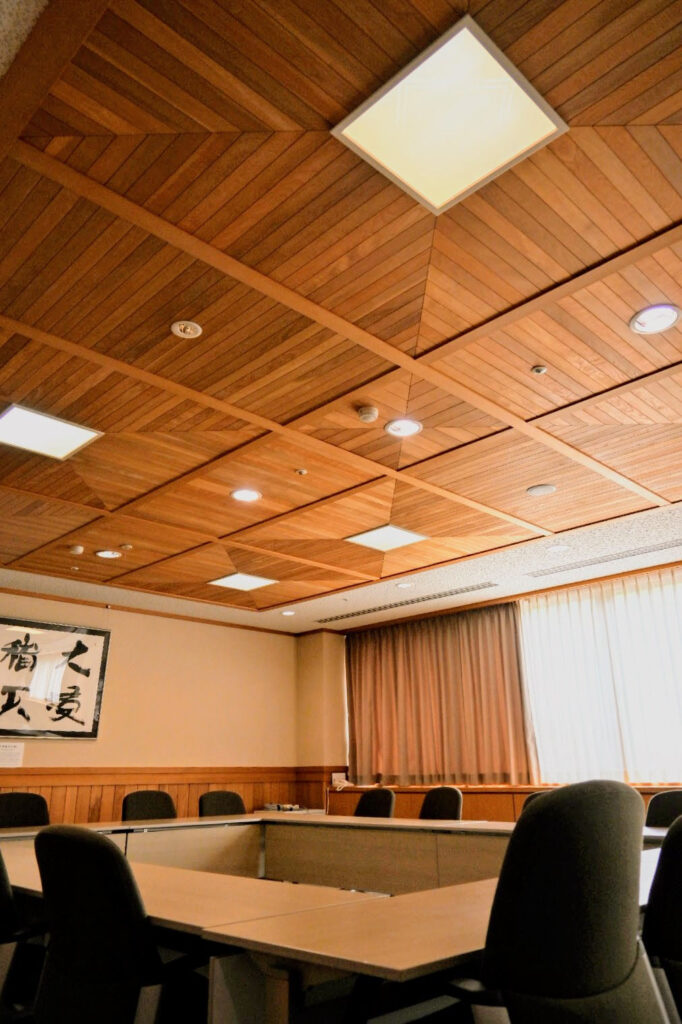
In addition, Nichinan Town has taken the lead in creating “outlets” for the timber by using it in public facilities—such as by constructing a wooden town hall that makes extensive use of locally produced FSC-certified lumber.
While Nichinan Town’s sustainable forestry system appears to be highly sophisticated, the reality on the ground is far from cause for unqualified celebration. Although the current system, supported by the local government and the forestry cooperative, ensures that landowners bear no out-of-pocket costs, the question of who will bear the costs of “non-revenue-generating tending operations”—such as thinning and pruning, which become necessary a dozen or so years after planting—remains unresolved.
That said, there are significant hurdles to simply replicating this “Nichinan Model” in other regions. One of Nichinan Town’s defining characteristics is the concentration of downstream industries—such as lumber complexes and LVL factories—within a relatively small collection area, all accessible by truck within a 30-minute radius. Furthermore, even within Nichinan Town, the community is constantly plagued by deep-rooted obstacles in rights coordination, such as situations where “a single forest plot has multiple co-owners, making it impossible to reach a consensus.”
How can we overcome these “next challenges”—which have become apparent precisely because this is a pioneering region? Nichinan Town’s efforts reflect the structural challenges facing Japan’s forestry industry. No matter how well the production system is organized, the cycle cannot function without a powerful entity to transform the timber into finished products. At the core of this effort is the “Orochi” LVL factory—an end-user industry that has obtained JAS certification for structural cedar LVL and makes full use of all grades of timber, from Grade A to Grades C and D. = To be continued
*Reference link
Nichinan Town Forestry Cooperative
Overview of Nichinan Town / Nichinan Town