


Updated by the Editorial Department of *Forest Circular Economy* on August 12, 2026, at 9:41 p.m. JST
Editorial Board, Forest Circular Economy
Forestcircularity-editor
We aim to realize "Vision 2050: Japan Shines, Forest Circular Economy" promoted by the Platinum Forest Industry Initiative. We will disseminate ideas and initiatives to promote biomass chemistry, realize woody and lumbery communities, and encourage innovation in the forestry industry in order to fully utilize forest resources to decarbonize the economy, strengthen economic security, and create local communities.
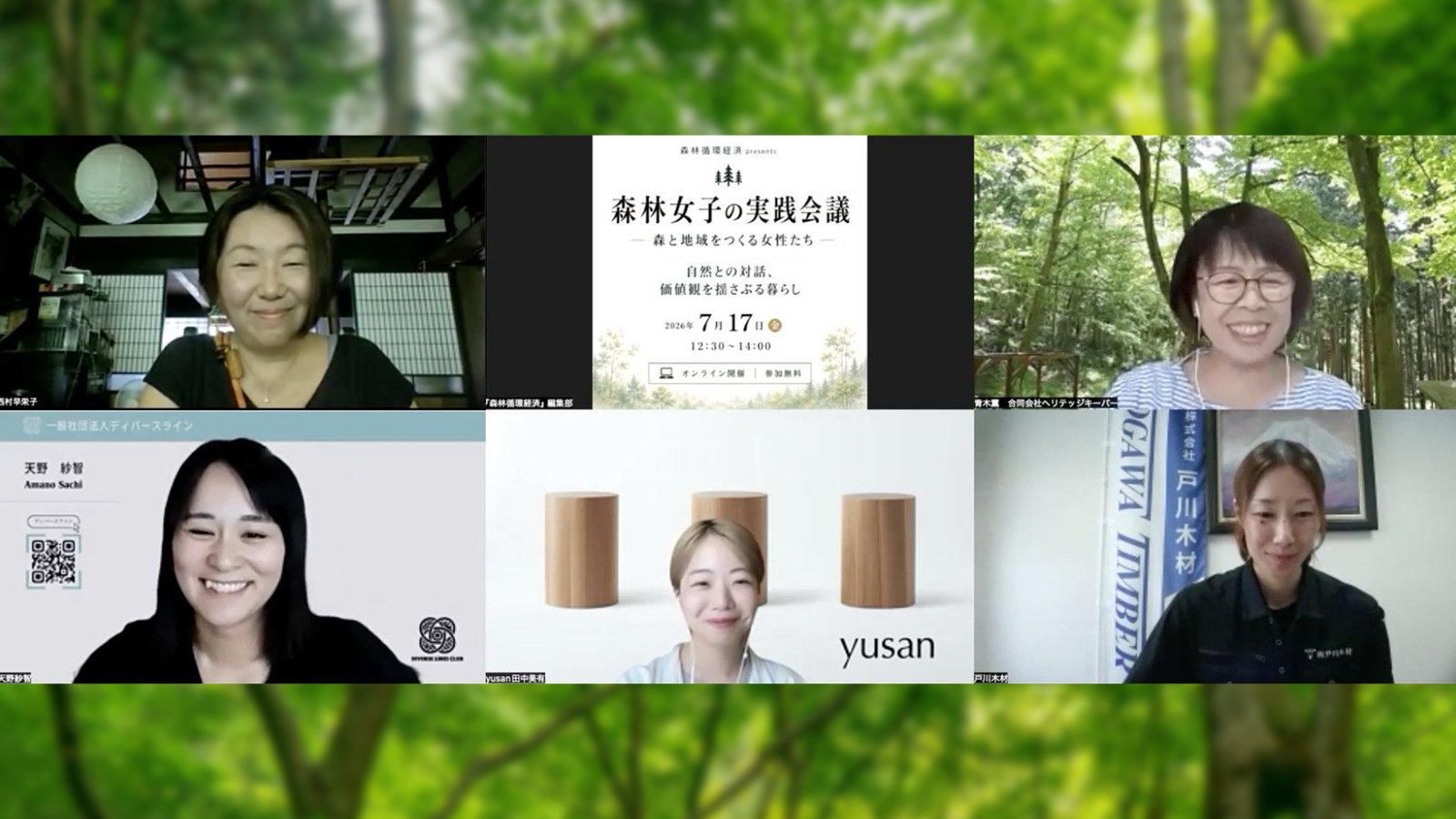
On July 17, we held the online event “Forest Women’s Action Conference: Women Shaping Forests and Communities.” The theme for the summer was “Dialogue with Nature: A Way of Life That Challenges Our Values.” We received over 400 registrations, reflecting significant interest in practical efforts to explore diverse ways of engaging with forests.
Five women who are active in various fields across the country—including parenting, satoyama conservation, community development, forestry, and product development—took the stage. Rather than presenting polished success stories, the event served as a forum for sharing their doubts, struggles, and decision-making processes, offering authentic insights into diverse ways of working and living.
The circumstances that led each person to enter the forest vary; there are many different paths that led them there.
Kaoru Aoki of Kanagawa Prefecture is a former nurse and mother of three. While grappling with concerns such as her children’s disabilities and school refusal, she realized that the forest had been a source of solace for her. Recognizing its potential as a “place that fosters personal growth,” she launched a project in the satoyama to create play areas for children and offer retreats. Sachi Amano of Nagano Prefecture is a former professional snowboarder. Drawn to the lifestyle she observed in Canada—where “there are no boundaries between work, life, and play”—she moved there and is now engaged in activities that combine self-managed forestry with diverse lifestyles.
Miyu Tanaka of Tokushima Prefecture reevaluated the value of the forest she inherited and ventured into the mountains herself. She launched “yusan,” a brand that incorporates the insights she gained there into modern life, offering tea spaces and wooden stools. Akari Tada of Okayama Prefecture made a career shift from an office job to becoming a heavy equipment operator in the forestry industry. Seeking a commutable environment that would allow her to balance work with raising her children, she took the plunge despite having no prior experience and has since discovered a sense of joy and fulfillment in realizing, “I can do this, too.” Saeko Nishimura of Tottori Prefecture decided to relocate because she felt a sense of crisis regarding Japan’s overprotective parenting style and wanted to “raise children to be resilient.” Together with friends, she launched a “forest kindergarten” without a physical building, creating a space for raising children in the countryside.
The Instagram account for Heritage Keeper LLC, led by Mr. Aoki
The Instagram account for Diverseline, a general incorporated association headed by Mr. Amano
The Instagram account for "yusan," the brand launched by Mr. Tanaka
A common theme that emerged throughout this session was the perspective of viewing forests not merely as “resources,” but as a social foundation that supports “sensory experiences,” “care,” “education,” and “local communities.”
In response to Mr. Tanaka’s observation that “my senses become more acute when I enter the mountains,” Mr. Aoki deeply resonated with the idea that “by consciously engaging with nature, our senses as living beings are reawakened.” He explains that actively receiving from the forest gives rise to a sense of gratitude, which in turn fosters a two-way “care (caring).”
In other words, what they all had in common was that, by engaging with nature, they were reawakening a sense that modern people tend to lose. Mr. Nishimura emphasized the importance of not just thinking about it intellectually, but rather “immersing oneself fully in the forest as a participant and feeling the energy with one’s body.” Drawing on his experiences in Canada, Mr. Amano also spoke of the comfort of being in nature, where “my five senses were heightened,” while Mr. Tada finds joy in feeling the ever-changing natural world firsthand as he operates heavy machinery.
The official website of Togawa Lumber, where Mr. Tada works
Click here to read Mr. Nishimura's column
In advance questions submitted by female audience members, specific topics such as “balancing work and child-rearing,” “anxieties about being a woman,” and “how to approach the mountains” were raised, and the panelists provided answers.
Regarding balancing work and parenting, Ms. Nishimura highlighted the power of the community at the “Forest Kindergarten,” offering encouragement by saying, “If you have friends who share the same values, you’ll manage somehow.” Ms. Tada also revealed the unexpected benefits of working in forestry, noting the reality of the field: “Since work ends when it gets dark, there’s no overtime, which makes it easier to pick up my children from school.”
Regarding how to navigate a male-dominated forestry industry, Ms. Tada pointed out, “If you try to do things exactly the same way as the men, it will definitely be difficult, so don’t even think about it.” She offered down-to-earth advice, saying, “Just focus on what makes you unique—whether that’s doing your work neatly and carefully or keeping things spotless.” Ms. Amano also explained that, rather than cutting trees with a chainsaw, she is involved in forest planning and surveying, demonstrating the diverse ways people can engage with the forest beyond just cutting trees.
Regarding the utilization of mountain resources and sales channels, participants shared practical approaches that also apply to community development. Mr. Aoki noted, “It’s important for the recipient to know which forest the story comes from.” Mr. Tanaka suggested, “First, go into the mountains and find something you enjoy,” while Mr. Nishimura proposed starting with “the low barrier to incorporating a single flower into your living space.” Mr. Amano spoke about the significance of “participating in workshops to build a community,” and new options were presented that anyone can start today.
Reflecting the excitement of the event, we received many comments from viewers. Here are some excerpts.
・Seeing everyone speak so animatedly and hearing stories that joyfully engage the five senses and the mind gave me a great deal of hope.
• I felt that the point about the shift “from demand for firewood and charcoal to demand for a place to cultivate one’s senses and sensibilities” was spot on. It felt as if you had put into words exactly what I’ve been trying to do.
・I was deeply impressed by everyone who cares deeply about the forest and puts that care into action through their activities.
・I found the innovative approaches and ideas for effectively utilizing forest resources and the natural environment to benefit society to be very helpful.
When we think of the forest industry, our attention tends to focus on its industrial aspects, such as timber use and forest management. However, what was discussed this time was the forest’s role as a “social foundation” that transforms people’s values and ways of life.
The new value of forests revealed through the practices of these women, the diverse approaches that differ from traditional, male-dominated forestry, and the new options for fostering local communities—these go beyond simply sharing a lifestyle and offer extremely important insights for the future of the forest circular economy and community development.
The editorial team of *Forest Circular Economy* will continue to host this series of practical workshops as part of the “Support Project for Women in Forestry.” The next session is scheduled for Friday, October 16, 2026, and will focus on the theme “Choosing to Relocate and Work in the Forest: Rebuilding Time, Place, and Relationships.” We hope you’ll look forward to seeing what the future holds for these practitioners who are bridging the gap between forests and local communities.
Event Name:Forest Women’s Action Conference—Women Shaping Forests and Communities
Theme:The Choice to Relocate and Work in the Forest
Date and Time:Friday, October 16, 2026, 12:30 p.m.–2:00 p.m.
Holding format:Online (Zoom Webinar)
Eligibility:Anyone can watch it.
Participation Fee:Free (advance registration required)
On-Demand Streaming:If you have registered, you can watch the event via on-demand streaming for a limited time, even if you are unable to watch it live.
Capacity:500 people
Contents:First Half: Self-Introductions and Discussion of the Topic / Second Half: Answers to Pre-Submitted Questions
Organized by:"Forest Circular Economy" (Platinum Vision Network, General Incorporated Association)
Sponsored by:Togawa Lumber Co., Ltd., Tokuyama Co., Ltd.


