



Mr. Daisuke Hodo, Representative Director and CEO of Shimon Co., Ltd.
Updated by the Editorial Department of *Forest Circular Economy* on August 25, 2026, at 11:10 a.m. JST
Editorial Board, Forest Circular Economy
Forestcircularity-editor
We aim to realize "Vision 2050: Japan Shines, Forest Circular Economy" promoted by the Platinum Forest Industry Initiative. We will disseminate ideas and initiatives to promote biomass chemistry, realize woody and lumbery communities, and encourage innovation in the forestry industry in order to fully utilize forest resources to decarbonize the economy, strengthen economic security, and create local communities.
In recent years, against a backdrop of an aging forest-owning population, people moving away from rural communities, and unregistered inheritances, cases where it is difficult to identify owners or clarify property boundaries have been increasing nationwide. The Forest Management System, which came into effect in 2019, established a framework whereby municipalities can confirm the intentions of forest owners and consolidate management rights as necessary; however, in reality, progress has been slow due to a shortage of manpower on the ground and the complexity of the procedures.
In response to this challenge, Shimon Co., Ltd., a comprehensive compensation consulting firm, launched a new business initiative spearheaded by its top executive. We spoke in detail with Daisuke Hodo, the company’s Representative Director and CEO, about the turning point in their entry into the forestry sector, their philosophy on building consensus with forest owners, “boundary design” utilizing remote sensing and AI, and their new “forest parcel reorganization” concept.
Since its founding in 1972, Shimon has built a track record over the past half-century as an expert in land acquisition and compensation for losses associated with public works projects. The company’s full-scale entry into the forestry sector was prompted by a demonstration project commissioned by the Forestry Agency in 2021. Pursuant to the Forest Management Act, municipalities conduct “intent surveys” and “owner searches” to confirm whether forest owners are willing to entrust their forest management to the municipality. Shimon was awarded the contract as a contractor capable of providing a comprehensive package of services—ranging from on-site surveys of standing trees to door-to-door visits with landowners and securing agreements. When he became involved in this project, Mr. Hodo reportedly had a powerful intuition.
"I came to realize that the biggest obstacle preventing the intensification of Japan's forests was not a lack of forestry technology, but rather the issue of land rights. If that's the case, we should be able to directly apply the expertise we've developed through public works projects."
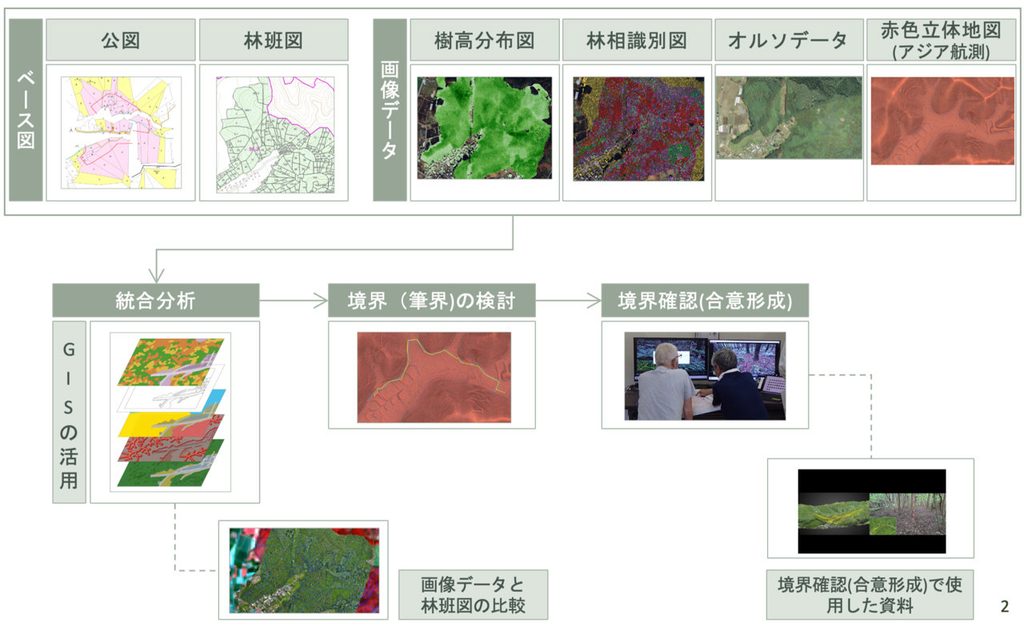
In the forestry sector, there were virtually no players specializing in the process of tracking down landowners, defining property boundaries, and persistently obtaining consent from each and every one of them.
“As ‘mediators between private rights and the public interest,’ we have spent 50 years cultivating the expertise to navigate people’s emotions and untangle legal rights—straddling the line between protecting property rights and developing infrastructure. Although this new business accounts for only about one-hundredth of our total revenue, it consumes 95 percent of my personal emotional energy. Precisely because it is a difficult venture that no one else wants to take on, I continue to visit the sites myself and rise to the challenge.”
When local governments conduct surveys to gauge interest and reach out to forest owners, they are expected to take concrete action afterward. However, there are few consultants available to assist with individual dialogues and consensus-building, and in some cases, local governments hesitate to proceed with the surveys out of concern about the follow-up steps and potential disputes.
"In our line of work, we say that approaching landowners is like 'opening Pandora's box.' Once you open it, there's no turning back. If you just send out a half-hearted survey and then leave it at that, residents will start to feel increasingly suspicious, wondering, 'What are they planning to do with our property?'"
Even after conducting a survey of intentions, specialized practical expertise is required to facilitate individual discussions with forest owners and reach a consensus.
"If you make just one mistake—like buttoning a shirt wrong—and create mistrust, it will take 10 or 20 years to regain that trust. 'Trust is everything' is a principle that has been drilled into us to the very core."
Compensation consultants are broadly divided into “appraisers” (investigators who conduct appraisals) and “negotiators,” and the aptitudes required for each role are entirely different. In particular, when engaging in dialogue and negotiations with landowners, advanced communication skills are required to empathize with the other party’s feelings and find a mutually acceptable solution.

"In negotiations, it’s not enough to simply ‘speak honestly and stick to the facts.’ Once, during compensation negotiations, I was told, ‘The amount won’t change,’ and when I simply stated the facts, the other party became furious. They weren’t just looking for a number; they wanted to see our sincerity and a satisfactory explanation."
What is at stake here is not only the ability to accurately convey the terms, but also the ability to create a process that allows landowners to reach a decision with a sense of conviction. For example, when there are numerous heirs, even the choice of whom to approach first can determine the outcome. If you reach out without first identifying the key figures within the family, emotional entanglements can make it difficult to reach an agreement. The significance of Shimono’s support lies in its ability to coordinate these matters, including such interpersonal dynamics. Mr. Hodo himself has experienced many failures in the past.
“It’s been 30 years of getting scolded nonstop (laughs). Once, when I was getting a final agreement signed by an elderly landowner, I noticed his hand was shaking, so—thinking I was doing the right thing—I offered to help and said, ‘Would you like me to sign for you?’ But he flew into a rage, shouting, ‘Are you trying to take my last job away from me?!’ and stormed off. I had thoughtlessly robbed him of the significance of that moment—the weight of his momentous decision to part with his land. Afterward, I went with my supervisor to apologize. It’s only by facing such failures head-on and dealing with the other person sincerely that a relationship of trust can be built.”
Currently, Shimon is utilizing “remote sensing” data—which involves observing surface topography and vegetation from a distance using images captured by satellites, aircraft, and drones—to verify the boundaries of forested areas. This approach is underpinned by the advanced technical capabilities the company has cultivated while working on the front lines of public works projects. In particular, the company’s remote boundary verification initiatives—which utilize high-density 3D point cloud data acquired via UAV (drone) lasers and mobile laser scanners—have garnered extremely high praise, including an award from the Ministry of Land, Infrastructure, Transport and Tourism for “Outstanding Infrastructure DX Projects” in connection with its river boundary demarcation work.
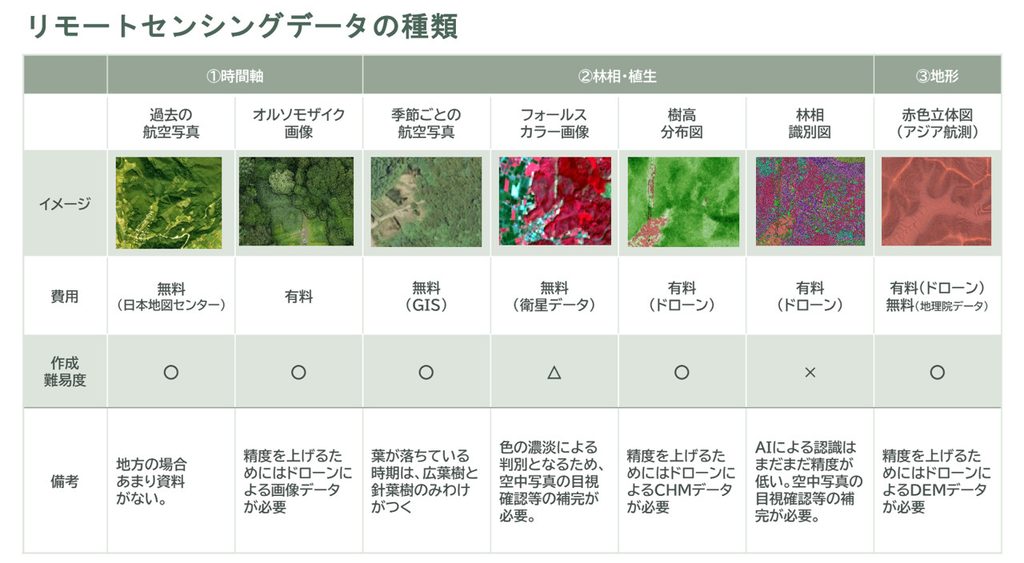
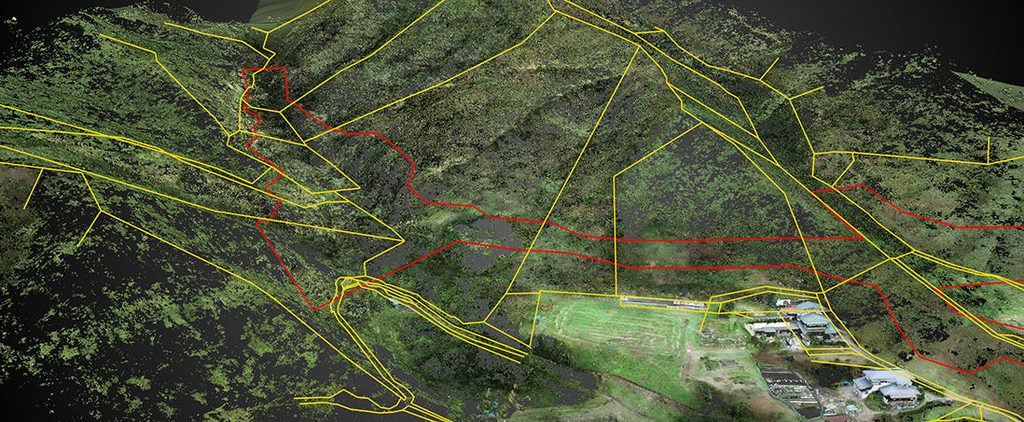
Shimon is currently expanding the “Hybrid Remote Boundary Verification System”—which was established through this riverland management project—to sites where forest land consolidation and boundary clarification are taking place. This system not only reduces the risks faced by surveyors navigating steep and dangerous cliffside terrain and improves safety, but also provides significant benefits to landowners who, due to aging or other reasons, say, “I can no longer climb my own mountain.” By viewing a screen that overlays 3D data with historical records together in meeting venues, parties can safely and visually reach a consensus on boundaries without having to enter the mountains—a truly “hybrid” system that fuses digital technology with dialogue.
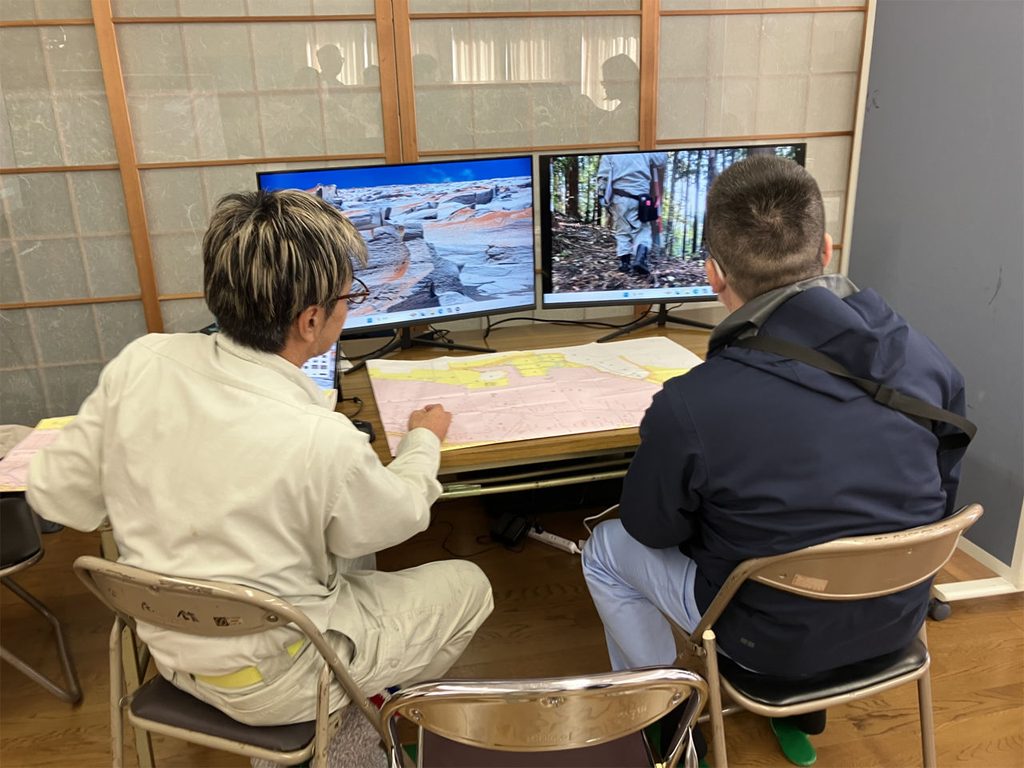
There are two types of land boundaries: “title boundaries,” which are established by mutual agreement between owners, and “cadastral boundaries,” which are established when the land is registered and cannot be changed by the parties’ agreement alone.
"In our world, it is said that 'boundaries are determined by God.' They are not something that humans can arbitrarily alter based solely on mutual agreement; rather, they are official lines that have been established from the outset. AI and digital technology do not automatically define these boundaries. We need to accumulate data and use it to facilitate agreements among landowners."
In the past, boundary demarcation in the forestry industry was often handled in a vague manner, relying solely on agreements regarding property boundaries that defined the scope of “above-ground assets” (trees). However, as forests are increasingly viewed as assets that can be managed and monetized—and with growing efforts to encourage the participation of financial institutions and investors—there is a growing need to clarify not only the scope of tree ownership but also the relationship between those boundaries and land parcel boundaries and land registry records.
“This requires meticulous cross-checking of documents and careful ‘preparatory work’ with the Legal Affairs Bureau. Rather than simply bringing in the blueprints, you should visit the Legal Affairs Bureau in advance to discuss the necessary grounds for your claim. Based on historical records and boundary lines inferred from the topography, we verify the documents and supporting evidence required for the registration process. On that basis, we then approach the landowners in negotiations, stating, ‘There is a reasonable basis for this line.’ It is only through this preparatory work that we can smoothly transition the boundary confirmation into the registration process.”
The process of deriving a single boundary line from complex data has traditionally relied on the “artistry (intuition)” of experienced professionals. To ensure reproducibility, Shimono has begun collaborating with partner companies to develop the “AI Forest Design” system, which predicts boundary lines based on vast amounts of data.
To promote the consolidation of forest land, it is necessary to work closely with the contracting local governments while carefully engaging in dialogue and building consensus with forest owners. Shimon acts as an intermediary between the government and landowners, providing practical support—such as locating owners, verifying boundaries, and confirming intentions—while also coordinating the project as a whole. Furthermore, “total planning” (an exit strategy) that looks beyond mere boundary verification to the ultimate use of timber and the regional economic cycle is crucial.
According to Mr. Hodo, there used to be specialists—referred to as “land acquisition experts”—within government agencies, including the Ministry of Land, Infrastructure, Transport and Tourism, who built their careers solely on land acquisition and were responsible for mapping out the overall project plan. However, as these veterans have retired from the front lines, personnel rotation—in which employees cycle through the general affairs and land acquisition departments every few years—has become the norm in recent years. As a result, there are now extremely few people on the ground in government agencies who can “map out the overall plan for land acquisition,” which has become a major challenge. Government contracts are also often divided into separate components, such as feasibility studies and boundary verification. With no experts in land management available to coordinate the overall process, situations are arising where projects fail to lead to subsequent forest operations or timber utilization.
"We are encouraging local governments to 'place orders as a comprehensive package.' We will work alongside them to implement an exit strategy that takes into account everything from timber revenue plans to economic benefits. This kind of comprehensive support is essential for transforming neglected forests into sustainable assets for the region."
No matter how advanced the technology or how strong the communication skills may be, there are time and cost constraints to handling individual cases one by one as a means of resolving private law rights under the Civil Code. Therefore, Shimono is working with internal and external stakeholders to institutionalize the “Forest Land Readjustment Project.”
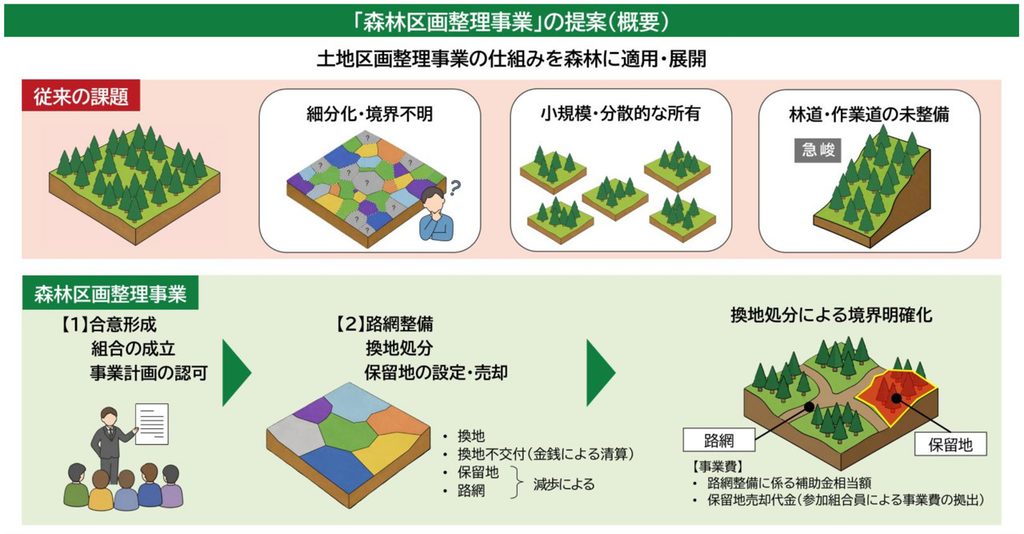
Similar to the “Land Readjustment Act”—which reorganizes haphazardly divided land in urban areas to establish infrastructure and city blocks—this concept involves comprehensively reorganizing forests that have become dysfunctional due to fragmented boundaries and ownership under a public scheme, thereby clearly reassigning and consolidating ownership and usage rights. Currently, a working group under the Platinum Forest Industry Initiative—part of the Platinum Vision Network, which comprises stakeholders from industry, government, and academia—is developing the institutional framework and aims to submit a proposal to the relevant agencies.
"We will combine the design philosophies behind our core businesses—'land readjustment' and 'urban planning'—with the existing forestry system to update the national framework itself."
To consistently handle owner identification, boundary verification, and consensus-building, one needs knowledge and experience that span the fields of law, surveying, and negotiation. A key challenge is not only establishing the necessary systems and technologies but also developing personnel capable of applying them in the field. Shimono adheres to the policy of “thoroughly training young recruits from the ground up to become professionals.” As an educational platform, the company established “Compensation School,” an online learning program operated through a general incorporated association. Since launching the service in December 2023, the cumulative number of registered users has reached approximately 1,000, contributing to raising the overall standard of the industry.
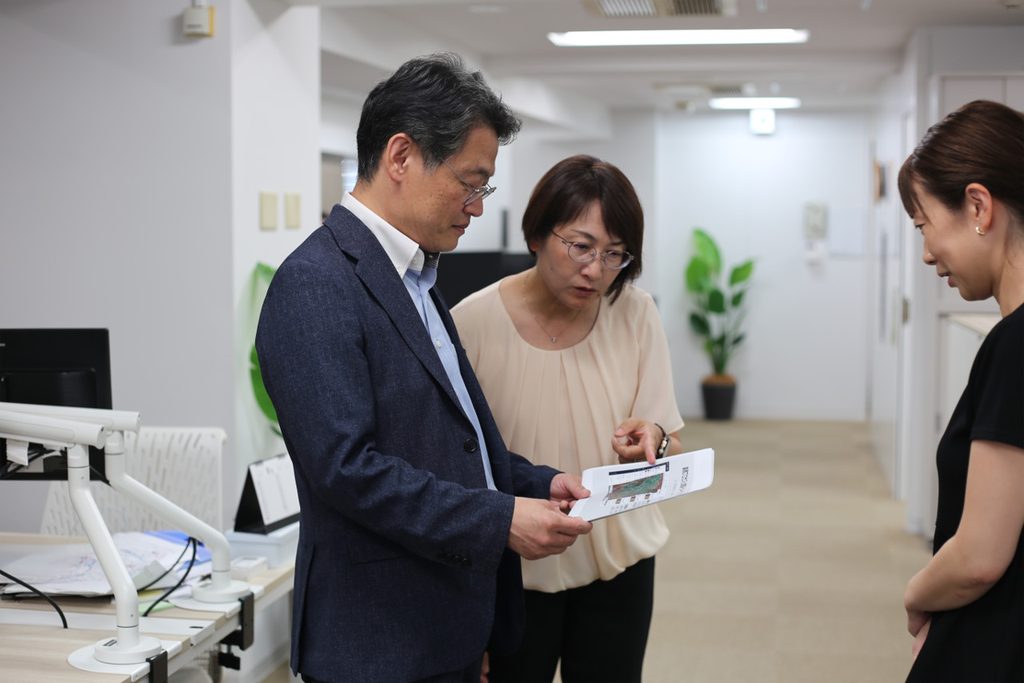
“When I explain how Shimon’s technologies are directly linked to disaster recovery and infrastructure development, many talented young people join the company saying, ‘I want to play a part in that, too.’ In my first address to new employees, I begin by conveying the significance of their work. ‘What you do is not merely paperwork or surveying. It is the most noble of tasks—balancing property rights with the public interest. Take pride in your profession,’ I tell them. Before technical skills, it is most important to cultivate a professional mindset and integrity.”
Mr. Hodo says that, through his interactions with young people these days, he has also sensed a strong “sense of mission” among them.
“The challenges facing our forests are not just the responsibility of the forestry industry. This is an issue concerning our national territory—and it concerns everyone living in Japan. That is precisely why we cannot solve these problems without the involvement of players from diverse fields like ours. Passing on our forests to the next generation is not simply a matter of preventing trees from dying and letting them stand. It means firmly establishing a ‘rights framework’ that ensures continued management and operation, a sustainable ‘economic foundation,’ and a ‘human resources base’ that will continue to support the necessary infrastructure. I am convinced that this is the greatest social mission we must fulfill for this country.”
[Company Information]
Company Name: Shimón Co., Ltd.
Headquarters Address: TUG-I Building, 2-4-1 Kanda Misakicho, Chiyoda-ku, Tokyo
Established: April 1974 (Founded December 1, 1972)
Capital: 30,000,000 yen
Representative Director and Chief Executive Officer: Daisuke Hodo
Number of employees: 111
Business Activities: Comprehensive compensation consulting, forest management support, boundary design services, development consulting, etc.
Official Website:https://www.simmon.co.jp/
[Click here for inquiries regarding business partnerships and business negotiations with Shimon]
Contact Form
(Planning and Production Support: Shimon Co., Ltd.)
Special Interview Series on the Forest Circular Economy: “This Was the Turning Point”
This special interview series features companies and organizations working to implement a circular forest economy, delving into the events, decisions, systems, technologies, and collaborative approaches that served as turning points in their businesses and projects. What were the turning points for these companies and organizations? By connecting these insights to industry contexts such as regional circular economies, woody biomass, decarbonization, and natural capital, we convey them to policymakers and industry decision-makers.
