Updated by "Forest Circular Economy" Editorial Board on January 13, 2026, 6:43 PM JST
Editorial Board, Forest Circular Economy
Forestcircularity-editor
We aim to realize "Vision 2050: Japan Shines, Forest Circular Economy" promoted by the Platinum Forest Industry Initiative. We will disseminate ideas and initiatives to promote biomass chemistry, realize woody and lumbery communities, and encourage innovation in the forestry industry in order to fully utilize forest resources to decarbonize the economy, strengthen economic security, and create local communities.
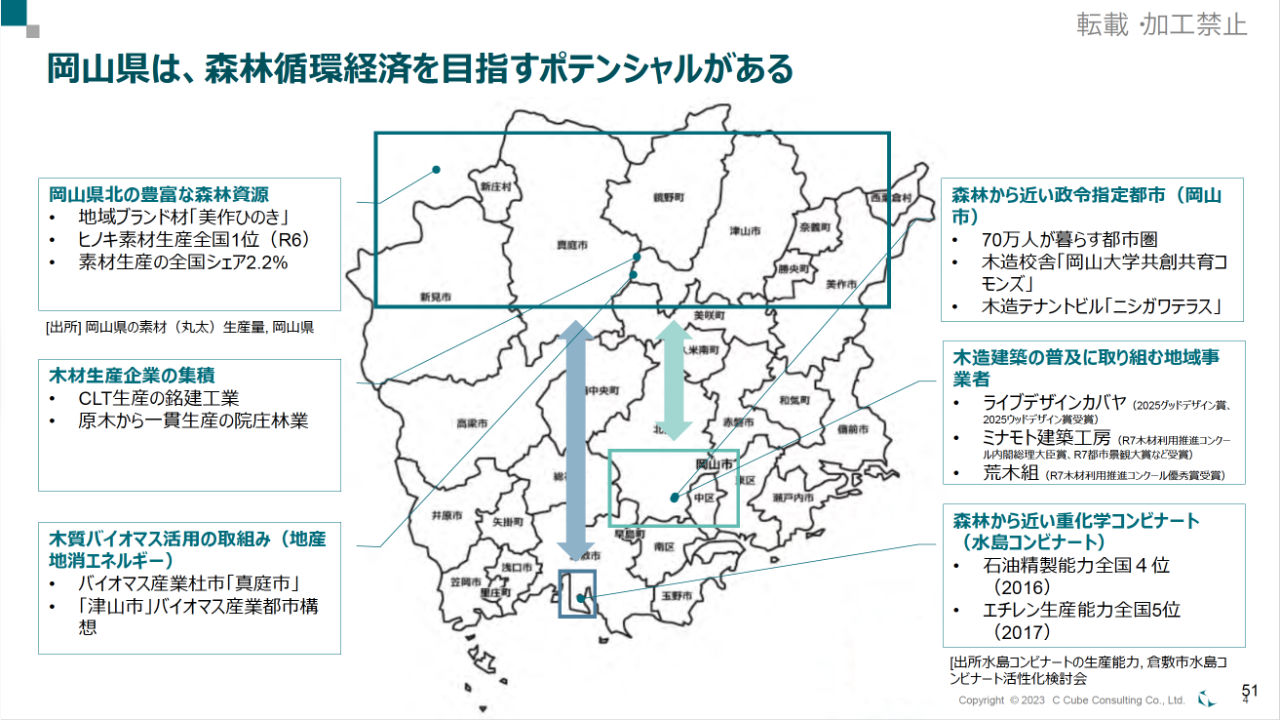
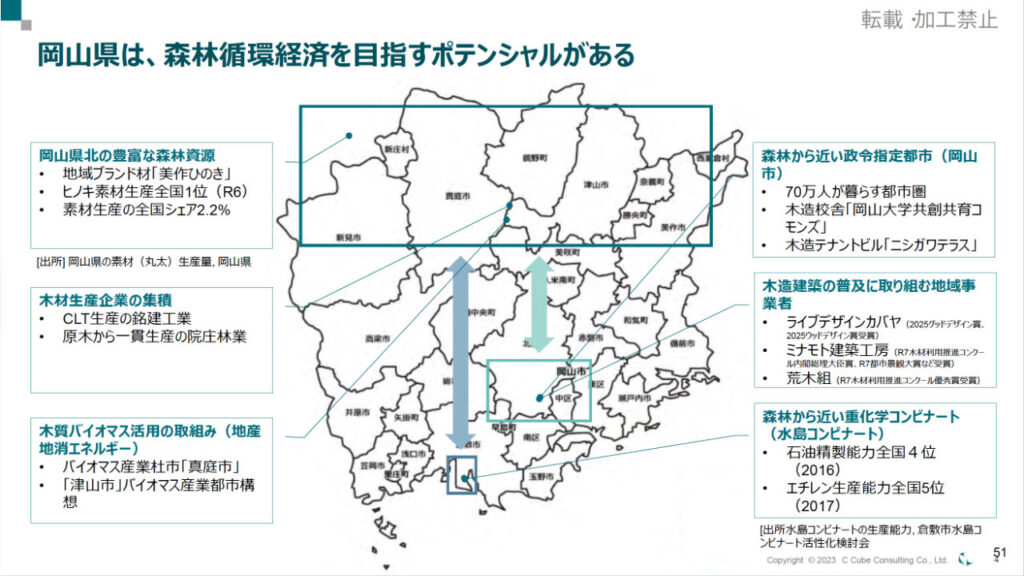
While issues such as stagnant demand for domestic lumber and a shortage of forestry workers are becoming apparent nationwide, Okayama Prefecture, which boasts the nation's largest production of Japanese cypress and is home to a concentration of CLT (laminated laminated laminates) industries, is accelerating industry-government-academia collaboration to implement a "circular economy of forestry. The symposium "From Okayama! Toward the Realization of a Circular Forest Economy," the symposium presented concrete strategies and the latest examples of progress toward simultaneously realizing decarbonization and regional development by utilizing forest resources at multiple levels, from upstream (forestry) to downstream (construction and energy).
At the beginning of the symposium, Okayama University President Yasutomo Nasu took the stage on behalf of the organizers. Since 2017, Okayama University has continued to take steps toward the realization of a sustainable society ahead of other universities as a "Research University for the Promotion of SDGs". Mr. Nasu expressed the university's firm determination as a research university to co-create the future of the region and the earth and contribute to global innovation, with a long-term vision for 2050, further beyond the achievement of the SDGs in 2030.
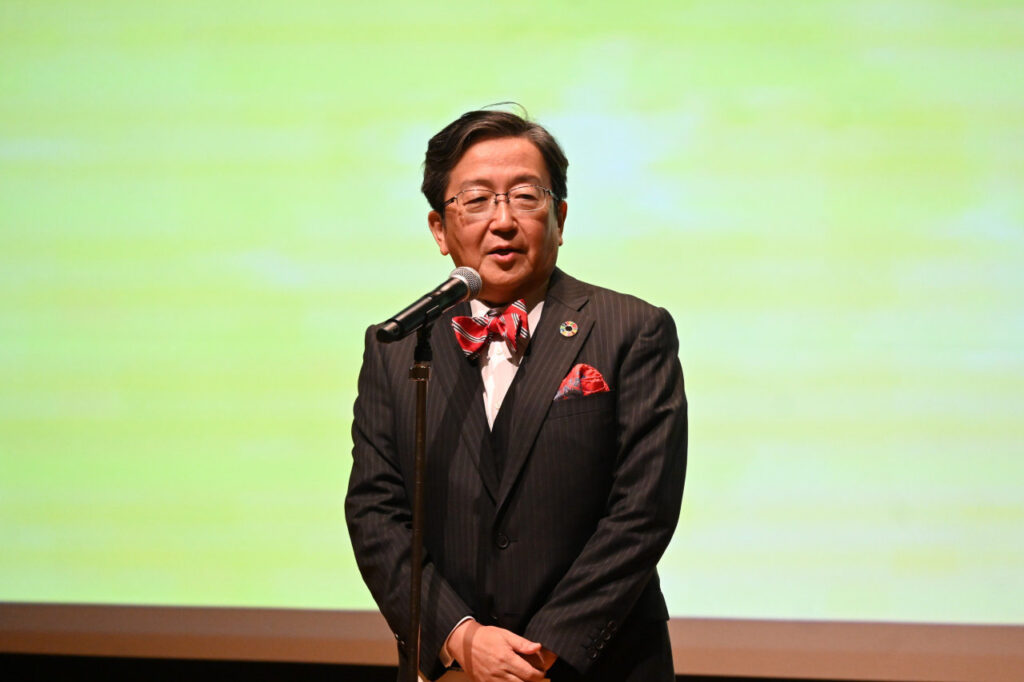
In particular, in his research with the rich forest resources of northern Okayama Prefecture as a keyword, Dr. Nasu emphasized the concept of a "whole-institutional approach. This refers to an attitude in which the university as a whole faces major issues, rather than individual researchers working individually. He also expressed his view that, starting from this intra-university collaboration, activities should be expanded to a "Whole Regional Approach" involving local communities and various stakeholders in the future.
Mr. Nasu also tells the students who will lead the next generation, "The SDGs are not something you learn just to pass an entrance exam. They are your future, your own issues." He continues to urge students to see social issues as "their own business. As if in response to this call, students at Okayama University are becoming increasingly active in proactively working to solve social issues, and many students are participating in practical settings. The boosting of the forest circular economy from the land of Okayama is nothing less than an activity to shape the future together with the next generation.
Next, Mr. Hiroshi Komiyama, former President of the University of Tokyo and Chairman of the Platinum Network for Sustainable Development, gave a special lecture titled "Creating a Forest Circular Economy to Lead Japan toward a 'Platinum Society'. Mr. Komiyama cited "The Limits to Growth," which explains the finite nature of the earth, and the concept of "social common capital" advocated by economist Hirofumi Uzawa as the starting point for the platinum concept. After emphasizing the importance of capital that should be maintained outside the market economy, such as roads, air, and education, he presented his vision of a platinum society: "a society where the earth is sustainable and prosperous and where self-realization is possible for all people.
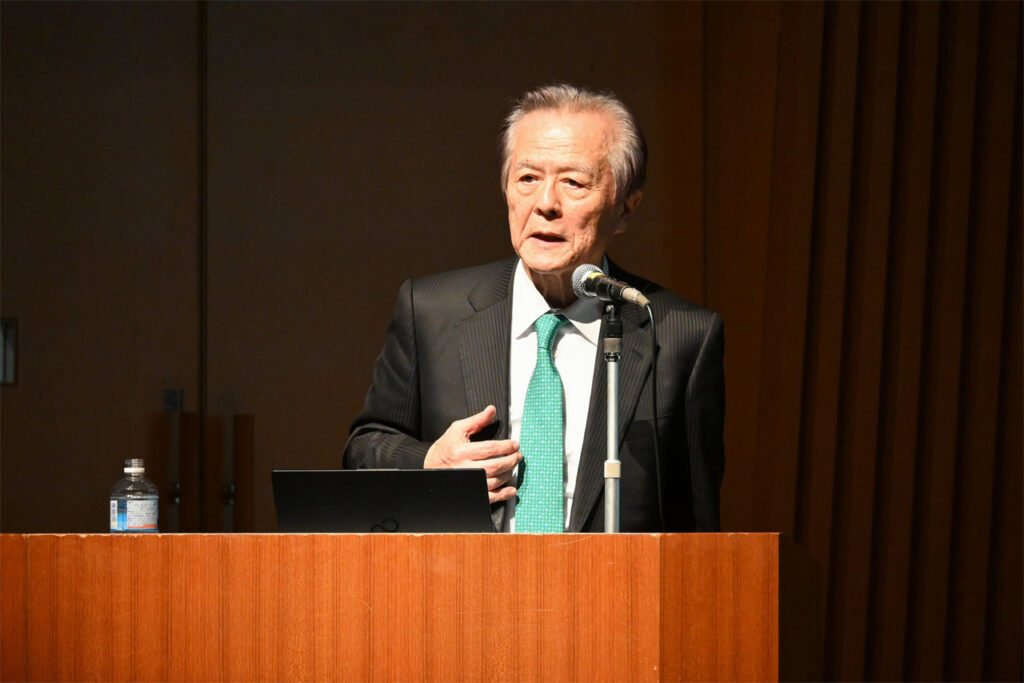
Mr. Komiyama identified three specific goals for Japan: "resource self-sufficiency," "lifetime growth," and "resident investment. Until now, Japan has been spoken of on the assumption that it is a "resource-poor country," but he asserted that the definition of resources will change in the 21st century. By shifting from a 20th century model that relies on underground resources to one based on renewable energy, urban mining, and forest biomass, Japan can evolve into a true "resource self-sufficient nation," he said.
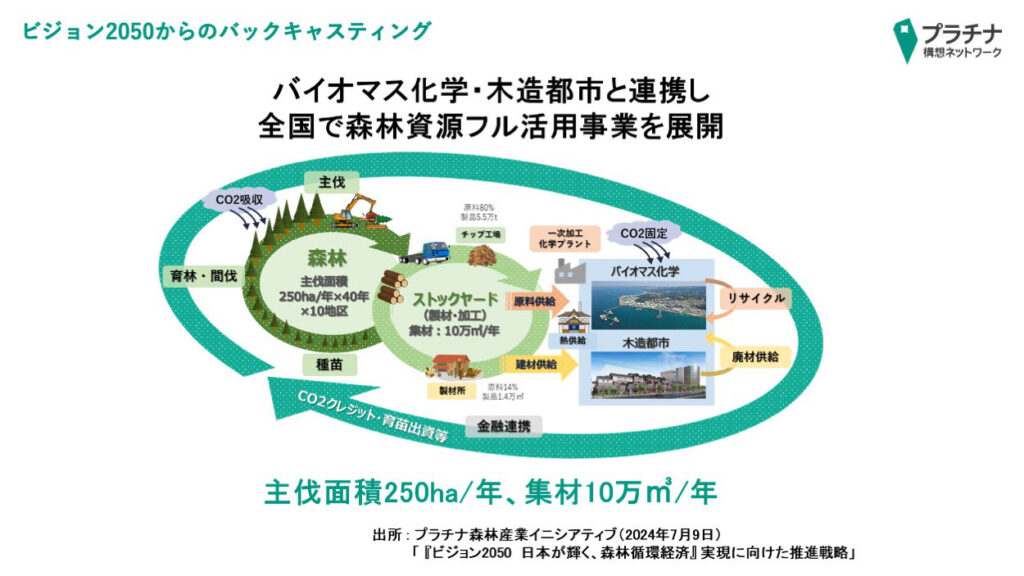
In particular, he pointed out that 80% of Japan's forests, which account for 70% of the country's land area, are neglected, and that their value is severely underestimated. To address this issue, Mr. Komiyama presented a model in which 10,000 hectares (equivalent to 10 km square) is one unit, and 250 hectares are logged and planted each year in a 40-year cycle. If this model were implemented in 1,000 locations throughout Japan, it would be possible to supply 100 million cubic meters of timber, about three times the current domestic timber production. This concept is not only for the use of wood in mid- and high-rise buildings, but also for biomass chemistry as a substitute for petroleum, and for energy use, as part of an economic cycle.
Furthermore, as an economic backstop, Mr. Komiyama stressed the importance of "resident investment," in which individual investment funds go to the domestic market. Currently, of the approximately 27 trillion yen invested annually in NISA and other investment programs, much of this money is currently going overseas. He stressed the need for a mechanism to return profits to local communities by directing a portion of these funds to domestic forests and renewable energy.
By linking primary industry to the energy industry and material circulation in this way, it will be possible to return part of the 30 trillion yen in energy costs paid overseas to the agriculture, forestry, and fisheries industries, which currently amount to 10 trillion yen, to the domestic market. Mr. Komiyama concluded by saying that such a model originating in Japan is the way to protect democracy and capitalism in the 21st century.
In his keynote speech, Masanobu Abe, Executive Director and Senior Vice President of Okayama University, spoke about specific implementation strategies under the title "Toward the Co-Creation of a Decarbonized Society through Wood Construction - Aspirations of Okayama University". Currently, about 37% of the world's CO2 emissions are building-related, and while progress has been made in measures for the operational phase of buildings (energy conservation, etc.), which accounts for 27% of the total, reducing emissions from the construction and demolition phase (embodied carbon), which accounts for the remaining 10%, is an urgent issue.
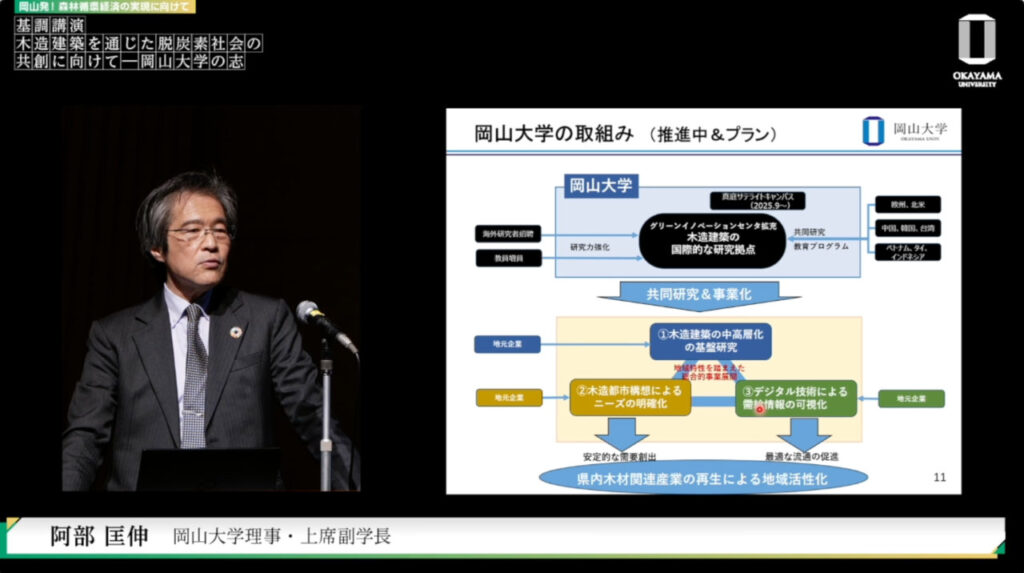
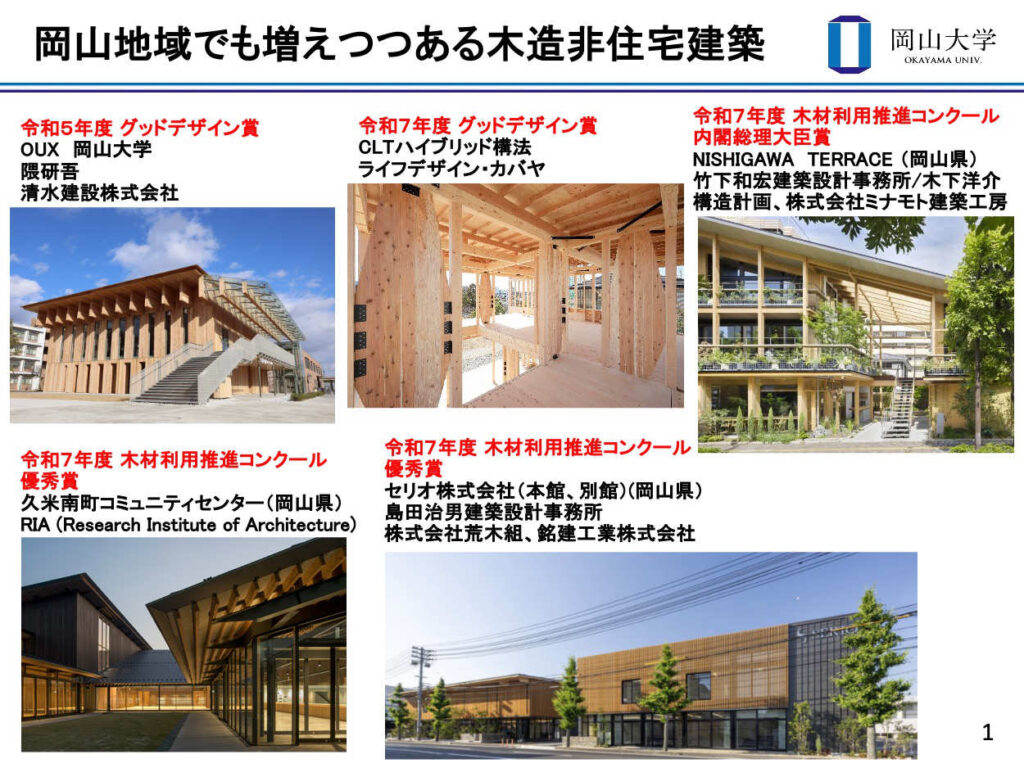
Mr. Abe pointed out that about 80% of Japanese residential buildings are low-rise wooden structures, while the use of wood in mid- and high-rise buildings with four or more floors and in the non-residential sector (offices, warehouses, etc.) is extremely low. Converting these areas to wood construction and turning cities into "second forests" would create significant decarbonization potential. In terms of cost, wood construction is currently 10-20% more expensive than steel-frame and reinforced concrete construction, but a cost reversal (cross-point) is expected to occur in the future due to carbon pricing, technological innovation, and progress in standardization, which will begin in earnest in FY2033.
Regarding fire resistance, which is a technological issue, the research results of the Green Innovation Center (GIC) at Okayama University, which was constructed in 2022, were introduced. Conventional fire-resistant technology requires coating with chemicals, etc., but Okayama University is researching a "pure wood fire-resistant structure" that uses the "difference in red-hot combustion temperature" of different species of wood to stop a fire with just wood. In addition, the university is also studying new construction methods that can take advantage of the technology of small and medium-sized local lumber mills, such as the introduction of binding and piling timbers (BP timbers) that bundle logs together to create large spaces.
In terms of education, the architectural education program in the Faculty of Engineering, newly established in April 2021, focuses on the development of highly specialized personnel with a strong background in wooden architecture. The program integrates research and education by utilizing areas such as Maniwa City in the northern part of the prefecture as a practical educational field.
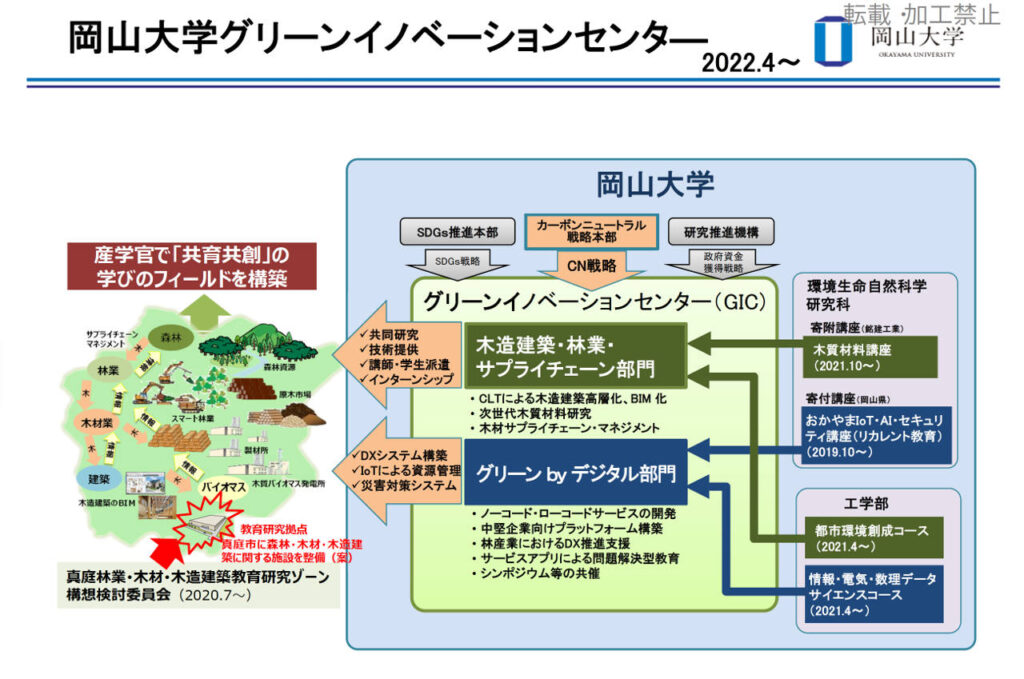
In addition, Mr. Abe advocated the use of digital technology to reform the supply chain. By sharing information in BIM (Building Information Model) and visualizing demand, planned harvesting and reforestation can be made possible. This system of consensus building through strategic alliances to ensure fair risk sharing and cost competitiveness is at the heart of the Okayama Model, which brings together technology, education, and industry to create a decarbonized society.
Reference Links
Okayama University] Okayama University Symposium "Toward the Realization of a Forest Circular Economy from Okayama" to be Held in Okayama, Japan | Okayama University National University Press Release
Life Design Kabaya spoke at the symposium "From Okayama: Toward the Realization of a Forest Circular Economy," hosted by Okayama University and co-hosted by Platinum Initiative Network, Inc! Toward the Realization of a Forest Circular Economy" hosted by Okayama University and co-sponsored by Platinum Initiative Network. | Press Release by Life Design Kabaya Co.