Turning water resource conservation into economic value: Quantifying and evaluating the effects of forest management.
Updated by Takanobu Aikawa on April 22, 2026, 8:44 PM JST
Takanobu AIKAWA
PwC Consulting Godo Kaisha
Senior Manager, PwC Intelligence, PwC Consulting LLC / With a background in forest ecology and policy studies, he has been extensively engaged in research and consulting for the forestry and forestry sectors for the Forestry Agency and local governments. In particular, he contributed to the establishment of human resource development programs and qualification systems in the forestry sector in Japan, based on comparisons with developed countries in Europe and the United States. In the wake of the Great East Japan Earthquake, engaged in surveys and research for the introduction of renewable energy, particularly biomass energy; participated in the formulation of sustainability standards for biomass fuels under the FIT system; since July 2024, in his current position, leads overall sustainability activities with a focus on climate change. He holds a master's degree in forest ecology from the Graduate School of Agriculture, Kyoto University, and a doctorate in forest policy from the Graduate School of Agricultural Science, Hokkaido University.
One of the important public functions of forests is the recharge of water resources. Japan, blessed with abundant rainfall, may not usually experience a shortage of water resources, but droughts and water shortages due to low rainfall have often occurred in the past, and water source forests have been created and secured since ancient times. Furthermore, while climate change is expected to increase the number of heavy rains, it is also expected to increase the number of periods of low precipitation and water shortages. In addition, concerns are occurring in some areas that water-intensive corporate activities, such as semiconductor manufacturing, beverage manufacturers, and data centers, are depleting groundwater resources.
Against this backdrop, attention is focusing on the water resource recharge function of forests. The accumulation of scientific knowledge and advances in technology are expected to help visualize the effects of forest maintenance operations, leading to more sophisticated forest management on a watershed landscape basis.
The water source recharge function is one of the most important public benefit functions of forests. There are three of these functions: flood mitigation, water purification, and water resource storage. Of these, the flood mitigation function of shifting the time between rainfall and runoff is important in the context of increasingly severe heavy rainfall events, but will be discussed in a separate paper.
Now, in 2001, the Science Council of Japan, in consultation with the Minister of Agriculture, Forestry and Fisheries, conducted a monetary conversion of the value of each beneficial function of forests. It estimated the value of flood mitigation, water purification, and water resource storage to be 5.6 trillion yen/year, 12.8 trillion yen/year, and 8.7 trillion yen/year, respectively.
The Science Council's calculations were groundbreaking in that they calculated the economic value of all forest functions in a unified manner, and the results have been widely used ever since, up to the present quarter century. The value of each region's forests has been calculated by dividing the amount reported for all forests in Japan by a uniform value for the entire country, regardless of the condition of those forests.
Behind the estimation of such economic value assessment was the growing environmental awareness in Japan and abroad since the latter half of the 20th century, and a sense of crisis over the simultaneously advancing deterioration of the economics of agriculture, forestry, and fisheries, and the decline of farming and mountain villages.
In particular, many municipalities in the mid-mountainous regions that host forests believed that downstream urban areas should also bear the cost of water source recharge and other public functions, or ecosystem services. Seeking to secure a permanent source of revenue, groups led by municipalities and others have repeatedly proposed a water source tax concept in 1986, followed by a national forest environment and water source tax in 2003, and a national forest environment tax in 2006. Finally, the long-cherished dream was realized as the 2018 Forest Environment Tax and Forest Environment Concession Tax, and now we, the taxpayers, are paying 1,000 yen per person per year.
Notable in this process is the removal of the word "water" from the name of the tax and the use of the more general name "forest environment. This is due to the increased interest in carbon sequestration, one of the public benefit functions of forests.
With the enactment of the Kyoto Protocol in 1997, thinning of forests has been promoted nationwide since the early 2000s as a forest sink measure, and it is now widely understood that forest maintenance contributes to the absorption and fixation of carbon dioxide. The Forest Environment Tax and Forest Environment Concession Tax also have the prevention of global warming as the primary purpose of the tax.
This renewed focus on water is largely due to the release of the final recommendations of the Task Force on Nature-related Financial Disclosures (TNFD) in September 2023.The TNFD requires companies to identify and assess nature-related The TNFD classifies nature into four areas: terrestrial, marine, freshwater, and atmospheric, and identifies "changes in land, freshwater, and marine use" as natural changes that should be captured. This has led to an increased focus on water and the forests that contribute to its recharge, particularly in the private sector.
This has led to increased attention among companies to evaluate the water resource recharge function of forests in their own water intake watersheds. The Science Council's report estimated the amount of water resource storage by all forests in Japan at 186.4 billion m3/year, but as mentioned earlier, the only way to calculate the amount in a specific area was to divide the area by the proposed area, and there was no established method to reflect weather conditions, soil quality, forest condition, and other factors.
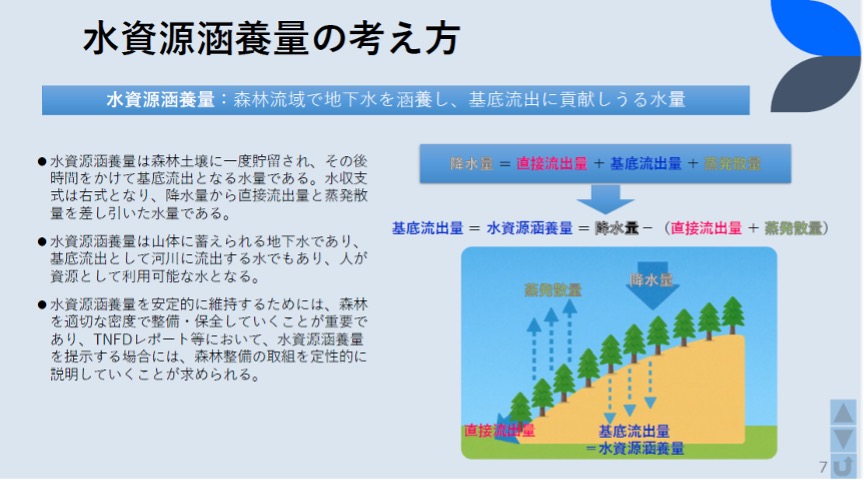
Therefore, the Forestry Agency started to develop a simplified assessment method and published explanatory materials and a spreadsheet for the calculation in March 2026. The method calculates base runoff from precipitation, evapotranspiration, and direct runoff, assuming that the amount of water resources recharged is "the amount of water that can recharge groundwater in the forest watershed and contribute to base runoff.
Specifically, assuming that direct runoff is mainly determined by geology, the relationship between precipitation and direct runoff can be calculated based on nationwide observation data. As for evapotranspiration, it can reflect differences in tree species (coniferous/broad-leaved, evergreen/deciduous) and forest conditions (stand density, tree thickness and height).
This allows the calculation of forest area relative to the required water source recharge, assuming a specific area.
However, this simplified evaluation method of the Forestry Agency is based on the assumption that forest practices such as thinning are properly implemented, and does not allow detailed evaluation of the effects of individual forest practices. Specifically, it should be noted that the method cannot reflect more complex changes in hydrological processes and the actual condition of the understory vegetation (and forest soil protected by it), such as increases or decreases in the direct runoff rate during rainfall due to changes in soil moisture conditions associated with thinning, changes in forest floor surface evaporation, and increases in soil infiltration capacity due to the development of understory vegetation.
In fact, even in the past, there were watershed landscape-based units that invested in upstream forests to recharge water resources. For example, in 1901, the then Tokyo Prefectural Government embarked on the management of more than 8,000 ha of water source forests to prevent the deterioration of forests upstream of the Tama River, which was a water source. Yokohama City also acquired over 2,800 ha of water source forest in Doshi Village, Yamanashi Prefecture in 1916. At the time, forests were in a state of decline throughout Japan, and it was likely that maintaining forests and protecting the surface soil would have an immediate effect on water source recharge. In other words, it was assumed that the public interest function of water source recharge could be achieved simply by maintaining forests.
In contrast, the relationship between the current forest and the water resource recharge function is a bit more complex. As forest managers, we would like to know the relationship between management practices and the amount of water resource recharge. Specifically, the key points include the effects of thinning and the negative effects of main cutting (clear cutting) and the effects of the surrounding retention zone (buffer zone).
Thus, the attempt to more precisely quantify the water resource recharge function and quantity of forests and to visualize the "difference" caused by human intervention is an attempt to integrate forest management and water cycle indicators. If the relationship between forest management and the various functions of forests, such as carbon dioxide absorption, biodiversity conservation, and landslide protection, in addition to water resources, can be clarified, forest management could be advanced to a higher level and the paradigm could be completely changed.
Simulation software has also been developed to evaluate water source recharge. It is hoped that tools based on scientific knowledge that incorporate the various forest functions described above will be developed and used to build consensus on forest management policies on a watershed landscape basis. (Takanobu Aikawa, Senior Manager, PwC Intelligence, PwC Consulting, LLC)
*References:
The Forestry Agency's website "(Reference) History of the Forest Environment Tax' (accessed April 13, 2026)
The Forestry Agency's website "Simple evaluation method for water resource recharge rate (storage function) in forest land' (accessed April 13, 2026)
・ Science Council of Japan (2001), "Appendix to the Report on the Evaluation of Multifunctional Aspects of Agriculture and Forests for the Global Environment and Human Life (Report) Types of Multifunctional Aspects of Forests and Examples of Possible Quantitative Evaluation and Estimation' (accessed April 13, 2026)
Tokyo Metropolitan Government Bureau of Waterworks websiteWhat is a water supply source forest?' (accessed April 13, 2026)
Yokohama City Waterworks Bureau website "Doshi Water Source Forest' (accessed April 13, 2026)