Updated by "Forest Circular Economy" Editorial Board on February 04, 2026, 8:08 PM JST
Editorial Board, Forest Circular Economy
Forestcircularity-editor
We aim to realize "Vision 2050: Japan Shines, Forest Circular Economy" promoted by the Platinum Forest Industry Initiative. We will disseminate ideas and initiatives to promote biomass chemistry, realize woody and lumbery communities, and encourage innovation in the forestry industry in order to fully utilize forest resources to decarbonize the economy, strengthen economic security, and create local communities.
*Previous article here
Learning from Austrian Forestry: Innovation in Material Production (1) Price Competitiveness Born from Sawmill Monopolization and High-Speed Production
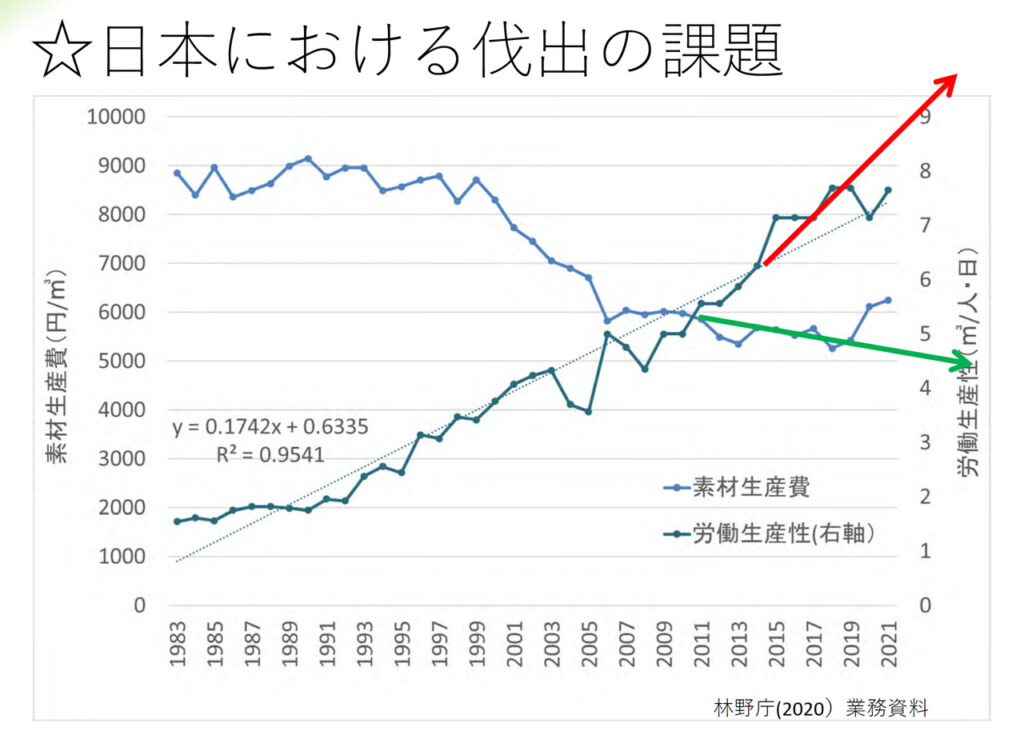
A longstanding issue in Japan's forestry material production sites has been to improve productivity and control costs, but the current situation is grim. According to data presented by Hiroshi Kuboyama of the Forestry and Forest Products Research Institute, the cost of the logging system is 6,248 yen/cubic meter for main cutting in 2021. The rate of productivity improvement has been around 2-4% per year, but recent increases in labor wages have offset this effect, and the reality is that costs are on a downward trend.
Mr. Kuboyama emphasizes, "In order to drastically improve the wage and employment environment for workers and secure the bearers of the workforce, process innovation (technological innovation) is needed that far exceeds the rate of improvement that is an extension of the existing system. An "aggressive stance" is required to redesign the very structure of the field itself.
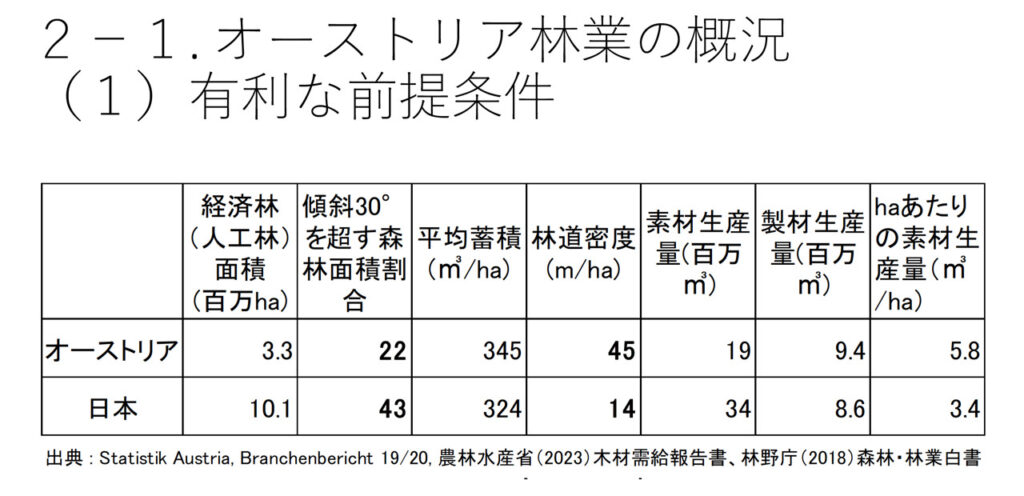
What determines the efficiency of material production is not so much the logging technology itself, but rather the quality of the "roads" as infrastructure. Austria is a mountainous country located at a higher latitude than Hokkaido, and the terrain is not all that flat. However, Austria produces 5.8 cubic meters/ha of material, about 1.7 times more than Japan's 3.4 cubic meters/ha.
The prerequisite for this high production capacity is the density of forest roads. The density of forest roads in Austria is 45 m/ha, which is about three times higher than the 14 m/ha in Japan. What is even more remarkable is that, in addition to the main forest roads used by large trucks, there is a separate forest work road of 45m/ha for tractors and other vehicles to travel on. This high-density road network, covering a total of 90 m/ha, provides an environment that enables the efficient removal of timber from the mountains and forests.
The greatest benefit from the high-density road network is ground collection by tractors and skidders, which accounts for 38% of Austria's total logging output. This is due to the widespread use of tractors for both agriculture and forestry, which has resulted in low logging costs of ¥3,840-5,760/cubic meter. This style of logging and timber collection, in which farmers' tractors are utilized in the winter as well, and logging and timber collection are done in close proximity to the work roads, is truly a rational style of "roadside forestry".
In the utilization of high-performance forestry machinery, Austria's figures are also much higher than the Japanese level. The labor productivity of harvesters, which are responsible for 21% of logging, reaches 30 to 60 cubic meters/man-day, several times more efficient than the Japanese average (7.7 cubic meters). The cost is also low, at 2,560-4,000 yen/cubic meter, and a production system with two operators combined with a forwarder is becoming common. The difference between Japan and the other countries is that the travel distance in the mountain forests is reduced to the minimum by road maintenance, and the design maximizes the operating time of the machines.
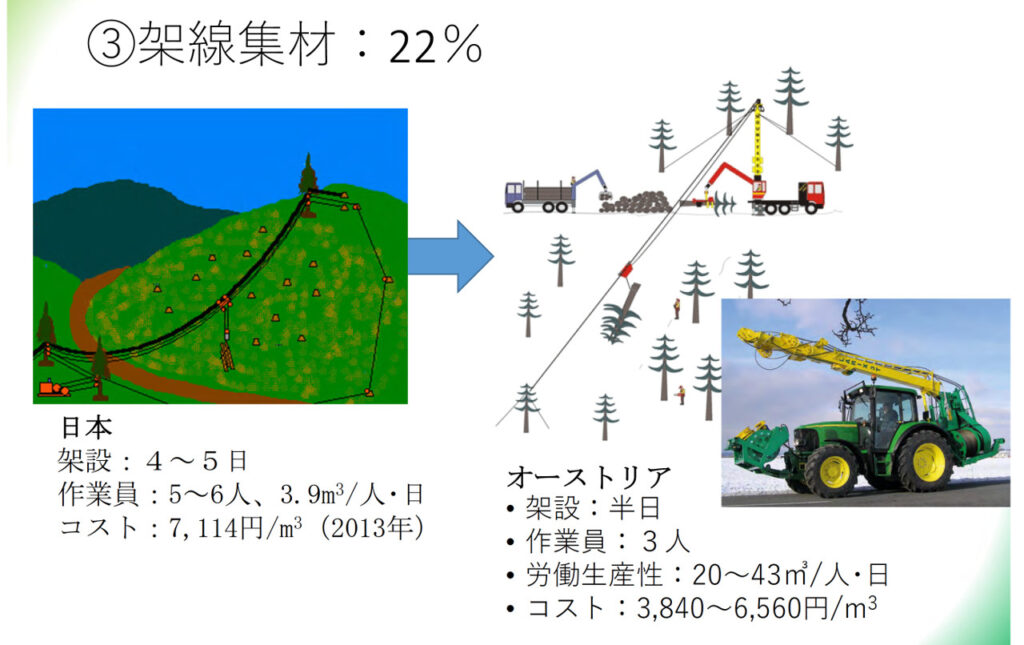
Japan, with its steep mountainous terrain, can also take a cue from Austria's sloping terrain measures. Overhead wire collection, which in Japan takes four to five days to erect and costs 7,114 yen/cubic meter (in 2013), is streamlined in Austria. By erecting towers as truck beds or tractor attachments, the installation of overhead wires is reduced to only half a day, and the logging cost is 3,840-6,560 yen/cubic meter, which is lower than the logging cost in Japan.
Furthermore, a recent technological innovation, the "winch assist," has dramatically expanded the working range of vehicle-based machinery. This technology enables harvesters and forwarders to operate on steep slopes of more than 30 degrees, where previously they had to rely on overhead wires, by holding and pulling the vehicle body with powerful cables. Mr. Kuboyama stresses that overcoming topographical constraints by placing these latest technologies in the right places is an essential means of maintaining low-cost production while paying high wages to forestry workers.
The essence of the material production innovation realized in Austria lies in the "thorough streamlining of the work site," which is based on the solid infrastructure of high forest road density and the pursuit of high-performance mechanization. The profits generated by this streamlining are returned to forest owners in the form of higher prices for standing timber. In Austria, forest owners are highly motivated to cut down trees due to low logging costs, and a vigorous resource cycle has been established in which approximately 89% of the annual growth volume is utilized. Mr. Kuboyama asserts, "The key to a sustainable forestry industry is to ensure that high forestry income remains in the hands of the owners. =Continued
Yushi Kuboyama's columnthis way (direction close to the speaker or towards the speaker)
■Reference Books
Wood Science Lecture 10: Biomass (Kaiseisha)
Forest Future Conference (Tsukiji Shokan)
Forest Products (Kyoritsu Publishing)