How to connect the construction and forestry industries - A collaborative model to transform road network development into " infrastructure maintenance and management"
Updated by Sogo Kato on March 26, 2026, 10:18 AM JST
Sougo KATO
Leaf Rain Co.
After working for a financial institution researching companies in the high-tech field, he worked as a supervisor at a landscape construction site before setting up his own business. He is interested in the materials industry, renewable energy, and wood utilization, and in recent years he has been writing about the forestry industry. With his experience of working in the forests in the past, he aims to write articles that explore the connection between the realities of the field and the industrial structure.
In recent years, Japan's forestry industry has seen a series of demonstration experiments by different industries, including IT companies and machinery manufacturers, against the backdrop of smart forestry and DX. There is a growing movement to utilize drones, ICT machines, and data analysis to improve the efficiency of forest management and timber production. However, the introduction of such technologies requires the development of infrastructure on forestry sites. High-performance forestry machinery and ICT technology will not function well unless the working environment, such as road networks, is well maintained. In the 2000s, as public works projects declined, the construction industry began to participate in the forestry industry in many areas, and their skills were used to improve roads and other forestry work. However, it is difficult to say that these efforts have taken root widely. Why did the construction industry's entry into the forestry industry not continue?
The reason why the construction industry sought to enter the forestry industry was due to the circumstances of both the forestry and construction industries. While the forestry industry was facing a serious shortage of forestry workers, the construction industry was experiencing a decline in the amount of work due to a decrease in public works projects in the 2000s. This situation prompted consideration of policies that would bring the two industries together, and collaborative efforts began in 2008 with the establishment of the Hida Forestry and Construction Industry Forest Growing Council in the Hida region of Gifu Prefecture.
At the time, Japan's forestry industry was in the beginning stages of mechanization, and there was a growing need to develop road networks in forests to utilize high-performance forestry machinery. Therefore, the construction industry, with its heavy machinery and surveying skills, was expected to participate in this project, as the maintenance of forest work roads and other road networks was considered a key to improving productivity.
However, this entry of the construction industry into the forestry industry has not been widely established. The main reason is believed to be that as the economy recovered and public works projects increased, construction companies returned to their original focus on civil engineering work.
However, this may be due in part to the business structure of the forestry industry. In the forestry industry, the scale of construction tends to be limited because the business units are small and dispersed, and the construction of work roads is incidental to forestry operations. In addition, work roads are often constructed in a simple structure, and the unit cost is lower than that of general roads with pavement. Such small-scale and dispersed construction work is difficult for the construction industry to generate volume as a business. While the burden of setup is heavy, the scale of construction and unit cost are limited, making it difficult to generate economic benefits.
In addition, while civil engineering and forestry share similarities in terms of work areas and use of heavy equipment, they tend to have very different construction approaches. Forestry emphasizes on-site judgment based on forest conditions and topography, while civil engineering is based on planned construction based on design drawings and construction accuracy. This difference in work philosophy also makes collaboration difficult, and the roles of the two sides tend to be fragmented. This may have been one of the reasons why entry into the industry did not take root.
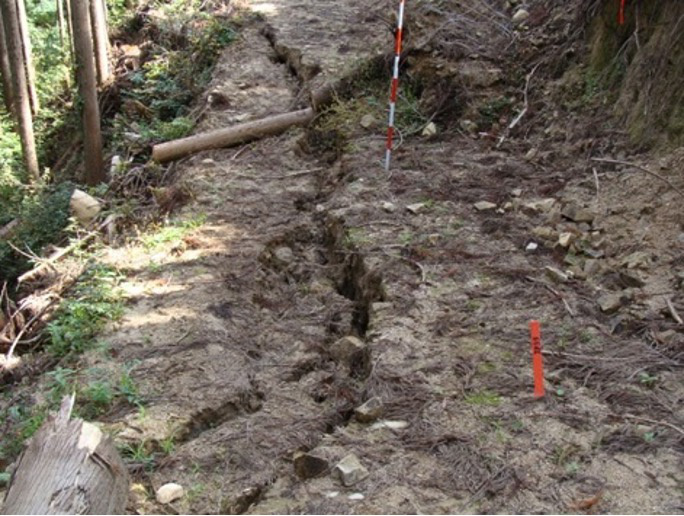
As a result of the lack of participation by the construction industry, the forestry side of the business shifted to take responsibility for the maintenance of working roads and other work. In recent years, with the spread of high-performance forestry machinery, forestry cooperatives and forestry enterprises have been using backhoes and other equipment to maintain road networks. However, forestry and civil engineering require different types of technology. While the main purpose of forestry is to produce timber, road construction in mountainous areas requires civil engineering design and construction techniques that take into account topography, soil quality, and water flow. In fact, there are concerns about the possibility of forest roads collapsing and disasters spreading due to inappropriate construction, as well as the variation in technical standards. In addition, compared to the spread of high-performance forestry machinery, road network maintenance is not sufficient, and it is not easy to simultaneously ensure safety and increase road network density under a forestry-led maintenance system.
In the construction industry, which, like the forestry industry, is facing a labor shortage, the trend toward collaboration with the forestry industry is not as strong as it used to be. However, in order to promote mechanization of the forestry industry, it is important to maintain links with the construction industry in areas that require civil engineering technology, such as road network maintenance. To this end, it is realistic to rebuild the relationship in the form of taking on the maintenance and management of mountain infrastructure, such as repair of work roads and drainage maintenance, rather than the traditional type of entry into the industry. By combining small-scale, dispersed tasks into annual maintenance work that can be forecasted as a certain amount of work, the construction industry will be able to continue its involvement without difficulty. Such a system would also help alleviate bottlenecks in road network maintenance, which is a prerequisite for mechanization and productivity improvement in the forestry industry. (Sogo Kato, Forestry Writer, Leaf Rain Inc.)