Image by Adobe Stock
Does civilization end when it loses its forests? Reconsidering the cycle of forests and humans from the remaining beech forest zone at the edge of Eurasia.
Updated by Kotaro Nagasawa on June 04, 2026, 9:00 PM JST
Kotaro NAGASAWA
(Platinum Initiative Network, Inc.
Born in Tokyo in 1958. Former Senior Managing Executive Officer of Mitsubishi Research Institute. During his tenure, he was mainly engaged in research and studies on infrastructure and social security. During his first few years with the company, he was involved in projects related to flood control, and learned from many experts on river systems at the time to think about the national land on a 100- or 1,000-year scale. Currently, he is an auditor of Jumonji Gakuen Educational Corporation. He is also a part-time lecturer at Tokyo City University. Co-authored "Introduction to Infrastructure" (Nikkei BP, 2017), "New Strategies from the Common Domain" (Diamond, 2021), and "40 Years After the Return" (Heibonsha, 2023). D. (Engineering).
*Previous column is here.
Reading "Beech Belt Culture" by Takeshi Umehara et al.
This issue will again focus on "Beech Belt Culture" by Takeshi Umehara et al. I would like to focus on Yoshinori Yasuda's "Natural History and Civilization of Two Beech Forests in the East and West" in Chapter 2. This is a discussion of such a large scale that it rivals or may even surpass "Shoyo Jyurin Bunka (Culture of Beech Belt Forests). Although the book deals with forests, only this chapter begins with a discussion of the emergence and spread of civilizations in Eurasia.
Mesopotamia is considered the oldest of the four major civilizations (from about 3500 BC). The Indus civilization is said to have occurred about 1,000 years later, followed by the Yellow River civilization a few hundred years later. The Egyptian civilization in the west is said to have originated a few hundred years later than the Mesopotamian civilization. It has been pointed out that there was mutual interaction between these various civilizations.
In response to this historical fact, Shumpei Ueyama of "The Culture of Evergreen Forests" argued that civilizations developed in two directions, eastward and westward, from western Asia, in other words, there are westward and eastward civilizations. Sasuke Nakao, also in "The Culture of Shoreline Forests," considered the eastward civilization as the hardwood forest culture and the westward civilization as the shiny-leaved forest culture, and viewed the east-west civilization in relation to the forest aspect. Based on these discussions, the author Yasuda attempts to clarify the spread of civilizations through pollen analysis.
The first is Mesopotamia. The hills on the left bank of the Tigris-Euphrates River had Mediterranean-type forests such as oak in the early stages of civilization, and we can see that humans destroyed them about 8,000 years ago, and that civilization itself died as a result. This means that there was deforestation even before agriculture.
Secondly, let's talk about the westward expansion of civilization. In Greece, oak forests were extensively destroyed 5,000 years ago. After the Greeks and Romans had destroyed all the forests, the center of gravity of civilization moved north of the Alps, where forests remained.
Then came the eastward expansion of civilization. In the Yellow River basin, there were deciduous broad-leaved forests centering on quercus, but they were destroyed early. The forests of the Korean peninsula were also destroyed, and a landscape similar to the present one, dominated by red pine forests, appeared 6,500 years ago, followed by significant deforestation caused by the spread of rice cultivation around 2,300 years ago.
What Yasuda is trying to show in the above description is that civilization rises in a land rich in forests and ends when the forests of that land are completely destroyed. Civilizations expand eastward and westward in search of new forests. This is the historical view. Today, the center of civilization in Eurasia has been driven to Western Europe and East Asia (including Japan), far away from Western Asia, the cradle of civilization, to the east and west.
Interestingly, the Eurasian beech belt exists at its eastern and western ends. They call this an "isolated distribution. In other words, modern beech forests are distributed in the eastern and western ends of the region, Western Europe and Japan, where civilizations have moved eastward and westward and modern industrial and technological civilization has blossomed.
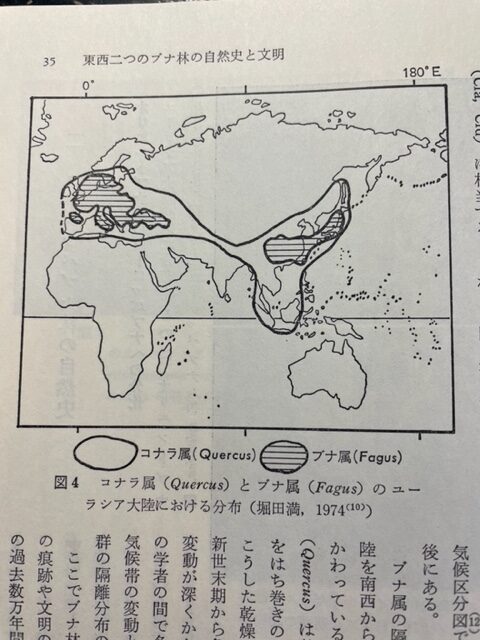
What does this mean? Does it mean that beech was originally spread throughout Eurasia, but was consumed with the rise of civilization, and remains only in areas that were late to become civilization centers?
Mucasibuna, the likely ancestor of beech, appeared on the ground between the middle to late Miocene and Pliocene periods. That is roughly 5 million years ago. It was not until the early Pleistocene (about 2 million years ago) that it was replaced by the present-day native flora of the Japanese archipelago. According to pollen analysis, beech had established a stable position in the plant community of the Japanese archipelago by this time. Since Homo sapiens is said to have appeared in the Pleistocene period, beech trees were in the Japanese archipelago earlier than humans.
The period of about 2.5 million years from the Pleistocene to the present is called the Quaternary. The Quaternary is a period of intense cold, dry, and humid changes. About 18,000 years ago, the last glacial period, when beech trees were unsuitable for growth, ended, and around 12,000 years ago, during the late glacial period, beech forests began to grow rapidly, mainly on the Sea of Japan side. After 8,500 years ago, beech forests decreased in western Japan due to climatic warming, and increased in northeastern Japan. This period marked the establishment of the oceanic climate that continues to the present day, and beech forests were distributed in a manner similar to that of today. The expansion of beech forests slowed down with the subsequent rise in temperature, but with the cooler and wetter climate from around 3,000 years ago, beech forests increased again along with cedar forests, and by 2,500 years ago, beech forests were almost completely distributed in the area shown in the present natural vegetation map.
The growth of beech forests expanded in the Japanese archipelago 12,000 years ago. Around that time, the earliest pottery culture emerged. This was in northeastern Japan.
Japanese beech has survived under conditions so favorable, Yasuda says, that it lacks the resilience of its European counterparts and is vulnerable to destruction. One indication of this, Yasuda writes, is that "Japanese beech trees do not sprout. Lack of adaptation by sprouting is a fatal weakness in the face of human destruction of forests. Germination and growth by seed is far less efficient than sprouting. Once a beech rootstock is cut down, it will never regenerate young trees again. A beech rootstock lasts only one generation."
The Japanese beech tree has a long, long history of more than 800,000 years. It has been coexisting with the Japanese people for 6,000 years since the Jomon period. However, the paper concludes by saying that the tradition is about to disappear in front of our eyes due to the recent clear-cutting of beech trees to meet the increasing demand for building materials.

This book is a collection of papers consisting of 13 chapters; although divided into two installments, we were only able to introduce chapters 1 and 2. However, we hope that we have been able to convey some of the breadth of the Beech Belt cultural theory.
What was striking to me was Takeshi Umehara's point that the Jomon is a beech belt. This is the viewpoint that the deciduous broadleaf forest zone was more suitable for human life in the earlier hunting and gathering stage, whereas the terrestrial forest zone later became highly productive due to rice paddy cultivation.
In considering this point, one is reminded of Carl Geyer's statement that "forestry is an industry quite different from agriculture." He said that the activity of dealing with forests is not so much about controlling nature as it is about placing oneself in the midst of a larger cycle. The culture of the beech belt embodies exactly this kind of relationship between humans and nature.
In recent years, the concepts of environmental symbiosis and resource recycling have been emphasized, and decentralized and autonomous social systems have been sought. These concepts are similar to the ecosystem of the beech forest in that the center does not control the whole, but rather the order of the whole is created through the relationships among individual people.
From this perspective, the long-standing hunter-gatherer worldview of the Japanese archipelago - that is, the recognition that humans are also part of the cycles of nature - is not a thing of the past, but is beginning to take on new meaning in the present day. It is beginning to take on new meaning today. If we were to call this "Jomon 2.0," it should not be understood as a return to the past, but rather as an attempt to reexamine our relationship with nature.
It is also interesting to note that this book has no editor, but rather describes the 14 authors in parallel. The structure of the book is not integrated by a single center, but rather the perspectives of each coexist. In this way, the relationship between the individual and the whole can also be seen. A 40-year-old book titled "Beech Belt Culture" still poses a quiet question to us today. (Kotaro Nagasawa, Director, Platinum Network)
*Honorifics omitted in the text.
*Note: This book was published in 1985, and some of the academic terms and findings in the text are expressions based on the state of research at that time.