


Updated by the Editorial Department of *Forest Circular Economy* on November 12, 2026, at 8:33 p.m. JST
Editorial Board, Forest Circular Economy
Forestcircularity-editor
We aim to realize "Vision 2050: Japan Shines, Forest Circular Economy" promoted by the Platinum Forest Industry Initiative. We will disseminate ideas and initiatives to promote biomass chemistry, realize woody and lumbery communities, and encourage innovation in the forestry industry in order to fully utilize forest resources to decarbonize the economy, strengthen economic security, and create local communities.
The “Platinum Forest Industry Initiative,” led by the Platinum Vision Network—a general incorporated association working toward the realization of a circular forest economy—held its Phase 5 plenary meeting on October 30. At the meeting, Keita Nagasakiya, Commissioner General of the Forestry Agency, delivered a lecture titled “Toward the Realization of a ‘Forest Nation and Wooden City’ That Will Last for a Hundred Years.” Regarding the new “Basic Plan for Forests and Forestry—Toward a ‘Forest Nation and Wooden Cities’ That Will Last a Hundred Years,” which was approved by the Cabinet on June 5, Commissioner Nagasakiya emphasized, “The keywords are ‘safety’ and ‘value.’” While the supply of domestically produced timber and the timber self-sufficiency rate are rising, sufficient profits are not reaching those working in the mountains, and reforestation is not progressing. How can these structural challenges be resolved to achieve growth into a “2 trillion to 3 trillion yen industry”? During Commissioner Nagasakiya’s lecture and the subsequent Q&A session with the audience, he outlined a growth strategy centered on improving safety in forestry, adding high value to timber, and stimulating demand.
Domestic timber supply reached 34.81 million cubic meters in 2024, an increase of 4.6 million cubic meters from 2018. The timber self-sufficiency rate has also risen to 42.5 percent. However, Commissioner Nagasakiya urged caution regarding the breakdown of these figures. “If you look at the details, fuel wood actually increased by 6 million cubic meters. Other than fuel wood, there has been no increase.” Total demand for construction lumber has also declined, and the increase in domestic timber supply is being driven by low-priced fuel wood. Although the self-sufficiency rate for construction lumber exceeded 50 percent at 52.9 percent, this is largely due to a decrease in the supply of imported timber.
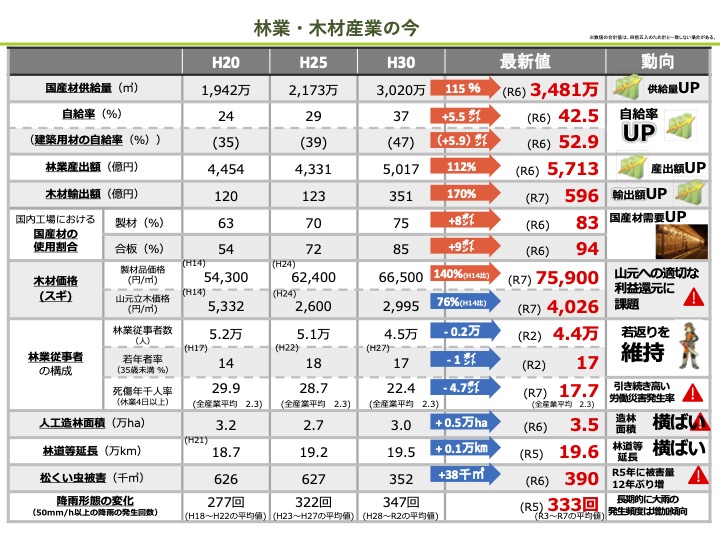
Commissioner Nagasakiya expressed his intention to aim for a 70 percent self-sufficiency rate in construction lumber in order to shift the pricing structure—which had been dominated by imported timber—toward one led by domestically produced timber. However, even if the supply of domestic timber increases, it will not lead to reforestation efforts to nurture the next generation of forests unless forest owners’ incomes improve. The relationship between standing timber prices and reforestation costs illustrates this challenge.
The standing timber price for Japanese cedar in 2025 is 4,026 yen per cubic meter. The presentation showed the financial results based on the assumption that forest owners receive a standing timber price of 3,000 yen, with 450 cubic meters harvested from one hectare of 50-year-old Japanese cedar forest. Under these conditions, the forest owner’s income would be 1.35 million yen. On the other hand, the cost of reforestation after the main harvest is 3.09 million yen per hectare, and even after deducting subsidies, the owner’s out-of-pocket expense amounts to 1.22 million yen.
Commissioner Nagasakiya explained that if this 1.22 million yen were invested at an annual interest rate of 1.5 percent for 50 years, it would grow to approximately 2.57 million yen. He estimated that to earn the same amount through the sale of standing timber, the price would need to be approximately 5,700 yen per cubic meter. “From the forest owners’ perspective, unless they can get 5,700 yen per cubic meter, they won’t be motivated to plant trees. That is why this is the goal of the new master plan.” Rather than simply increasing the volume of timber harvested, a key challenge of the new master plan is to create a revenue structure that enables forest owners to invest in reforestation.
During the question-and-answer session, a question was raised about how to engage elderly forest owners in new initiatives. Commissioner Nagasakiya replied, “Ultimately, it’s essential to have accurate information showing that ‘this will be profitable.’” Citing examples from Iwate Prefecture and elsewhere, he emphasized the importance of systems that provide forest owners with information on demand and prices—specifically, which trees are shipped where and for how much.
Commissioner Nagasakiya identified “safety” as a key concept in the new basic plan. The injury and fatality rate per 1,000 worker-years in the forestry industry is 8 to 10 times higher than the average for all industries. This high rate is not limited to logging and timber hauling operations in forests; it also holds true for the wood and wood products manufacturing industry (excluding furniture), where it is approximately five times higher than the average for all industries.
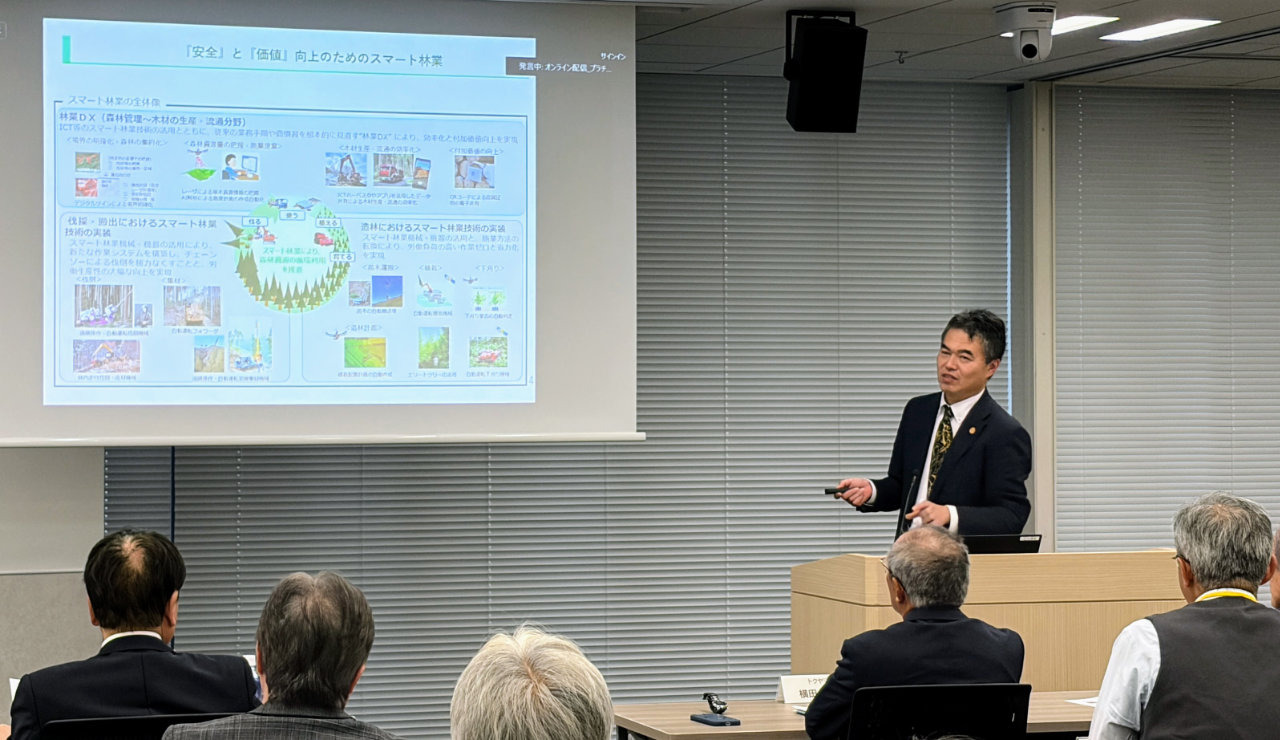
To improve these hazardous working conditions, the Forestry Agency is promoting “smart forestry.” The presentation introduced technologies such as machines that remotely grasp and fell standing trees before hauling them to forest roads, as well as forwarders that transport timber using autonomous driving. Autonomous forwarders utilize SLAM technology to estimate their own position while recognizing their surroundings. According to Commissioner Nagasakiya, these machines are expected to be introduced to the market in two years.
In addition, efforts are underway to introduce remote-controlled operations for cable logging, which uses wire ropes to haul timber out of the forest. Furthermore, development is progressing on automation technologies for underbrush clearing, which is carried out during the intense summer heat.
The introduction of these technologies does more than just reduce workplace accidents. Replacing dangerous and grueling tasks with machinery also helps secure a workforce for the forestry industry and improve labor productivity. Commissioner Nagasakiya emphasized the need to simultaneously enhance both safety and productivity in order to strengthen the timber supply capacity.
Regarding “value”—another key concept—Commissioner Nagasakiya outlined a growth strategy aimed at increasing the added value generated during the processing and utilization of timber and returning those profits to forest owners. During the lecture, estimates were presented indicating that a profit improvement of 3,200 yen per cubic meter of material could be expected through the increased use of wood in urban construction, the use of wood in medium- to large-scale buildings, and the streamlining of the supply chain.
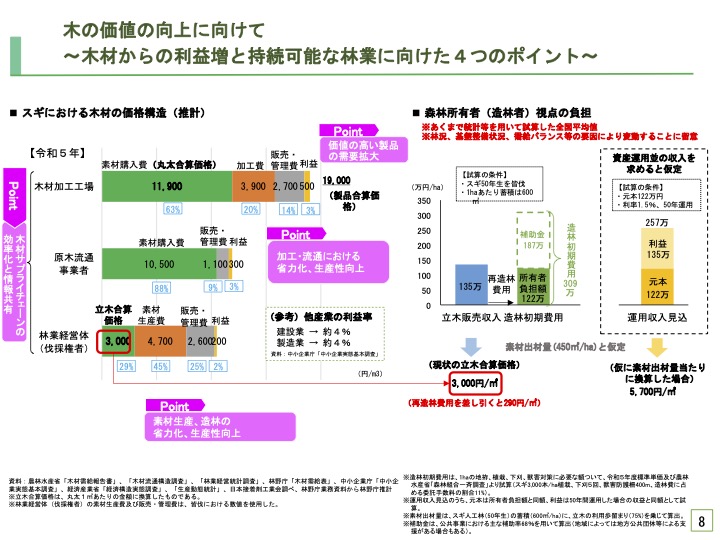
Commissioner Nagasakiya explained that if the increased profits could be appropriately shared between the forestry and lumber processing sectors, it would be possible for forest owners to secure a rate of return comparable to that of asset management, such as bank deposits. One specific measure toward this goal is the advancement of lumber processing technologies to accommodate the increasing diameter of domestic plantation forests.
The company enhances the product value of timber through methods such as “two-piece cutting,” which efficiently yields multiple lumber products from large-diameter logs with a butt diameter of 30 centimeters or more. During the presentation, examples were shown in which these sawing methods are expected to increase value by approximately 2.5 times compared to conventional methods. Furthermore, efforts are underway to establish new standards and specifications for wood-based building materials to promote the widespread adoption of medium- to large-scale wooden buildings.
Work is underway to establish design standards and specifications for BP materials (bonded laminated timber), which simplify the bonding process, with a target of fiscal year 2027, and for DLT (Dowel Laminated Timber), which joins timber using wooden dowels, with a target of fiscal year 2028. In addition, initiatives such as WOOD.ALC, which utilizes wood-based panels, and “wood-framed agricultural greenhouses,” which use wood as structural members instead of steel, were introduced as efforts to generate new demand.
Regarding timber-framed agricultural greenhouses, Director-General Nagasakiya explained that using wood offers advantages in terms of waste disposal in the event of collapse due to typhoons or other disasters. However, the actual disposal methods vary depending on local government waste disposal regulations and other factors. Furthermore, he outlined a policy to promote the use of wood and wood-based materials in highly public facilities, such as schools and hospitals, in collaboration with the Ministry of Education, Culture, Sports, Science and Technology; the Ministry of Health, Labor and Welfare; and the Ministry of Land, Infrastructure, Transport and Tourism.
What is important is not only to expand the range of uses for timber but also to ensure that the added value generated from these uses translates into increased income for forest owners. How profits generated at each stage—such as sawmilling, processing, and construction—are distributed, and how this leads to higher prices for standing timber, will determine the success of the forest circular economy.
Adding high value to wood is not limited to construction lumber. Director Nagasakiya also mentioned the development of new products that utilize the components of wood. One such product is “Wood Wine,” developed by the Forestry and Forest Products Research Institute.
This technology involves using enzymes to convert the cellulose in wood into sugars, which are then fermented and distilled to produce alcoholic beverages. Products are expected to feature distinct aromas and flavors depending on the tree species, such as Japanese cedar, Japanese white oak, and Japanese sweetwood. During the presentation, it was explained that a single piece of firewood—approximately 10 centimeters in diameter and 35 centimeters in length—can be used to produce enough liquor to fill about one bottle of whiskey.
Technology transfer to two private companies in the sake brewing industry is already underway, with the goal of launching general sales in 2028. This development opens up the possibility of a new use—as an ingredient in alcoholic beverages—for wood that was previously difficult to use as a building material. This is an example of how processing technology can create new market value from wood, rather than simply burning it as fuel.
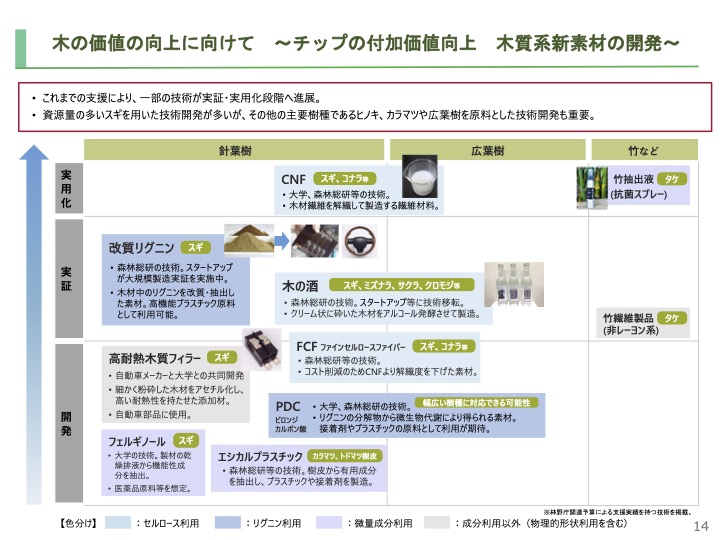
In addition, initiatives were presented on the use of wood-derived components—such as cellulose nanofibers (CNF), modified lignin, and wood-based fillers—in industrial materials and chemical products. Diversifying the uses of wood—including construction materials, fuel, and raw materials for chemicals—contributes to enhancing the overall value of forest resources.
Meanwhile, during the question-and-answer session, a question was raised as to whether the city should plant fast-growing tree species, such as eucalyptus and Koyozan, to increase the self-sufficiency rate of domestically produced timber, such as that used for paper manufacturing. In response, Commissioner Nagasakiya stated, “Even if we plant fast-growing trees now, it will take 20 years before they can be harvested, and it is difficult to predict what the situation will be 20 years from now.” He expressed the view that priority should be given to effectively utilizing existing broadleaf tree resources and elite cedar trees rather than rapidly shifting to non-native tree species.
Given the uncertainty surrounding future demand, what types of forest resources should be cultivated, and for what purposes should they be supplied? To increase the value of timber, forest management that takes long-term demand into account is also necessary.
Toward the end of his lecture, Director Nagasakiya addressed the utilization of broadleaf trees in satoyama forests. Demand for firewood and charcoal, which stood at approximately 20 million cubic meters annually in the 1950s, has now fallen to about 100,000 cubic meters. Satoyama forests, which were once used as sources of fuel, have lost that role, and it is estimated that approximately 4 million hectares nationwide are not being adequately utilized or managed.
On the other hand, while domestic demand for hardwoods totals approximately 24 million cubic meters annually, the supply of domestically produced timber stands at about 2.5 million cubic meters—representing only about 10 percent of demand. Furthermore, most of the hardwood produced domestically is used for pulp and wood chips, and the proportion of timber used for finished products such as furniture and handicrafts is small.
However, there is a high-value-added market for domestic hardwoods that requires specific tree species. Commissioner Nagasakiya cited examples such as Japanese magnolia (Ho-no-ki), used for the handles of traditional Japanese kitchen knives, and Japanese dogwood (Mizuki), used for kokeshi dolls. He pointed out a mismatch between supply and demand: even when the tree species sought by consumers exist in domestic forests, they are not being supplied to the market.
To address this issue, efforts are underway to develop a system for digitally mapping broadleaf tree resources and facilitating the flow of information. Demonstrations are progressing on technology that uses ground-based laser scanning and other methods to measure each tree in a forest individually, thereby gathering information on tree species, shape, and curvature. Commissioner Nagasakiya outlined a plan to launch the “Satoyama Broadleaf Tree Platform” in April 2027, which will use this information to connect the supply and demand sides of the market.
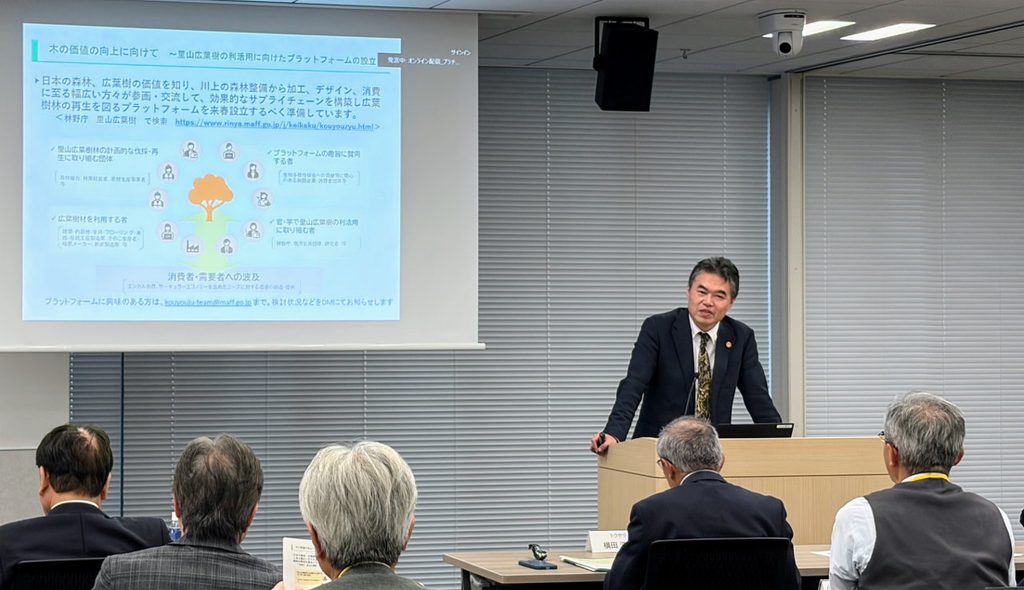
During the question-and-answer session, there were also questions regarding land-use planning that combines the revitalization of abandoned farmland and satoyama with solar power generation. While Commissioner Nagasakiya expressed understanding for small-scale, farm-integrated solar power generation, he stated, “Covering satoyama with mega-solar projects is not advisable from the perspectives of disaster prevention and resource management.” He further emphasized, “Abandoned broadleaf trees are a valuable resource, so we will reuse and regenerate them as such.” He also expressed support for the need for regional planning that treats farmland and surrounding forests as an integrated whole.
To promote the restoration of satoyama, it is important not only to manage the forests but also to recognize the economic value of broad-leaved trees and establish systems that allow for their sustainable use within the local community.
Another important direction that emerged from the presentation and Q&A session was the establishment of a timber supply chain based on demand information. During the Q&A, a construction company interested in using locally sourced timber asked how to address issues such as fluctuations in timber prices and inventory risks associated with advance ordering.
In response, Commissioner Nagasakiya presented an innovative case study in which architectural design data (CAD/BIM) is fed into AI to determine the required shapes and quantities of lumber, which is then synchronized with timber-cutting data from the forest. Commissioner Nagasakiya described this as “the ultimate supply chain that ensures absolutely no wasteful logging in the mountains.”
If we can identify the demand from the construction sector in advance and communicate the required tree species, dimensions, and quantities to the forestry sector, we can reduce mismatches between supply and demand, which could lead to a reduction in inventory risk and distribution costs.
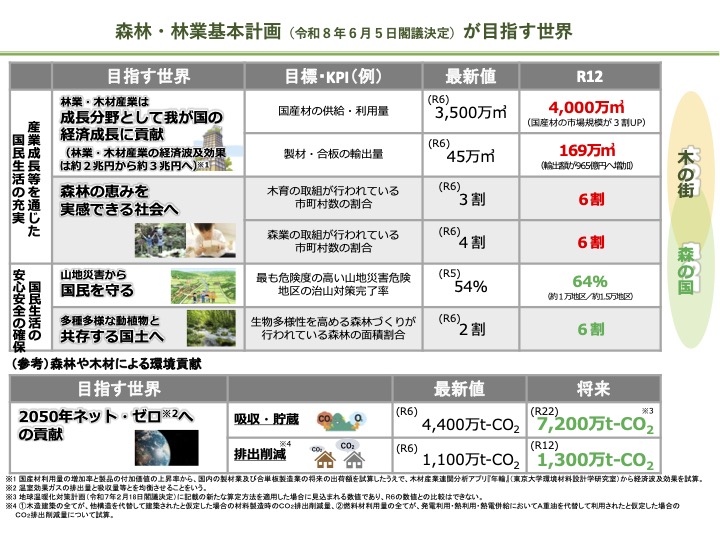
The new Basic Plan for Forests and Forestry sets out a goal of expanding the supply of domestically produced timber from 35 million cubic meters to 40 million cubic meters by 2030. Furthermore, the plan sets a growth target of increasing the economic ripple effect of the forestry and timber industries from the current level of approximately 2 trillion yen to approximately 3 trillion yen.
To achieve this, Commissioner Nagasakiya outlined a growth strategy that goes beyond simply increasing the volume of timber harvested. Through smart forestry, the plan aims to improve workplace safety and productivity while cultivating demand in areas such as urban timber construction, new wood-based materials, and biomass chemistry. Furthermore, the profits generated by adding high value to timber will be returned to forest owners, thereby supporting reforestation efforts to nurture the forests of the next generation.
The concepts of “safety” and “value,” which were repeatedly emphasized in the presentation, can be seen as the two conditions necessary to make this cycle work. Can we create an industrial structure that links the expansion of the domestic timber supply to increased profits for forest owners, thereby encouraging them to plant trees again? The effectiveness of the new basic plan depends on the specific initiatives taken going forward.
*Reference link
Basic Plan for Forests and Forestry: Forestry Agency
Hardwood Initiatives: Forestry Agency
Platinum Forest Industry Initiative—History of Activities | Platinum Vision Network, General Incorporated Association
*Related Articles
Why Focus on “Wood Utilization” Now? — Satoshi Tachibana, Chair of the Forestry Policy Council, Discusses the Goals of “A ‘Forest Nation and City of Wood’ That Will Last a Century”
[Reforestation Trends 2026] The Direction Set by the New “Basic Plan for Forests and Forestry”: Laying the Groundwork for a Forest Cycle Driven by Public-Private Partnerships
