
Image by Unsplash
[The Priest’s View] Transforming Corporate Green Spaces into Business Assets through the Time Perspective of "Nakaima" (The Eternal Present): Natural Capital Management in the TNFD Era, Viewed from the Perspective of Sacred Groves
Updated by Kazuhiro Aoki on July 30, 2026, at 8:20 p.m. JST
Kazuhiro AOKI
Representative Director, WSense Corporation / DELTA SENSE Production Committee
Representative Director, WSense Corporation / DELTA SENSE Production Committee Born in Aizuwakamatsu City, Fukushima Prefecture. From a family background of flower arrangement, tea ceremony, and Noh theater, he has been exposed to Japanese culture from an early age. His interest in wood began when he witnessed a shrine carpenter "sharpening a plane" and became aware of the depth of the craft. Currently, based on the knowledge he gained as a Shinto priest, he is promoting initiatives that lead to the public interest. He is a member of the Tokyo Junior Chamber of Commerce, holds a graduate degree and an MBA (Master of Business Administration), and has been a Boy Scout and a soccer player since he was 4 years old.DELTA SENSE Official HP WSense Corporation
*Previous column is here.
[From a Shinto Priest’s Perspective] How Should We Communicate the Value of Corporate Green Spaces? — Natural Capital Management in the TNFD Era, as Seen Through the Lens of Shrine Forests
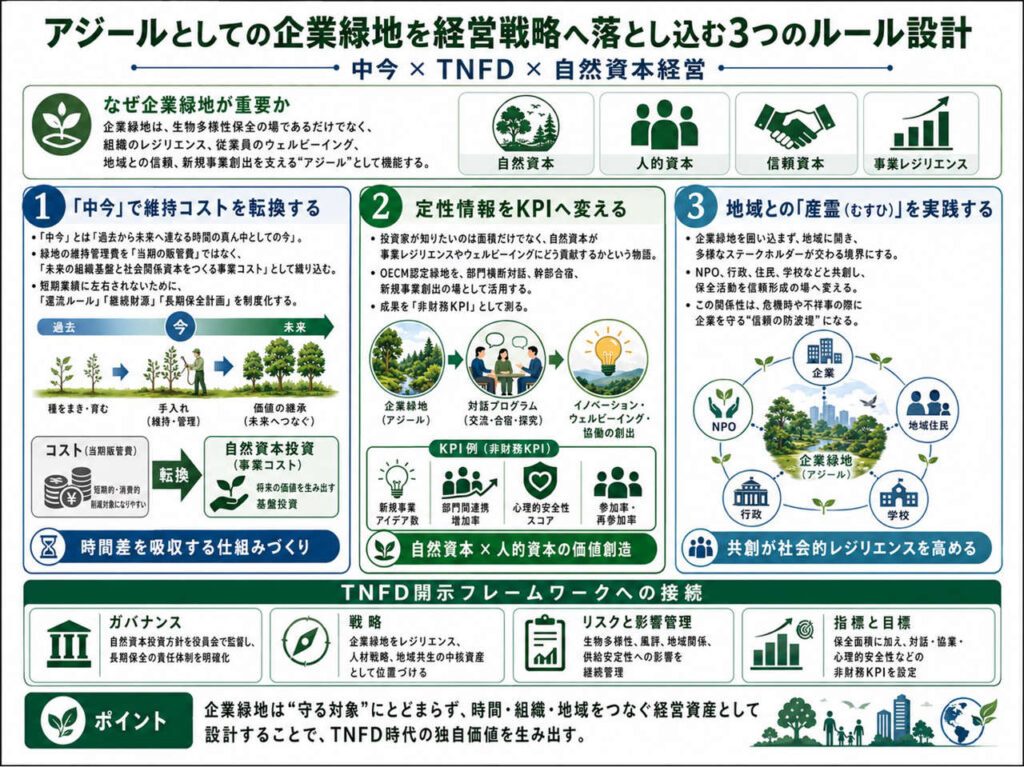
How can we translate the qualitative value of “corporate green spaces as sanctuaries (neutral, free zones)”—discussed in my previous column—into concrete business strategies and the TNFD (Task Force on Nature-related Financial Disclosures) disclosure framework? Here, drawing on the Shinto concept of “Nakai-ma,” I will present three specific actions (rule designs) that companies should begin implementing starting tomorrow.
First, we must dramatically transform the concept of maintenance costs along the “middle-now” timeline. “Middle-now” does not simply refer to the present; rather, it is a profound sense of time—the “now” as the center of a continuum stretching from the past to the future. Cultivating forests and green spaces requires a long period of time—on the order of 30 to 50 years—and this often leads to a situation where “stakeholders are absent,” as the people who plant the trees and those who reap the benefits are different. Consumers tend to view the careful maintenance carried out in the past as a “given supply,” and because current profits are not reinvested in the future, the chain of time is broken. When time is fragmented, maintenance becomes merely a “cost,” value is seen only as “price,” and neglect is rationalized.
The lush green spaces we enjoy today are the result of the time and effort our predecessors invested in maintaining them, and we have a responsibility to pass them on to future generations. If we reframe this from a corporate finance perspective, rather than treating the maintenance costs of green spaces as “current-period costs,” we should incorporate them from the outset as “capital expenditures” aimed at building the organization’s future foundation and social capital. Rather than using the concept of “present-future” merely to justify ideological principles or endurance, we should utilize it as motivation to create mechanisms such as “recycling rules” and “sustainable funding sources” to absorb time lags, thereby institutionalizing sustainable natural capital investments that are not swayed by short-term fluctuations in business performance.
Second, the challenge of converting qualitative information into “key performance indicators (KPIs).” When it comes to TNFD disclosures, what prudent investors are truly seeking is not just quantitative data such as “how much land area has been protected.” It is the “narrative” explaining how that natural capital contributes to the company’s business resilience and the well-being of its employees.
For example, the company uses its own green spaces—designated as OECMs (Areas Contributing to Biodiversity Conservation Outside Protected Areas)—as venues for cross-departmental interactive programs and executive retreats. It then sets metrics such as the number of new business ideas generated there, the rate of increase in cross-departmental collaboration, and trends in employee psychological safety scores as “non-financial KPIs.” We actively utilize natural capital as a “mechanism to dispel organizational burnout” and link the results to indicators of human capital management. As a result, a unique value creation narrative—where natural capital and human capital intersect—is deeply embedded in our disclosure materials.
Third, it is the practical application of the “Musuhi” economics with local communities. Rather than enclosing corporate green spaces behind high fences and monopolizing them for the company’s exclusive use, these spaces are opened up to the local community and function as a boundary where diverse stakeholders can interact. As illustrated by the examples of NEC, Takenaka Corporation, and Shimizu Corporation mentioned in my previous column, co-creating conservation activities in collaboration with local NPOs and government agencies builds an extremely strong bond of trust between the company and the local community. This serves as a resilient bulwark that protects the company in the event of a crisis or scandal. Building this relationship is the modern embodiment of what Shinto calls “Musuhi” (the power to create new value) and represents the very essence of sustainability management.
Discussions on forest sustainability and the conservation of the natural environment often tend to fall into simple dichotomies such as “economic growth versus environmental conservation” or “private profit versus the public good.” However, the fact that Japan’s “guardian forests” have continued to exist for over a thousand years proves to us that these two elements are by no means in conflict, but rather can coexist in a state of high harmony as inseparable entities.
Having a corporate green space certified as an OECM is by no means the end goal. It is the starting point for fundamentally reexamining a company’s management philosophy—what it values and what it discards—and its aesthetic—how it upholds those values. How can we respect nature’s “invisible value” and translate it into our business activities and organizational culture, implementing it as a set of rules? Therein lies an overwhelming and fundamental differentiator for surviving the TNFD era, which is characterized by the utmost uncertainty.
[This Month's Question]
Has the “nature” (green spaces and forests) owned or managed by your organization become nothing more than a figure representing area used to pad your sustainability report?
What “assumptions” should we change starting tomorrow to ensure that our pursuit of short-term profits does not undermine our responsibility to the future, to dispel the “spiritual exhaustion” within the organization, and to enable it to function as a “sanctuary” that fosters the next wave of innovation?
(President and CEO, WSense Inc. / DELTA SENSE Production Committee, Kazuhiro Aoki)