


"AUSTROFOMA 2027": Where Forestry Machinery Is Put to Work in the Forest — What Japan Should Learn About Mastering Steep-Slope Terrain
Updated by Yasunari Kobayashi on August 4, 2026, at 9:16 p.m. JST
Yasuhisa KOBAYASHI
Alpha Forum, Inc.
President of Alpha Forum, Inc. and Steering Committee Member of the Platinum Forest Industry Initiative. Ltd. in 2001, taking advantage of the company's venture support program. In September 2023, he received the Wood Use System Research Association Award.
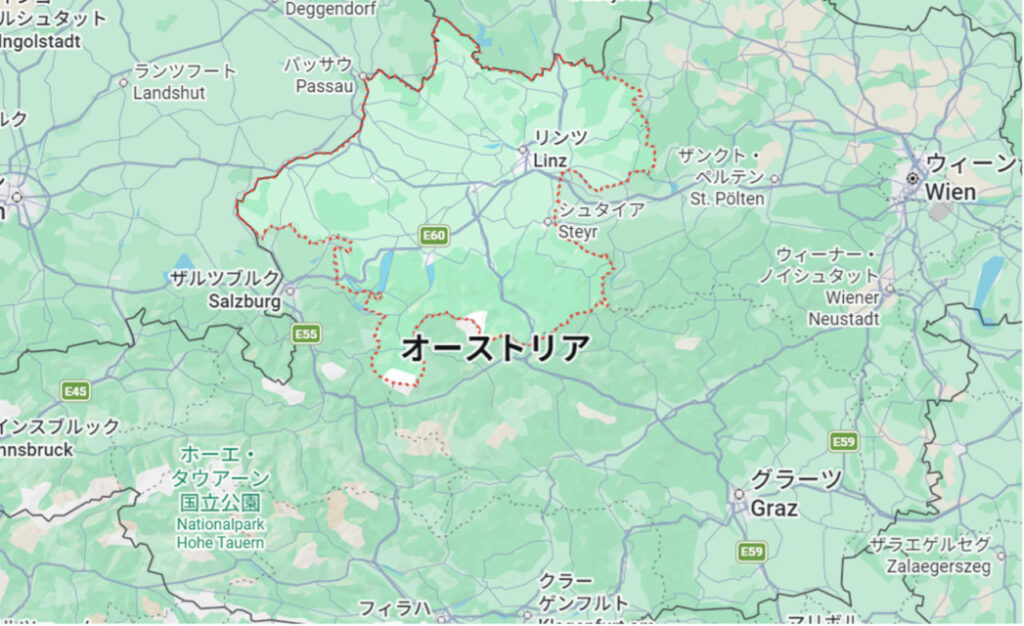
AustroFoma is the world’s largest forestry machinery exhibition, held every four years in Austria, where visitors can touch nearly all of the exhibits and machines and watch live demonstrations. It is scheduled to take place over three days, from September 21 to 23, 2027, in the Hochficht forest, which is owned by Stift Schlägl in the state of Upper Austria (Oberösterreich).
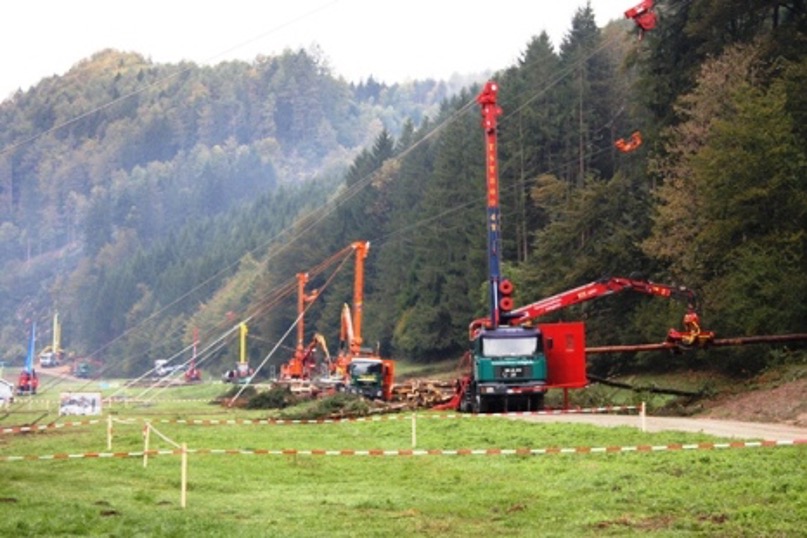
Its most distinctive feature is the live demonstrations conducted within the forest. This is an exhibition where machinery and equipment are actually operated in a real forest environment—unlike typical trade shows, which feature only static displays—and that is what makes it so appealing. A full range of machinery and equipment—from chainsaws, tractors, and harvesters to skidding winches and auto-chokers—covering the entire process from felling to hauling is on display, with exhibitors primarily consisting of manufacturers and distributors providing services within Austria.
Thirteen tower yarders were lined up in a row. All of them were demonstrating the felling and skidding process. I had never seen a machinery exhibition on this scale before, and in 2011, I was struck by the difference in its scale and the level of enthusiasm.
I’ve participated four times in a row—in 2011, 2015, 2019, and 2023. Of course, I plan to go next year (September 2027) as well.
I’d like to share some materials I came across in Austria in 2011—15 years ago.
Forestry work is often carried out by teams of about 2 to 4 people. This graph shows how timber production has increased alongside advances in high-performance forestry machinery. Generally, with three people per crew, the output is 20 cubic meters per day, or 60 cubic meters per day per crew. If a crew can produce timber for 200 days a year, this amounts to 12,000 cubic meters per year per crew. The data indicates that Austria achieved this level as early as 2000, and production is expected to continue rising due to advancements in forestry machinery and improvements in operational methods...
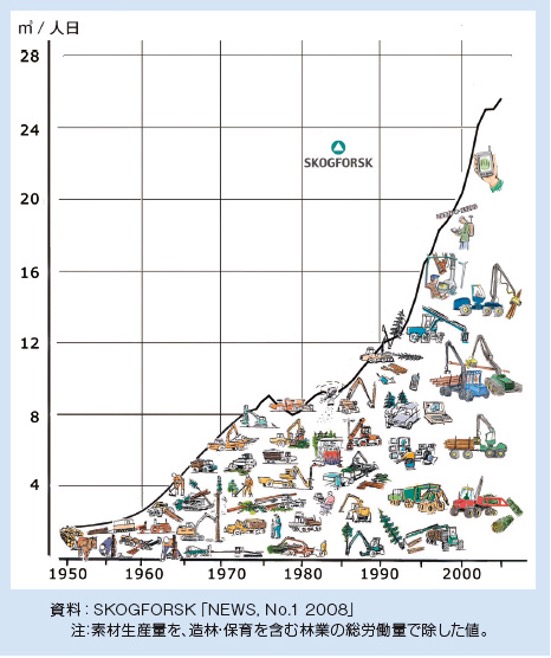
In December 2025, during a study tour of Austria organized and co-hosted jointly with the Platinum Vision Network, we observed thinning operations at a Konrad Tower Yarder worksite. During the explanation, I heard, “Thinning has achieved a production rate of 12,000 cubic meters per year per crew…” and asked, “You mean thinning, not final felling (clear-cutting), right?” The representative replied, “For clear-cutting, the target is 20,000 to 25,000 cubic meters per year per crew of two to three people, and we are achieving that…”
While the graph above can be viewed as reflecting figures based on the assumption of a main harvest with high timber production efficiency, it indicates that production has increased to over 40 cubic meters per person per day. In Japan, that figure is less than half of that.
Out of personal interest, there are a few things I pay close attention to every time. One of them is the Tether System (tether, winch support).
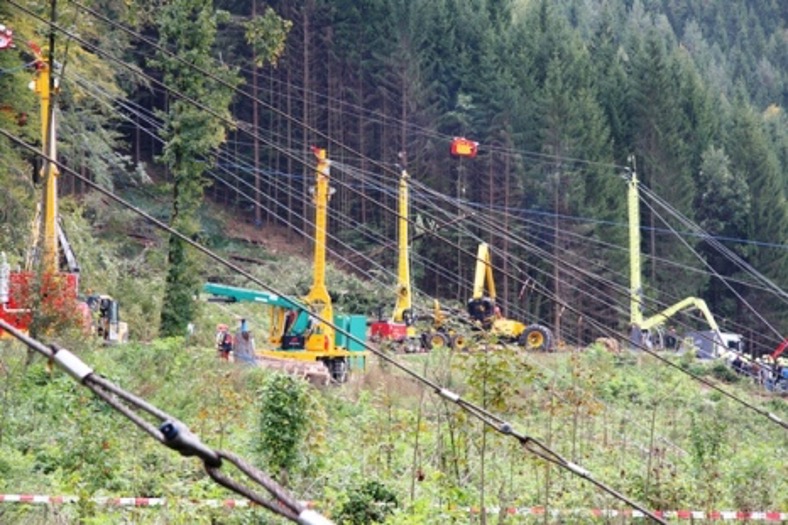
The photo below was taken at AustroFoma in 2011. Although the wires may be hard to see in the photo, wires are strung vertically, and the forwarder moves back and forth supported by these wires. No access roads have been cleared. A harvester is working in the upper section.
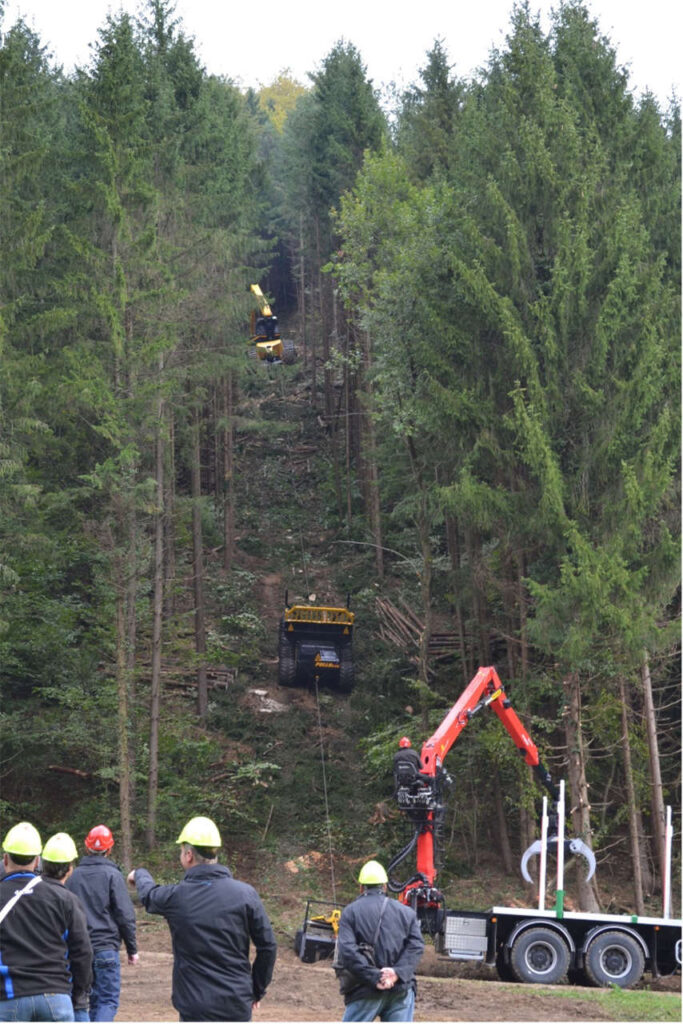
Although this probably can’t be applied directly in Japan, where slopes often have bumps, I thought, “This is new! With a little ingenuity, this could be used in our country’s forestry industry too!!”
Many forestry sites in Japan have “muddy” soil that contains a high moisture content. Even machines with caterpillar tracks can sometimes get stuck in the mud. In Austria, the ground is predominantly “rocky,” and wheeled vehicles are considered easy to operate there. It is said that the prevalence of 6- to 8-wheeled vehicles—even among heavy machinery equipped with harvester heads—in Austria is due to the “nature” of the ground. Many forest roads and dedicated logging roads in Austria are wide enough to accommodate trucks and trailers weighing over 10 metric tons and are usable year-round. In Japan, however, it is not uncommon for rain to leave ruts in forest roads and dedicated logging roads, making it difficult for large trucks to pass unless the roads are repaired. The same is true for “work roads” used primarily by heavy machinery such as forwarders.
Consequently, methods that minimize the need to construct new roads are being tested. The use of this Tether System (winch support) is considered a potential solution to this challenge.
AustroFoma is held once every four years, and with each edition, Tether System expands its lineup of exhibited models and enhances its ability to support large, high-performance forestry machinery. The two photos below were taken at the 2023 AustroFoma. Compared to the 2011 AustroFoma—12 years ago—it is clear that the company now supports much larger heavy machinery.
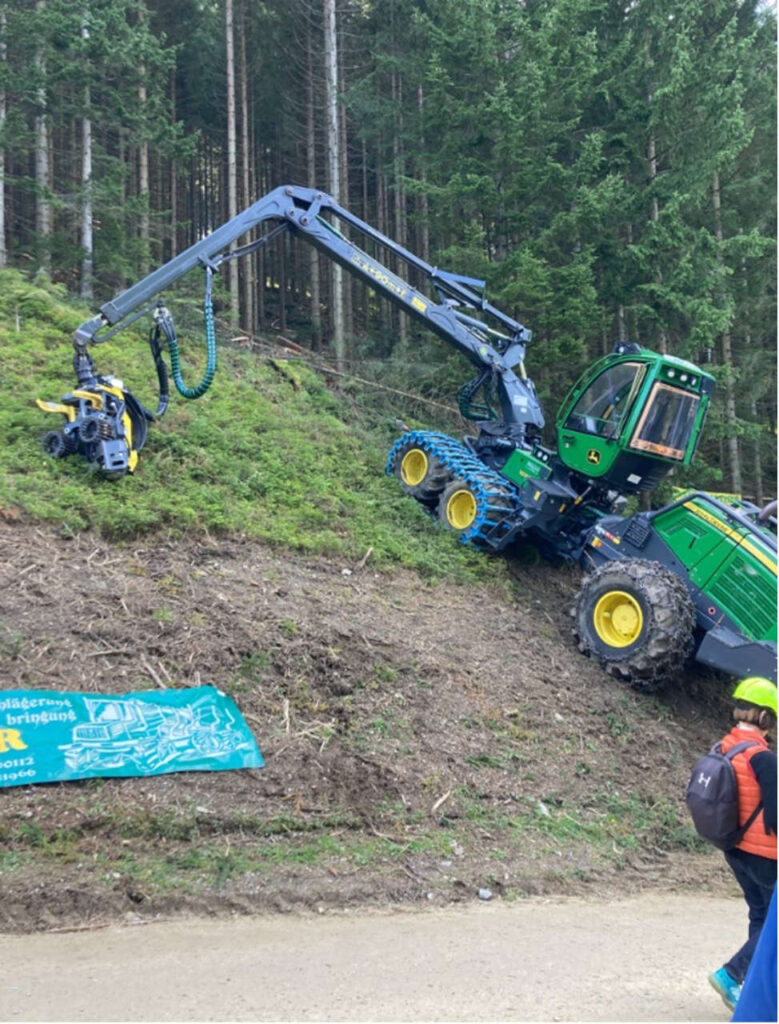
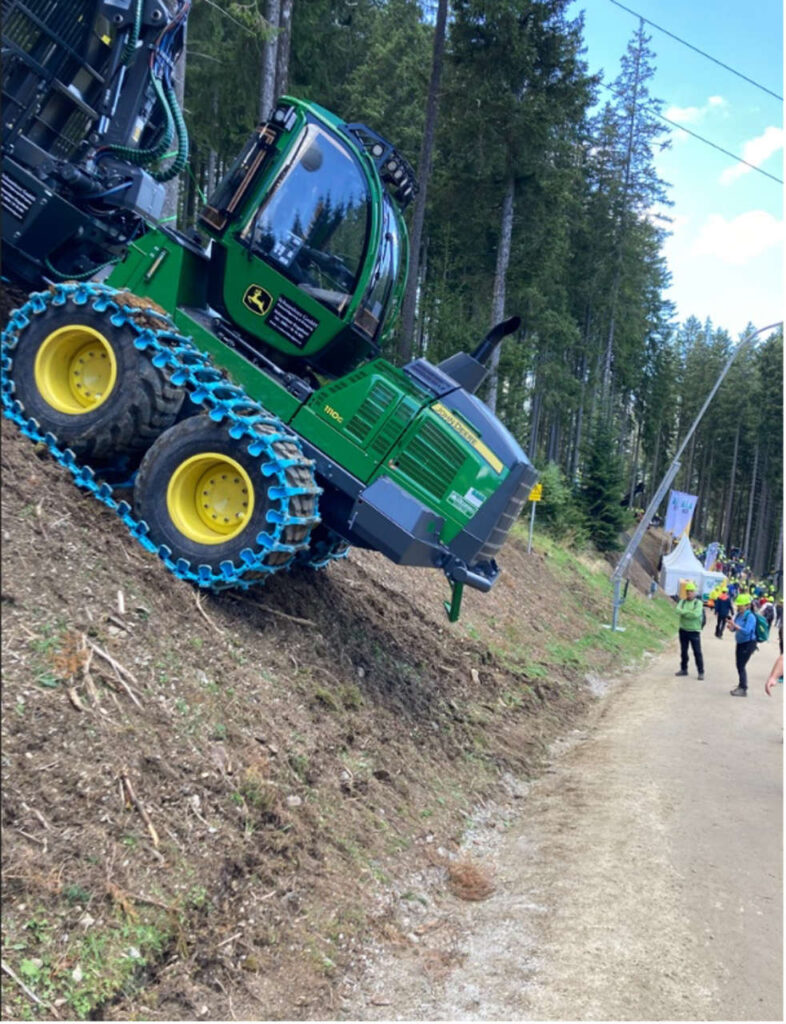
In the photo on the left—though it’s a bit hard to make out—you can see a wire between the all-wheel drive and the harvester arm. Special arrangements have been made for the wire’s anchor points to support the large heavy machinery. In some cases, the wire is secured to multiple standing trees, but here, the skidder is positioned at the point where the forest road enters the work site, with its blade dug into the ground. A wire is extended from a wire winch mounted in the center of the skidder’s blade, with the heavy machinery attached to the other end. As you can see in the photo, even on slopes exceeding 30 degrees, work can proceed without a service road by using a tether and special chains attached to the wheels. This has led to significant cost reductions. This technology is expected to advance further, and its application is anticipated in Japan as well.
At the AustroFoma trade shows in 2019 and 2023, representatives at the booths of harvester head and grapple manufacturers explained the features of their new products to me. I remember being struck by how proudly they would say, “We’ve achieved a weight reduction of XX % or XX kg.”
When moving heavy objects, it’s better for the harvester head’s “grip–cut–release” cycle to be as light as possible. For example, based on a simple calculation, it takes approximately 9.8 J (joules) of energy to lift an object with a mass of 1 kg 1 m upward.
E = m g h = 1 × 9.8 × 1 ≒ 9.8 J (assuming the acceleration due to gravity is 9.8 m/s²)
Now, when 1 liter of light oil (diesel fuel) is simply burned, it generates approximately 38.5 MJ (megajoules) per liter = 38,500,000 J (joules)/liter of energy is generated; however, the combustion efficiency (the percentage of energy that can be used to produce power) of a diesel engine alone is generally considered to be 35–40%. Furthermore, when hydraulic efficiency and friction are taken into account, isn’t it likely that only about 20% of the total energy is actually used for work?
Over the course of a year of felling and hauling operations, just how much energy consumption can be reduced by making the heavy machinery itself or the harvester head 1 kg lighter? In addition to lowering operating costs, making the equipment lighter also makes a significant contribution to the global environment. I find myself convinced by their proud explanation of this.
As an aside, while there are high hopes for the development and widespread adoption of electric vehicles, it would defeat the whole purpose if the vehicles ended up becoming heavier. I believe the best approach is to thoroughly pursue “weight reduction” in all moving objects.
We plan to organize a tour in collaboration with the Innovation in Forestry Subcommittee of the Platinum Initiative Network during AustroFoma, September 21–23, 2027. Seeing is believing… Be sure to clear your schedule now!! (Yasunari Kobayashi, President and CEO, Alpha Forum Co., Ltd.; Member, Platinum Forest Industry Initiative Steering Committee)
*Reference site
Austrofoma 2027
