Nutrient Content of Methane Fermentation Digestate
The Production Process for the Materials Introduced and Important Notes Regarding the Data
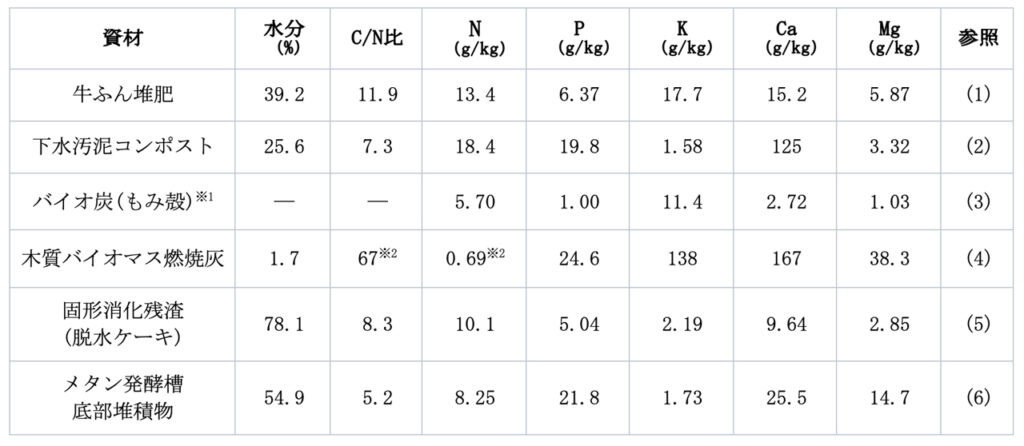
First, regarding Table 1, we will explain the production processes for the four types of materials—ranging from cow manure compost to woody biomass combustion ash—as well as the data used.
・The figures for cattle manure compost represent the average of 140 samples of cattle manure compost registered with “Compost Net” in Chiba Prefecture. Of these, 66% contain at least 10% supplementary materials by mass (*See Reference 1).
• “Sewage sludge compost” refers to sewage sludge that has been composted. Similar materials are widely used under names such as “sludge compost” and “sludge fertilizer” (*See Reference 8). The figures in Table 1 were obtained from the composting facility at the Takashima Water Purification Center, as described in Reference 2.
・According to Reference 3, “biochar” is defined in the 2019 update to the 2006 IPCC Guidelines as “a solid material produced by heating biomass at temperatures exceeding 350 degrees under oxygen concentrations controlled to a level that prevents combustion.” The values in Table 1 represent the average fertilizer components of agricultural rice husk charcoal commercially available in the Kyushu region. There are also numerous types of biochar produced from raw materials other than rice husks.
• “Wood biomass combustion ash” refers to the ash remaining after wood biomass is burned for thermal energy or power generation. It is often simply called “combustion ash.” The figures in Table 1 are the results of analyses conducted on combustion ash from whole-tree larch pellets collected from multiple pellet stoves.
Other materials include the residue liquid (hereinafter referred to as “digestate”) obtained after recovering the biogas generated by methane fermentation, the material resulting from solid-liquid separation, and the material that has settled at the bottom of the fermentation tank.
・The methane fermentation digestate shown in Table 2 has not undergone any processing, such as solid-liquid separation. These figures were obtained from digestate produced using a mixture of dairy cow manure and urine combined with food waste as feedstock.
・The “solid digestion residue (dewatered cake)” listed in Table 1 refers to the solid fraction, consisting primarily of organic matter, that is recovered by mechanically separating the solid and liquid phases of the digestion liquid after fermentation. The remaining liquid is the “dewatered filtrate” listed in Table 2. The feedstock consists of dairy cow manure and urine mixed with vegetable juice.
・The “sediment at the bottom of the methane digester” referred to in Table 1 refers to material that naturally settled and accumulated at the bottom of the digester during long-term operation. The feedstock consists of dairy cow manure and urine mixed with food waste.
・When livestock manure is used as a raw material, it often contains straw or wood shavings used as bedding in livestock barns.
Utilization of Biomass-Derived Materials and Future Prospects
The nutrient content of each material varies significantly depending on the raw materials and manufacturing conditions. At the same time, these materials are actually being utilized as fertilizers and soil conditioners. In the case of digested slurry, which is a liquid fertilizer, it is sometimes used in combination with chemical fertilizers when certain components are lacking (*See Reference 9). “Methane digester bottom sludge” gradually forms and accumulates during the operation of methane digestion facilities, so it must be removed periodically. However, there are still few cases in which it has been returned to the soil, and its wider adoption is encouraged.
Among the materials discussed here, under the current (August 2026) J-Credit system, the application of biochar to farmland is eligible as a soil carbon sequestration measure (*See References 10 and 11). It remains to be confirmed whether the return of these materials to forested land qualifies under the system. On the other hand, returning the materials discussed in Tables 1 and 2 to forested land as fertilizers or soil conditioners has the potential to contribute to waste reduction and carbon neutrality.
In future articles, we will present case studies of actual applications in farmland and forest land and examine the potential for applying these methods to biomass afforestation sites in Japan. (Amaki Editorial Production; Forest Science Advisor: Yasunori Nakagawa)
*See also
(1) Yasuhiko Yoshihashi (2025). Characteristics of Livestock Manure Compost Produced in Chiba Prefecture. Research Reports of the Chiba Prefectural Agricultural and Forestry Research Center. 17, 34–42.
(2) Noriko Yamaguchi and Keiki Ihara (2026)Initiatives for Utilizing Sewage Sludge as a Resource and an App for Visualizing Fertilizer Effectiveness. Presentation Materials for the Chugoku-Shikoku Region Network for Expanding the Use of Domestic Fertilizer Resources Study Session. (Accessed August 2, 2026)
(3) Edited by the Consortium for Environmental Research in Agriculture and Forestry toward Decarbonization (2025)Case Studies on the Agricultural Use of Biochar and a Guidebook for Its Application. (Accessed August 2, 2026)
(4) Ken Orihashi, Atsushi Yamada, Toru Takahashi, Naoaki Tashiro, and Shinya Koga (2011) “Basic Findings on the Return of Wood Biomass Combustion Ash to Forest Lands: A Study Using Ash from the Combustion of Larch Pellets.” Reports of the Kyushu University Faculty of Agriculture Experimental Forest. 92, 13–18.
(5) Masato Nakamura (2011). “A Study on the Use of Methane Fermentation Digestate as a Liquid Fertilizer and Its Environmental Impacts.” Reports of the Institute of Rural Engineering. 50, 1–57.
(6) Masato Nakamura, Ken Yamaoka, Hideki Aihara, Yoshito Yuzuyama, and Fumiko Oritate (2014). “Compositional Characteristics of Substances Accumulating in Methane Fermentation Reactors.” Technical Report of the Institute of Rural Engineering. 215, 31–37.
(7) National Agriculture and Food Research Organization, Institute of Rural Engineering (2012)Use of Methane Fermentation Digestate as Liquid Fertilizer in Field Crops: Fertilizer Effects and Environmental Impacts. (Accessed August 2, 2026)
(8) Production Materials Policy Office, Technology Extension Division, Agricultural Products Bureau, Ministry of Agriculture, Forestry and Fisheries. Case Studies on the Use of Fertilizers Derived from Domestic Resources (2. Sewage Sludge Resources). (Accessed August 2, 2026)
(9) Japan Organic Resources Association (2024) Collection of Best Practices for Using Bio-Liquid Fertilizers. (Accessed August 2, 2026)
(10) Ministry of Agriculture, Forestry and Fisheries (2024)Under the J-Credit System, emission reductions based on methodologies specific to the agricultural sector have been certified as credits!(Viewed: August 2, 2026)
(11) J-Credit System Secretariat. List of Methodologies. (Accessed August 4, 2026).
- Tags.
-

- Subscribe to our newsletter "Forest Circular Economy" (free of charge)